
Every semester, I watch the same thing happen in university computer labs. A student logs into the campus portal with a password at 9 a.m., and that single login stays valid for hours—through the library Wi-Fi, a coffee shop hotspot, and a friend’s laptop when their own battery dies.
Nobody checks again. That one gap, the assumption that a person who logged in once is still the same person hours later, is exactly what attackers count on. Continuous authentication was built to close that gap, and it’s also why the debate between Zero Trust and traditional security has become one of the most important conversations in cybersecurity today.
This blog breaks down what the model actually is, how it differs from the perimeter-based security most institutions still run on, and how it fits inside the broader Zero Trust framework.
It’s written for students trying to understand modern identity security without wading through complicated vocabulary—the kind of explanation I wish someone had handed me before my first internship interview, when a recruiter casually asked how session risk gets recalculated after login and I had absolutely no idea what to say.
What Is Continuous Authentication?
Continuous authentication is a security approach that verifies a person’s identity throughout an entire session, not just at the login screen. Instead of one static checkpoint, it treats every action—a new file download, a login from an unfamiliar city, an odd typing rhythm—as a fresh signal worth checking.
Traditional user authentication happens once: you type a password, maybe confirm a one-time code, and you’re trusted until you log out or the session times out. This model removes that blind trust. It watches behavioral patterns, device signals, and location data quietly in the background and recalculates risk in real time, for as long as the session is active.
Security researchers at NIST describe this session-monitoring approach as a layer that doesn’t replace passwords or multi-factor prompts but sits on top of them. That distinction matters: it is not a replacement for a login screen—it’s what happens after the login screen.
Traditional Security: Why the Old Model Is Falling Apart
Traditional network security was built around a simple idea: build a strong wall, and trust everyone inside it. Firewalls, VPNs, and a single password check at the door made sense when employees worked from one office, on one network, using company-owned desktops. Once you were inside that “castle,” you were trusted almost completely.
That model breaks down the moment people work from laptops, phones, and personal devices scattered across cities. A stolen password today doesn’t just open a door—it hands an attacker the same access an office badge used to.
Traditional access management assumed the network boundary was the security boundary. It rarely questioned a device once it was already connected, and it had almost no ongoing mechanism for endpoint security once a machine passed its initial check.
If a laptop got compromised after login, the traditional model had no built-in way to notice. Think of it like a nightclub bouncer who checks your ID at the door once and then never looks at you again for the rest of the night, no matter what you do inside.
Zero Trust: The Framework Behind the Model
Zero Trust flips the old assumption on its head. Its guiding principle, laid out in NIST’s Zero Trust Architecture publication, is “never trust, always verify.” No user, device, or application is trusted by default—not even ones already inside the network. Every request for access is evaluated on its own merits, using identity, device health, and context.
The Cybersecurity and Infrastructure Security Agency’s Zero Trust Maturity Model breaks this down into five pillars: identity, devices, networks, applications, and data. The device’s pillar is where endpoint security lives in practice—evaluating patch status, posture, and health before a session is ever trusted.
Ongoing identity checks sit mainly inside the identity pillar, but they touch every other pillar too, because verifying “who” someone is depends on signals from their device and their behavior. Sound identity governance ties these pillars together by defining who should have access to what and for how long before session-level checks ever step in to confirm that access is still legitimate.
Continuous Authentication vs Traditional Security vs Zero Trust
|
Aspect |
Traditional Security | Zero Trust |
This Model |
|
Trust model |
Trust once, inside the network. | Never trust by default; always verify |
Trust is temporary and constantly re-evaluated. |
|
Verification point |
Login screen only | Every access request |
Throughout the entire session |
|
Focus |
Network perimeter | Identity, devices, data, applications |
User behavior and risk signals |
|
Response to threats |
Reactive, after damage is done | Policy-based access decisions |
Real-time anomaly detection and step-up checks |
|
Best suited for |
Small, static, on-premise networks | Cloud, hybrid, and remote work environments |
High-risk sessions needing ongoing proof of identity |
Zero Trust is the philosophy; continuous authentication is one of the practical tools that makes that philosophy work in real time.
How Does the Model Actually Work?
The system collects a mix of passive signals during a session: typing cadence, mouse movement, device fingerprint, IP address, time of day, and app usage patterns. These signals feed into a model that produces a trust score—a running number representing how confident the system is that the current user is who they claim to be. When that score stays high, the session continues without interruption.
When it drops—say, because someone is suddenly accessing files from a country they’ve never logged in from—the system triggers anomaly detection routines that can prompt a step-up authentication request, restrict access to sensitive data, or end the session entirely. The endpoint reports device health and location, while the identity layer decides how much that changes the running score.
Financial apps use this constantly. A banking app might let you check your balance at a stable score but demand a fresh authentication factor the moment you try to transfer a large sum, because the risk of that specific action is higher.
Real-World Examples of the Model in Action
Theory is easier to grasp with concrete cases, so here’s what this looks like outside a textbook.
A large bank rolling out this model doesn’t ask a customer to re-enter a password every few minutes. Instead, it quietly scores each session using device fingerprint, typing rhythm, and geolocation, and only interrupts the flow with a fresh prompt when something looks genuinely off, such as a login from a new country paired with an unusually large transfer request. The customer’s initial user authentication at sign-in still matters, but it’s treated as the starting point of trust rather than the final word on it.
A university IT department protecting student records works similarly but leans harder on device posture. A laptop that hasn’t been patched in months, or one connecting from a jailbroken phone, gets flagged even if the correct password was entered, because the risk isn’t really about who typed the password—it’s about whether the device carrying that session can be trusted. That’s endpoint security doing its job quietly in the background, well after the login screen has already been cleared.
Large enterprises take this further with workplace single sign-on. An employee who logs into email from their usual laptop in their usual city gets a smooth, frictionless day. The same employee logging in from an unfamiliar VPN exit node at 3 a.m., trying to download an entire customer database, gets stopped cold—not because their password was wrong, but because the pattern around that request doesn’t match anything the system has learned to expect.
Key Components of the System
A working setup usually leans on six building blocks:
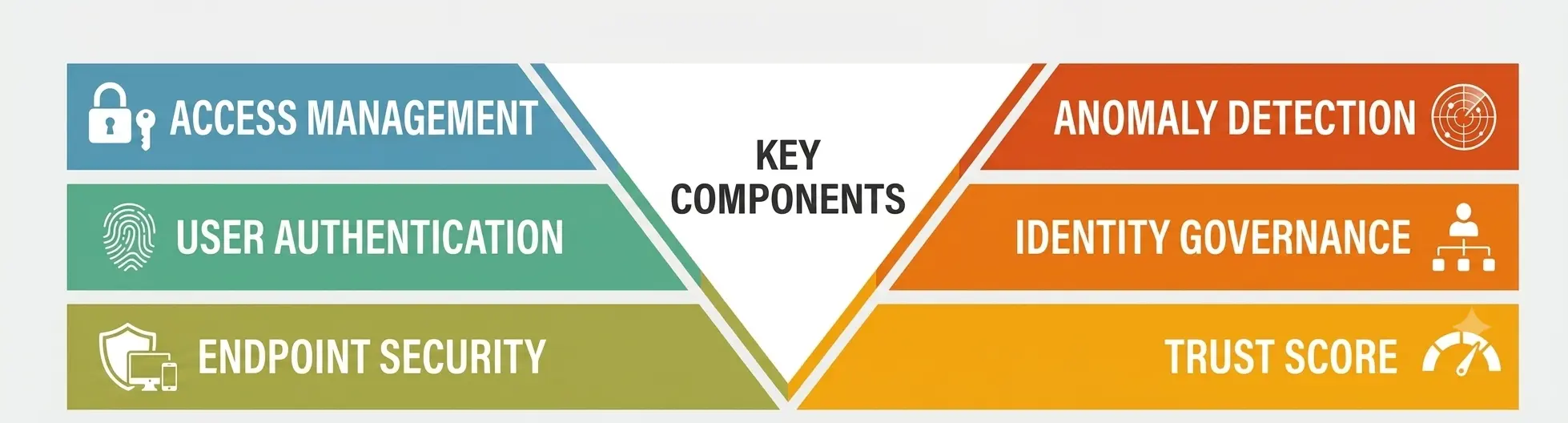
- Access management: deciding, moment to moment, what a verified identity is allowed to touch. Good access control doesn’t just grant a blanket “yes” at login; it scopes permissions to what’s actually needed.
- User authentication: the underlying methods—passwords, biometrics, passkeys—that establish identity in the first place, before ongoing checks take over.
- Endpoint security: monitoring the health, patch status, and behavior of the device itself, since a compromised laptop can undermine even a strong login.
- Anomaly detection: the analytics engine that spots deviations from a user’s normal pattern and flags them before they become a breach.
- Identity governance: the policies and audit trails that define who should have which access rights and for how long across an organization. Okta’s breakdown of this practice describes it as the discipline that ties access reviews, role management, and compliance reporting together.
- Trust score: the single number that turns all of the above into a decision—allow, restrict, or challenge.
Access management without identity governance turns into permission sprawl, and anomaly detection without a trust score has no clean way to weigh how serious a red flag actually is. These pieces are meant to function as a loop, not a checklist.
Why Does This Matter for Students Heading Into Tech Careers?
If you’re studying computer science, information systems, or cybersecurity, this isn’t just theory you’ll forget after the exam. Nearly every company you’ll eventually work for is migrating toward some version of Zero Trust, and understanding how ongoing identity checks work gives you a practical edge in interviews and internships.
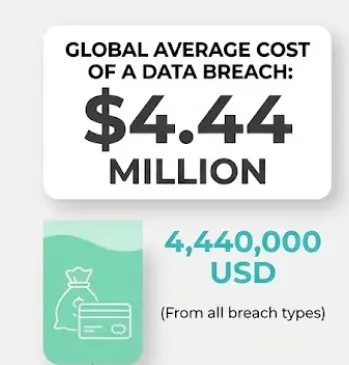
It also matters because the stakes are real. IBM’s 2025 Cost of a Data Breach Report found that the global average cost of a data breach reached $4.44 million, and breaches that began with stolen or compromised credentials took roughly 292 days to identify and contain—nearly ten months of an attacker sitting undetected inside a system. A model built on a single login check simply can’t catch that kind of slow-moving compromise, which is exactly why the window Continuous Authentication is designed to shrink.
For a student, learning to configure identity governance policies or reason about endpoint security isn’t abstract—it’s the exact skill set that security teams are hiring for right now.
Challenges and Limitations Worth Knowing
The model is not a magic fix, and it’s worth understanding where it fails:
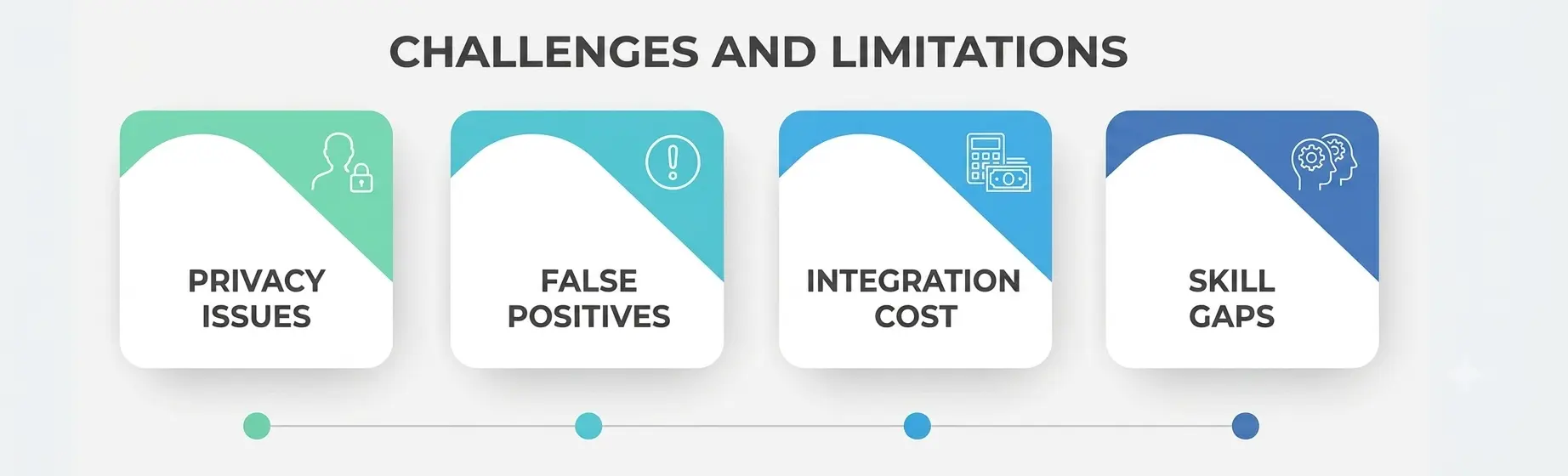
- Privacy issues: constant monitoring of typing patterns, location, and device behavior may raise valid questions about how much data organizations should be gathering and for how long.
- False positives: If an underlying risk model is not finely tuned, a legitimate user using a new device or connecting from a different city may create unnecessary friction.
- Integration cost: retrofitting session-level checks into legacy systems built for one-time user authentication takes real engineering effort and budget.
- Skill gaps: many IT teams are still more comfortable with traditional access management tools than with behavior-based scoring, which slows adoption.
None of these challenges are reasons to avoid the model—they’re reasons organizations need skilled people who understand both the technology and its trade-offs.
The Road Ahead: AI-Driven Identity Checks
The next phase of this shift is already visible. Vendors are folding machine learning directly into identity platforms so that risk models improve the more data they see, and access decisions adjust dynamically instead of relying on fixed rules.
Microsoft’s own Entra platform, for instance, is built around continuously verifying identities for both human users and automated service accounts, extending the same logic that protects a student’s login to the AI agents and scripts increasingly running inside modern organizations. As Zero Trust becomes the default rather than the exception, continuous authentication is likely to become as ordinary as a password field is today.
For anyone entering the workforce over the next few years, that shift will probably feel less like a dramatic overhaul and more like a quiet assumption baked into every platform they touch—the same way multi-factor prompts went from novel to routine in less than a decade.
A Personal Note
I’ve spent a fair amount of time reading breach reports, and the pattern that sticks with me isn’t the sophistication of the attacks—it’s how often the attacker didn’t need to be sophisticated at all. They just needed one stolen password and a system that stopped checking after the front door.
Writing about continuous authentication and zero trust isn’t just an academic exercise for me; it’s a reminder that security is less about building higher walls and more about staying genuinely curious about what’s happening inside them.
If you’re a student reading this, my honest advice is to get hands-on with an identity platform’s free tier before you ever see one in a job. Reading about a trust score is nothing like watching one move in real time.