
Most people picture a hacker as someone already inside the building, sitting at a stolen laptop. That picture is outdated. The far more common story in 2026 is someone sitting nowhere near the office at all, probing a public IP address from the other side of the world. That is exactly the scenario External Penetration Testing is built to catch, and it is why the practice has quietly become one of the most requested security services this year.
What Is External Penetration Testing?
External penetration testing is a controlled, authorized simulation of an attack launched from outside an organization’s own network boundary. A tester, working with written permission and a defined scope, tries to break into whatever is exposed to the public internet: web applications, email servers, VPN gateways, APIs, cloud storage buckets, and remote access portals.
The goal is not to embarrass anyone. It is to answer one practical question before a criminal does: if someone with no inside knowledge and no special access tried to get in today, could they?
Unlike an internal assessment, which assumes an attacker already has a foothold, this kind of test starts from zero. The tester knows only what is publicly visible, which is precisely the position a real attacker is in on day one. That is what makes the exercise so valuable. It mirrors the actual first move in most breach timelines instead of a hypothetical worst case.
Why External Penetration Testing Matters in 2026?
The numbers from this year back up the urgency. Compiled research from Bright Defense shows that public-facing systems are getting breached at nearly double the rate of internal ones, with close to a third of enterprises reporting some form of compromise on their web-facing assets over the past year.
The same data notes that almost every organization changes something in its IT environment at least once a quarter, which means the attack surface a company checked in January often looks nothing like the one it is running in July.
There is also a confidence gap worth sitting with. The same research found that a large majority of security teams feel good about their posture, yet real-world testing keeps surfacing weaknesses those teams did not know existed. Confidence and reality are not the same thing, and this kind of testing exists precisely to close that gap with evidence instead of assumptions.
Speed matters too. The 2026 exploitation research summarized by SecurityBriefing.net found that roughly three in ten known exploited vulnerabilities were already being actively used by attackers on or before the day the flaw was publicly disclosed, with hundreds of vulnerabilities showing first-time exploitation evidence in a single recent year alone. Attackers are not waiting for a patch cycle. Neither should the people defending against them.
External Penetration Testing vs. Vulnerability Scanning: What’s the Difference?
Students and even some junior IT staff mix these two up constantly, so it is worth laying them out side by side.
|
Aspect |
External Penetration Testing |
Vulnerability Scanning |
|
Who or what performs it? |
A human tester, often assisted by tools |
Automated software only |
|
Goal |
Prove exploitability and real business impact. |
Identify and list known weaknesses. |
|
Depth |
Chains multiple flaws to simulate a real attacker |
Flags issues without exploiting them |
|
Output |
Narrative report with exploited paths and risk exposure |
List of vulnerabilities with severity scores |
|
Frequency |
Typically annual or after major changes |
Can run continuously or weekly |
|
Cost and time |
Higher cost, several days to weeks |
Lower cost, hours to run |
Vulnerability scanning is the smoke detector. It tells you something might be wrong. A full external engagement is the fire drill. It tells you whether the door actually opens when someone pushes on it.
Most mature security programs run both, since automated vulnerability scanning catches volume, and a hands-on engagement catches the subtle, chained issues a scanner cannot reason about on its own.
The External Penetration Testing Process, Step by Step
Reputable testers do not improvise. Most engagements follow a structured methodology such as the Penetration Testing Execution Standard or NIST SP 800-115, the federal government’s technical guide to security testing. Broadly, the phases look like this:
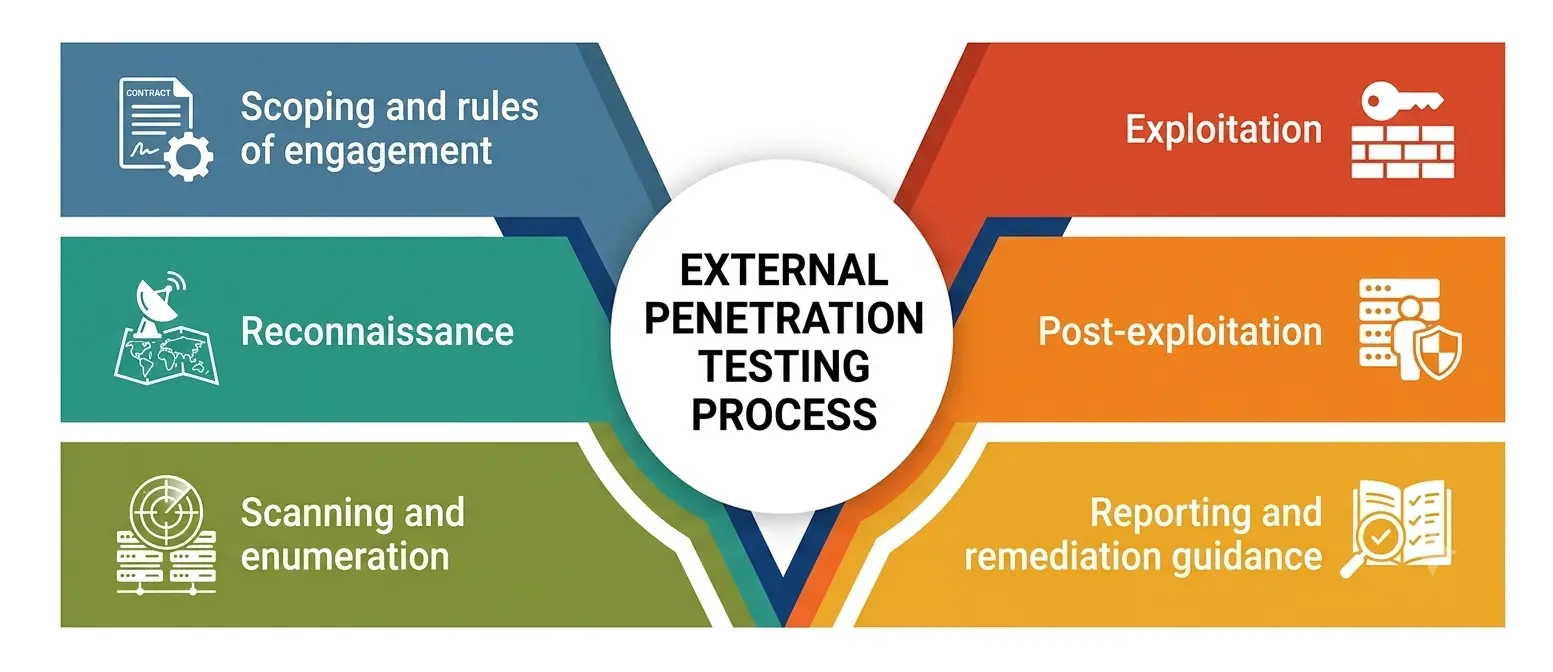
- Scoping and rules of engagement—defining exactly which IPs, domains, and applications are in play and what is off-limits.
- Reconnaissance—gathering public information such as DNS records, exposed subdomains, employee emails, and technology fingerprints.
- Scanning and enumeration—identifying live hosts, open ports, and running services along the network perimeter.
- Exploitation—attempting to actually use discovered weaknesses to gain access, not just flag them.
- Post-exploitation—checking how far an attacker could pivot once inside and what data would be reachable.
- Reporting and remediation guidance—a written breakdown of findings, business risk, and fix priority.
The OWASP Web Security Testing Guide is the companion reference most testers lean on for the web-application slice of this work, since it defines dozens of concrete test cases instead of vague guidance.
Ethical Hacking: The Human Element That Automation Can’t Replace
Tools get a lot of attention, but ethical hacking is still the backbone of a good engagement. A scanner can tell you a login form exists. A person practicing ethical hacking can figure out that the same form is vulnerable to a logic flaw a scanner would never think to try, like chaining a password-reset bug with an exposed staging subdomain to reach an admin panel.
Ethical hacking is bound by a signed agreement, a defined scope, and a legal framework; that authorization is the entire line between a security professional and a criminal carrying out the exact same technical actions.
Anyone considering a career in ethical hacking should know it is not just about breaking things. The best testers write reports a non-technical executive can actually act on, which is arguably harder than the technical break-in itself.
Defending the Network Perimeter
The network perimeter used to mean a firewall and not much else. In 2026 it means every internet-facing asset a company owns: cloud storage, remote-access VPNs, third-party APIs, forgotten test servers, and SaaS admin consoles. Every one of those is a potential entry point, and a thorough assessment treats the whole set as the perimeter, not just the traditional edge devices.
A weak network perimeter rarely fails in one dramatic way. It fails through small, boring oversights: a firewall rule left open after a migration, an old VPN concentrator running unpatched firmware, and a cloud bucket set to public by mistake. Testing the network perimeter regularly is how those small oversights get caught while they are still boring, instead of after they have become headlines.
Understanding and Reducing Risk Exposure
A test report is only useful if the risk exposure it describes gets acted on, and this is where a lot of organizations quietly fall short. According to the same Bright Defense research, most organizations set two-week remediation targets for findings, yet the actual median time to resolve any finding runs well past two months, with even serious, high-severity findings taking around seven weeks to close on average. That gap between policy and practice is itself a form of risk exposure: a known hole that stays open for months after it has already been documented.
Reducing risk exposure is not only about fixing what a report says. It means triaging findings by actual business impact, assigning clear ownership for each fix, and re-testing to confirm the issue was actually closed rather than just marked “resolved” in a ticketing system. A finding that sits untouched for fifty days is functionally the same as a finding nobody found at all.
System Hardening: Turning Findings Into Fixes
Every engagement like this eventually points to the same conclusion: harden the systems that were found weak. System hardening means removing unnecessary services, closing unused ports, enforcing least-privilege access, and applying vetted configuration baselines instead of relying on a vendor’s out-of-the-box defaults.
The most widely used reference for this is the set of CIS Benchmarks, maintained by the nonprofit Center for Internet Security. They provide tested, specific configuration recommendations for operating systems, cloud platforms, and network devices, and they map cleanly to frameworks like NIST and ISO 27001.
As one practical hardening guide points out, misconfigurations remain one of the most common root causes of breaches, which means system hardening against a recognized baseline is often the single highest-leverage fix a team can make after a test. System hardening is not a one-time project either; new services and new employees quietly erode a hardened baseline unless it is checked on a schedule.
Tools and Frameworks Testers Use in 2026
The toolkit has shifted noticeably this year. AI-assisted correlation is now standard in serious testing platforms, and a 2026 industry outlook from Capture The Bug describes AI-assisted correlation becoming embedded into nearly every serious testing-as-a-service platform, alongside a broader shift toward live dashboards replacing static PDF reports.
That said, the same source is candid that the industry has gotten good at detecting vulnerabilities but still needs to get faster at validating and actually fixing them. Automation finds things; it does not fix them for you.
On the technical side, testers still lean on a familiar core: Nmap for host and port discovery, Burp Suite for intercepting and manipulating web traffic, Nessus or OpenVAS for baseline vulnerability scanning, and the MITRE ATT&CK matrix for mapping findings to real adversary behavior instead of abstract categories.
A newer governance layer, OWASP APTS, has also emerged specifically to define how much autonomy an AI-driven testing tool should be allowed on a production network, a sign that the field is maturing rather than just automating.
Compliance: Where External Penetration Testing Becomes Mandatory
For a growing number of organizations, this is not just good practice; it is a checkbox required by law or contract. PCI DSS Requirement 11.3 explicitly calls for regular penetration testing of the cardholder data environment, covering both the outside-in and inside-out perspectives.
SOC 2 audits increasingly expect a recent third-party test report as supporting evidence for the security trust principle, and healthcare organizations bound by HIPAA lean on the same kind of evidence to satisfy their required risk analysis obligations. ISO 27001’s Annex A controls point in a similar direction, expecting organizations to validate technical weaknesses through testing rather than paperwork alone.
None of these frameworks tell you exactly how to run the test, which is why the methodologies covered earlier, such as PTES and NIST SP 800-115, matter so much in practice. Auditors are not just looking for a passing automated scan. They want to see a dated report, a clearly defined scope, and evidence that findings were actually remediated rather than simply filed away.
For students planning to work in governance, risk, and compliance-adjacent security roles, understanding this expectation is just as important as knowing how to run the tools themselves. In a lot of real jobs, the written report is the actual deliverable an auditor cares about, not the exploit that produced it.
A Note for Students Getting Started
If you are a student eyeing this field, start small and start hands-on. Build a home lab, work through platforms like TryHackMe or Hack The Box, and get comfortable with basic system hardening practices before you dive into exploitation techniques, since knowing how something should be configured is what lets you spot when it is not.
Entry-level certifications such as eJPT give you a realistic first checkpoint, and OSCP remains one of the most respected next steps once you are comfortable with the fundamentals. Learn to read, and eventually contribute to, the OWASP WSTG, since it will train your eye to notice the kind of subtle logic flaws that automated scanners miss.
Most importantly, practice writing up what you find in plain language. A brilliant exploit that no one can understand from your report is, from a client’s perspective, indistinguishable from nothing found at all.
Internships and bug bounty programs are worth pursuing early too, even unpaid ones, because nothing teaches scope discipline and report writing faster than working under someone who has to sign off on your findings before a client ever sees them.
Join a local capture-the-flag community if one exists near you, or start one; explaining a technique out loud to a teammate is often the fastest way to discover you did not actually understand it as well as you thought.
A Personal Note
I have read more security reports than I can count, and the pattern that sticks with me is not the exotic exploit chains. It is often the root cause is something almost embarrassingly ordinary: a forgotten subdomain, a default password nobody rotated, or a firewall rule that outlived the project it was created for.
If you take one thing from this piece, let it be that external penetration testing is not really about proving how clever an attacker can be. It is about proving how forgiving your own housekeeping has become, before someone with worse intentions proves it for you.