

A quick note before we start:
This story reflects real career transitions our team has guided over the past two years. Names and small details have been changed to protect privacy. The outcomes, struggles, and salary ranges described are real; they just don’t all belong to one single person.
Marcus was 27 when he first messaged me on LinkedIn.
He’d been working at a customer service call center for almost five years, handling support calls for a big telecom brand. Ten-hour shifts. Angry customers. A script on one screen, a CRM on the other, and a supervisor behind him measuring “average handle time” like it was oxygen.
His salary was around $38,000. He had a business degree nobody in his office had ever asked about. He was good at his job. And he was exhausted.
“I’m tired,” his message said. “I think I’m done with this life. But I don’t know what else I can do. I never learned coding. I’m not a tech person.”
I hear some version of that message four times a week.
Four months later, Marcus was a Cloud Support Associate at a remote-first IT services company, earning $72,000. Today he’s a Junior Cloud Engineer earning around $92,000. Works from home most days. Uses Zoom instead of a headset. Nobody measures his AHT.
If you’re in customer service, a call center, or helpdesk work right now and you’ve wondered whether tech is actually an option for someone like you, I want to tell you the real version of how he got there.
Why Customer Service People Are Quietly Good At Cloud
Here’s something you’ve probably never been told:
Customer service is one of the most underrated backgrounds for a cloud career.
You’ve been told the opposite for years. That tech is for “real engineers.” That you need a computer science degree. That real programmers started coding at twelve. None of that is true, and in 2026 it’s less true than ever.
Think about what customer service has quietly taught you:
You stay calm when things are on fire. Angry customer yelling on the line? You keep your voice steady and work the problem. That’s exactly what cloud engineers do when production breaks at 2 AM, except the fire is a server, not a billing dispute.
You translate between two worlds:
Customer frustration into tickets and technical answers into plain English. Cloud architects do this daily, translating business needs into system designs.
You ask clarifying questions instinctively. “What error are you seeing?” is the same muscle a cloud engineer needs when a developer says “the deployment isn’t working.”
You handle ambiguity under time pressure. This is the hardest skill to teach in tech, and you’ve been doing it for years without realizing it was a skill.
Cloud hiring managers know this. I’ve seen resumes from call center backgrounds move to the top of the pile because the hiring manager said, “This person will handle a production incident better than the kid with a CS degree who’s never dealt with a stressed human.”
You just need to get your foot in the door. That’s the whole game.
What 8 Weeks of Focused Training Actually Looked Like
When Marcus first reached out, he wanted to know if he should study on his own or follow a structured program. I’ve had this conversation hundreds of times.
Here’s what I told him:
Free resources on YouTube and blogs can absolutely teach you the cloud eventually. The problem isn’t the information. The problem is sequence, accountability, and time. Most self-learners spend six to nine months piecing together what a structured path delivers in eight weeks, because they don’t know what to learn next or when to stop one topic and move to another. And by month four, life gets in the way, and they quit.
Marcus didn’t want to be another month-four dropout. He chose a structured 8-week cloud training path with live sessions, a clear curriculum, and hands-on labs.
Here’s the rough shape of what those 8 weeks looked like, not so you can replicate it on your own, but so you understand what focused learning feels like:
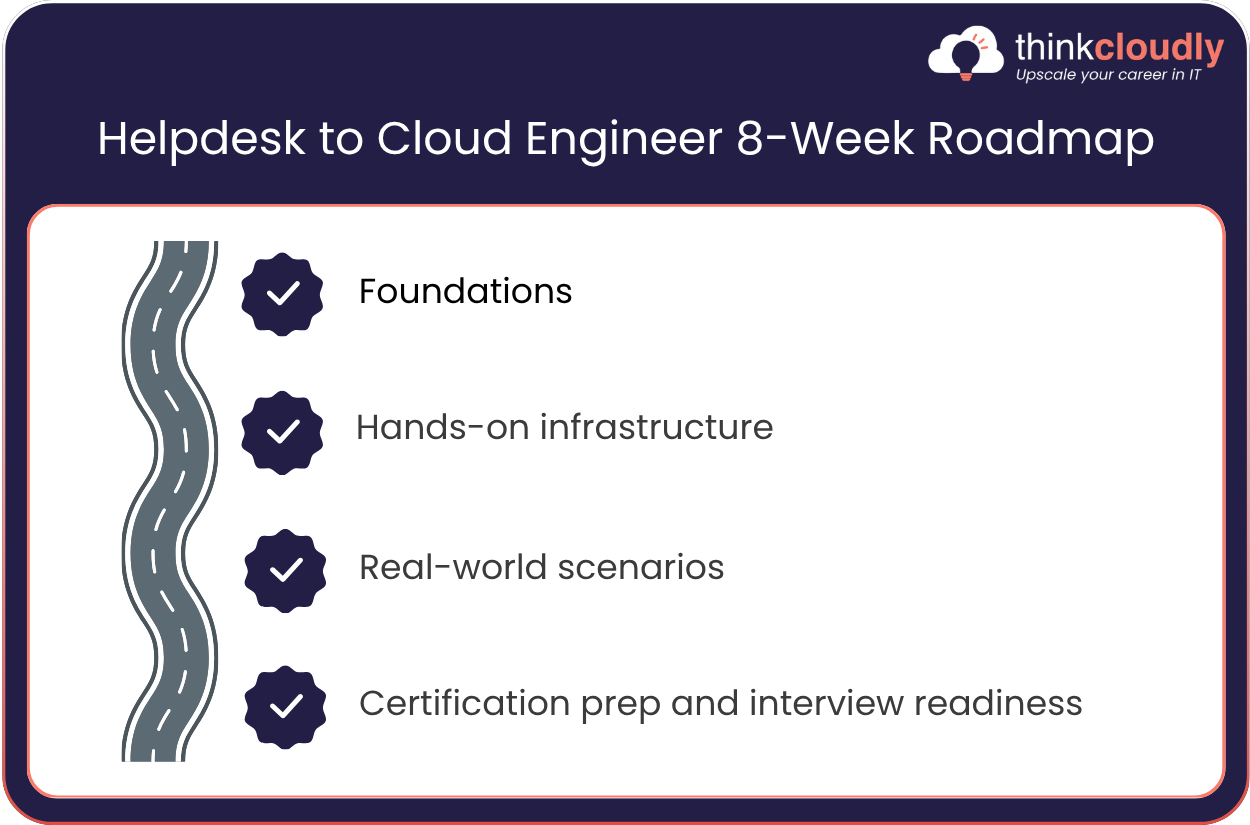
- Weeks 1–2: Foundations. What cloud actually is, why companies use it, and the core AWS services that run 80% of workloads. The vocabulary became normal. EC2, S3, IAM, and VPC stopped sounding like a foreign language.
- Weeks 3–4: Hands-on infrastructure. He started deploying things himself, not reading about them. Launching servers, creating storage buckets, setting up networks. This is where the cloud stops being a theory.
- Weeks 5–6: Real-world scenarios. Guided projects that looked like actual work, building a three-tier architecture, setting up monitoring, and handling security groups. The exact stuff an employer wants to see on day one.
- Weeks 7–8: Certification prep and interview readiness. Targeting AWS Certified Cloud Practitioner as the first credential, plus mock interviews and resume positioning.
Two things stood out to Marcus during this period.
First, he didn’t have to figure out what to learn next. That sounds trivial, but anyone who has tried to self-teach a new field knows it’s the single biggest drain on motivation.
Second, when he got stuck, there was a human he could ask. Not a Reddit thread from 2019. Not an AI chatbot hallucinating about old AWS services. A real instructor and a cohort of other people going through the same thing.
By the end of week 8, Marcus passed his AWS Cloud Practitioner exam on his first attempt. More importantly, he had three hands-on projects on GitHub he could point to in interviews.
What Happened After the 8 Weeks
Finishing the training wasn’t the end of Marcus’s journey. It was the actual starting line. But now he had a certification, three projects, and maybe most importantly, the confidence to apply.
He applied to 47 jobs over six weeks. He got 6 interviews. He got 4 rejections before his first offer.
43 applications didn’t even get a reply. He was rejected far more often than he was accepted. This is the part of career-switcher stories that usually gets edited out.
We had one rule: if the job description was 60% a match, he applied. Not 100%. Not 80%. 60%. Research from LinkedIn and Harvard Business Review has shown that qualified people routinely disqualify themselves by waiting to match every line of a job description. Marcus refused to play that game.
The offer that I finally said yes to was a Cloud Support Associate role at a remote-first IT services company. $72,000 per year, and he accepted.
He gave his call center manager two weeks’ notice. His manager asked if he was going to a competitor. Marcus said, “No, I’m going to the cloud.” His manager had no idea what that meant.
The first 90 days were humbling. His team used Jira, Git, Slack, and Confluence tools he’d never used professionally. Imposter syndrome hit hard in week three. He messaged me: “I don’t belong here. Everyone knows more than me.”
I told him what I tell every student in that moment: “Everyone knows more than you because they’ve been here two years longer. In two years, someone will think you know too much.”
By month two, he solved his first production ticket: a customer couldn’t access their S3 bucket because of an IAM misconfiguration. He had seen the exact same problem while building a project during his training.
By month four, he applied for an internal transfer and got promoted to Junior Cloud Engineer. His salary jumped from $72,000 to $92,000.
By month five, he was mentoring the new hire who replaced him in his old seat.
What This Journey Looks Like for You
I want to be honest with you about one thing.
Marcus’s story is not a miracle. It’s also not magic. There was no lucky break, no rich uncle, no insider connection. What he had were three things most career switchers don’t.
One: he chose structured learning over infinite YouTube. He gave himself a real deadline of 8 weeks instead of an open-ended “I’ll figure it out eventually.”
Two: he kept his day job until he had an offer. He didn’t dramatically quit. He studied around his shifts. He was uncomfortable, but he wasn’t broke or desperate when he walked into interviews. That changes how you come across.
Three: he applied while “underqualified” and didn’t wait until he felt ready. If he’d waited for 100% confidence, he’d still be on those telecom calls.
If you’re reading this and thinking “yeah but I don’t have Marcus’s energy / confidence / time,” I get it. Most people feel that way. But here’s the actual filter: he wasn’t more talented than you. He wasn’t more technical. He was in the same chair you are right now, four months before his first cloud offer.
The cloud industry will hire more career-switchers in 2026 than at any point in the last decade. Over 90% of organizations are projected to face IT skills shortages this year. That’s not a bad sign for you. It’s a door that’s currently wide open.
Sources & Further Reading
Salary ranges, timeline benchmarks, and hiring trends in this article are drawn from the following sources:
- Pluralsight State of Cloud Report – cloud talent shortage data
- LinkedIn Economic Graph – 2025-26 cloud hiring trends
- Robert Half 2026 Salary Guide – cloud engineer salary benchmarks across US, UK, Europe
- Glassdoor – customer service and cloud support salaries across global markets
- Harvard Business Review – research on the “60% rule” in job applications
- AWS Certification official exam guide – cloud Practitioner specifications
Student career patterns referenced are based on our internal data from 2024-2026 cohorts. Names and identifying details have been changed throughout.
If you’ve been sitting with this career switch idea for a while, it’s time to move. Browse our training programs and find the one that matches your timeline, or talk to our consultants for a free 1-on-1 session to map your personal switch plan. Don’t spend another year “thinking about it.”