
That’s changing. Fast.
Some of the biggest names in the world—IBM, Google, Apple, Bank of America, General Motors, and Tesla — have already removed the 4-year degree requirement from many of their IT job postings. And they’re not alone. According to a survey of 1,000 hiring managers, 84% of companies that removed degree requirements said it was a successful move. Another survey found that 1 in 3 U.S. companies eliminated bachelor’s degree requirements from some job postings, with an additional 25% planning to do the same by 2026.
This isn’t a small trend. It’s a shift in how the world thinks about talent.
So what’s driving it? And more importantly, what are companies actually looking for now?
Why Companies Are Walking Away from the Degree Requirement
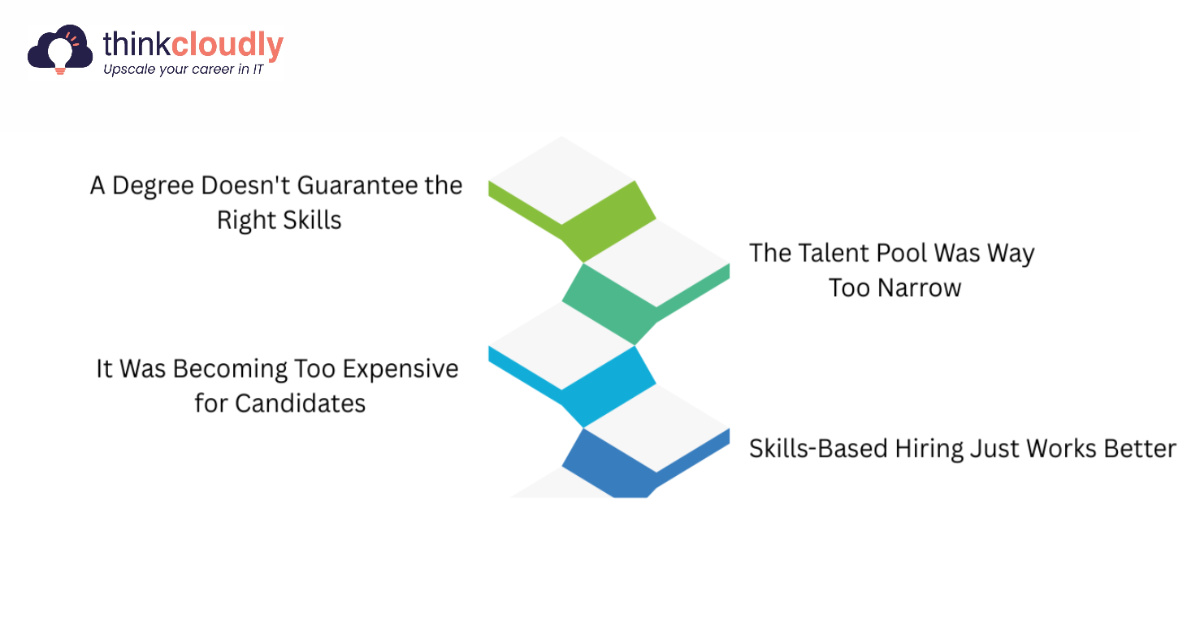
1. A Degree Doesn’t Guarantee the Right Skills
Here’s a problem companies kept running into: they’d hire someone with a shiny computer science degree, and that person still didn’t know how to do the actual job on day one.
A 2024 report by the Society for Human Resource Management (SHRM) found that 45% of employers believe college graduates lack the essential job skills needed for today’s roles. The tech world moves incredibly fast — cloud computing, cybersecurity, AI, data analytics — and university curriculum simply can’t keep up with how quickly these fields evolve.
As one tech leader put it: “Technical skills are changing so quickly. The half-life of them — or how long they’re really valid — is shrinking every single year.”
2. The Talent Pool Was Way Too Narrow
Only about one-third of adults in the U.S. have a college degree. When companies insisted on that requirement for every IT role, they were automatically cutting out two-thirds of the population — including plenty of talented, capable people who simply couldn’t afford college or chose a different path.
IBM was one of the first major companies to recognize this clearly. They coined the term “new collar” jobs — roles that don’t need a traditional degree but do need real, specific skills. Today, half of IBM’s U.S. roles welcome candidates without a 4-year degree.
3. It Was Becoming Too Expensive for Candidates
The average cost of attending a private university in the U.S. has climbed to around $36,000+ per student per year — that’s over $140,000 for a full degree. As the cost of college has soared, fewer people are choosing that path — especially when they can learn the same skills online in a fraction of the time and cost.
4. Skills-Based Hiring Just Works Better
When companies started measuring outcomes — who actually performed well, who stayed longer, who grew faster — they found something interesting: the correlation between a degree and job performance in IT roles was weak.
Google acknowledged years ago that college transcripts and test scores are poor predictors of job performance. Skills assessments, real-world problem solving, portfolio reviews, and practical coding tests turned out to be much better indicators of success.
A 2024 LinkedIn survey found that 72% of employers now prioritize skills over degrees, especially in tech, marketing, and healthcare. The shift isn’t ideological—it’s simply working.
Big Companies That Have Already Made the Move
- IBM — Half of U.S. roles no longer require a 4-year degree. They’ve been vocal about valuing “new-collar” workers for years.
- Google — Treats its own online certificate programs as equivalent to university degrees for entry-level roles.
- Apple — Removed degree requirements from many positions, evaluating candidates on skills and experience instead.
- Tesla — Elon Musk has publicly stated that degrees are “not required” for most roles.
- Bank of America — Doesn’t require college degrees for most entry-level jobs.
- Accenture — Overhauled its job requirements globally to focus on applicant skills rather than education.
- General Motors — Removed degree requirements from several roles that previously required them.
- Walmart — Announced plans to eliminate degree requirements and rewrite job descriptions accordingly.
A Real-Life Story: From Warehouse Worker to Cloud Support Engineer
Meet Jordan — a 28-year-old who spent three years working warehouse logistics in Ohio, frustrated that every IT job posting seemed to ask for a degree he didn’t have and couldn’t afford.
In early 2025, he signed up for the Google IT Support Certificate online, completing it in about three months while working nights. He then added a CompTIA A+ certification six months later. With those two credentials and a small home lab he’d built to practice troubleshooting, he applied for an IT support role at a regional healthcare company — one that had quietly removed its degree requirement the previous year.
He got the job. His starting salary was $52,000 — nearly double what he earned in logistics. Within 18 months, he moved into a cloud support role and is now studying for his AWS Cloud Practitioner certification.
Jordan’s story isn’t unique. It’s exactly what skills-based hiring was designed to make possible.
So What Are Companies Actually Asking For Now?
Dropping degree requirements doesn’t mean companies are lowering their standards — it means they’re being more specific and more practical about what they actually need. Here’s what’s replacing the diploma:
Certifications That Prove Real Skills
Industry certifications have become the new gold standard for many IT roles. They’re faster to earn, cheaper than a degree, regularly updated, and — most importantly — they tell an employer exactly what you know and can do.
|
Certification |
Area |
Level |
Avg. Salary |
|
AWS Certified Solutions Architect |
Cloud |
Associate/Pro |
$150,000–$180,000 |
|
Microsoft Azure Solutions Architect Expert |
Cloud |
Expert |
$120,000–$160,000 |
|
Google Cloud Professional Cloud Architect |
Cloud |
Professional |
$175,000–$200,000
|
|
CompTIA Security+ |
Cybersecurity |
Entry |
$80,000–$100,000 |
|
CISSP |
Cybersecurity |
Senior |
$130,000–$165,000 |
|
CEH — Certified Ethical Hacker |
Cybersecurity |
Intermediate |
$95,000–$130,000 |
|
CompTIA A+ |
IT Foundations |
Beginner |
$40,000–$60,000 |
|
CompTIA Network+ |
IT Foundations |
Beginner |
$55,000–$80,000 |
|
Google IT Support Certificate |
IT Foundations |
Beginner |
$45,000–$65,000 |
According to CompTIA’s 2026 IT Industry Outlook, IT professionals who hold a top-tier certification earn significantly more than their uncertified peers — with cloud and cybersecurity certifications ranking highest in both pay and employer demand.
Hands-On Experience and Portfolios
Companies want to see that you can actually do the work — not just that you sat through classes.
This means:
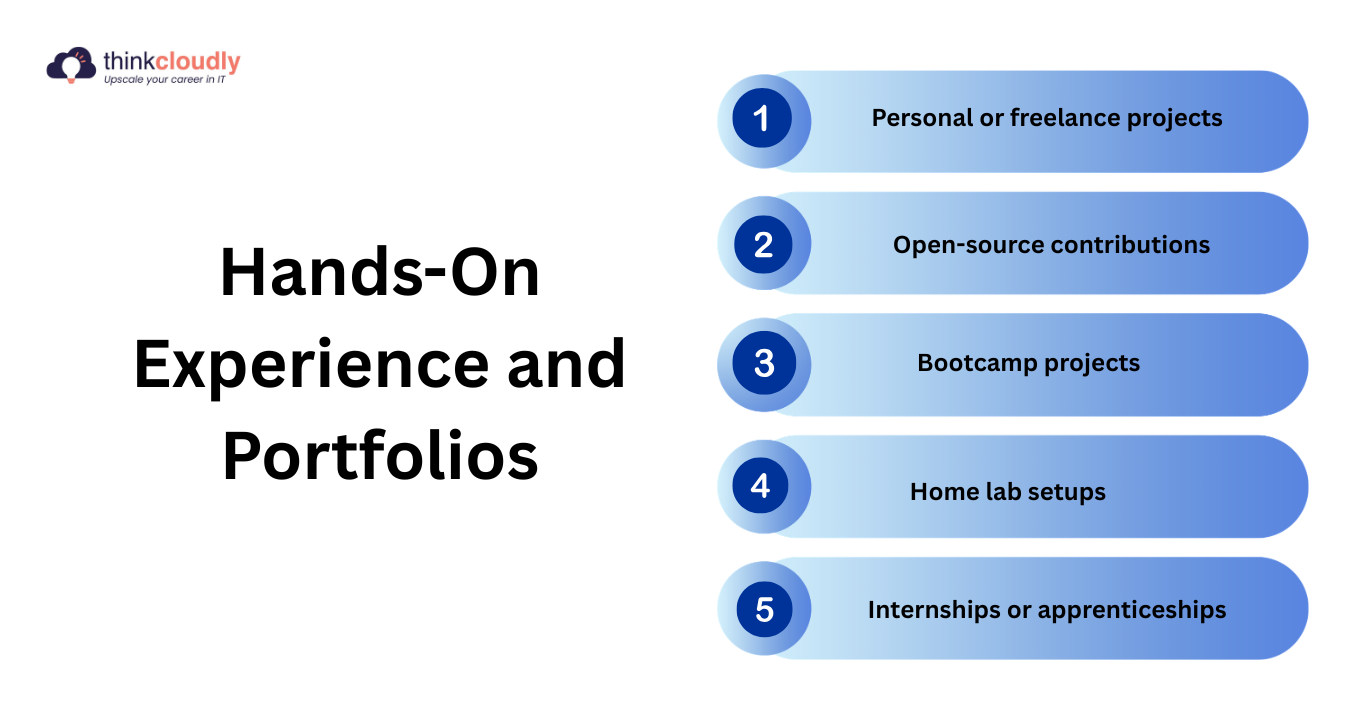
- Personal or freelance projects you’ve built and can talk through
- Open-source contributions on platforms like GitHub
- Bootcamp projects that simulate real-world scenarios
- Home lab setups for cybersecurity practice
- Internships or apprenticeships that gave you live experience
If you’ve built something, deployed something, or fixed something real — that’s worth more than a transcript.
Soft Skills That Can’t Be Googled
As companies drop degree requirements, they’re getting more specific about the human skills they want. These include communication, adaptability, problem-solving, teamwork, and what many call “learning agility” — the ability to pick up new skills quickly.
IBM’s HR leaders have been especially vocal about this: “It’s those soft skills that are evergreen. Every role is going to need someone with communication skills, with teamwork skills, with adaptability.”
Skills Assessments During Hiring
Instead of relying on a diploma as a filter, many companies now use practical tests as part of their hiring process:
- Coding challenges and take-home projects for software roles
- Scenario-based questions for cybersecurity candidates
- Case studies and problem-solving exercises for IT analysts
These assessments put everyone on a level playing field — your degree (or lack of one) doesn’t matter if you can solve the problem in front of you.
What This Means for Anyone Considering a Tech Career in 2026
If you’ve been thinking about a career in IT but felt blocked by the idea of a 4-year degree, this shift is significant news.
You don’t need to spend four years and tens of thousands of dollars to get your foot in the door. Many certification programs can be completed in weeks or months, often for a few hundred dollars. Coding bootcamps typically run three to six months. And self-paced learning platforms have made it easier than ever to build real, job-ready skills on your own schedule.
75% of companies surveyed say they value certificate programs, and 68% say they find associate degrees valuable — meaning alternative credentials are increasingly seen as legitimate by the people doing the hiring.
A Note of Realism: Degrees Still Have Value
A 4-year degree still has real advantages in many situations. Companies in fields like law, medicine, and chemical engineering still require them. And over the long arc of a career, having a degree can still open certain doors — especially at the senior leadership level.
The message isn’t “never get a degree.” It’s that a degree is no longer the only path, and for many IT roles, it’s no longer even the preferred one.
Conclusion
The hiring landscape for IT roles is genuinely changing in 2026. Companies are realizing that the best person for the job isn’t always the one who went to the “right” school — it’s the one who can actually do the work.
Skills-based hiring is expanding fast, major corporations are leading the way, and the evidence shows it’s working. If you’re willing to build real skills, earn the right credentials, and demonstrate what you can actually do, the tech world has more open doors right now than at any point in recent history.
The question isn’t whether you have a degree. The question is: what can you do?
Sources & References
SHRM — Skills-Based Hiring Research 2024
HRDive — 1 in 4 Employers Plan to Eliminate Degree Requirements (2025)
CBS News — 1 in 3 Companies Have Dropped College Degree Requirements (2024)
Higher Ed Dive — Nearly Half of Companies Plan to Eliminate Bachelor’s Degree Requirements
SDXCentral — Tech Companies Ditch Degree Requirements, Focus on Skills (2024)
Computerworld — No Degree? No Problem. Tech Firms Move Away from College Requirement
Computerworld — Companies Move to Drop College Degree Requirements, Focus on Skills
Quartz — Apple, IBM, and Google Don’t Care Anymore If You Went to College
Intelligent.com — Nearly Half of Companies Plan to Eliminate Bachelor’s Degree Requirements in 2024
CompTIA — IT Industry Outlook 2026
CIO.com — The 20 Top-Paying IT Certifications of 2026
U.S. Bureau of Labor Statistics — Computer and Information Technology Occupations Outlook
World Economic Forum — Future of Jobs Report 2025