
Some IT skills are growing so fast in 2026 that companies cannot find enough people to hire.
According to Dice’s April 2026 US Tech Job Market Report, AI skill requirements jumped 167% between March 2025 and March 2026 alone. That single shift is reshaping every IT job description being written today. Some specialized skills inside that AI wave grew over 300% in just twelve months.
If you’re a student, a fresher, or someone thinking about which IT path to choose, the next two years are going to look very different from the last ten. The skills that companies were begging for in 2025 are not the same ones they’re begging for in 2026.
I went through the latest April 2026 Dice Tech Job Market Report (which analyzed over 7 million tech job postings using Lightcast data), the CompTIA State of the Tech Workforce 2026, Robert Half’s 2026 Demand for Skilled Talent, and recent reports from Cisco, the World Economic Forum, and Indeed.
The picture is clear. Five specific IT skills exploded in job listings between March 2025 and March 2026 — each growing more than 300% year-over-year. Learning even one of them right now can change your career path.
Here are the five fastest-growing IT skills of 2026, what they actually mean in plain English, how much they pay, and how you can start learning them today.
Quick Look: The 5 Fastest-Growing IT Skills of 2026
Before we explain each skill, here’s a quick reference table you can save:
|
IT Skill |
Growth (Mar 2025 to Mar 2026) | Avg US Salary (2026) |
|
Agentic AI & AI Agents |
300%+ YoY | $150K–$220K |
| Prompt Engineering | 300%+ YoY |
$120K–$180K |
| RAG & Vector Databases | 300%+ YoY |
$140K–$200K |
|
Responsible AI & Governance |
300%+ YoY | $130K–$180K |
| Cybersecurity Compliance | 300%+ YoY |
$110K–$175K |
Source: Dice US Tech Job Market Report (April 2026), CompTIA State of the Tech Workforce 2026, Robert Half 2026 Salary Guide.
Now let’s break down each one in simple language so you understand what these skills actually are, who uses them, and how you can start.
The Big Picture: How Much the IT Skills Market Has Shifted in 12 Months
Before we go deep into the five skills, here are the most important numbers from the latest 2026 reports.
These show how much things have changed — and why these specific skills are growing the fastest:
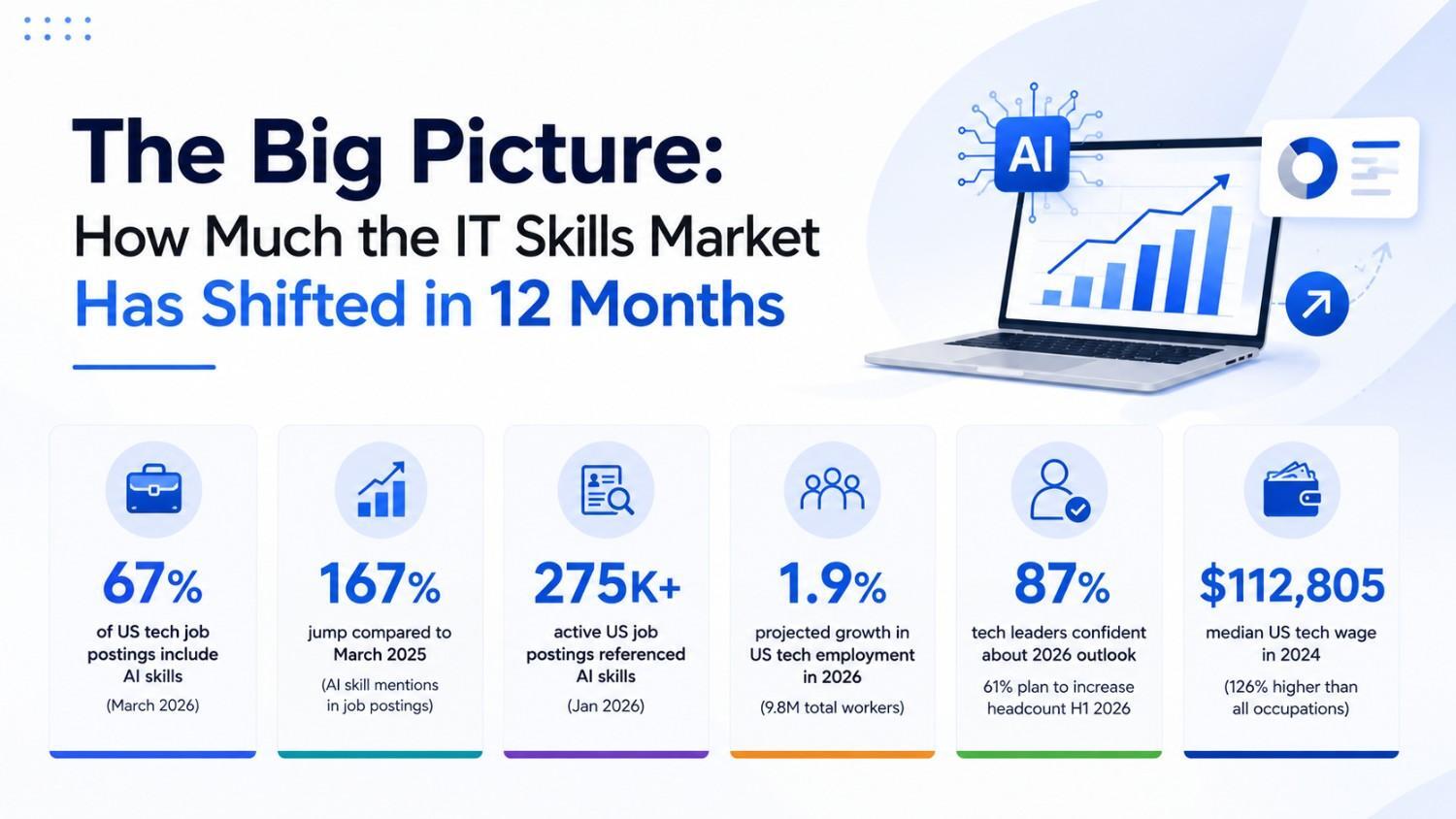
- AI skills now appear in 67% of all US tech job postings as of March 2026, up from 61% in February 2026 (Dice April 2026 Report).
- That’s a 167% jump compared to March 2025, when far fewer postings mentioned AI requirements.
- Over 275,000 active US job postings referenced AI skills in January 2026 alone (CompTIA State of the Tech Workforce 2026).
- US tech employment is projected to grow 1.9% in 2026, reaching 9.8 million workers — about 128,000 additional tech jobs in a single year (CompTIA).
- 87% of technology leaders feel confident about their 2026 outlook, and 61% plan to increase headcount in the first half of 2026 (Robert Half 2026).
- Median US tech wage hit $112,805 in 2024, about 126% higher than the median wage across all US occupations (CompTIA).
Now you understand the context. Tech hiring is no longer the broad explosive growth of 2021–2022. It’s targeted growth — heavily focused on a small set of skills that companies need urgently. Those skills are the ones below.
1. Agentic AI and AI Agents — The Hottest Skill of 2026
What it is in simple words: Agentic AI is the skill of building AI systems that can complete multi-step tasks on their own. Unlike regular ChatGPT-style AI that needs human prompts every step, an AI agent can plan, take actions, use tools, and finish entire jobs without supervision. Think of an AI that can book your flights, manage your inbox, or run a full marketing campaign by itself.
Why it grew so fast: Throughout 2025, AI tools were limited to one-off tasks. By 2026, companies wanted AI that could actually run workflows. Dice’s April 2026 report found that Agentic AI and AI Agents were among the top skills growing 300% or more year-over-year in tech job postings. According to the report: “the concentration of Agentic AI, AI Agents, RAG, Vector Database, and Prompt Engineering reflects the shift from assistive AI tools toward agentic systems capable of completing multi-step tasks autonomously.”
Who uses agentic AI skills?
- Software companies building AI workflow products
- Customer service teams creating autonomous support agents
- Marketing platforms running AI-driven campaign agents
- Banks and finance firms automating fraud detection workflows
- Healthcare companies using AI for patient triage and reporting
Salary range and demand
Average US salary: $150,000–$220,000 per year. Senior AI agent engineers at major tech companies regularly earn $250K+ with stock options. This is one of the highest-paying skills in 2026 because so few people have hands-on experience with it yet.
How to start learning agentic AI
This skill is technical but more accessible than people assume. Plan for 4 to 8 months:
- Learn Python first if you don’t already know it. Most agentic AI frameworks are Python-based.
- Get comfortable with LLM APIs from OpenAI, Anthropic, or Google. Learn how to call them and parse responses.
- Master one agent framework such as LangChain, LlamaIndex, or CrewAI. Free tutorials are available on YouTube and the official documentation.
- Build 2–3 small agent projects — a research agent that summarizes articles, an email-sorting agent, or a coding helper agent.
- Document everything on GitHub with clear READMEs. Recruiters in 2026 specifically search for agent project repositories.
2. Prompt Engineering — Continuing to Grow at 300%+ Year-Over-Year
What it is in simple words: Prompt engineering is the skill of giving clear instructions to AI tools like ChatGPT, Claude, or Gemini so they give you exactly what you want. It sounds simple, but doing it well saves companies thousands of hours.
Why it kept growing in 2026: By the end of 2025, almost every company had adopted AI for content, code, customer service, marketing, and analytics. But most employees still don’t know how to use AI well. Dice’s April 2026 data confirms prompt engineering is still one of the top 5 skills growing 300%+ year-over-year. CIO magazine reported that organizations now expect candidates to have basic prompt engineering skills at minimum, even for entry-level IT roles.
Who uses prompt engineering?
- Marketing teams writing campaigns with AI
- Software developers using AI to write and check code
- Customer service teams building AI chatbots
- HR teams screening resumes with AI
- Healthcare and legal firms automating reports
- Salary range and demand
Average US salary: $120,000–$180,000 per year for dedicated prompt engineering roles. Even non-engineering roles like marketers and analysts get paid 15–25% more if they have prompt engineering on their resume. In the UK, prompt engineering pays £70,000–£140,000.
How to start learning prompt engineering
This is one of the easiest IT skills to begin learning because you don’t need a coding background.
Spend two to four months doing the following:
- Use ChatGPT, Claude, or Gemini daily for real tasks like writing emails, summarizing articles, or planning your week. Notice what works and what doesn’t.
- Take a free prompt engineering course on platforms like DeepLearning.AI, Coursera, or Anthropic’s official prompt engineering guide.
- Practice writing structured prompts — set the role, give context, define the output format, and add examples.
- Build a small portfolio of 5 to 10 prompts you’ve designed for real problems. Document them on GitHub or LinkedIn.
3. RAG and Vector Databases — The Backbone of 2026 AI Apps
What it is in simple words: RAG stands for Retrieval-Augmented Generation. It’s the skill of teaching AI models to look up information from a company’s own data before answering questions. A vector database is a special type of database designed to store information in a way that AI can search through it instantly.
Why these matter: regular AI tools like ChatGPT only know what they were trained on. They cannot read your company’s documents, customer data, or internal knowledge. RAG fixes this. When a company wants its AI to answer questions about its specific products, policies, or data, RAG is how it’s done.
Why it grew so fast: In 2025, companies started realizing that off-the-shelf AI wasn’t enough. They needed AI that could actually use their own information. Dice’s April 2026 report listed RAG and Vector Database skills among the top 5 fastest-growing skills of 2026 — both posting 300% or greater year-over-year growth in job postings.
Who hires for RAG and vector database skills?
- Enterprise software companies building internal AI tools
- Banks and law firms creating document search systems
- Healthcare and pharma companies analyzing medical research
- Startups building niche AI products in any industry
- Consulting firms helping clients implement AI internally
Salary range
Average US salary: $140,000–$200,000 per year. Engineers who can build production-ready RAG systems with vector databases like Pinecone, Weaviate, or Qdrant are in extremely short supply. Senior roles can hit $230K+.
How to start learning RAG and vector databases
This skill is technical and best for people with some programming background. Plan for 3 to 6 months:
- Build a strong Python foundation if you don’t already have one.
- Learn how embeddings work — how text gets converted into numbers that AI can search through.
- Practice with a free vector database like Chroma or FAISS. Both are free and easy to start with.
- Build a real RAG project — a chatbot that answers questions from a PDF, your favorite books, or any document collection.
- Move up to production-grade tools like Pinecone, Weaviate, or Qdrant once your basic project works.
4. Responsible AI and AI Governance — The Skill Companies Now Legally Need
What it is in simple words: Responsible AI and AI governance is the skill of making sure AI systems are safe, fair, legal, and trustworthy. It includes preventing AI from making biased decisions, protecting user data, complying with new AI laws like the EU AI Act, and stopping AI from being misused.
Why it grew so fast in 2026: As companies started deploying agentic AI and autonomous systems in 2025-2026, they realized these systems carry real risks. The Dice April 2026 report explicitly notes: “Responsible AI and Cybersecurity Compliance are growing alongside [agentic AI] for the same reason: autonomous systems introduce risks that require governance infrastructure.” According to Cisco’s 2025 AI Workforce Consortium report, demand for AI governance skills jumped 150%, and AI ethics demand jumped 125%. Several countries passed AI laws in 2024-2025, making governance suddenly mandatory.
Who hires for AI governance and ethics?
- Big banks and insurance companies (regulated industries)
- Healthcare organizations using AI for diagnostics
- Government agencies and public sector contractors
- Tech giants like Google, Microsoft, IBM, and Meta
- Consulting firms helping clients comply with AI laws
Salary range
Average US salary: $130,000–$180,000. AI governance officers and ethics leads at large enterprises can earn $200K+. In the UK, AI governance roles pay £95,000–£225,000 per year — yes, that’s a real range, with senior leadership going to the high end.
How to start learning AI governance and ethics
This is one of the few IT skills where a non-technical background actually helps. Lawyers, policy analysts, and business graduates are getting hired into these roles. Plan for 4 to 6 months:
- Read the basics of AI laws — the EU AI Act, US Executive Orders on AI, and your country’s emerging AI rules.
- Take an AI ethics course from MIT, Coursera, or the IEEE’s AI ethics program.
- Study real AI governance frameworks like NIST’s AI Risk Management Framework or ISO 42001.
- Get a certification like the IAPP AI Governance Professional (AIGP) credential — it’s becoming the industry standard.
- Write or share opinions on real AI ethics cases — bias in hiring AI, healthcare AI errors, deepfake regulation. Build a public profile.
5. Cybersecurity Compliance — Growing Faster Than Ever in 2026
What it is in simple words: Cybersecurity compliance is the skill of making sure a company’s IT systems follow security laws, industry standards, and AI safety rules. In 2026, this includes traditional cybersecurity work plus the new task of protecting AI systems themselves from attacks like prompt injection, model poisoning, and data leakage.
Why it grew so fast: The Dice April 2026 report listed Cybersecurity Compliance among the top skills growing 300% or more year-over-year. Why? Because as agentic AI systems started taking real actions in 2026, every company needed someone who could verify these systems followed security and compliance rules. The US Bureau of Labor Statistics projects 33% growth for information security analyst roles through 2034 — one of the highest growth rates across any US occupation.
What kinds of cybersecurity compliance jobs are growing?
- SOC Analyst — monitor security alerts and respond to threats. Most common entry-level role.
- GRC Analyst (Governance, Risk, Compliance) — make sure systems follow regulations. Great for non-technical career switchers.
- Cloud Security Engineer — protect cloud-based systems on AWS, Azure, or GCP. Highest-paying entry path.
- AI Security Specialist — protect AI models from prompt injection and data poisoning. Brand new role in 2026.
- Compliance Auditor — audit IT systems against frameworks like SOC 2, ISO 27001, HIPAA, or the new AI Act requirements.
Salary range
Average US salary: $110,000–$175,000. Senior security architects and AI security specialists regularly earn $200K+. Entry-level SOC Analyst Tier 1 averages $90,462 in the US (Glassdoor 2026). In the UK, entry-level cybersecurity pays £42,000–£55,000. In Germany, €55,000–€70,000.
How to start learning cybersecurity compliance
This is one of the most accessible high-paying IT paths because employers care more about certifications and projects than degrees.
Plan for 6 to 9 months:
- Learn the basics first — networking, Linux, and Windows. CompTIA Network+ is the standard foundation.
- Get CompTIA Security+ certification — this single certification opens almost every entry-level cybersecurity door, including US Department of Defense roles.
- Practice on TryHackMe and Hack The Box — these platforms give you real, safe environments to learn hands-on hacking and defense.
- Study common compliance frameworks like SOC 2, ISO 27001, HIPAA, and the EU AI Act security requirements.
- Apply while “underqualified” — if a job description is 60% a match, apply. Most cybersecurity employers in 2026 want Security+ plus a portfolio over a 5-year resume.
Why These 5 Skills (And Not Cloud or Python)?
You might be wondering — what about cloud computing, Python, AWS, or DevOps? Those skills are also in demand. But here’s the thing.
Cloud, Python, and DevOps grew at a steady pace in 2025-2026 — somewhere between 10% and 30% year-over-year. They’re important. They will keep paying well. But they didn’t explode the way the five skills above did.
This blog focuses on the skills that surged because for students and freshers entering the field, these are the areas where you’ll have less competition and faster career growth. Established skills like Python and AWS already have millions of qualified people. The skills above have far fewer trained professionals — which is exactly why salaries and demand are climbing so fast.
If you’re already on a cloud or Python path, you’re not behind — you’re well-positioned. Just consider adding one of the five fastest-growing skills as a complement. A Python developer with agentic AI skills, or a cloud engineer with AI security knowledge, becomes one of the most hireable people in 2026.
The Bigger Picture: Why IT Skills Are Shifting So Fast
All five of these skills have one thing in common — they exist because of AI’s spread into every industry.
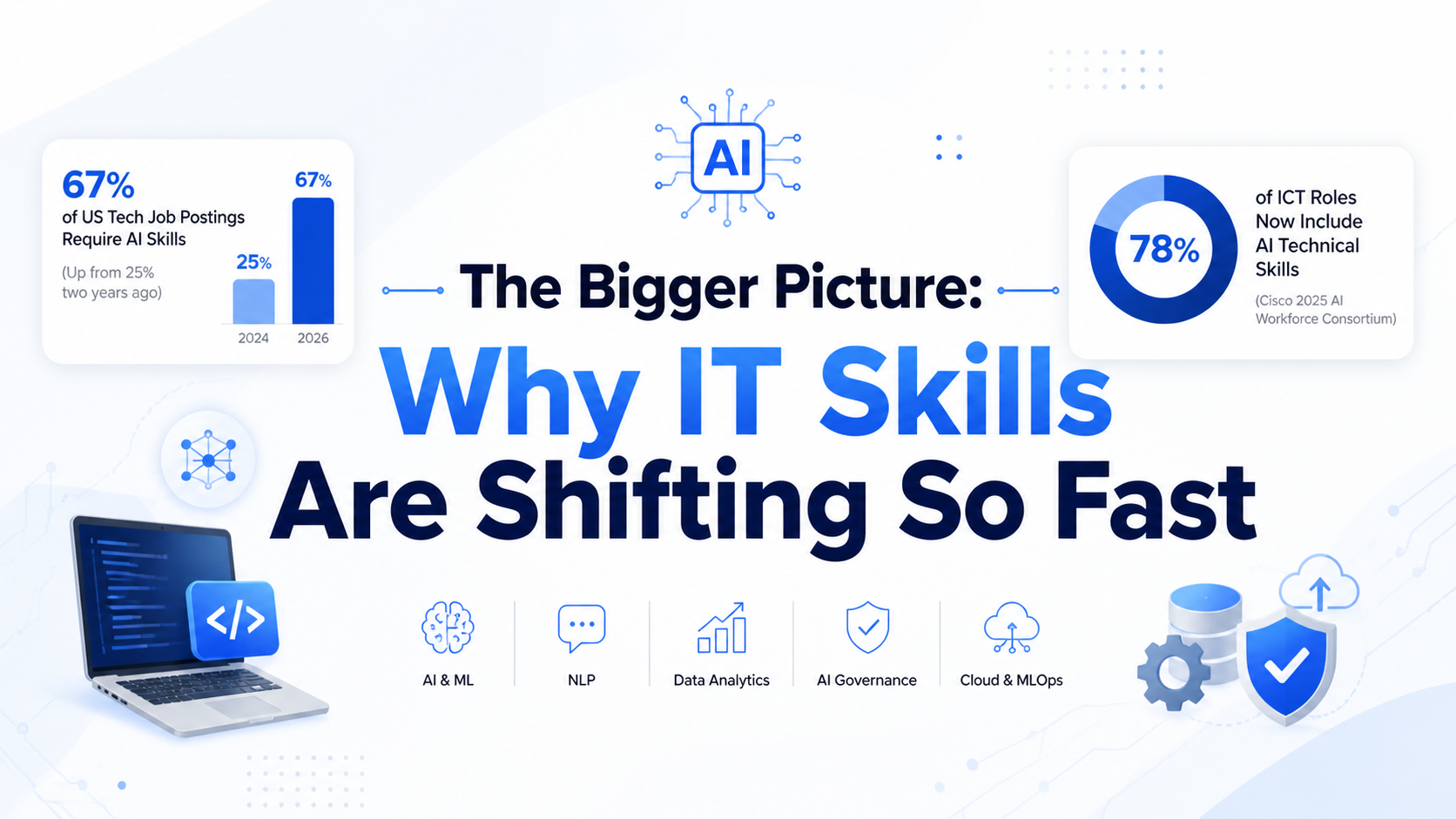
According to Cisco’s 2025 AI Workforce Consortium report, 78% of all information and communications technology (ICT) roles now include AI technical skills. Seven out of the ten fastest-growing tech roles in 2025–2026 are AI-related, including AI/ML Engineer, AI Risk and Governance Specialist, and NLP Engineer.
The Dice April 2026 report goes one step further. AI skill requirements are now in 67% of all US tech job postings — up from just 25% two years ago. That’s not a trend anymore. That’s a complete reshaping of what “IT skills” even means in 2026.
The World Economic Forum’s 2025 Future of Jobs Report makes another strong point: 39% of existing skill sets will be transformed or outdated by 2030. That sounds scary, but it also means anyone learning these new skills now will be ahead of most of the workforce in just a few years.
If you’re a student or fresher reading this, that’s the opportunity. The IT field is rebuilding itself. The people who pick the right skills today will be the senior professionals of 2030.
What Should You Actually Do Next?
Reading about job market data is interesting, but it doesn’t change anything unless you act on it. Here’s a simple plan based on where you are right now:
If you’re a student with 1+ year before graduation: Pick one of these five skills and start learning during your free time. Prompt engineering and Responsible AI are the easiest to start with. By the time you graduate, you’ll have 6–12 months of self-learning that most graduates won’t have.
If you’re a fresher who graduated 0–1 year ago: Don’t try to learn all five. Pick one based on your interest and career goal. Spend the next 4–6 months going deep — get one certification, build 3 projects, and start applying.
If you’re already in IT and want to switch paths: Use your existing skills as a starting point. A Python developer can move into agentic AI or RAG. A networking person can move into cybersecurity compliance. A business analyst can move into AI governance. Stack the new skill on top of what you already have.
If you have no tech background at all: Prompt engineering, AI governance, and SOC Analyst (cybersecurity compliance) roles are the three most accessible paths. None of them require a CS degree. Plan for 6–12 months of focused, structured learning to land your first role.
The Bottom Line
Between March 2025 and March 2026, the IT job market shifted in ways most people did not see coming.
AI skills are now in 67% of all US tech job postings. Five specific skills — agentic AI, prompt engineering, RAG and vector databases, responsible AI, and cybersecurity compliance — each grew over 300% year-over-year. Companies cannot find enough qualified people. The salaries are climbing fast.
If you’re reading this and thinking about what to learn, don’t try to learn everything. Pick one of the five skills above. Spend 4 to 8 months going deep. Build real projects. Get one good certification if your skill area has one. Show your work publicly on GitHub or LinkedIn.
That’s enough. People who do exactly this in 2026 are landing $90,000+ jobs at companies they used to think they couldn’t even apply to.
The IT field rewards people who pick the right skills early — not the people who wait for the trend to settle. By the time everyone agrees that agentic AI or AI governance is the next big thing, the high-paying roles will already be filled.
The window is wide open right now. The question is whether you’ll act on it.
Sources & Further Reading
The data and statistics in this article are drawn from the following sources:
- Dice US Tech Job Market Report (April 2026) — 167% year-over-year growth in AI skill requirements (March 2025 to March 2026); 67% of US tech postings require AI skills; 300%+ YoY growth in Agentic AI, RAG, Vector Databases, Prompt Engineering, and Cybersecurity Compliance
- CompTIA State of the Tech Workforce 2026 — 275,000+ active US AI job postings in January 2026; 1.9% projected tech employment growth in 2026; median tech wage $112,805
- Robert Half 2026 Demand for Skilled Talent — 87% of tech leaders confident about 2026 outlook; 61% planning headcount increases; AI/ML Engineer, DevOps Engineer, Cloud Engineer salary benchmarks
- Cisco AI Workforce Consortium 2025 Report — AI governance demand up 150%; AI ethics demand up 125%; 78% of ICT roles include AI technical skills
- CIO Magazine 2026 Hottest IT Skills (Indeed Data) — AI skills appearing in 9% of postings (vs. 5% one year prior); Algorithm skills 0.5% to 2% of postings
- Lightcast Generative AI Job Market Analysis — Generative AI postings grew from 55 (Jan 2021) to ~10,000 (May 2025); 51% of AI postings now outside core IT roles
- World Economic Forum Future of Jobs Report 2025 — 39% of skill sets will be transformed or outdated by 2030; AI and big data top fastest-growing skills globally
- US Bureau of Labor Statistics Occupational Outlook — 33% growth projection for information security analysts through 2034
- O’Reilly 2025 Tech Trends Report — 456% growth in prompt engineering platform usage in 2025
- Pluralsight 2026 Tech Forecast — Cybersecurity ranked #1 most important skill for IT professionals to learn in 2026
- Glassdoor 2026 Salary Database — SOC Analyst Tier 1 average $90,462; cybersecurity role salary benchmarks
- Indeed Hiring Lab 2026 Skills Trends — Top 5 fastest-growing tech skills in job postings: Python, AWS, APIs, CI/CD, AI
All data verified as of April 2026. AI skills statistics and job posting growth percentages reflect Q1 2026 reports from leading job market research firms.
If you’ve read this far and you’re ready to pick one of these IT skills and start learning, we can help. Browse our IT training programs to find the path that matches your timeline, or book a free 1-on-1 consultation with our career advisors. We’ll help you figure out which skill fits your background and how to plan a realistic path to your first role.