
Cloud computing used to have a clear job description. You managed servers, kept systems running, and made sure data was stored safely. That was enough.
It is not enough anymore.
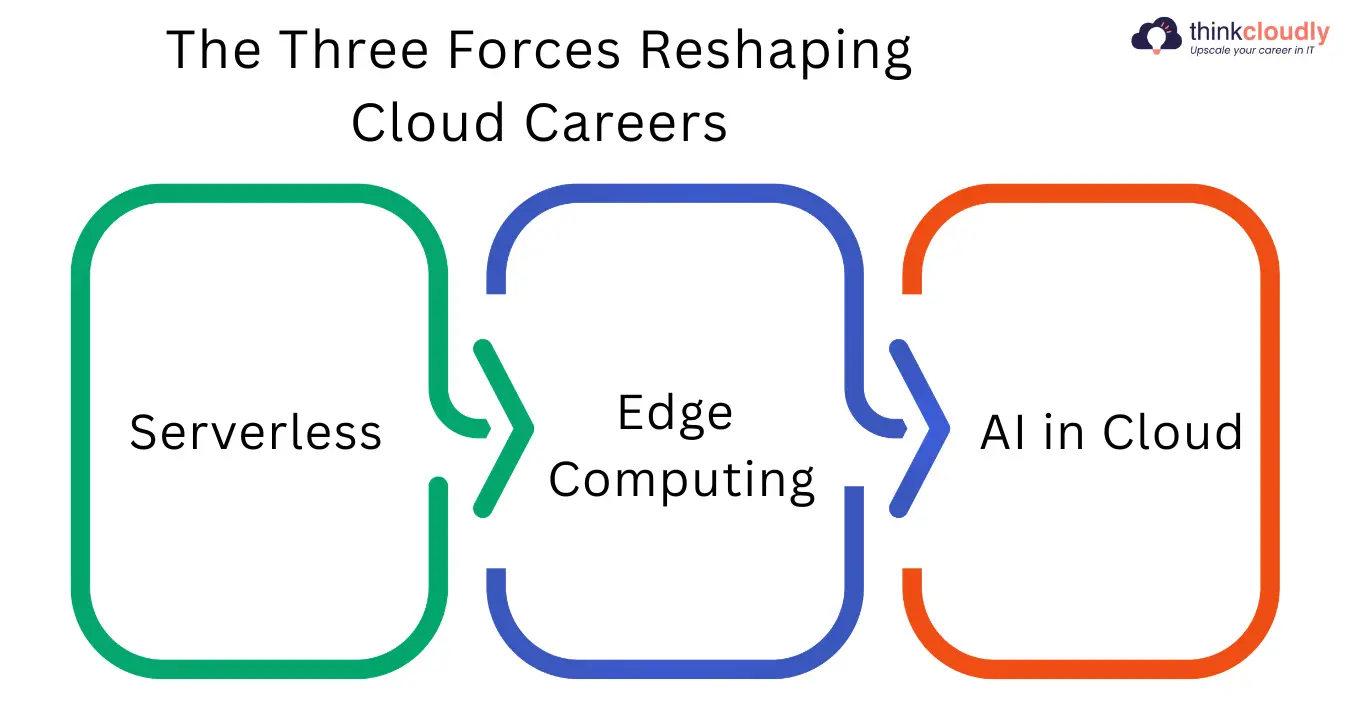
Three shifts — serverless computing, edge computing, and AI integration — have changed what cloud work actually looks like. They have also changed who gets hired, what gets paid, and which skills employers hunt for. If you are building a cloud career right now, understanding these three things is not optional. It is the whole game.
Why the Cloud Job Market Is Worth Your Attention Right Now
Start with the numbers, because they matter here.
Cloud-related roles in the US are growing at 25 to 26 percent through 2034—compared to just 4 percent for the average occupation. The US Bureau of Labor Statistics puts annual cloud job openings at around 317,700 every year. A senior cloud engineer can pull in over $182,000. Mid-level engineers sit between $115,000 and $145,000. Even entry-level positions offer competitive starting salaries.
What is driving this? More than 90 percent of organizations globally report IT skills shortages. Businesses are not being picky — they simply cannot find enough qualified people. That imbalance between supply and demand is exactly where career opportunities live.
The three forces below are what are creating the most urgent demand right now.
Serverless: From Experiment to Expectation
Not long ago, serverless was something a small group of developers tinkered with. It felt like a clever idea that had not quite found its moment. That moment has arrived.
Serverless computing means you write the code and the cloud provider takes care of everything else — provisioning, scaling, maintenance. You are not paying for a server sitting idle. You pay only for the exact time your code runs. Tools like AWS Lambda, Azure Functions, and Google Cloud Functions have made this accessible and reliable at scale.
The market has noticed. The global serverless market stood at roughly $32 billion in 2026 and is projected to grow to over $91 billion by 2031, according to Mordor Intelligence. Healthcare alone is expected to lead adoption, driven by real-time AI inference and variable patient data loads.
What this means for your career is practical. Job postings increasingly list serverless skills as a baseline requirement rather than a bonus. Employers want people who think in events—code that runs when something happens, not code that sits waiting. They want engineers who can write clean, testable functions and who understand the specific challenge of debugging a system spread across many small moving pieces. If you can do that, you are already ahead of a sizeable portion of the candidate pool.
Edge Computing: Processing Data Where It Actually Lives
Picture a wind turbine in a remote field. It generates sensor data constantly. That data could be sent to a server hundreds of miles away for processing, but by the time a response comes back, the moment has passed. Or the connection drops entirely.
Edge computing solves this by moving the processing close to where the data is created—on the turbine itself or on a small local server nearby. The result is near-instant decisions, lower bandwidth costs, and systems that work even when the network does not.
The industries pushing the edge forward are not niche. Manufacturing uses it to detect equipment failures in real time. Healthcare uses it for bedside monitoring that cannot tolerate delays. Retail uses it for in-store analytics. Autonomous vehicles depend on it entirely—a car making a split-second safety decision cannot wait for a round trip to a distant data center.
What makes this particularly interesting for careers is that serverless and edge are converging. Functions now run at edge locations closest to end users, cutting response times to milliseconds. This is still a relatively young discipline, which means competition is lower and the engineers who build expertise here early tend to move quickly into senior roles.
For anyone mapping out a learning path, platforms like AWS Outposts, Azure Edge Zones, and Cloudflare Workers are worth getting familiar with. Understanding why latency matters — not just technically, but in terms of real business impact — will set you apart in interviews.
AI in Cloud: The Fastest-Growing Piece of the Puzzle
There is a version of this conversation that goes, “AI is coming for cloud jobs.” That version is incomplete.
Yes, certain tasks that cloud engineers used to do manually — routine configuration, basic monitoring, some infrastructure provisioning — are being handled by automated tools. That part is real. But the larger reality is that every AI system in existence runs on cloud infrastructure. Every model being trained, every inference being served, every recommendation being generated — all of it needs compute, storage, networking, and the engineers who understand how to build and maintain those environments.
The roles growing fastest right now include AI/ML engineers, MLOps specialists, and cloud AI architects. These are not pure AI researchers. They are the people who sit between the model and production—building the pipelines that train models reliably, deploying them at scale, and keeping them running as usage grows unpredictably.
The London School of Economics, reporting on the UK’s most in-demand tech careers for 2026, noted that demand for AI engineers is outpacing supply — particularly in finance, healthcare, and enterprise automation. The skills fuelling that demand include generative AI integration, MLOps practices, and edge AI deployment. These are not skills that exist in isolation. They sit directly on top of cloud fundamentals.
The practical read: if you understand cloud infrastructure and can layer on AI deployment knowledge, you occupy a position that relatively few people currently fill. That is a strong place to be.
The Three Forces at a Glance
|
Area |
What It Actually Means |
Career Impact |
|
Serverless |
Write code; the cloud handles the rest |
Now a baseline requirement in many cloud roles |
|
Edge Computing |
Process data near its source, not a distant server |
Growing fast, newer discipline, less saturated |
|
AI in Cloud |
Deploy and manage AI models on cloud infrastructure |
Highest growth rate, clear salary premium |
What to Actually Learn — In Order
Knowing these three areas matter is useful. Knowing where to start is more useful.
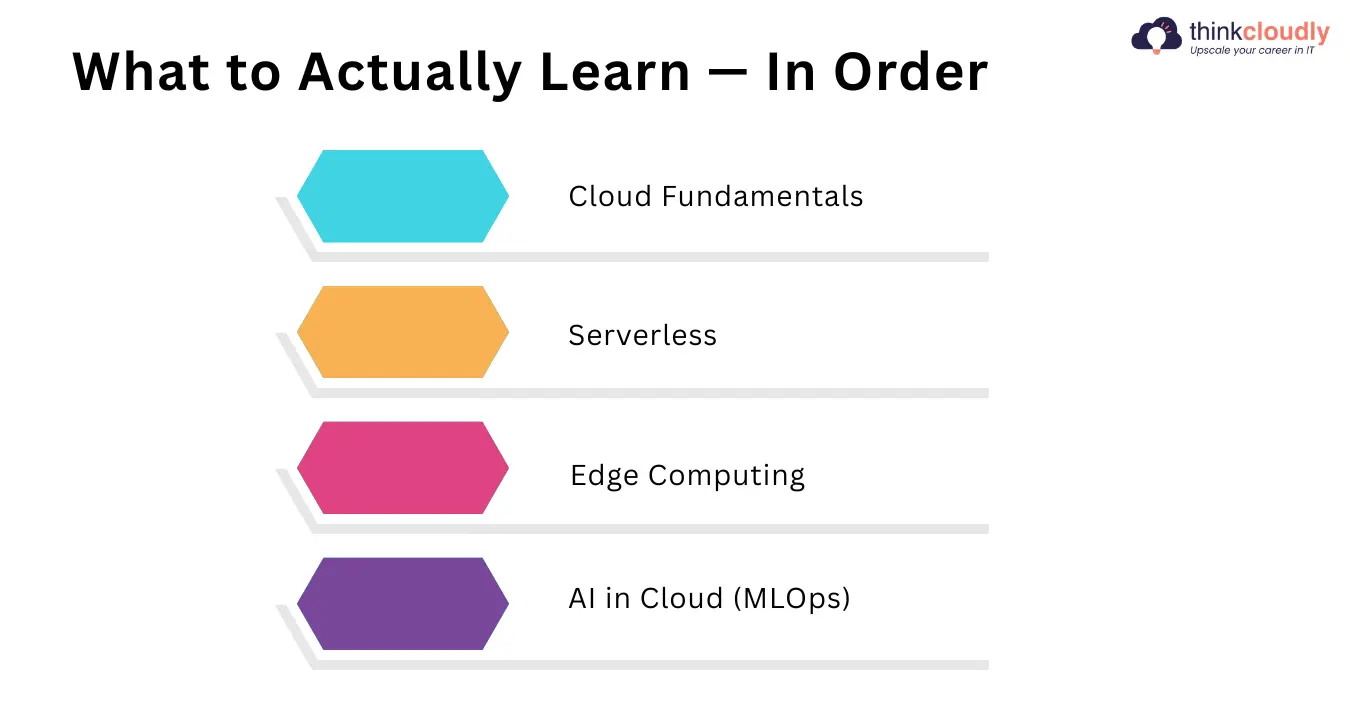
Begin with cloud fundamentals if you have not already. Networking, compute, storage, identity, and security — these underpin everything else. Pick one major provider, go deep, and get a certification to validate it. AWS, Azure, and Google Cloud certifications consistently appear in job postings and help your application pass initial screening.
Once you have that foundation, serverless is the logical next step. AWS Lambda is the most widely referenced in job postings, but Azure Functions and Google Cloud Functions translate to the same underlying thinking. Focus on event-driven architecture — understanding triggers, how functions chain together, and how to test and monitor them.
Edge comes next, especially if you are drawn to industries like manufacturing, healthcare, or logistics. The concepts build naturally from what you already know about the cloud—you are essentially extending that knowledge to environments with tighter constraints.
AI in the cloud—specifically MLOps—is where the salary ceiling rises most sharply. Tools like AWS SageMaker, Azure ML, and Google Vertex AI are widely used. The ability to take a model from a data scientist’s notebook and get it running reliably in production, at scale, is a skill organizations are paying well for right now.
Hands-on experience matters more than certificates alone. Employers consistently report that project work — even personal or open-source projects — carries more weight in interviews than badges do.
Who Is Most at Risk in This Market
This is worth saying directly.
Cloud professionals who have narrowed their entire value to one repetitive task are more exposed than those with broader skills. AI tools are already faster at certain narrow jobs — writing basic IAM policies, monitoring routine metrics, and handling standard configurations. Professionals who have not expanded beyond those tasks are competing with automation.
The market rewards people who understand systems, not just components. Someone who can look at a failing distributed application, trace the problem across serverless functions, edge nodes, and an AI inference pipeline, and fix it — that person is not replaceable by a tool. That person gets promoted.
Starting Does Not Have to Feel Overwhelming
If this reads like a lot, step back for a moment.
Nobody learns all of this at once. The professionals doing best in this market built their skills in layers, over time, and stayed curious about what was coming next. They did not wait until they felt ready — they built things, broke things, fixed them, and kept going.
The cloud job market in 2026 is not a closing window. It is one of the more open career paths available in tech right now. The question is simply whether the skills you are building are pointing toward where demand is heading.
Serverless, edge, and AI are where it is heading.
Sources & Further Reading
The data and statistics in this article are drawn from the following sources:
- US Bureau of Labor Statistics / Electromech Cloud Analysis — Is Cloud Computing a Hot Skill in 2026? — Cloud-related roles growing at 25–26% through 2034; 317,700 annual job openings in the US
- Mordor Intelligence — Serverless Computing Market Report — Serverless market at $32.59 billion in 2026, projected to reach $91.56 billion by 2031 at a 22.94% CAGR; healthcare leading adoption
- Motion Recruitment — 2026 Tech Salary Guide: Cloud Computing — Senior cloud engineers earning up to $182,000; mid-level range of $115,000–$145,000
- London School of Economics Executive Education — The 10 Most In-Demand Tech Careers of 2026 — AI engineering among the ten most in-demand UK tech careers of 2026; demand outpacing supply in finance, healthcare, and enterprise automation
- LockedIn AI — Cloud Computing Skills Employers Want in 2026—Serverless enabling on-demand AI inference; edge computing delivering low-latency AI for IoT and mobile applications
- Digital Cloud Training — Which Cloud Jobs Will Survive the AI Boom in 2026? — Analysis of which cloud roles survive automation; the risk of narrow specialisation in an AI-driven market
- Glocomms — Tech Careers in 2026: AI, Cloud and Emerging Roles—Fastest-growing roles include AI/ML Engineer, Cloud Architect, and DevOps Engineer; edge computing listed as a high-demand employer skill
- Syracuse University iSchool — Top Careers in Cloud Computing 2026 — Cloud-native developer and AI/MLOps Specialist among the most sought-after cloud roles
All salary figures and job market data referenced in this article reflect conditions in the United States unless otherwise stated. Statistics are sourced from reports and analyses published in 2025–2026.