

If you’re about to start a cloud career or already in one, you’ve probably asked yourself this question at least once: “Should I learn AWS, Azure, or Google Cloud? Which one will actually pay me more?”
It’s a fair question. And in 2026, the answer is not as simple as most blogs make it sound.
I spent the last few weeks pulling salary data from Glassdoor, Indeed, Payscale, LinkedIn, and real job postings across the world. I also talked to cloud hiring managers and looked at what companies are actually paying right now — not what cert websites claim they pay.
The short answer is: all three pay well. But each one pays differently depending on your role, experience, and industry. One of them is quietly paying the highest average salary for most cloud jobs in 2026 — and most beginners pick the wrong one.
Here’s the real data.
Quick Context: Who’s Winning the Cloud Market in 2026?
Before we talk salaries, you need to understand who has the most jobs to offer.
As of early 2026, the cloud market looks like this: AWS holds around 30-32% of the global market share, Azure has roughly 22-23%, and Google Cloud sits at 11-13% (Synergy Research Group, 2026).
What does this mean for you? More market share usually means more open jobs. AWS has the biggest pool of cloud engineer roles worldwide. Azure is growing fastest in enterprise companies. Google Cloud has fewer openings but is dominant in AI and data-heavy companies.
One more stat that matters: 42% of job postings in 2026 mention two or more cloud platforms. That means employers are increasingly looking for multi-cloud skills. Specializing in one cloud is still fine — but knowing a second one is no longer a bonus, it’s expected.
The Real Salary Data — AWS vs Azure vs Google Cloud in 2026
Let’s get to the numbers. Here’s what cloud engineers are actually earning in the US in 2026, based on data from Indeed, Payscale, Glassdoor, and LinkedIn:
|
Experience Level |
AWS | Azure |
Google Cloud |
|
Entry-Level |
$82K–$105K | $80K–$100K |
$85K–$110K |
|
Mid-Level |
$115K–$145K | $110K–$140K |
$120K–$150K |
|
Senior |
$150K–$190K | $145K–$185K |
$155K–$200K |
|
Principal/Architect |
$190K–$250K+ | $180K–$240K+ |
$195K–$260K+ |
At first glance, Google Cloud pays slightly more on average at every level. And the gap gets bigger as you move up the ladder. A senior Google Cloud engineer can earn $10,000-$15,000 more than a senior AWS engineer with similar experience.
But here’s the catch — and this is the part most blogs skip.
Why Google Cloud Pays More (But AWS Still Wins for Most People)
Google Cloud pays the highest average salary for one simple reason: supply and demand.
There are fewer certified Google Cloud engineers in the market compared to AWS or Azure. Since companies still need GCP expertise — especially in AI, data engineering, and analytics-heavy roles — they pay a premium to attract the limited talent pool.
In fact, Global Knowledge’s IT Skills and Salary Report consistently shows that Google Cloud certifications top the highest-paying IT certifications list — often exceeding $160,000 for specialized roles like Professional Cloud Network Engineer and Professional Cloud Security Engineer.
So why isn’t everyone just learning Google Cloud?
Because there are fewer GCP jobs overall. Studytech.ai’s 2026 analysis found:
- AWS: ~55,000 active cloud engineer job postings globally
- Azure: ~42,000 active cloud engineer job postings globally
- GCP: ~20,000 active cloud engineer job postings globally
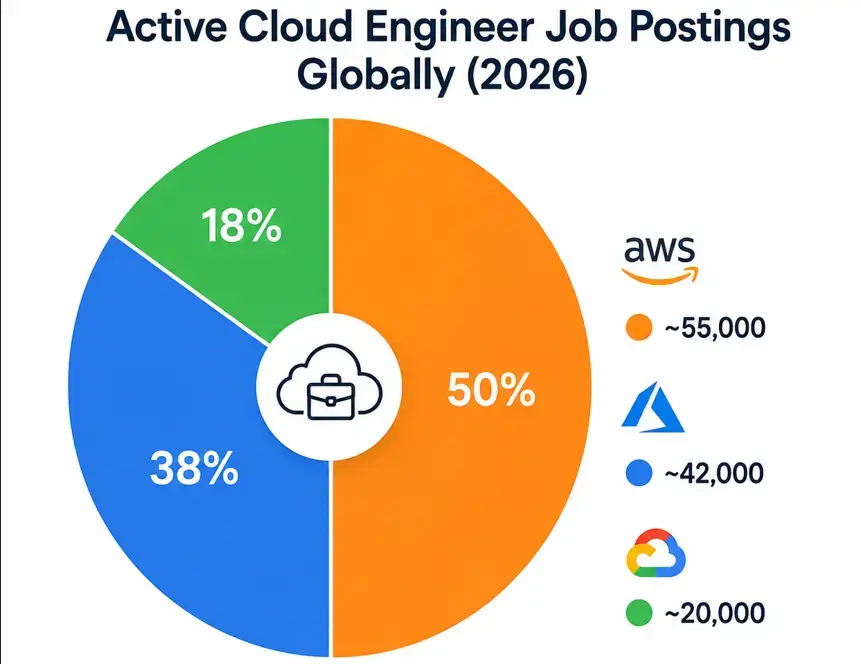
Think about it this way: Google Cloud pays 10-15% more per job, but AWS has 2.5x more jobs available. If you learn AWS, you’ll probably get hired faster. If you learn Google Cloud, you’ll probably earn more once you get hired — but it might take longer to land the first role.
Which Cloud Wins in Your Industry?
Salary alone doesn’t tell the whole story. The cloud platform that dominates your target industry matters just as much.
Here’s a quick breakdown of which cloud rules which sector in 2026:
AWS wins in:
- Startups and tech companies (Netflix, Airbnb, Slack, Stripe)
- E-commerce platforms
- Media and streaming services
- Government contracts in the US
- Early-stage product teams that want to move fast
Azure wins in:
- Large enterprises and banks (JPMorgan, HSBC, Deutsche Bank)
- Companies already using Microsoft 365 or Windows Server
- Insurance, manufacturing, and retail
- Government contracts in Europe and the UK
- Healthcare and regulated industries
Google Cloud wins in:
- AI and machine learning companies
- Data-heavy analytics firms
- Digital advertising and media analytics
- Research organizations and universities
- Companies using BigQuery or Vertex AI heavily
If you already know which industry you want to work in, that alone can answer the “which cloud” question for you.
The Highest-Paying Cloud Certifications in 2026
If you’re going to invest time in a certification, here’s what the numbers say about which ones pay off the most.
Top-paying AWS certifications (global averages):
- AWS Certified DevOps Engineer – Professional: $150K–$175K
- AWS Certified Solutions Architect – Professional: $150K–$180K
- AWS Certified Machine Learning – Specialty: $145K–$170K
- AWS Certified Security – Specialty: $140K–$165K
Top-paying Azure certifications:
- Azure Solutions Architect Expert (AZ-305): $145K–$175K
- Azure DevOps Engineer Expert (AZ-400): $140K–$165K
- Azure Security Engineer Associate (AZ-500): $135K–$160K
Top-paying Google Cloud certifications:
- Professional Cloud Network Engineer: $160K–$180K
- Professional Cloud Security Engineer: $155K–$175K
- Professional Cloud Architect: $145K–$170K
- Professional Cloud DevOps Engineer: $135K–$165K
Notice something? GCP’s top certifications pay slightly more on average than AWS’s or Azure’s top certs — but again, the pool of jobs requiring them is smaller.
Cloud Skills Are Worth More Than Certifications
Cloud certifications get you noticed, but by 2026 employers will increasingly judge you on what you can build, automate, secure, and troubleshoot. Professionals with credentials and practical skills in AWS, Azure and Google Cloud often are in a better spot for career openings and long-term earning potential.
Some high-value skills include Infrastructure as Code with Terraform, cloud automation, Kubernetes, DevOps practices, cloud security, cost optimization, and CI/CD pipelines. For example, an AWS professional who can deploy secure applications on Terraform and Kubernetes may be a better fit than a candidate with a bunch of certificates but less hands-on experience.
We’d also be interested in Azure professionals with PowerShell and DevOps experience and Google Cloud professionals with BigQuery and data engineering skills. Add two or three practical cloud projects to your portfolio and document them well to build your career profile. Certifications get you in the door but cloud skills get you up the ladder once you are in.
Cloud Salaries Across Countries—Because 2026 Is Remote-First
Since most cloud jobs are now remote or hybrid, it’s worth knowing how these salaries change across major markets.
Here’s a rough comparison for mid-level cloud engineers in 2026:
- United States: $115,000–$145,000
- United Kingdom: £62,000–£85,000 (~$78K–$107K)
- Germany: €70,000–€95,000 (~$75K–$102K)
- Canada: CAD 95,000–CAD 130,000 (~$70K–$95K)
- Australia: AUD 120,000–AUD 160,000 (~$78K–$104K)
- Netherlands: €65,000–€90,000 (~$70K–$96K)
The US pays the most on average. But here’s the interesting part — many US companies now hire cloud engineers globally for remote positions. That means engineers in the UK, Germany, Canada, or even smaller cities can work for US companies and earn closer to US salaries.
This is one of the biggest shifts in cloud hiring in 2026. If you live outside the US but work for a US company remotely, you can often earn 40-60% more than the local market rate for the same role.
So Which Cloud Should You Actually Pick?
Let me give you the honest answer based on what I’ve seen work for real career-switchers in 2026:
Pick AWS if:
- You’re a beginner and want the fastest path to a first job
- You want the widest pool of opportunities globally
- You want to work at startups or tech-first companies
- You want the most community resources, tutorials, and free learning material
Pick Azure if:
- You want to work at large enterprises, banks, or in government
- Your target companies already use Microsoft products
- You’re based in the UK, Germany, or Europe and want local employer matches
- You prefer a structured, enterprise-style environment over a startup
Pick Google Cloud if:
- You’re specifically interested in AI, ML, or data engineering
- You don’t mind a slightly longer job search for a higher-paying role
- You want to maximize earnings per certification
- You already have some data or analytics background
And if you’re reading this and still unsure, here’s my default recommendation: start with AWS. It’s the safest bet for a first cloud job in 2026 because of pure job volume. Once you’re in, you can always learn Azure or GCP as a second platform and earn the multi-cloud premium.
The Multi-Cloud Advantage Nobody Talks About
Here’s something most beginners miss: cloud engineers who know two platforms earn significantly more than single-platform engineers.
According to LinkedIn Economic Graph data from 2025-26, professionals with certifications across AWS + Azure or AWS + GCP earn, on average, 18-25% more than engineers with only one platform under their belt. The premium grows as you move into senior and architect-level roles.
This is because real enterprises rarely run on one cloud anymore. A typical Fortune 500 company might run their main product on AWS, their business apps on Azure, and their AI workloads on Google Cloud. Companies want engineers who can move between platforms without needing a separate hire.
You don’t need to learn all three at once. Get solid in one first. Then, 1-2 years into your first cloud job, pick up a second platform. That’s where the compounding salary growth really starts.
AWS vs Azure vs Google Cloud: Which cloud platform is best?
And the choice of AWS, Azure or Google Cloud, should not be solely on salary. Your technical background, target industry, preferred job role and long-term career goals can all determine which platform has the best path for you.
AWS is a real choice for beginners who want to go for cloud engineering, devops, startups or wide global opportunities. If you are a professional already working with Microsoft technologies, enterprise systems, Windows environments or business applications, then Azure may be a better fit.
Instead of selecting a platform because it pays the most, check out job descriptions in your desired location and see what tools employers are asking for most. Often the best cloud platform is one that matches your current skills, but has room to grow.
Final Thought
In 2026, the question is no longer “which cloud pays more.” All three pay well. The real question is “which cloud fits your goals best.”
On paper, Google Cloud pays the highest average. In practice, AWS gets you hired the fastest. And Azure opens the most enterprise doors. All three are solid choices.
The bigger lesson is that the platform matters less than what you do with it. A certified AWS engineer who builds real projects, understands the business side of cloud, and can communicate clearly will out-earn someone with three GCP certifications who only memorized exam questions.
Pick one cloud. Get certified. Build two or three real projects. Apply while underqualified. Then add a second cloud in year two.
That’s the real 2026 playbook for cloud salary growth — not which logo is on your certification badge.
Sources & Further Reading
Salary data, market share numbers, and hiring trends in this article are drawn from the following sources:
- Synergy Research Group — 2026 global cloud market share data (AWS 30-32%, Azure 22-23%, GCP 11-13%)
- Indeed 2026 Cloud Engineer Salary Report — salary averages across experience levels
- PayScale Cloud Software Engineer Compensation — entry-level to senior salary ranges
- Glassdoor Cloud Engineer Salaries — platform-specific salary ranges (AWS, Azure, GCP)
- Global Knowledge IT Skills & Salary Report 2026 — highest-paying cloud certifications data
- LinkedIn Economic Graph — multi-cloud salary premium and 2026 hiring trends
- Gartner 2026 Public Cloud Services Forecast — market growth projections and enterprise adoption data
- Studytech 2026 Cloud Certifications Analysis — platform-wise cloud job posting volume and demand
- Robert Half 2026 Demand for Skilled Talent — cloud engineer salary benchmarks across US, UK, Europe, and Canada
Cloud market share data is updated quarterly. Salary figures represent 2026 averages across major US metropolitan areas and are adjusted for geographic variations noted in the article.
Still can’t decide which cloud to start with? Browse our cloud programs to find the path that matches your timeline, or book a free consultation with our career advisors for a 1-on-1 session. We’ll help you pick the right cloud based on your background and goals.