
Here’s a number that stopped me mid-scroll the first time I saw it: Microsoft’s own study guide for this exam was quietly updated on April 17, 2026, and almost nobody outside a small circle of IT forums noticed. If you’re planning to sit for the AZ 104 certification this year, that date matters more than any older study guide, because the exam you’ll actually take isn’t the one your colleague passed back in 2023.
Domain weightings shifted, new services entered the blueprint, and Microsoft Entra ID terminology fully replaced the old Azure Active Directory naming. In this guide, I’ll cover what changed, what it costs, how it’s scored, and — based on my own experience preparing for it earlier this year — what actually helped me pass on the first attempt.
What Is the AZ 104 Certification, Exactly?
The AZ 104 certification is Microsoft’s Azure Administrator Associate credential. It confirms you can implement, manage, and monitor an organization’s Azure environment—identity, governance, storage, compute, networking, and monitoring—in production, not just theory. Microsoft describes the ideal candidate as someone with subject-matter expertise in these areas, working within a larger team that also touches security, DevOps, and application development.
Unlike Azure Fundamentals (AZ-900), an introductory credential for anyone wanting a broad overview of cloud concepts, this exam assumes hands-on comfort with the Azure portal, PowerShell, the Azure CLI, and — as of the April 2026 update — Bicep files. If you’ve only completed Azure fundamentals training and never deployed a resource group, close that gap before booking your exam date.
According to the course outline, a typical Azure administrator implements, manages, and monitors identity, governance, storage, compute, and virtual networks in a cloud environment and can also provision, size, and adjust resources as business needs change.
What Changed in the April 2026 Skills Update?
This is the part most outdated study guides get wrong. Microsoft last updated the AZ-104 skills-measured outline on April 17, 2026, adjusting domain weights. Here’s what moved:
|
Skill Domain |
Old Weight | 2026 Weight |
Direction |
|
Identities and Governance |
15–20% | 20–25% |
Increased |
|
Storage |
15–20% | 15–20% |
Unchanged |
|
Compute |
20–25% | 20–25% |
Unchanged |
|
Networking |
20–25% | 15–20% |
Decreased |
|
Monitoring |
10–15% | 10–15% |
Unchanged |
The AZ-104 Study Guide 2026 outline also tests ARM templates and Bicep files, Azure Container Apps, Azure Bastion, and Network Watcher, and the exam has fully adopted Microsoft Entra ID naming, so older material still referring to “Azure Active Directory” throughout should be treated as a warning sign.
Exam Format, Cost, and Passing Score
Before you build a study plan, get the logistics straight. The AZ-104 exam gives candidates 100 minutes and typically contains 40 to 60 questions, mixing multiple choice, drag-and-drop, and scenario-based case studies. The AZ-104 passing score is 700 out of 1000 to pass, and that is a scaled score, not simply 70 percent of questions answered correctly—Microsoft weighs the difficulty of your question set, so two candidates who both feel like they “did fine” can walk away with different scores.
The AZ-104 exam fee is $165 USD in the United States, scheduled through Pearson VUE. There’s no mandatory prerequisite, though Microsoft recommends roughly six months of hands-on Azure experience beforehand. If retaking after a failed attempt: a 24-hour wait after the first fail, 14 days after the second, and so on within a twelve-month window.
Why Employers Still Value This Credential in 2026?
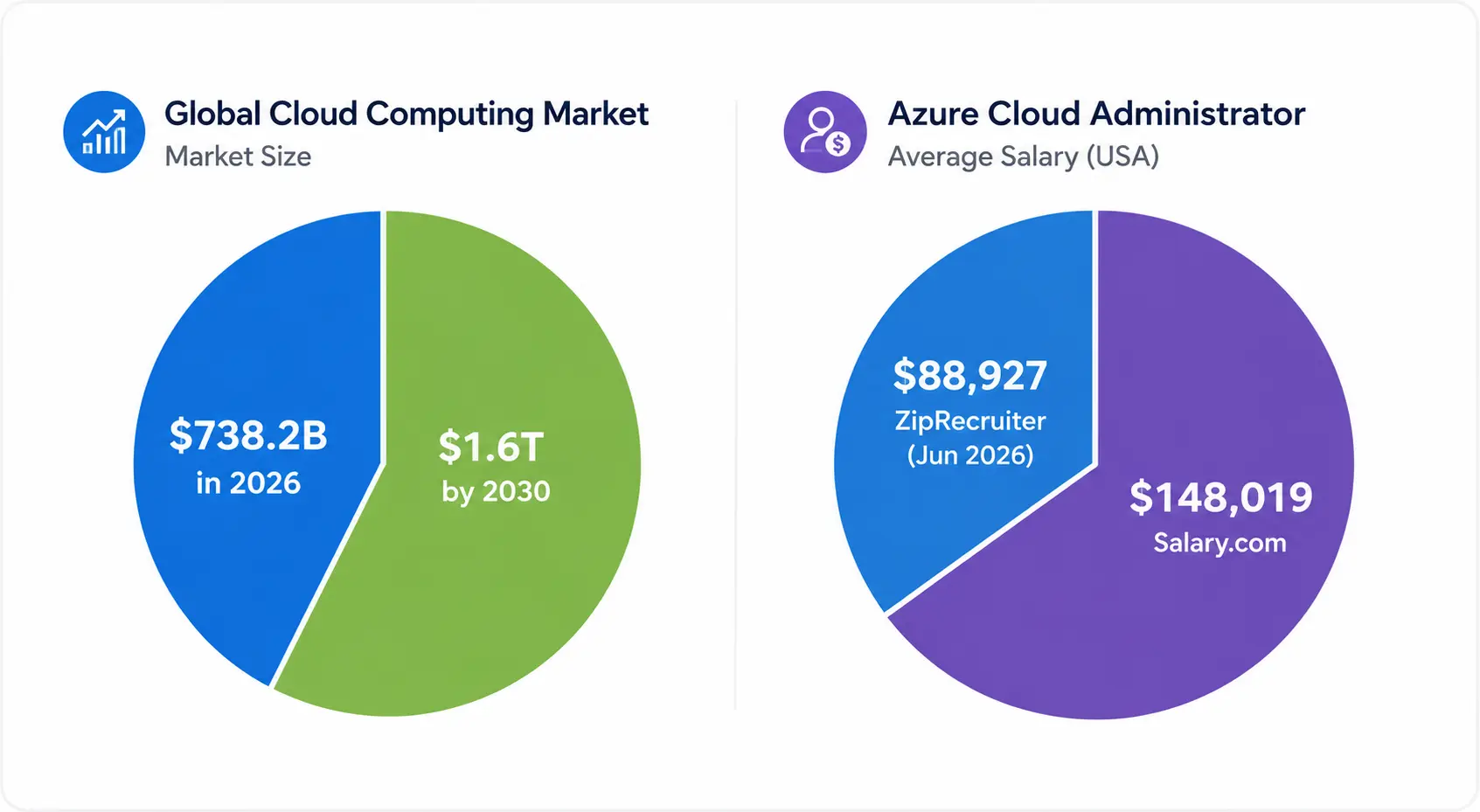
Cloud budgets haven’t slowed down, and neither has hiring for the people who keep those environments running. If you’re weighing whether this credential is worth the study hours, the compensation data is a good place to start. The global cloud computing market is expected to grow from $738.2 billion in 2026 to $1.6 trillion by 2030, and that growth translates directly into demand for administrators who run these environments day to day, not just design them on a whiteboard.
On pay specifically, the numbers vary by source but tell a consistent story. The average salary for an Azure cloud administrator in the United States sits around $148,019 per year, while other figures put the average Microsoft Azure administrator salary closer to $88,927 annually, with top earners reaching well above six figures. That spread tells you something: a strong Azure learning path and a few years of production experience can move you from the lower end of that range to the upper end fairly quickly.
For anyone tracking long-term IT career growth, this credential tends to work as a launchpad rather than a ceiling. Employers increasingly list it among preferred qualifications for mid-level IT job roles in cloud teams, because it signals verified, current experience instead of a self-reported skill on a resume. Many of today’s fastest-growing IT job roles now list this credential as a baseline requirement rather than a bonus.
Building an Azure Learning Path Beyond This Exam
Passing one exam rarely happens in isolation. A well-planned Azure learning path usually starts with Azure fundamental concepts, moves through the associate-level Azure certification, and then branches into specialty tracks such as security or DevOps as your IT career growth continues. That kind of steady movement is what real IT career growth looks like, and it gradually reshapes what employers expect from IT job roles across an entire team.
If you already work as a cloud administrator or you’re trying to break into that title, mapping your next Azure certification in advance pays off. Many professionals build their Azure learning path around a simple sequence: an entry-level Azure certification first, this associate-level Azure certification second, then an expert-level Azure certification once they have production experience. That sequence shows up in postings for senior IT job roles, which now ask candidates to describe their Azure learning path.
Recruiters in cloud-heavy industries repeat the same advice for IT career growth: certifications open the interview door, but hands-on lab time gets you hired and promoted into better IT job roles. Treat each Azure certification as proof of skills already built, not a substitute for building them—that mindset is what sustainable IT career growth actually looks like.
Skills You’ll Actually Be Tested On
Rather than listing every bullet from Microsoft’s official outline, here’s the practical breakdown organized the way I wish someone had organized it for me.
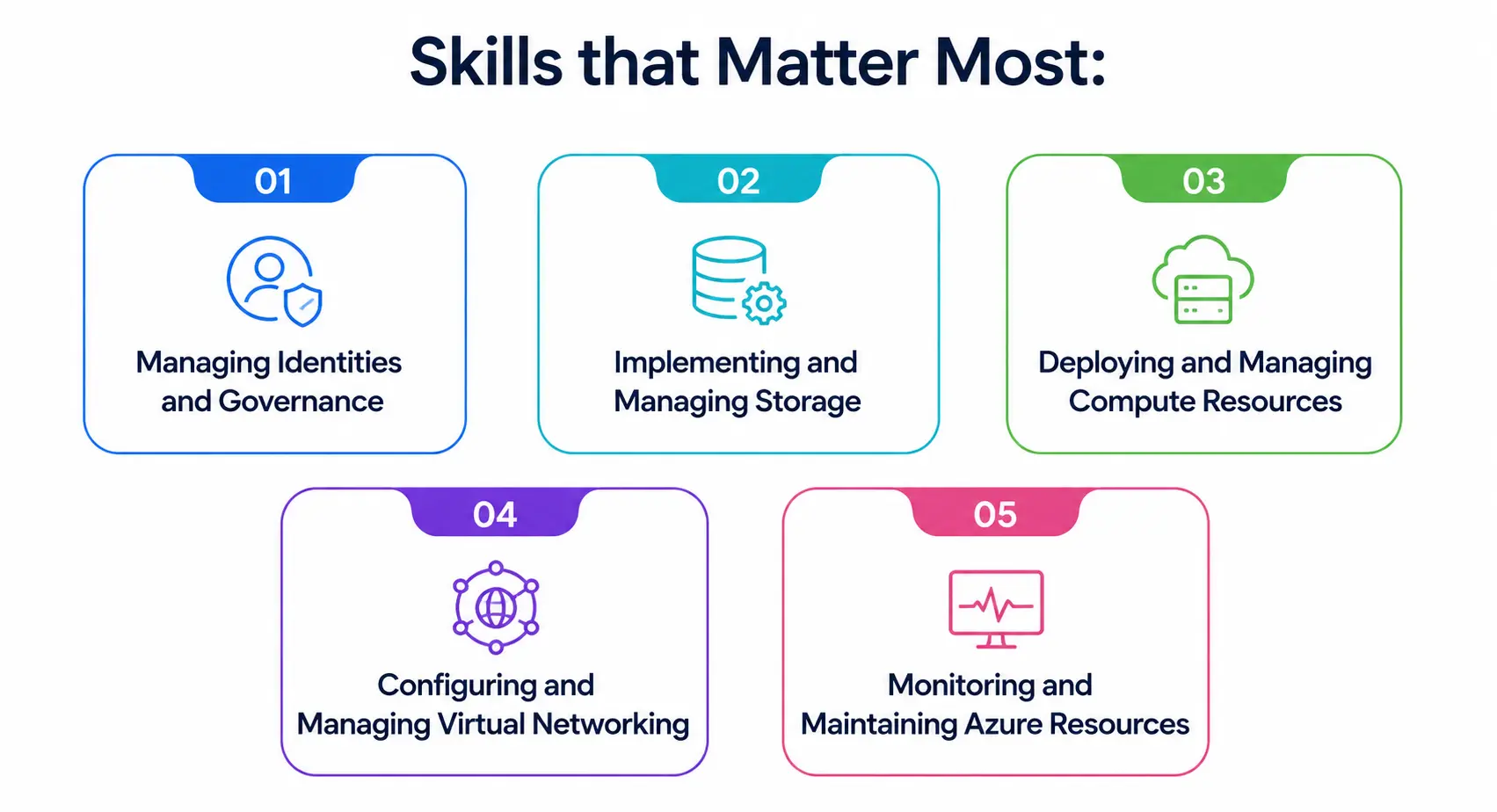
1. Managing Identities and Governance
This domain grew the most in the 2026 update, so don’t treat it as an afterthought. Expect scenario questions on Microsoft Entra ID user and group management, role-based access control (RBAC), Azure Policy, resource locks, and subscription-level governance. The exam wants to see that you understand who can act on a resource and where that permission is enforced.
2. Implementing and Managing Storage
Storage accounts, redundancy options (LRS, ZRS, GRS), blob lifecycle management, and access tiers show up repeatedly. Be comfortable explaining when soft delete and versioning matter and how shared access signatures differ from account keys.
3. Deploying and Managing Compute Resources
Virtual machines, availability sets, scale sets, and—new for 2026—Azure Container Apps sit here. You’ll also need familiarity with ARM templates and converting them to Bicep, a skill explicitly called out in the current blueprint.
4. Configuring and Managing Virtual Networking
Even with reduced weighting, networking still touches nearly everything else. VNets, subnets, NSGs, Azure Bastion, and Network Watcher are all fair game, usually wrapped inside troubleshooting scenarios.
5. Monitoring and Maintaining Azure Resources
The smallest domain by weight but not by importance—Azure Monitor, alerts, backup configuration, and Site Recovery failover scenarios all live here, usually inside case studies rather than single questions.
A 10-Week Study Plan That Actually Respects Your Time
You don’t need six months of study time if you already work with IT infrastructure—you need structure. Here’s a realistic breakdown:
- Weeks 1–2: Build or refresh your Azure fundamentals knowledge, then set up a free-tier Azure subscription for hands-on labs.
- Weeks 3–4: Work through identity and governance labs — create users, groups, custom RBAC roles, and Azure Policy assignments.
- Weeks 5–6: Move into storage and compute, deploying VMs, scale sets, and at least one ARM-to-Bicep conversion by hand.
- Weeks 7–8: Networking deep dive — build a VNet with subnets, NSGs, and a Bastion host from scratch, then break it on purpose and fix it.
- Weeks 9–10: Monitoring, backup, and full-time practice exams, reviewing every wrong answer until the reasoning is second nature.
My Own Experience Preparing for This Exam
I’ll be honest about something most guides skip: I underestimated the identity and governance section the first time through my practice tests, assuming it was “the easy part” left over from years of general IT experience. It wasn’t. The scenario questions expect you to reason through least-privilege access under specific business constraints, not just recall what RBAC stands for.
What actually moved my practice scores was forcing myself to build and tear down a small resource group with custom roles every single day for two weeks rather than passively rewatching video lectures. By the time I sat for the real AZ 104 certification exam, the case studies felt familiar, and that hands-on repetition—not the reading—is what got me across the 700 line.
Conclusion
The AZ 104 certification in 2026 is a different exam than it was even eighteen months ago, and treating it that way is the single biggest advantage you can give yourself across today’s competitive IT job roles. Study from the April 2026 blueprint, put real hours into a live Azure subscription, and don’t skip governance just because it sounds administrative rather than technical.
Whether you’re switching careers, formalizing skills you use daily as a cloud administrator, or aiming for long-term IT career growth into architecture or DevOps, this credential still opens doors — the 2026 salary and hiring data make that case on their own. Build your Azure learning path around the current outline, not an outdated one, and the exam becomes far less intimidating than the forums make it sound.