

If you’ve spent any time browsing cybersecurity job listings lately, you’ve probably noticed one credential popping up again and again in the “preferred qualifications” section. That credential is the Certified Information Security Manager, or CISM, and honestly, there’s a good reason it keeps showing up.
It’s not just another line to pad a resume—it’s one of the few certifications built specifically for people who want to lead security programs, not just run vulnerability scans. I remember when I first looked into this certification, I was confused about how it was different from other security certifications out there.
Everyone kept throwing around acronyms — CISSP, CISA, CEH — and none of the explanations actually made sense in plain English. So this post is my attempt to explain the Certified Information Security Manager credential the way I wish someone had explained it to me: no jargon overload, just a straightforward walkthrough of what it is, who it’s for, and whether it’s worth your time and money.
What Is the Certified Information Security Manager Certification?
The Certified Information Security Manager certification is offered by ISACA, a global association that has been setting standards in IT governance and security since the 1960s. Unlike certifications that test your hands-on technical skills — think penetration testing or firewall configuration — CISM is built around the management side of the house.
It checks whether you can actually run an information security program, align it with business goals, and keep it standing up under pressure. According to ISACA, the certification affirms your ability to assess risks, implement effective governance, and proactively respond to incidents, and it has been updated over time to reflect emerging technologies such as AI and blockchain.
That last part matters because a lot of older security certifications feel frozen in time. CISM, on the other hand, gets refreshed to keep pace with how threats and technology actually evolve.
In simple terms: if CISSP and similar certs are about proving you understand security techniques, the Certified Information Security Manager certification is about proving you can run security as a business function. You’re not just protecting systems — you’re protecting the organization’s ability to operate, make money, and stay out of legal trouble.
Why Does the Certified Information Security Manager Certification Matter So Much Right Now?
Cybersecurity hiring hasn’t slowed down, and management-level roles are becoming harder to fill than entry-level ones. Employment in information security roles based in the United States is projected to grow 29% from 2024 to 2034, far outpacing the national average, according to recent labor projections cited by Destination Certification.
That growth isn’t evenly spread, though. Plenty of people can run a scan or patch a server. Fewer people can sit in a boardroom and explain, in language executives understand, why the company needs to spend six figures on a new governance framework or why a particular cyber risk is worth losing sleep over.
That’s the gap CISM is designed to fill, and it’s exactly why the certification carries so much weight with hiring managers.
Breaking Down the Four CISM Domains
The exam content isn’t randomly assembled — it maps to four real job functions that a security manager performs. The exam evaluates leadership and management capability across four domains: information security governance, risk management, program development and management, and incident management.
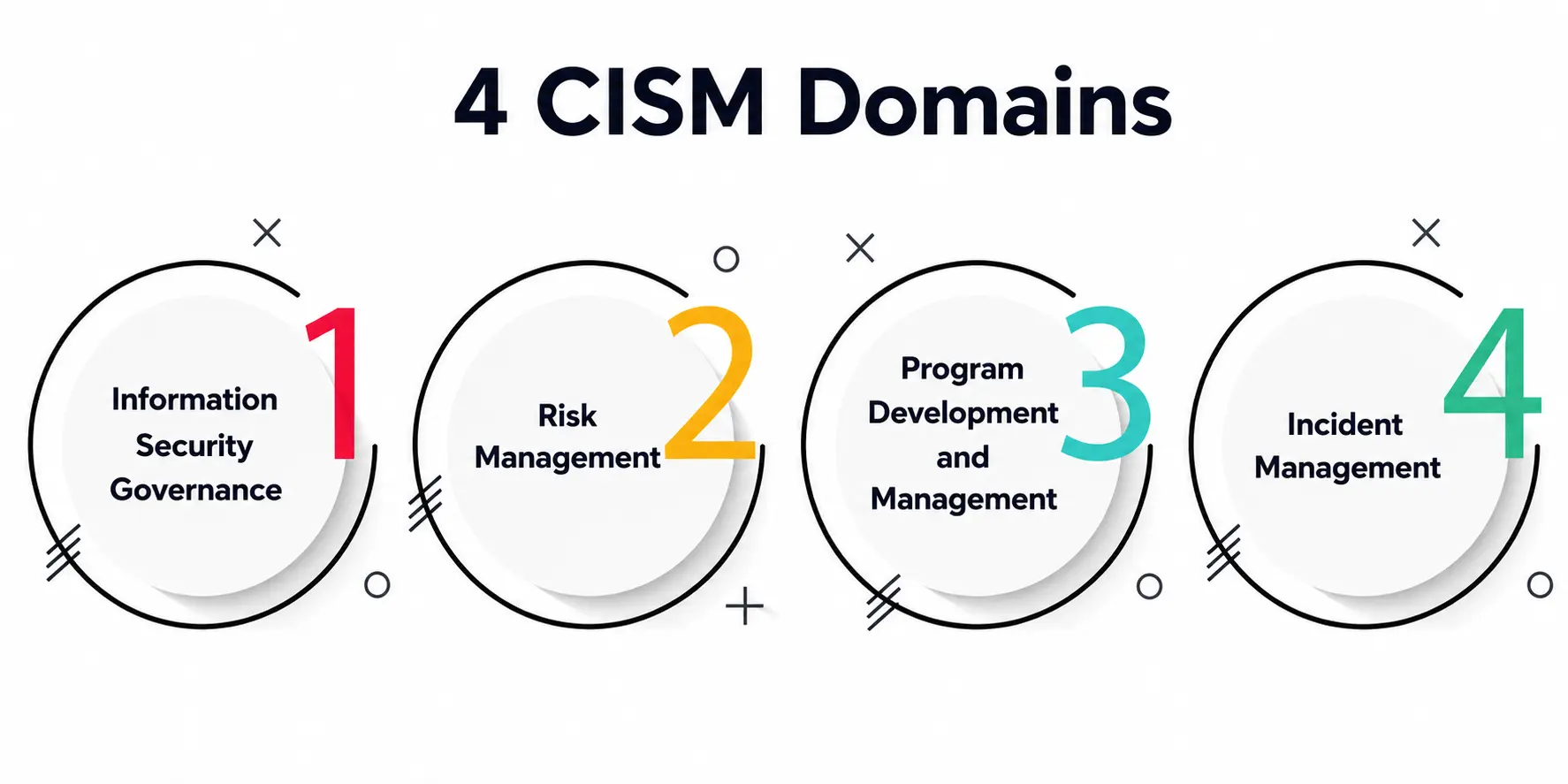
Let’s go through each one in plain language.
1. Information Security Governance
This domain is about setting direction. It covers how an organization builds its governance framework — the policies, structures, and reporting lines that decide who’s responsible for what when it comes to protecting data. Think of it as the constitution of your security program.
2. Risk Management
This is the heart of risk management as a discipline: identifying what could go wrong, figuring out how likely and how damaging it would be, and deciding what to do about it. A big part of information security work is realizing you can’t eliminate every cyber risk — you have to prioritize and manage it intelligently.
3. Program Development and Management
Here’s where strategy turns into action. This domain tests whether you can actually build and run a security program day-to-day, including choosing and implementing the right security controls to protect systems and data.
4. Incident Management
No matter how good your defenses are, something eventually breaks. This domain covers detection, response, and recovery — how you keep a bad day from becoming a catastrophic one.
CISM Exam Format: What to Expect on Test Day
Let’s talk logistics, because vague answers don’t help anyone plan a study schedule.
According to test-prep resources, the exam includes 150 multiple-choice questions, and candidates have four hours to complete the exam, and a score of 450 on a scale of 200 to 800 is required to pass.
The questions aren’t simple recall either—each question asks you to choose the most appropriate answer from several options that may all seem plausible, which means test-takers need genuine judgment, not just memorized facts.
One detail that trips people up: you don’t necessarily need all your work experience banked before sitting the exam. As explained by Destination Certification, you may take the exam before meeting the full work experience requirement, but ISACA awards certification only after all eligibility requirements are satisfied. So if you’re close to the experience threshold, there’s no reason to wait — you can test now and file your application once your experience catches up.
Also worth flagging: ISACA has announced upcoming changes. Per the official ISACA CISM page, the exam content outline is being refreshed, and the CISM Exam Content Outline will be updated effective 3 November 2026. If you’re studying close to that date, double-check which version of the outline your materials are built on.
Eligibility Requirements: Do You Qualify?
This is where a lot of people get stuck—not because the requirements are unreasonable, but because they’re specific.
ISACA requires at least five years of professional experience in information security, with at least three of those years in information security management, and that management experience has to span at least three CISM domains.
This trips up a lot of technically skilled people. You might be excellent at your job — coordinating incident response, auditing controls, managing risk registers — but if your title says “analyst” or “engineer,” it’s easy to assume you don’t qualify.
Professionals in these roles may already coordinate incident responses, lead projects, or assess organizational risks—but still wonder whether that experience actually satisfies CISM prerequisites or simply reflects hands-on technical work. The honest advice here: don’t self-eliminate. Map your actual responsibilities against the domains before assuming you’re not eligible.
Beyond experience, there are a few non-negotiables. Per iCert Global’s guide, candidates must commit to the ISACA Code of Professional Ethics and agree to comply with the Continuing Professional Education policy, which ensures that certificate holders stay current with the rapidly changing security environment.
Step-by-Step: How to Actually Earn the Certification
Here’s the structured path, based on guidance from iCert Global:
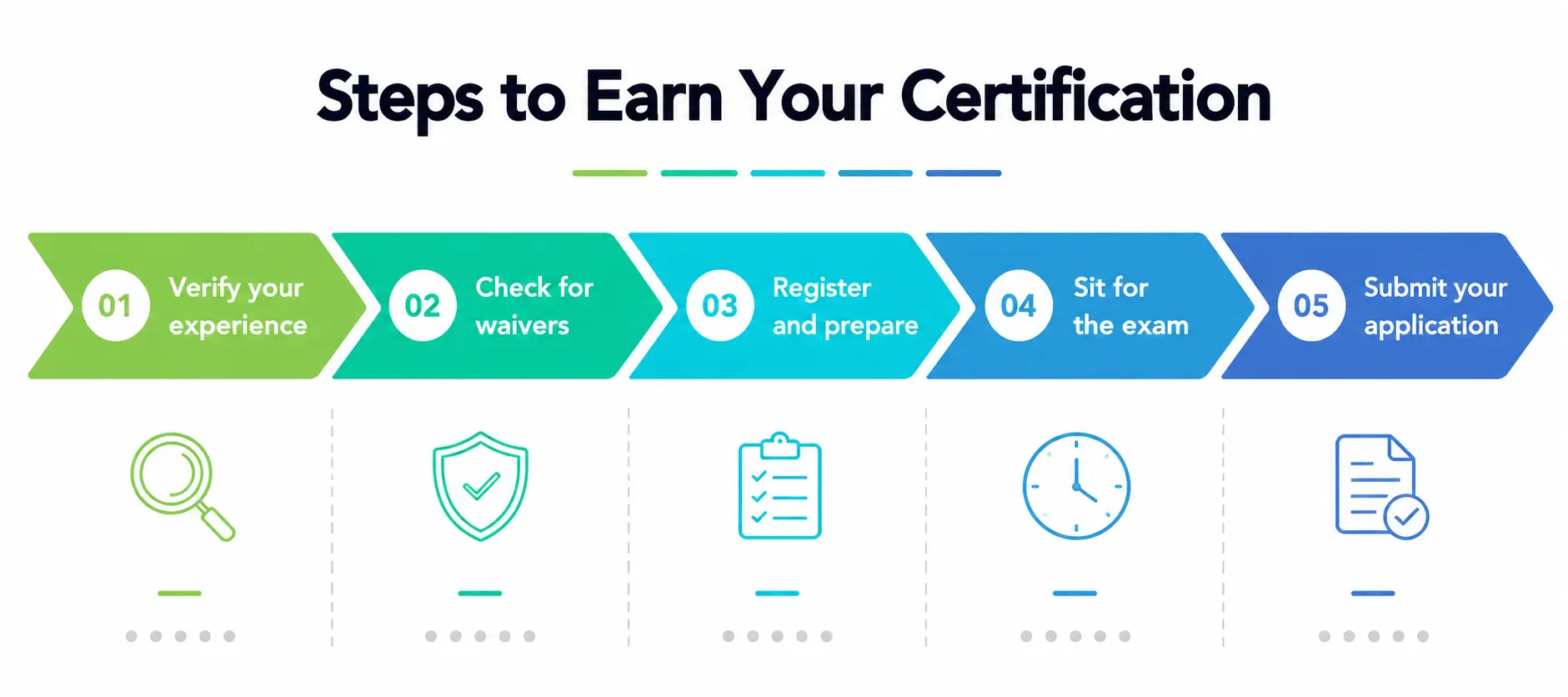
- Verify your experience against the four functional domains—don’t guess, actually map it out.
- Check for waivers. Some existing credentials or academic degrees may reduce the experience requirement.
- Register and prepare. Build a study plan that gives each domain dedicated time.
- Sit the exam. Per iCert Global, you need to pass the 150-question evaluation with a scaled score of 450 or higher.
- Submit your application with verified proof of experience from a supervisor.
One tip that shows up consistently across prep resources: build your study calendar around the domains individually rather than cramming everything together. As Destination Certification suggests, it helps to build a study plan that assigns specific weeks to each domain so nothing piles up as your test date approaches.
Why Do Employers Actually Care About This Certification?
It’s easy to be skeptical of certifications in general—plenty exist mostly to sell training courses. CISM is different because of what it signals structurally.
Government hiring backs this up directly. According to NICCS, the CISM credential is an approved baseline certification under the DoD 8570.01-M IAM Levels II & III and CSSP Manager. That’s not marketing language — that’s a formal recognition inside U.S. government hiring frameworks.
For organizations, having certified staff isn’t just about the individual either. As NICCS explains, the certification brings credibility to your team and ensures alignment between the organization’s information security program and its broader goals and objectives.
In plain terms: it tells clients, auditors, and regulators that your information security function isn’t improvised—it’s run by someone accountable to a real standard, backed by properly tested security controls rather than guesswork.
On the private-sector side, demand data tells a similar story. Per LiveCertifications, ISACA’s own research indicates that 56% of firms have unfilled security roles, and job-posting analysis suggests the credential is listed as a requirement or strong preference in over 40% of senior Cybersecurity job postings on LinkedIn and Indeed as of 2026. That’s a meaningful chunk of the senior job market effectively gated behind this one certification.
CISM vs. Other Security Certifications: A Quick Comparison
People often ask how CISM stacks up against other well-known credentials. Here’s a simple table to make the comparison easier to digest.
|
Feature |
CISM (Certified Information Security Manager) | CISSP |
CISA |
|
Primary Focus |
Security management & governance framework | Broad technical + managerial security |
IT audit and control |
|
Best Suited For |
Security managers, CISOs, program leads | Security architects, engineers, managers |
Auditors, compliance professionals |
|
Experience Required |
5 years (3 in management) | 5 years across security domains |
5 years in IS audit/control |
|
Exam Length |
4 hours, 150 questions | 3–4 hours, up to 150 questions |
4 hours, 150 questions |
|
Core Domains |
Governance, risk management, program development, incident management | 8 domains covering broad technical security |
Audit process, governance, acquisition, protection of assets |
|
Issuing Body |
ISACA | (ISC)² |
ISACA |
|
Ideal Career Stage |
Mid-to-senior management | Technical to managerial transition |
Audit and assurance careers |
This table isn’t meant to declare a “winner”—it”‘s meant to help you see which credential actually matches the work you want to be doing. If your goal is to eventually run a security department and speak fluently about risk management, cyber risk, and security controls at the leadership level, CISM is the more targeted choice.
Common Mistakes Candidates Make
A few patterns show up again and again among people preparing for this exam:
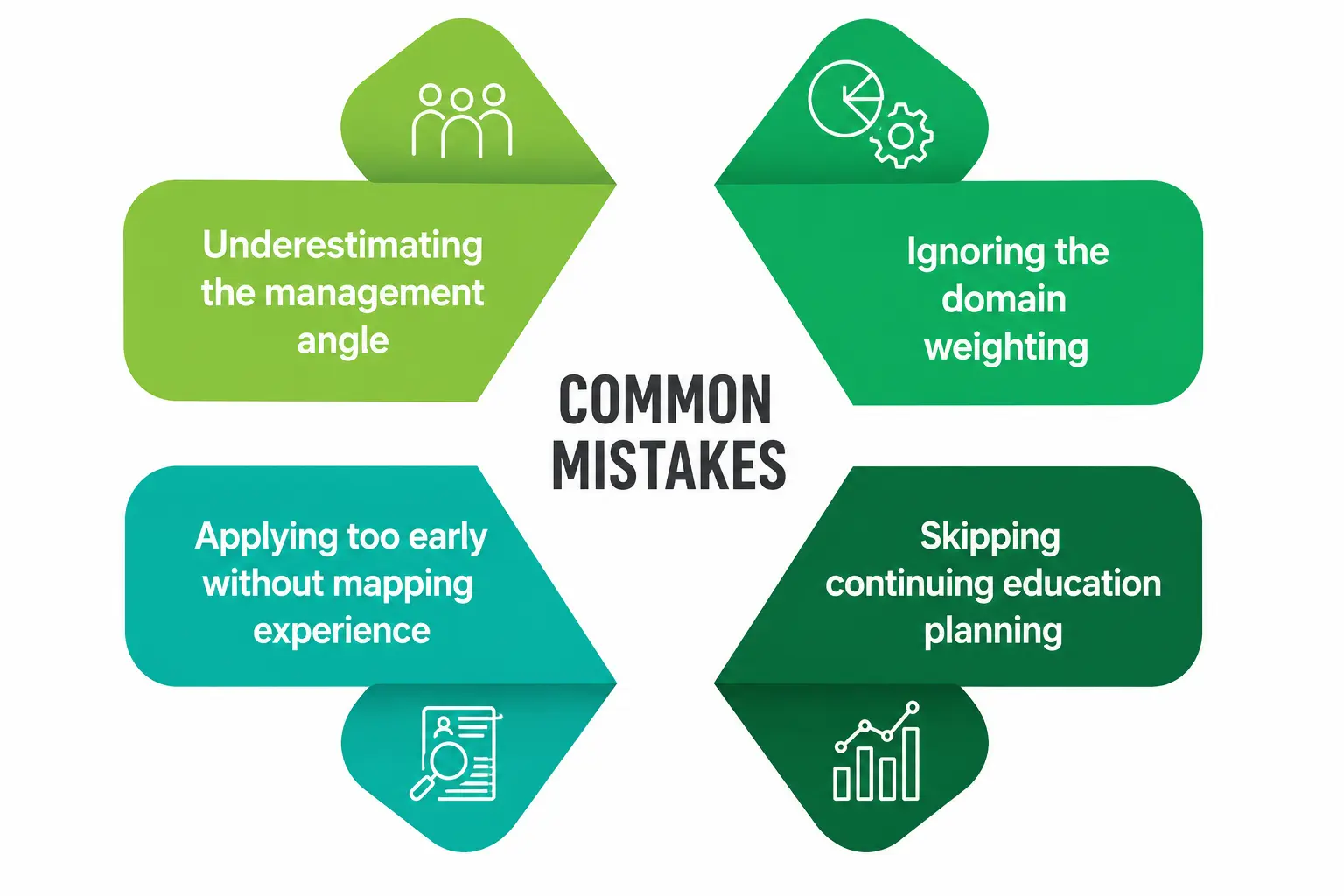
- Underestimating the management angle. Technical experts sometimes fail because they answer questions the way a technician would, not the way a manager should. CISM rewards the “best business answer,” not necessarily the most technically thorough one.
- Ignoring the domain weighting. Not all domains carry equal weight, and skipping ahead to your comfort zone leaves gaps elsewhere.
- Applying too early without mapping experience. Take the time to genuinely check your background against the domains before assuming you either qualify or don’t.
- Skipping continuing education planning. Passing the exam is not the finish line — most ISACA certifications require ongoing renewal through continuing education or CPD credits, so factor that into your long-term plan.
Final Thoughts on the Value of This Certification
If you’re weighing whether the Certified Information Security Manager certification is worth pursuing, my honest take is this: it’s not a credential for beginners, and it’s not meant to be. It’s built for people who already have real experience managing risk, running programs, and responding when things go wrong — and it exists to formally recognize that experience in a way employers trust.
What makes it genuinely valuable isn’t the letters after your name. It’s the shift in how you think. Studying for the four domains forces you to connect the dots between technical security work and actual business strategy — something a lot of us learn on the job in scattered, unstructured ways. The Certified Information Security Manager exam just organizes that learning into something coherent and testable.
A Personal Note
I’ll be honest with you—writing this guide made me appreciate how much of security work is invisible until it fails. Nobody thanks a security manager for the breach that didn’t happen. The Certified Information Security Manager certification exists partly to give that invisible work a visible, respected credential.
If you’re a student weighing whether to go technical or managerial in your security career, don’t treat it as an either/or. Get your hands dirty first, understand the technical layer deeply, and then let CISM be the bridge that takes you from “person who fixes problems” to “person who prevents them at scale.”