
Regulatory fines hit record highs in 2025, the average data breach now costs companies $4.88 million per incident, and boards everywhere are under more pressure than ever to prove their governance actually works. The result is a sharp surge in demand for skilled GRC Professionals who can navigate that complexity with confidence—and the GRCP Certification is the credential that proves you are one of them.
If you have been researching this credential, you are already thinking in the right direction. The GRC Professional credential, issued by the Open Compliance and Ethics Group (OCEG), has become one of the most recognized entry points into the fast-growing world of GRC risk management. With the global GRC market valued in the tens of billions of dollars and growing at a double-digit annual rate, the timing for earning this credential could hardly be better. In a market where every board wants proof that its controls work, the people who can build that proof are the ones getting hired first.
This guide covers everything: what the GRCP Certification is, who should pursue it, what the exam looks like, how to study, and what your career can look like afterward.
What Is the GRCP Certification?
It is a beginner-friendly credential that validates your ability to manage governance, risk, compliance, and ethics within a modern organization.
Understanding the purpose
Think of the GRCP Certification as a passport into the room where risk decisions get made: it proves you can run a complete framework and translate abstract governance principles into day-to-day practice.
The credential is issued by OCEG, the body behind the GRC Capability Model — the document OCEG calls its “Red Book.” It confirms that you can apply a working framework across an organization’s governance, risk, compliance, and ethics functions as one connected, integrated system.
Unlike credentials that focus narrowly on IT security or audit, this credential takes a broad, principle-based approach rooted in sound governance fundamentals. It equips GRC Professionals to think strategically about risk and compliance rather than just checking boxes.
Who should pursue it
One of the most attractive features of the credential is its accessibility. There are no mandatory prerequisites — no minimum experience, no required degree.
That makes it genuinely open to a wide audience, including:
- IT and cybersecurity practitioners moving into governance roles
- Compliance officers seeking a formal, recognized credential
- Risk analysts who want a broader foundation in GRC risk management
- Career changers from legal, finance, or operations
- Students and early-career professionals entering the field
- IT auditors expanding beyond technical controls into integrated GRC
If you work in — or want to work in — any area that touches governance principles, risk oversight, or regulatory compliance, this credential is built for you.
How it fits into modern programs
Organizations no longer treat governance, risk, and compliance as three separate departments. They run them as an interconnected system, which is exactly where the GRCP Certification shines. The credential is grounded in OCEG’s GRC framework, which defines how governance, performance, risk, and compliance should work together as integrated GRC rather than in isolation. Certified GRC Professionals can support, build, and advise on these integrated programs from day one.
Why the GRCP Certification Matters More in 2026
As regulations grow and risks become more complex, organizations need skilled people — and disciplined risk management — more than ever.
Rising regulatory and compliance challenges
New rules are landing faster than most teams can map them, and that widening gap is exactly where disciplined GRC risk management earns its keep.
The regulatory landscape in 2026 is the most complex it has ever been. In the U.S. alone, organizations juggle SEC cybersecurity disclosure rules, evolving state privacy laws (CCPA and its successors), HIPAA updates, FedRAMP requirements, and ESG reporting mandates. Globally, GDPR enforcement has intensified, the EU AI Act is in effect, and DORA is reshaping financial-services compliance across borders.
Every new regulation creates demand for GRC Professionals who can translate legal requirements into operational controls—and that translation is exactly what the credential teaches through structured GRC risk management.
The growing importance of corporate governance
Corporate governance has evolved from a boardroom formality into a business-critical function. Investors, regulators, and customers all scrutinize how organizations govern themselves. Companies with strong corporate governance earn greater trust, attract more investment, and recover faster from disruption. The credential trains professionals to support corporate governance at every level—and strong corporate governance always traces back to clear governance principles everyone can name and act on.
Why organizations need skilled people
The numbers tell the story. Market researchers put the GRC sector well into the tens of billions of dollars, and survey data from firms like PwC shows the large majority of companies planning to increase compliance-technology investment. Across industries, employers struggle to find GRC Professionals who combine technical knowledge with strategic thinking about integration.
That scarcity shows up in pay. Per CertMag survey data, GRCP Certification holders in the U.S. have reported an average salary around $132,000, while Glassdoor figures for GRC consultants run higher still, with top earners well into the $200,000s. (Salary figures move; re-verify before publishing.)
The Hidden Cost of Weak Governance and Risk Management
Most conversations about the credential focus on career benefits. But there is an equally strong reason to pursue it: understanding what happens when organizations lack skilled practitioners and a real GRC framework.
Financial losses from weak governance
Poor governance is expensive. IBM’s 2024 Cost of a Data Breach Report put the average breach at $4.88 million, and organizations with weak governance and immature risk management consistently see higher costs and longer recovery. In financial services, governance failures have triggered fines in the hundreds of millions. A single missed control can cascade into a failure that takes years to resolve.
Compliance failures and regulatory penalties
Governance breakdowns do not just cost money internally — they attract regulators. The SEC alone issued billions of dollars in enforcement actions in fiscal 2024, and GDPR regulators have levied fines exceeding €2 billion in a single year. Organizations lacking qualified risk-management talent are far more likely to miss control gaps, fail audits, and face penalties that dwarf the cost of prevention.
Reputational damage and disruption
Compliance failures are increasingly public. A regulatory action, a data breach, or a governance scandal can destroy brand equity built over decades. Customers leave, partners walk, and stock prices drop. Skilled practitioners spot these risks before they materialize—and that is value that is genuinely hard to price.
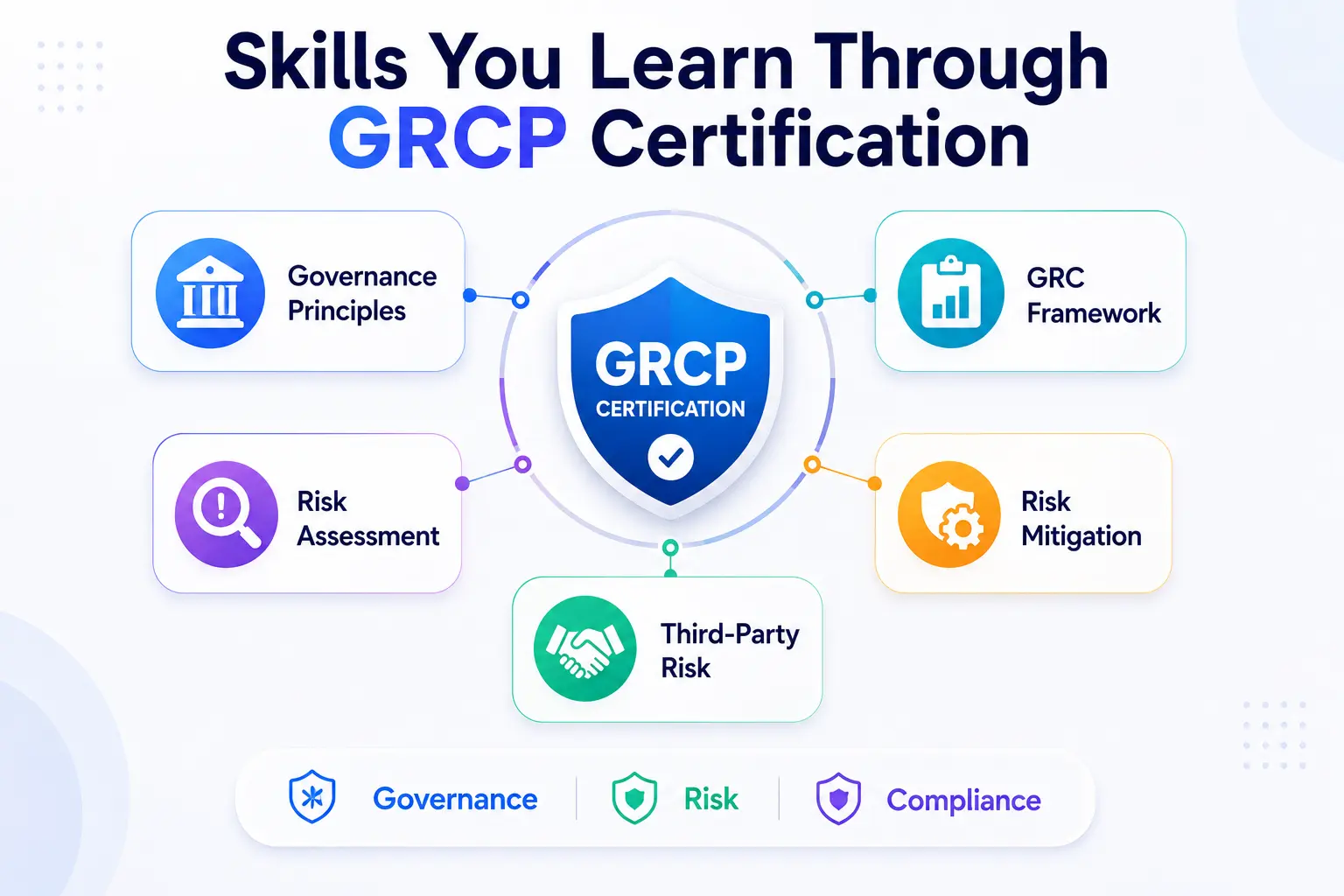
What Skills Do You Learn Through the GRCP Certification?
The credential equips you with practical governance, risk management, compliance, and decision-making skills used in real-world programs.
Understanding governance principles
Before a single control or checklist exists, governance principles set the rules of the game. The curriculum digs into how boards set direction, how accountability is designed, how policies are created and enforced, and how ethics gets embedded into culture. These principles form the backbone of every sustainable compliance program and underpin strong governance.
Building an effective GRC framework
Candidates learn to design and implement a functional GRC framework — one that fuses these principles with risk assessment and compliance management into a single integrated program rather than three standalone efforts. That means mapping controls across regulatory requirements, prioritizing risk responses, and reporting status to leadership. Master one GRC framework well and you can flex it to fit whatever regulation lands next.
Enterprise risk identification and assessment
Effective GRC risk management starts with knowing what risks exist. The curriculum covers enterprise-wide identification—structured workshops, risk registers, and automated scanning. Candidates learn to assess likelihood and impact, categorize risks, and decide which are material enough to escalate. Strong GRC risk management skills are among the most in-demand capabilities employers seek in 2026.
Risk response and mitigation strategies
Once risks are identified, professionals must act. The curriculum covers the full spectrum of responses — acceptance, avoidance, transfer, and mitigation — and teaches you to design controls, document treatment decisions, and validate that mitigations work in practice. This is the GRC risk management discipline applied to real exposure.
Third-party risk management fundamentals
No organization operates alone. The average enterprise now works with hundreds of vendors, each a potential source of risk. The credential covers third party risk management fundamentals: assessing vendor security posture, building due-diligence questionnaires, monitoring supplier performance, and escalating concerns. With supply-chain incidents dominating headlines, these vendor-risk skills are now essential for any GRC role. In short, vendor oversight is no longer optional; it is foundational.
Why Integrated GRC Is Replacing Traditional Risk Management
Here is something underdiscussed: the way most organizations managed risk five years ago simply does not work anymore. The shift from fragmented, reactive compliance to integrated GRC is one of the most important trends reshaping the profession—and the GRCP Certification puts you ahead of it.
Traditional risk management vs integrated GRC
Traditional risk management ran in silos. Legally managed contracts. IT owned cybersecurity. Finance tracked exposure. Audit ran periodic reviews. None of them talked consistently, so risks slipped through the cracks, controls overlapped, and leadership never saw the full picture. Integrated GRC fixes this by connecting governance, risk, and compliance inside a unified GRC framework, giving every stakeholder shared visibility and a coordinated response.
|
Traditional Risk Management |
Integrated GRC |
|
Siloed teams |
Connected teams |
|
Manual reporting |
Centralized visibility |
|
Reactive controls |
Proactive monitoring |
|
Point-in-time assessments |
Continuous monitoring |
|
Duplicated effort |
Shared control library |
|
Slow audit prep |
Always audit-ready |
Benefits of an integrated approach
Integrated GRC reduces duplication, speeds compliance reporting, and improves decisions at every level. When risk data flows into governance conversations in real time, boards decide better. When requirements map to one shared GRC framework, audit prep drops from weeks to days. When vendor risks sit alongside internal ones through diligent vendor oversight, the organization finally sees its full exposure. That is the clear advantage.
How modern organizations use it
Leading banks, healthcare systems, and tech companies build integrated GRC programs that connect policy management, risk assessment, audit management, and third party risk management in a single operating model. That is what employers actually mean when they say they want a GRC professional: someone who understands how every piece connects.
Real-World Challenges the GRCP Certification Helps Solve
Understanding concepts is one thing. Applying them is where the credential proves its value.
Managing vendor and supplier risks
Picture a mid-sized financial firm relying on 300-plus vendors. Without a structured third-party risk management program, one vulnerable vendor becomes the entry point for a major breach. GRCP-trained GRC Professionals build tiered vendor assessments—categorizing by criticality and applying proportionate due diligence. This is the exact third-party risk management work regulators like the OCC and FFIEC expect institutions to demonstrate. Done well, this work turns vendor sprawl into a managed, monitored portfolio.
Strengthening corporate governance programs
A manufacturer facing new ESG mandates needs someone who can translate corporate governance expectations into operational processes—who decides what, how conflicts are managed, and how board oversight functions. The credential trains professionals for exactly this corporate governance work, anchored in governance principles.
Improving regulatory compliance processes
When a healthcare organization faces a HIPAA audit, mapping existing controls to requirements — and finding the gaps before the auditor does — is invaluable. That is GRC risk management in action: proactive, structured, and evidence-based.
Supporting enterprise risk decisions
A GRCP-certified analyst can translate operational activity into the risk language executives act on. That translation, from the floor to the priorities leadership cares about, is one of the most valuable things the credential builds.
How AI Is Changing GRC in 2026
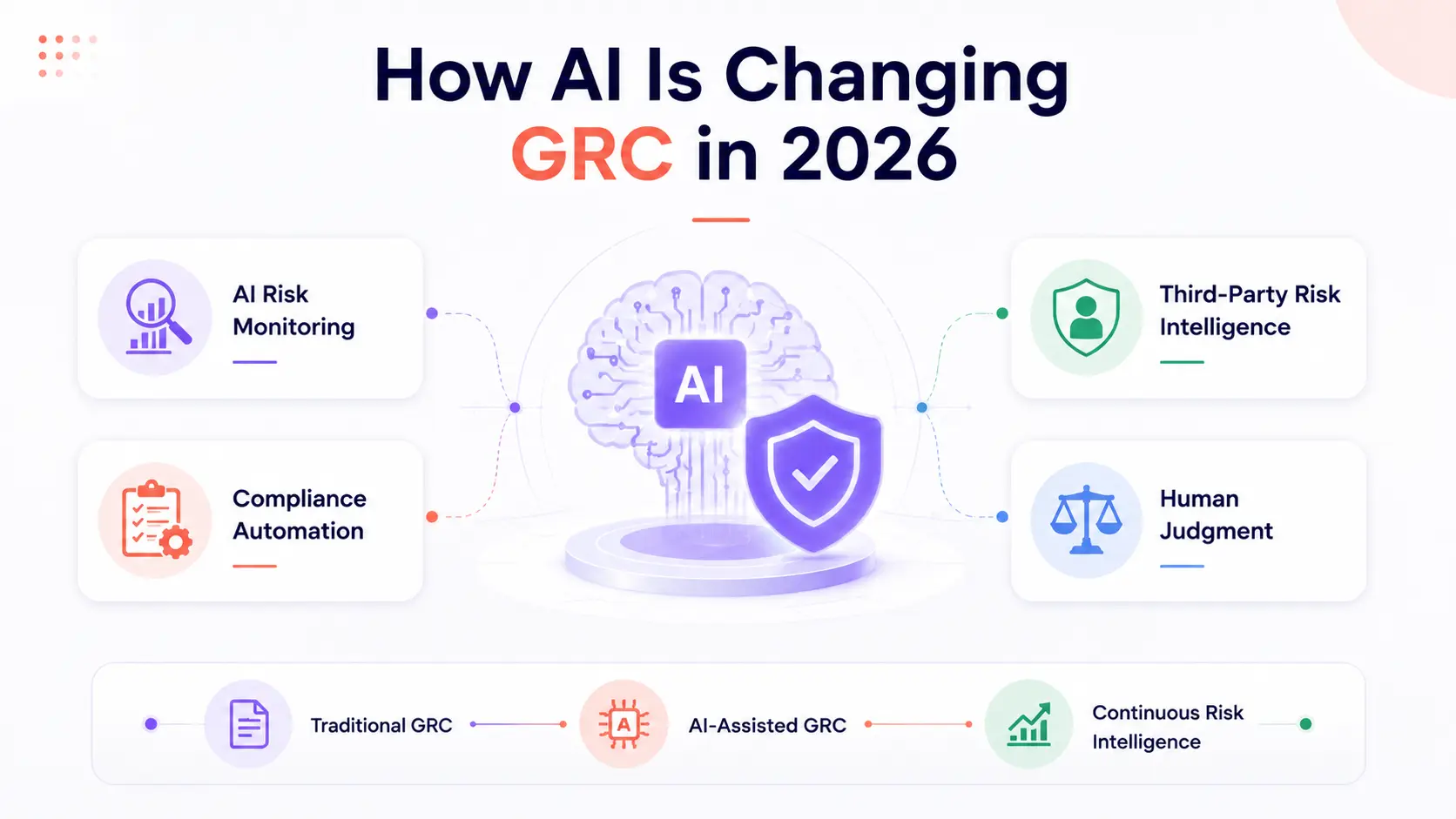
This is the section most certification content ignores — and the one that matters most for anyone earning the GRCP Certification today.
AI-powered risk monitoring
Instead of annual reviews, leading teams now use AI to continuously scan for anomalies, flag control failures, and surface emerging risks early. Platforms with embedded AI process thousands of signals no human team could track, supercharging GRC risk management.
Automated compliance tracking
Regulatory-change management once required teams of lawyers. Today, AI-assisted tools monitor updates across jurisdictions and map changes to affected controls automatically. This does not replace GRC professionals—it elevates what they focus on, which is exactly the higher-order judgment this certification develops.
Third-party risk management with AI
AI is also reshaping third-party risk management. Rather than trusting static questionnaires, AI tools analyze threat intelligence, financial signals, and behavioural data to produce continuous vendor risk scores. GRC Professionals who can interpret these third-party risk management signals are positioned for senior roles. The future of third-party risk management is continuous, not annual.
Future skills professionals need
The GRC Professionals who thrive over the next five years pair traditional governance and GRC risk management expertise with the ability to work alongside AI: knowing what it can and cannot assess, evaluating its output critically, and keeping the human judgment regulators expect. This is the next chapter of integrated GRC — augmented by machines and anchored by people.
GRCP Certification Exam Structure and Requirements
Understanding the format, eligibility, and study expectations is essential before you start.
Exam format
The GRCP exam is multiple-choice and open-book, completed in two hours. It contains 100 scored questions plus up to 15 unscored pilot questions that OCEG uses to validate future items; the pilot questions do not count toward your result, but they are not labeled, so treat every question as if it counts. The open-book format is intentional: OCEG designed the exam to test judgment and application, not memorization. Access to materials will not save you if you cannot apply the governance principles under time pressure.
Certification requirements
There are no mandatory prerequisites for the credential — no minimum experience, degree, or prior credential. You register through OCEG, prepare with the GRC Capability Model, and schedule your exam.
|
Exam Element |
Detail |
|
Scored questions |
100 multiple-choice |
|
Unscored pilot questions |
Up to 15 (do not affect your score) |
|
Time allowed |
2 hours |
|
Passing score |
70 of 100 scored questions (70%) |
|
Format |
Open-book, online |
|
Retakes |
Up to 6 attempts per year |
| Prerequisites |
None |
|
Cost |
Included in the OCEG Pro All Access Pass (annual membership) |
A note on cost
OCEG does not charge a standalone exam fee. It bundles everything into a single annual membership—the Pro All Access Pass — covering study materials, the exam and its retakes, and ongoing maintenance for every OCEG certification. OCEG has recently listed this pass at roughly $499–$599 per year; confirm the current figure on OCEG’s site before you budget, since that single number is effectively the whole cost of earning the GRCP Certification.
Recommended experience
Nothing is required, but most candidates have some exposure to compliance, risk, governance, legal, IT, or audit. The credential is approachable for early-career professionals, though six to twelve months of experience helps you contextualize the integrated concepts faster.
Renewal
The credential is maintained through OCEG’s continuing-education program. Starting in your second year, you earn continuing-education credits annually — through training, professional development, and community contributions — to keep it current.
GRCP Certification Study Plan (30–60 Days)
Sixty days is realistic for most candidates. Here is a structured approach.
Weeks 1–2 — Governance principles. Start with OCEG’s GRC Capability Model. Focus on core governance principles: how organizations set direction, define accountability, create policy, and embed an ethical culture. Do not memorize; understand why these principles are designed the way they are. Build a glossary of key terms and how they connect.
Weeks 3–4 — GRC risk management concepts. Shift to the identification, assessment, and response cycle. Apply the OCEG risk taxonomy to scenarios — trace how a risk in one area affects governance or compliance elsewhere. This cross-functional GRC risk management thinking is exactly what the exam tests.
Weeks 5–6 — Compliance, controls, and integration. Study how compliance obligations get identified, mapped to controls, and monitored. Learn preventive, detective, and corrective controls. Review third party risk management concepts and how it ties them into a single GRC framework.
Weeks 7–8 — Practice and revision. Run full practice exams under timed conditions. Use the open-book format strategically — practice finding answers fast rather than relying on recall. Revisit any area where you scored below 75% before exam day.
Skills Employers Expect from GRC Professionals in 2026
The job market has matured. Employers want practical capability from day one — and the credential signals it.
- Risk analysis. Comfort with risk registers, heat maps, and both qualitative and quantitative risk-management methods, plus the ability to present findings that support decisions.
- Governance reporting. Boards and audit committees need plain-language reporting tailored to governance audiences. Professionals who can explain a complex risk landscape clearly are far more valuable than those who only produce technical documentation.
- Compliance management. Deep familiarity with the frameworks that matter in your sector — HIPAA in healthcare; SOC 2, FFIEC, and OCC guidance in financial services; SEC cyber rules in tech. The credential provides the governance principles that transfer across all of them.
- Vendor assessment. Designing questionnaires, interpreting responses, and running ongoing third party risk management programs. Employers now treat third party risk management fluency as a baseline expectation.
- Executive communication. The most underrated skill for GRC Professionals: turning risk and compliance complexity into business terms executives act on. That is what separates analysts from leaders.
Career Opportunities After the GRCP Certification
Career paths for GRC Professionals in 2026 are broader and better-paid than ever. A common progression looks like this:
Compliance Analyst → GRC Analyst → Risk Consultant → GRC Manager → Enterprise Risk Leader
GRC Analyst — the most common entry role after earning it. Analysts support risk assessments, compliance monitoring, and policy work within a GRC framework. Glassdoor reports a U.S. average around $112,000, with top earners well above that.
Risk Management Consultant — consultants advise on GRC risk management strategy, build a GRC framework, and implement controls. Glassdoor figures for this role run higher, with top earners reaching into the $200,000s.
Compliance Specialist—focused on regulatory requirements, policy management, and audit support and prominent in healthcare, financial services, and government contracting, all heavy on corporate governance.
Governance Manager — leads board reporting, policy governance, and accountability structures rooted in corporate governance and governance principles. It is a senior role, and the GRCP Certification is a recognized step toward it.
Enterprise Risk Manager — owns the full GRC risk management strategy and works directly with the C-suite, commanding the highest pay in the field.
(Salary figures above come from third-party survey and aggregator data and move over time.)
GRCP Certification vs Other GRC Certifications
Knowing how the credential compares helps you choose for your stage and goals.
|
Certification |
Issuing Body | Focus |
Experience Required |
|
GRCP |
OCEG | Integrated GRC principles |
None |
|
CRISC |
ISACA | IT risk and controls |
3 years |
|
CISA |
ISACA | Information systems auditing |
5 years |
|
CISM |
ISACA | Information security management |
5 years |
GRCP vs CRISC. CRISC requires three years of experience and is strongly IT-focused. The GRCP Certification covers a broader span—governance principles, ethics, risk, and compliance. Choose the GRCP for a broad foundation; choose CRISC to specialize in IT risk.
GRCP vs CISA. CISA focuses on IT auditing and requires five years of experience—the gold standard for IT auditors. The credential is more accessible and more governance-focused. Many professionals earn the GRCP first and add CISA later.
GRCP vs CISM. CISM targets security leaders and requires five years in security management. The credential provides broader integrated principles that complement it well. For anyone who wants to operate across governance, risk, and security, the GRCP makes a strong primary credential.
Which should you choose? Early in your career, or want broad fluency across all three? Start with the GRCP Certification. Five-plus years in IT audit, security, or risk? Layer CRISC, CISA, or CISM on top to build a stack that shows depth.
Is the GRCP Certification Worth It in 2026?
With rising demand for talent and strong salary potential, many professionals view the GRCP Certification as a valuable career investment.
For compliance professionals
The real unlock is fluency. You stop chasing individual rules and start operating a coherent GRC framework, applying GRC risk management thinking to calls that used to feel like guesswork. The GRCP Certification validates exactly that ability and is one of the few credentials accessible without a tech or audit background.
For risk managers
The credential reinforces GRC risk management fundamentals and adds the enterprise-wide, integrated perspective many point-solution specialists lack. If you have built depth in one risk type, it helps you speak credibly across all of them.
For security and governance teams
Security professionals moving into corporate governance and leadership find the GRCP Certification aligns with that transition. It covers governance structures, corporate governance, policy development, and compliance frameworks—areas security pros encounter but rarely study formally.
Final verdict
The GRCP Certification is worth it in 2026. The market is growing fast, demand for GRC Professionals is strong, and there is no experience barrier. Against a single annual membership fee, the cost is modest relative to the return, and survey data consistently shows GRCP Certification holders earning well above six figures. For anyone eyeing a career in governance, risk, or compliance, it is a smart investment.