
Here’s a number worth sitting with for a second: over 514,000 cybersecurity jobs were open across the United States as of early 2026, and employers could only fill roughly three out of every four of them. That gap is exactly why so many people are suddenly asking about an ethical hacker certification instead of just reading about hacking as a hobby.
If someone has ever wondered whether paying over a thousand dollars for a piece of paper actually changes their career, this piece walks through the real cost, what the certification exam is actually like, what the job pays in 2026, and where the field is realistically headed. No recycled definitions, no fluff. Just the numbers and the honest tradeoffs.
What This Credential Actually Covers?
At its core, this credential is a formal way of proving that someone can break into systems the same way a criminal would, except they’re doing it with permission and reporting the holes instead of exploiting them.
The most recognized version is the Certified Ethical Hacker (CEH), issued by the EC-Council, though it isn’t the only path into the field. Ethical hacking as a discipline covers reconnaissance, scanning, gaining access, maintaining access, and covering tracks, all taught from an attacker’s mindset so defenders know exactly what they’re up against.
The goal isn’t to memorize tool names; it’s to think the way an attacker thinks before an attacker actually shows up, and to run structured vulnerability testing against systems before someone with worse intentions finds the same gaps first.
Why Does an Ethical Hacker Certification Still Matters in 2026?
Plenty of self-taught hackers are genuinely skilled without ever sitting an exam, so it’s fair to ask whether certification is even necessary anymore. According to Unihackers’ 2026 CEH guide, the CEH stays on the DoD 8140 Cyber Workforce Qualification Program list, which means U.S. federal agencies and cleared contractors keep listing it as a checkbox requirement for certain roles, regardless of how good a candidate’s practical skills are.
That single fact explains why government and defense-adjacent employers still ask for it by name, especially for roles that require an active security clearance. Private-sector employers care less about the letters after someone’s name and more about proof of hands-on ability, but recruiters still use CEH as a fast filter when scanning hundreds of resumes for open roles.
Ethical Hacker Certification Cost: The Real Numbers for 2026
This is where most articles get vague, so here are the actual figures. The exam itself runs $950 through an EC-Council testing center or $1,199 through Pearson VUE, plus a separate $100 application fee for anyone qualifying through work experience instead of official training.
CertPath’s 2026 guide puts the realistic all-in cost, once study materials and a prep course are factored in, closer to $1,500 to $2,500 rather than the bare $1,199 sticker price most people quote.
|
Cost Component |
Typical Price (USD, 2026) |
|
Exam voucher (EC-Council test center) |
$950 |
|
Exam voucher (Pearson VUE) |
$1,199 |
|
Application fee (experience-based eligibility) |
$100 |
|
Official training course (includes one voucher) |
$1,950 – $3,600 |
|
Remote proctoring surcharge |
$100 |
|
Retake voucher |
$499 |
|
Annual maintenance fee |
$80/year |
Anyone budgeting for this should treat $1,199 as the floor, not the ceiling, and plan for closer to $2,000 once prep materials are added in.
What the CEH Exam Actually Involves?
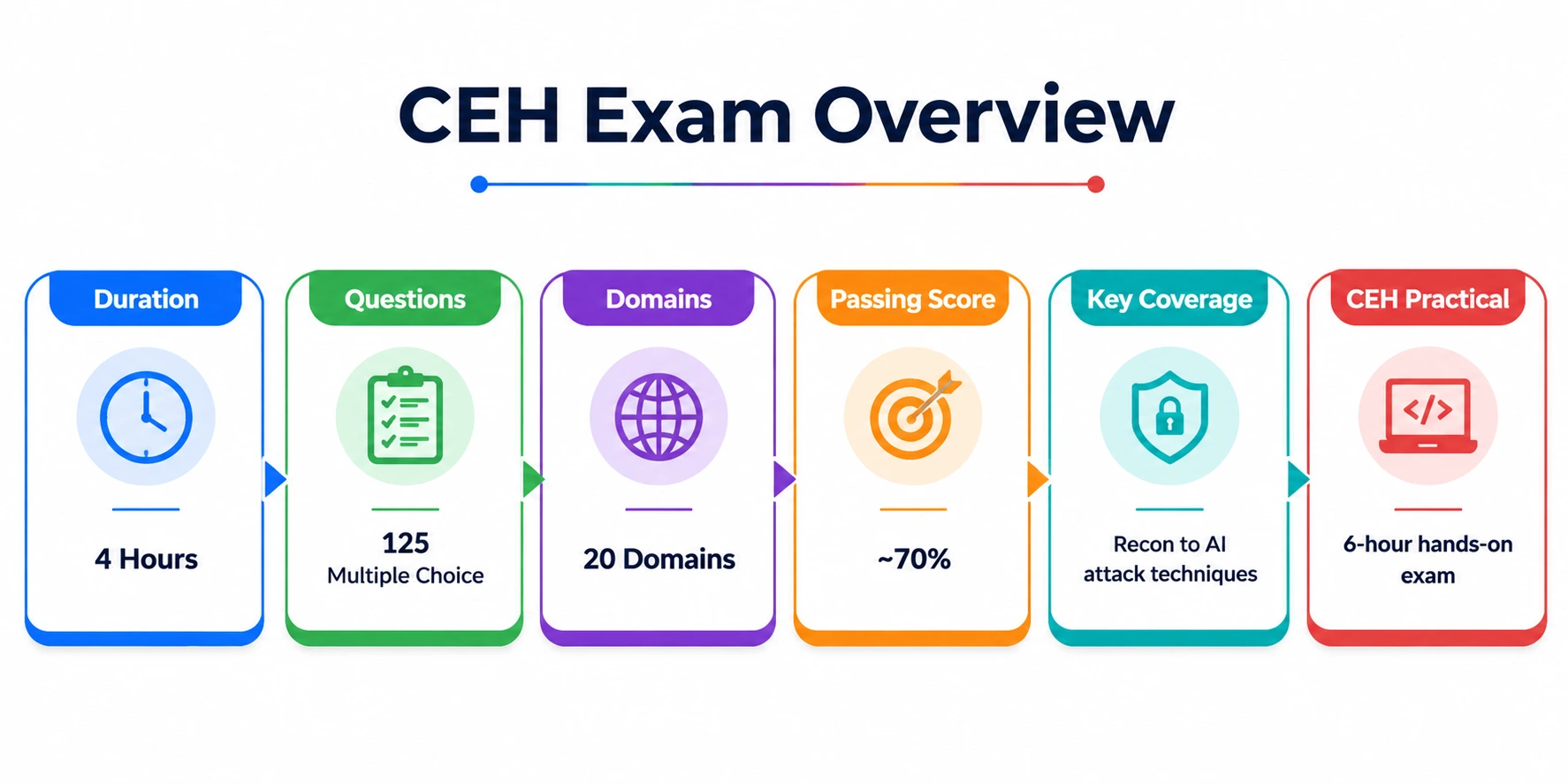
The CEH exam is a 4-hour test made up of 125 multiple-choice questions spanning 20 domains, covering everything from reconnaissance and scanning to cloud security and AI-assisted attack techniques folded directly into the core curriculum.
A passing score generally sits around 70%, though EC-Council adjusts the exact cutoff slightly depending on the specific test form. Candidates who want to go further can also sit the CEH Practical, a separate six-hour exam involving 20 real-world challenges inside a live network environment, which earns the higher CEH Master designation.
For anyone who has only ever done vulnerability testing in a lab environment, that practical exam is a genuinely different kind of pressure, since it mirrors the messiness of real production networks rather than a tidy textbook scenario.
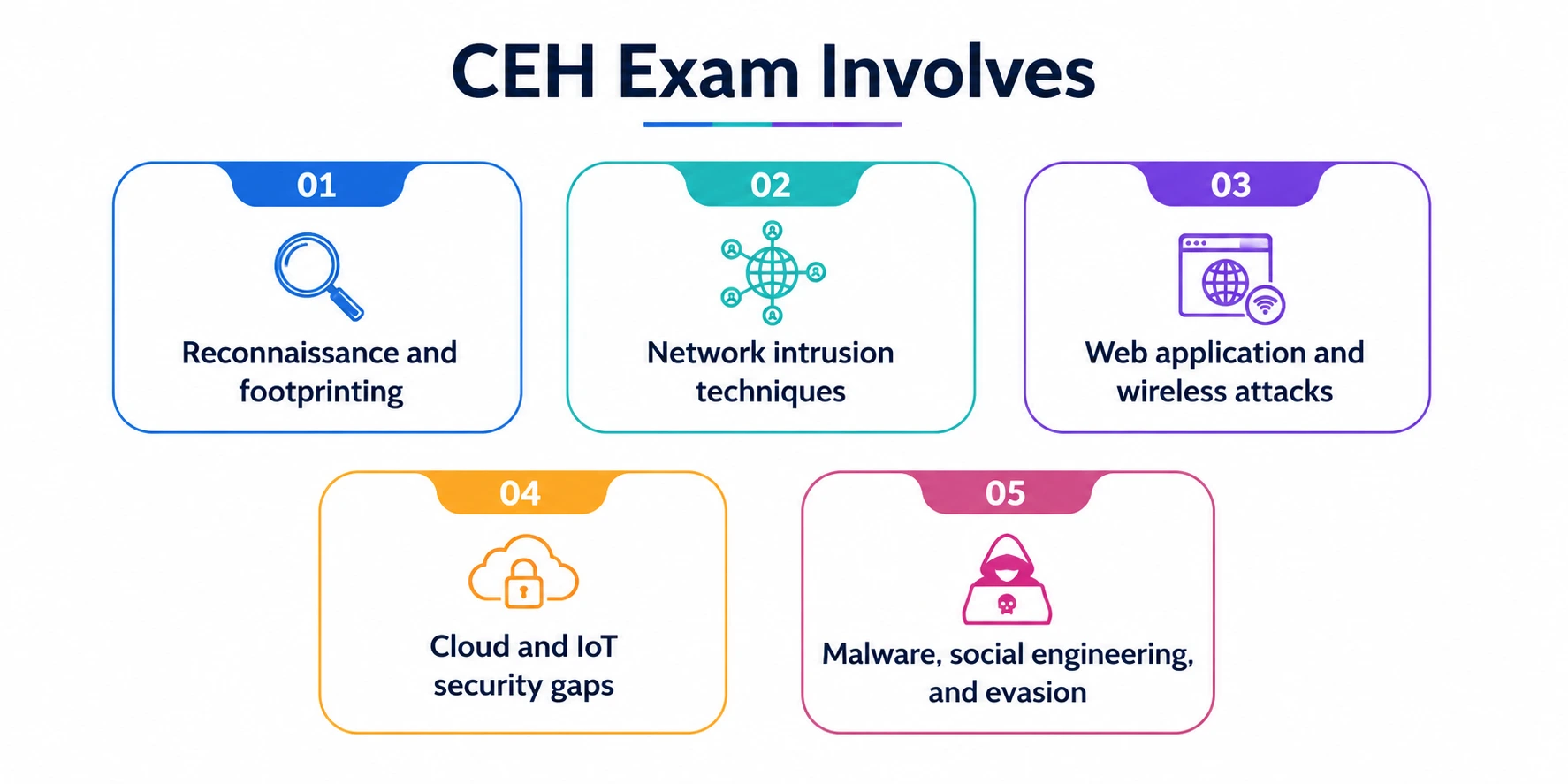
Preparing for it usually means covering:
- Reconnaissance and footprinting — gathering information about a target before touching it directly
- Network intrusion techniques — scanning, enumeration, and exploiting weak points in a network’s perimeter
- Web application and wireless attacks — covering everything from SQL injection to rogue access points
- Cloud and IoT security gaps — an area that keeps expanding as more infrastructure moves off-premises
- Malware, social engineering, and evasion — the human and code-based tricks attackers rely on most
CEH Salary and Career Growth in 2026
This is usually the part people actually care about, so here it is straight. Unihackers’ research adds that CEH holders typically see roughly a 31% salary bump compared to peers without the credential, which is a meaningful jump for a certification that costs a few thousand dollars total.
Growth prospects look just as strong. Demand for offensive security specialists specifically, including penetration testers and ethical hackers, continues climbing as more organizations move from occasional compliance audits to continuous, always-on security testing.
CEH vs. Other Paths Into the Field
CEH isn’t the only route, and it isn’t automatically the best one for every situation. Offensive Security’s OSCP is widely considered more hands-on and technically demanding, since it requires actually compromising machines in a timed practical exam rather than answering multiple-choice questions about theory.
CompTIA Security+ sits at an earlier stage, better suited to someone just entering security rather than someone specializing in offensive work. The practical reality is that many serious professionals eventually hold more than one credential, using CEH to satisfy HR filters and government requirements while using something like OSCP to prove genuine offensive security skill to technical hiring managers.
What Certified Professionals Actually Do Day to Day?
The exam is only the entry ticket to an ethical hacker certification; the actual job looks different depending on the employer. In a typical week, a certified professional might run a scheduled vulnerability testing cycle against a client’s external-facing servers, then follow up with a controlled network intrusion attempt to see whether a discovered weakness can actually be exploited or whether it’s purely theoretical.
That distinction matters enormously to clients, since a vulnerability scanner can flag hundreds of low-priority issues, but only manual testing shows which ones a real attacker could actually chain together into serious damage.
Reporting is a bigger part of the job than most newcomers expect; a finding is only useful if it’s written up clearly enough that a non-technical manager understands the business risk, not just the technical detail.
Beyond the technical side, a meaningful chunk of the work involves staying current. Attack techniques shift constantly, and a network intrusion method that worked flawlessly two years ago might be blocked instantly by modern detection tooling today.
Professionals who take this seriously spend real time in home labs, following disclosed vulnerabilities, and occasionally competing in capture-the-flag events just to keep their instincts sharp between paid engagements. That ongoing practice is often what separates someone who passed an exam once from someone who is still genuinely dangerous to a target’s defenses years later.
Should Someone Actually Pursue This Credential?
The honest answer depends on the goal. For anyone targeting government, defense, or cleared-contractor work, an ethical hacker certification isn’t really optional, since those employers often list it as a hard requirement tied to security clearance eligibility and DoD 8140 compliance.
For anyone chasing a purely private-sector security engineering role at a tech company, hands-on lab experience, a solid GitHub or write-up portfolio, and a certification like OSCP might carry more weight with the engineers actually doing the interviewing.
Either way, the math tends to work out: if a certification that costs around $2,000 total helps someone land a role paying six figures, the return on that investment shows up within the very first month of the new job.
Conclusion
An ethical hacker certification isn’t a magic ticket, but in a job market where more than half a million cybersecurity roles sit unfilled, it remains one of the fastest ways to get a resume past an automated filter and into a hiring manager’s inbox.
Between the exam cost, the training, and the renewal fees, the total investment usually lands between $1,500 and $2,500, a figure that looks small next to average salaries now stretching well past $130,000 a year.
Whether someone chooses CEH, layers it with OSCP later, or builds toward a specific government eligibility requirement, the field itself isn’t slowing down anytime soon.
A personal note
I’ve watched a good number of career-changers ask me whether this certification is “worth it,” and my honest answer is always the same: it’s worth it if it opens a door that would otherwise stay closed, not because the exam itself makes anyone a better hacker.
The real skill still comes from hours spent in a home lab, breaking things on purpose, and reading write-ups from people who’ve been doing this far longer. Treat the certificate as a key, not a finish line, and the rest of the career tends to take care of itself.