

A single exam voucher costs less than most people spend on a used laptop, yet it can be the one line item that adds tens of thousands of dollars to someone’s paycheck within a year.
That’s the strange math behind cybersecurity credentials, and it’s why I keep getting asked the same question by people thinking about switching careers: is a security analyst certification actually worth the money, or is it just another piece of paper that looks good on LinkedIn? I’ve spent enough time around hiring managers, SOC teams, and career-changers to have a real opinion on this, backed by real 2026 numbers rather than marketing copy.
This piece walks through what these credentials really cost, what the roles they unlock actually pay, and where the return on that investment genuinely comes from.
What Does a Security Analyst Certification Actually Cost in 2026?
Let’s start with the number everyone fixates on: the exam fee. According to a detailed 2026 pricing breakdown, the CompTIA Security+ exam voucher costs $425 through Pearson VUE, with total preparation costs — including study materials — typically landing between $500 for disciplined self-study and $3,500 for an intensive bootcamp.
Renewal every three years runs about $150. That’s the most common entry point into this field, and it’s priced deliberately low compared to more advanced credentials. Higher up the ladder sits CISSP, the credential most mid-career security analysts eventually chase. Per Infosec Institute’s 2026 cost guide, the CISSP exam fee runs $749, plus an annual ISC2 membership fee to keep it active.
Add in a training course, and the realistic first-year total investment for CISSP sits anywhere from $1,200 to $3,000 depending on how much structured coaching a person needs. None of that is small money, especially for someone paying out of pocket while working a full-time job. But the real question was never just the sticker price — it’s what that price buys once you’re sitting across from a hiring manager.
|
Certification |
Exam Fee (2026) | Realistic Total Cost |
Best Suited For |
| $425 | $500 – $3,500 |
Entry-level analysts, career-changers |
|
| ~$404 | $600 – $2,500 |
SOC analyst, threat detection roles |
|
| $749 | $1,200 – $3,000 |
Mid-to-senior analysts, security operations leadership |
|
| ~$575 | $900 – $2,800 |
Compliance analyst, audit-focused roles |
Security Analyst Certification vs a Traditional Degree
One question I get almost as often as the cost question is whether a security analyst certification can actually replace a four-year computer science degree, or whether it only works as a supplement.
The honest answer sits somewhere in the middle. Plenty of hiring managers, especially at mid-sized companies and managed security service providers, no longer list a degree as a hard requirement for entry-level analyst roles, as long as a candidate holds one of these credentials and can demonstrate real, hands-on skill.
Large enterprises and government contractors tend to be the exception, since many of those postings still require a bachelor’s degree specifically to satisfy internal HR policy or federal contracting rules, regardless of how strong a candidate’s practical background looks on paper.
For someone weighing a four-year degree against a faster certification path, the math usually favors certification if the goal is simply breaking into the field quickly. A degree costs tens of thousands of dollars and four years of opportunity cost, while a certification costs a few hundred dollars and a few months of focused study.
That said, a degree still holds real value for people aiming at long-term leadership tracks, since some CISO and director-level postings do list a bachelor’s degree as a baseline expectation even decades into a career.
The practical strategy many successful analysts use is starting with certification to get into the field fast, then adding a degree later part-time if leadership ambitions grow, often funded by an employer’s tuition assistance program once someone is already earning a stronger analyst salary.
What the Job Actually Pays: Real Analyst Salary Numbers?
Here’s where the picture gets genuinely interesting. According to the U.S. Bureau of Labor Statistics’ Occupational Outlook Handbook, the median annual wage for information security analysts was $124,910 as of May 2024, with the lowest 10 percent earning under $69,660 and the top 10 percent clearing $186,420.
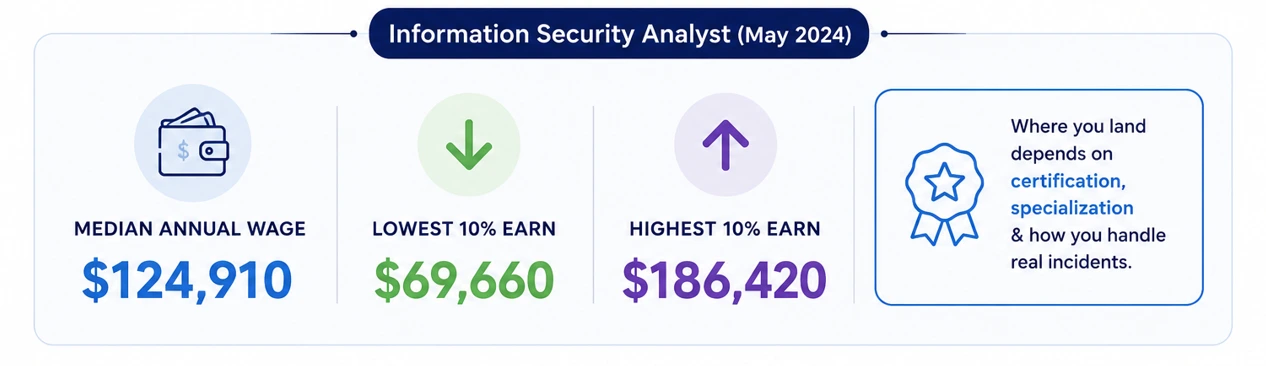
That’s a wide enough range that where a person lands often comes down to certification, specialization, and how well they can talk through a real incident in an interview, not just years on the calendar.
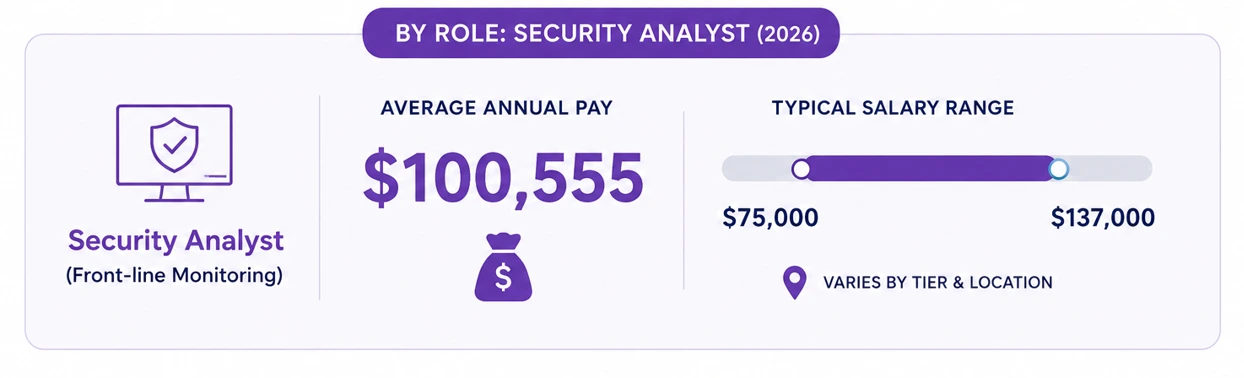
Breaking that down by specific role tells an even clearer story. 2026 salary data puts the average pay for this front-line monitoring role at $100,555 a year in the United States, with the typical range running from roughly $75,000 to $137,000 depending on tier and location.
Meanwhile, Glassdoor’s role pay data shows an average of $94,011 a year, which climbs noticeably once someone adds regulatory-specific credentials like CISA or CRISC on top of a base security background. What actually moves individual pay up within these bands isn’t tenure alone — it’s demonstrated ability.
Someone working the front lines of a SOC who can walk an interviewer through real log data, explain how they’d triage a SIEM alert at 2 a.m., or describe how they’ve supported an audit from the regulatory side tends to out-earn a peer with the same years of experience but no security analyst certification and no concrete story to tell.
Where the Real ROI Hides: Log Analysis, Security Operations, and Beyond?
This is the part most cost-versus-salary comparisons skip entirely, and it’s the part I think matters most. A security analyst certification doesn’t pay for itself because of the letters after someone’s name.
It pays for itself because of what those letters force a person to actually learn — and because it gets a resume past filters that automatically reject candidates without a recognized credential, regardless of how capable they might genuinely be.
Take log analysis as an example. Nearly every entry-level and mid-level role in this field, whether it’s SOC-focused or compliance-focused, requires comfort digging through logs to spot anomalies, trace an intrusion, or reconstruct a timeline after an incident.
Certification study material forces structured practice with this skill well before a first day on the job, which shortens the ramp-up period and makes a new hire useful faster. Hiring managers notice that, and it shows up in starting offers.
The same logic applies to security operations more broadly. Modern SOC teams run on a tiered structure, and understanding how alerts escalate from Tier 1 triage to Tier 2 investigation to Tier 3 threat hunting is exactly the kind of structural knowledge that certification training maps out clearly.
Someone who walks into an interview already fluent in how a monitoring team actually functions, rather than learning it reactively on the job, tends to get placed higher on the pay band from day one rather than needing a raise to catch up later.
SOC Analyst vs Compliance Analyst: Two Different Certification Paths
One mistake I see often is people treating “security certification” as one single track, when in reality the field splits into a few distinct lanes fairly early on.
- The technical monitoring lane leads toward frontline SOC work, where CompTIA Security+ followed by CySA+ builds a strong technical foundation focused on detection, log analysis, and incident response.
- The governance and audit lane leads toward regulatory and audit-focused work, where certifications like CISA or CRISC matter more than deep technical depth, since the job leans on frameworks, controls, and regulatory reporting rather than hands-on threat hunting.
- The generalist leadership lane eventually points toward CISSP, which works well for analysts aiming to move into management or architecture roles rather than staying purely hands-on.
- The specialist lane covers niche paths like cloud security or penetration testing, where narrower certifications pay off once someone already has a security analyst certification as a foundation.
- The compliance-adjacent hybrid lane is growing fastest in 2026, blending light technical monitoring with regulatory reporting, which is why some regulatory-focused postings now list Security+ as a preferred, not just a nice-to-have, credential.
Picking the wrong lane early doesn’t waste money exactly, but it does waste time, since study material for a SOC-focused path and a compliance-focused path barely overlaps once you get past the fundamentals.
Common Mistakes People Make When Budgeting for This Move
After watching enough people go through this decision, a few patterns show up again and again. The first mistake is buying the most expensive bootcamp available assuming a higher price guarantees a pass, when in reality a $2,500 course with poor instructor engagement often performs worse than a $200 self-study bundle paired with genuine discipline. Fit matters more than sticker price.
The second mistake is treating the exam fee as the entire budget and skipping practice exams entirely, which leads directly to failed first attempts and an unplanned retake fee that could have been avoided for the cost of a decent practice test bundle.
The third mistake is picking a credential based on what a friend pursued rather than what the target role actually requires. Someone aiming for a regulatory-focused position gains little from spending months memorizing packet-capture techniques meant for a threat-hunting track, just as someone aiming for hands-on monitoring work gains little from a governance-heavy credential built around audit frameworks.
The fourth and most common mistake is underestimating study time. Most people quoting a two-week timeline for something like CISSP haven’t accounted for the fact that the exam tests judgment and scenario-based thinking, not simple recall, which typically takes several months of consistent study to build properly, not a few late nights before the test date.
Avoiding these four mistakes alone tends to close most of the gap between someone who passes on the first attempt and starts a new role within budget, and someone who spends double the money and twice the time chasing the same outcome.
So, Is It Worth It? My Honest Take
Running the actual numbers, a $425 to $750 exam fee against a salary jump that regularly ranges from $10,000 to $30,000 annually is not a close call financially. Even accounting for a bootcamp on the expensive end of that spectrum, most people recover the entire cost within their first three to six months in a certified role.
The bigger risk isn’t overspending on the exam — it’s underinvesting in the study process and walking into an interview able to recite definitions but unable to talk through a real scenario convincingly.
The honest caveat is that a security analyst certification alone rarely gets someone hired without at least some practical exposure, whether that’s a home lab, an internship, or hands-on practice with real tools.
The certification opens the door and justifies the starting number on an offer letter; it’s the practical skill underneath it that keeps someone in the room once they’re there.
A Personal Note
I’ll be honest about something most guides skip: when I first looked at the cost of these exams, it genuinely gave me pause. A few hundred dollars felt like a lot to gamble on a single afternoon exam, especially without a guaranteed job waiting on the other side.
What changed my mind wasn’t a sales pitch — it was watching people I knew personally go from stuck, underpaid IT support roles to genuinely stable security careers within a year of getting certified, simply because the credential gave them a reason to be taken seriously in that first interview.
If you’re on the fence, my honest advice is this: budget for the exam and for real study time, not just one or the other, and treat the certification as the starting line rather than the finish line.
Sources referenced:
- U.S. Bureau of Labor Statistics — Occupational Outlook Handbook: Information Security Analysts
- Glassdoor — SOC Analyst: Average Salary & Pay Trends 2026
- Glassdoor — Compliance Analyst: Average Salary & Pay Trends 2026
- CertEmpire — CompTIA Security+ Certification Cost 2026: Full Breakdown