Here is a number that stopped me mid-scroll a few weeks ago: certified cloud architects are now out-earning plenty of senior engineers who have been coding for a decade longer than them.
According to the Frontline 2026 report, the Google Professional Cloud Architect certification now tops the charts at $175,000 to $200,000 a year, ahead of almost every other IT credential on the market. That is not a fluke. It reflects how fast companies are moving workloads to the cloud without enough trained people to secure them properly.
If someone is trying to figure out which of the many cloud security certifications actually deserves their time and money this year, this guide walks through the ones worth pursuing, what they cost in real effort, and how they translate into an actual paycheck.
Why Do Cloud Security Certifications Matter So Much Right Now?
It helps to understand the backdrop first. Almost every company, from small retailers to hospital networks, has shifted core systems onto AWS, Azure, or Google Cloud over the last few years, and most of them did it faster than their security teams could keep up.
The 2026 overview notes that organizations are migrating legacy workloads and adopting multi-cloud strategies while folding automation into nearly every business unit, and that security-focused cloud credentials are seeing incredible demand as a direct result.
That single trend is why cloud security certifications have quietly become some of the most valuable papers any IT professional can hold. Employers are not just looking for people who understand cloud jobs in general; they specifically want people who can prove, on paper, that they know how to lock these environments down.
The pay reflects that scarcity. Frontline Source Group also points out that IT professionals holding a top-tier certification earn roughly 25 percent more than uncertified peers doing similar work, and cloud-focused security roles sit right at the top of that list alongside the CISSP, which itself commands $130,000 or more in starting pay.
The Cloud Jobs Market Right Now
Anyone scanning job boards this year has probably noticed the same pattern: cloud skills show up in nearly every serious tech posting, security or not. Research in 2026 found that cloud now ranks as the second most in-demand skill on LinkedIn, and that roughly 80 percent of cloud job postings specifically call out AWS certifications as a requirement or strong preference.
That is a striking number for anyone weighing which credential to chase first, since it means a huge share of cloud jobs simply will not get a serious look without at least one recognized cloud credential attached to the resume.
This is also where the AWS Cloud Practitioner certification earns its reputation as the most sensible starting point for beginners. It does not require deep technical experience, it takes a matter of weeks to prepare properly, and it gives someone enough working vocabulary to hold a real conversation about cloud architecture in an interview.
Plenty of people who eventually specialize in security start here, treating the AWS Cloud Practitioner exam as the on-ramp before layering on more advanced, security-specific credentials later.
Top Cloud Security Certifications Worth Pursuing
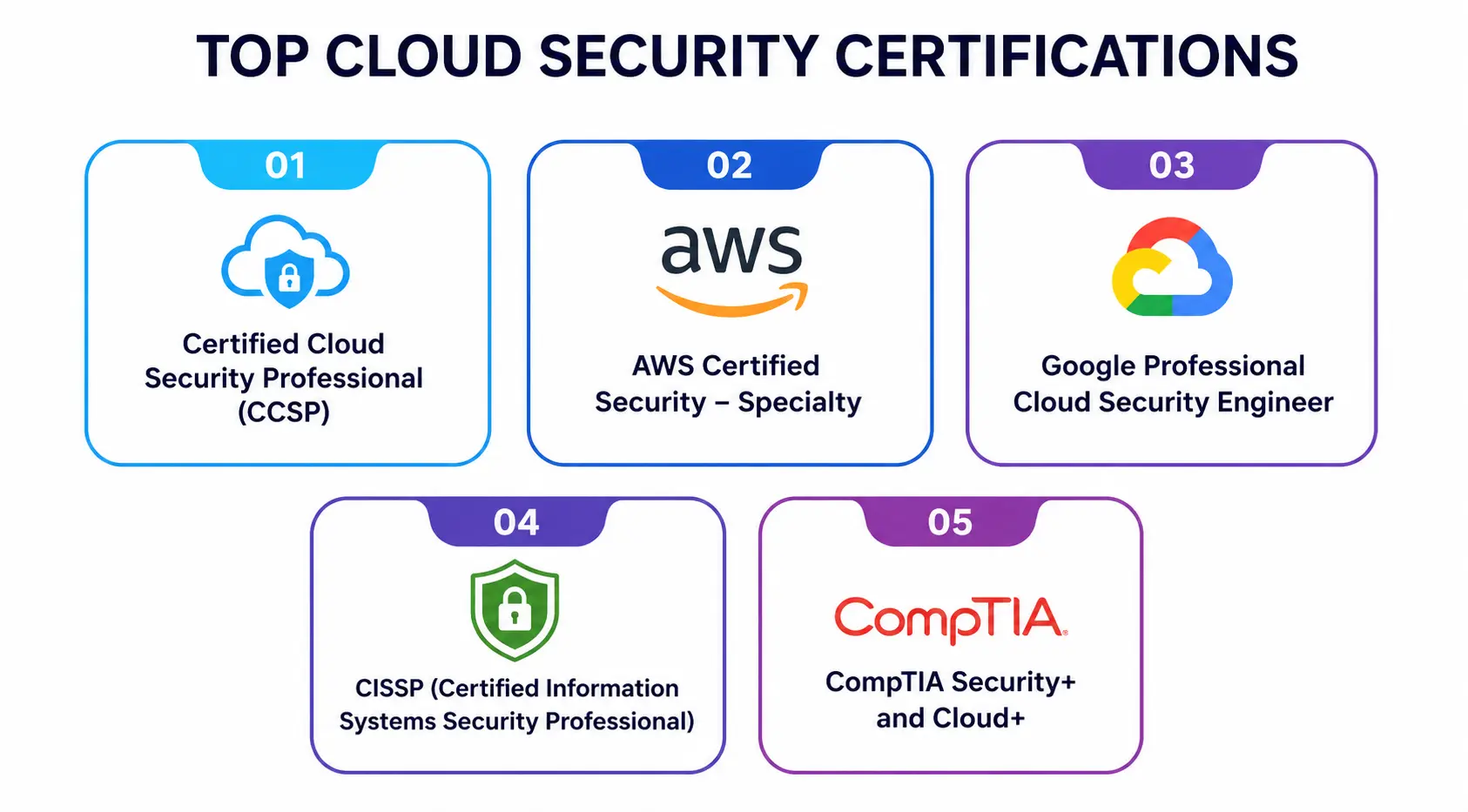
1. Certified Cloud Security Professional (CCSP)
Issued by ISC2, the CCSP is built for professionals who already have real security experience and want to formalize it around cloud environments specifically. ISC2’s CCSP salary data shows that holders consistently report strong compensation, and more recent 2026 tracking puts the median US base salary for CCSP holders between roughly $130,000 and $155,000, climbing higher when paired with a CISSP.
The exam covers six domains, including cloud data security, cloud platform and infrastructure security, and legal and compliance, which makes it one of the more thorough tests of genuine security expertise in this space rather than a quick vendor-specific badge.
Pay for this credential also varies quite a bit by region, which is worth knowing before comparing offers across borders. In North America, CCSP holders typically earn $130,000 to $180,000 or more depending on role and seniority, while in the UK and Western Europe the equivalent range sits closer to €90,000 to €140,000.
Anyone weighing a remote role or a relocation should factor that gap in early, since the same credential can land very differently depending on where the paycheck is issued.
2. AWS Certified Security – Specialty
This is the natural next step for anyone who has already worked hands-on inside AWS and wants to prove they can secure it at a specialist level. It covers incident response, logging and monitoring, infrastructure security, identity and access management, and data protection controls specific to AWS services.
Because it demands real production experience rather than textbook memorization, it tends to carry serious weight with hiring managers who are actually building out security operations teams.
3. Google Professional Cloud Security Engineer
For anyone working primarily inside Google Cloud environments, this certification validates the ability to design and implement secure infrastructure, manage identity and access, and handle data protection requirements across GCP services.
It pairs naturally with the broader Google Professional Cloud Architect credential, which currently sits at the very top of the salary charts industry-wide.
4. CISSP (Certified Information Systems Security Professional)
The CISSP is not cloud-specific, but it remains the anchor credential for anyone building a long-term security career, and it is frequently required or preferred for senior cloud security roles.
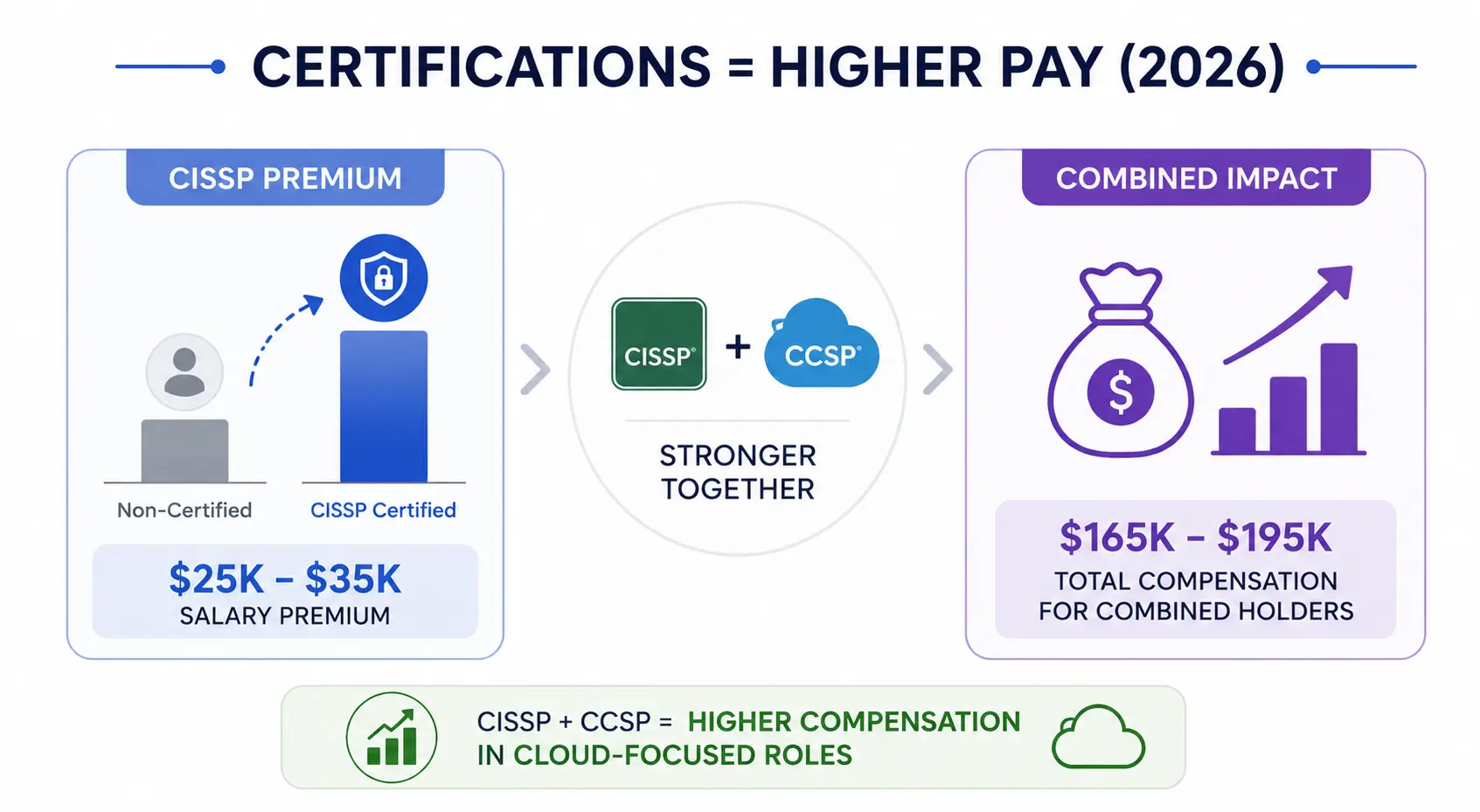
Multiple 2026 salary breakdowns show CISSP commanding a $25,000 to $35,000 premium over non-certified peers, and pairing it with a cloud-specific credential like the CCSP tends to push total compensation meaningfully higher still, sometimes into the $165,000 to $195,000 range for combined credential holders in cloud-heavy organizations.
5. CompTIA Security+ and Cloud+
For people earlier in their careers, CompTIA’s Security+ remains one of the most widely recognized entry points into security work generally, while Cloud+ adds a layer of cloud-specific knowledge without requiring years of prior experience.
Neither carries the salary ceiling of the specialist credentials above, but both are genuinely useful stepping stones for a cloud engineer who wants to pivot toward security work without committing to a multi-year study plan first.
Cloud Security Certifications at a Glance
|
Certification |
Issuing Body | Best Suited For |
Typical 2026 Salary Range (USD) |
| AWS | Absolute beginners, non-technical roles |
$65,000 – $95,000 |
|
|
CompTIA Security+ |
CompTIA | Entry-level security generalists |
$73,000 – $120,000 |
|
AWS Certified Security – Specialty |
AWS | Experienced AWS practitioners |
$120,000 – $160,000 |
|
Google Professional Cloud Security Engineer |
Google Cloud | GCP-focused security specialists |
$125,000 – $165,000 |
|
CCSP |
ISC2 | Experienced professionals moving into cloud security leadership |
$130,000 – $180,000+ |
|
CISSP (paired with CCSP) |
ISC2 | Senior architects and security directors |
$165,000 – $195,000+ |
How to Choose the Right Certification for Your Path?
Picking from this list should not come down to whichever name looks most impressive on LinkedIn. Plenty of people pick a certification because a friend mentioned it, then spend months studying for a credential that has almost no relevance to the platform their target employer actually runs on. A few honest questions tend to narrow things down far more reliably.
- Which cloud platform does the target employer actually run on? A resume full of Azure knowledge does very little good at a company running entirely on AWS, so it pays to check job postings in the target market before committing months of study to one vendor’s ecosystem.
- Is the goal to build security expertise from scratch, or to formalize experience already gained on the job? The CCSP and AWS Certified Security – Specialty both expect real prior exposure, while the entry-level AWS credential and Security+ are built for people starting fresh.
- How much hands-on lab time is realistically available each week? The more advanced, scenario-heavy exams reward candidates who have actually configured security controls and monitored live environments, not just memorized flashcards.
- Does the target role sit closer to security operations or to architecture and governance? Operations-heavy roles tend to value AWS Certified Security – Specialty and Google Professional Cloud Security Engineer, while governance and leadership tracks lean toward CCSP and CISSP.
Building Real Security Expertise Beyond the Exam
A certificate alone rarely closes the gap between passing an exam and actually protecting a cloud environment. The professionals who get hired fastest tend to pair their credentials with a home lab, a handful of documented projects, and genuine comfort discussing data protection controls, identity management, and incident response in plain language during an interview.
Sunset Learning Institute makes a similar point, noting that cloud certifications correlate with higher salaries and faster promotions specifically when paired with demonstrated hands-on ability, not the certificate in isolation.
Building genuine security operations experience also means getting comfortable with the tools employers actually use day to day, things like cloud-native logging dashboards, automated alerting, and access reviews, rather than only studying exam objectives.
Recruiters and hiring managers can usually tell within a few interview questions whether someone has actually run these systems in a live environment or only read about them, and that distinction matters more than which cloud security certifications happen to be listed at the top of a resume.
Conclusion
The market for cloud security certifications in 2026 rewards people who combine the right credential with real hands-on ability, rather than chasing every acronym available. Starting with an approachable entry-level cloud credential, then layering on a specialist certification such as the CCSP or AWS Certified Security – Specialty, gives most people a realistic two-to-three-year path toward six-figure cloud security work.
Whichever certification gets chosen first, the honest advice stays the same: pick the one that matches the cloud platform actually being used at work, keep building genuine, provable expertise alongside it, and let the paycheck catch up to the skill rather than the other way around.
A personal note
I have spent enough time around hiring managers and recruiters in this space to say this plainly: a certificate opens the door, but it will not carry a conversation on its own. The people I have watched land strong cloud security offers were the ones who could talk through a real misconfiguration they had found and fixed, not just recite exam objectives.
If there is one thing I would tell anyone starting this path today, it is to build something alongside the studying, even a small home lab, because that is usually what makes an interview memorable.