
Tech companies are laying off thousands and hiring frantically at the same time—here is what that actually means for your career.
Open any news site right now, and you will see two opposite stories. One says companies are cutting thousands of tech jobs. The other says companies cannot find enough qualified tech workers. Both are true at the same time.
That sounds confusing, but it makes sense once you understand what is actually happening. Companies are not cutting tech jobs because tech stopped mattering. They are cutting specific roles that AI and automation can now handle, and they are desperately hiring for other roles that humans still need to fill—especially in areas that are new, specialized, or hard to automate.
If you are worried about your IT career, or you are trying to figure out where to focus your learning, this is the guide you need. We looked at what employers are actually paying for in 2026, and the picture is clear.
The numbers paint a strange picture. More than 90% of organizations say they are already feeling the hit from IT skills shortages. The BLS is projecting around 317,000 new IT job openings every year through 2034. Cybersecurity alone is set to grow 33% through 2033. And the productivity that companies are losing because they cannot find the right tech talent? Analysts put that figure at $5.5 trillion. That is not a market in decline. That is a market with a very specific problem—the wrong people are being let go, and the right people are nowhere near enough.
Why Are Layoffs and Skill Shortages Happening at the Same Time?
This is the question everyone is asking. The short answer is that not all IT jobs are the same. Some roles—basic support, routine coding, and generic project coordination—are being replaced or reduced because AI tools can do parts of that work. But highly specialized roles in areas like cybersecurity, cloud architecture, and AI engineering are in fierce demand because there simply are not enough qualified people to fill them.
Even companies that have announced layoffs are hiring at the same time for different roles. A well-known enterprise software company cut over 1,600 positions earlier this year while announcing plans to hire 800 AI-focused roles. That is not a contradiction. That is a market shifting its priorities very fast.
The result is that if you have the right skills, you are in an extremely strong position. If you are holding on to older, generalist skills without updating them, things get harder. And that is the real story here—companies are not firing people because they need less technology. They are firing people because the type of technology skills they need has shifted faster than anyone had time to prepare for.
The IT Skills That Are Actually Growing Right Now
Here are the areas seeing the strongest demand in 2026, backed by hiring data, salary reports, and workforce research.
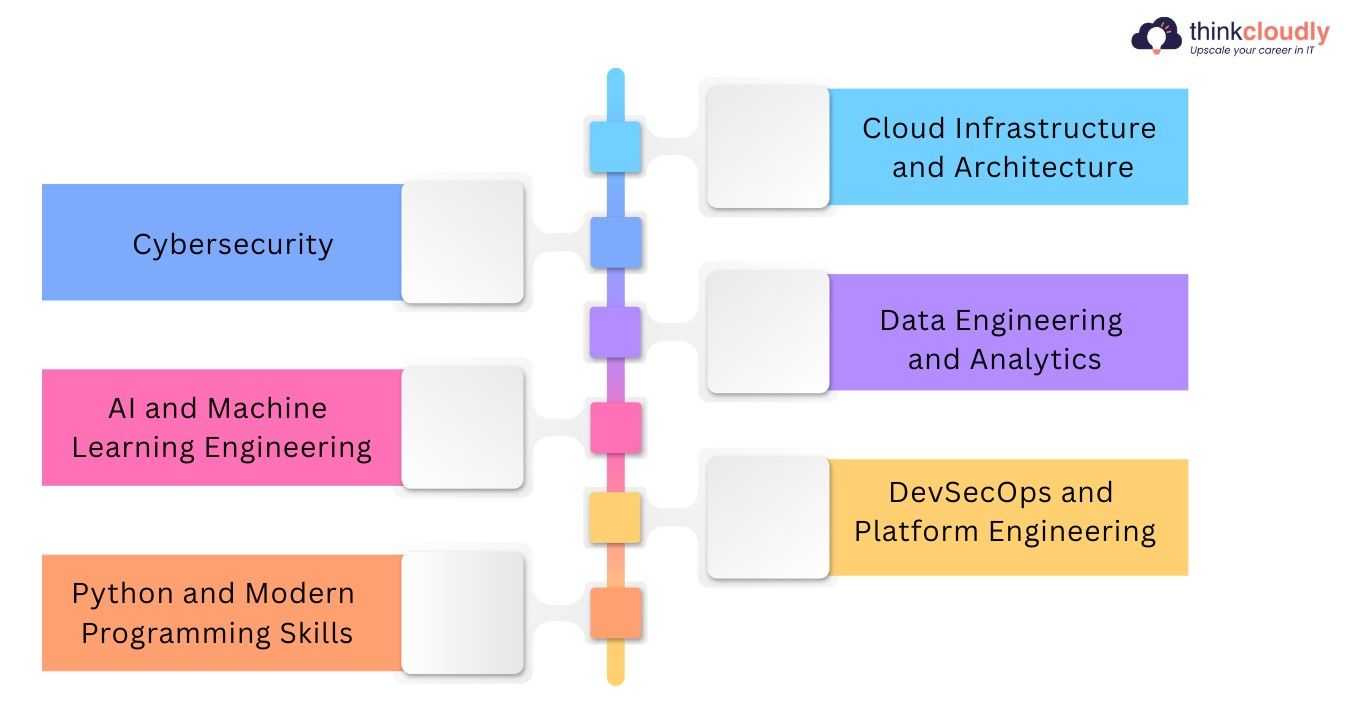
1. Cybersecurity
Cybersecurity is the one that keeps moving regardless of what the economy does. Attackers do not take breaks during downturns. If anything, a shaky economy gives bad actors more reasons to strike—and companies fewer excuses to ignore their defenses. Every company moving to cloud infrastructure, expanding digital services, or adopting AI tools is creating a larger attack surface. And they need people who can protect it.
The Bureau of Labor Statistics projects 33% growth in cybersecurity analyst roles through 2033, which is several times faster than the average for all jobs. There are currently only around 5.5 million trained cybersecurity professionals globally, against a need for over 10 million. That gap is not closing anytime soon.
The highest-demand specializations inside cybersecurity right now include cloud security engineering, identity and access management, DevSecOps, AI security, and penetration testing. Salaries at the mid-level range from around $107,000 to $130,000 annually in the US, with senior roles regularly crossing $150,000.
2. Cloud Infrastructure and Architecture
Companies have not hit the brakes on the cloud—not even close. The push away from on-premise servers has been going on for years, and right now it is picking up speed rather than flattening out. The catch is that running cloud environments properly, especially when a business splits its workload across AWS, Azure, and Google Cloud all at once, is genuinely complicated. You cannot hand that work to someone who just passed a one-week course.
Cloud engineers, cloud security architects, and SREs are pulling some of the highest paychecks in IT right now in 2026, and the reason is simple—there are not enough of them.
The demand is being driven by companies accelerating their digital infrastructure work and by the fact that cloud mistakes are extremely costly, which means they want experienced people, not beginners.
3. AI and Machine Learning Engineering
AI is reshaping every part of the tech world, but here is the part that often gets missed — it is creating more IT jobs than it is eliminating, at least for people with the right expertise. AI engineers, MLOps (machine learning operations) specialists, and AI safety researchers are in very high demand.
Dedicated AI roles are up 81% year-on-year according to CompTIA’s State of the Tech Workforce 2026 report. These roles tend to sit inside large enterprises and require a strong background in both software engineering and data science. AI is not replacing these jobs. It is creating them.
4. Data Engineering and Analytics
Data is only valuable if someone can manage, structure, and make sense of it. Data engineers build the pipelines that move data from one place to another. Data analysts find the patterns that help companies make decisions. Both roles are in high demand across nearly every industry—not just tech.
The CompTIA report projects 414% growth for data scientists and analysts over the next decade, which is the highest figure for any tech job category. Companies in healthcare, finance, retail, and government are all hiring for these skills, which gives data professionals an unusually wide range of employer options.
5. Python and Modern Programming Skills
At this point, Python is everywhere—data work, AI tooling, automation scripts, and backend pipelines. It has quietly become the language that sits underneath most of what companies are building right now. That said, just listing Python on your resume is not going to do much. Generic dev roles are crowded, and hiring managers can spot someone who learned the syntax without actually using it in a real project.
Where things get interesting is when Python fluency stacks on top of something else—say, data engineering experience or hands-on ML work. That combination is legitimately hard for companies to hire for, and the salary reflects it.
6. DevSecOps and Platform Engineering
For a long time, the standard approach was simple: developers write the code, and security people check it later. That model broke down as release cycles got faster and the cost of fixing vulnerabilities after deployment went through the roof. DevSecOps came out of that frustration—it is essentially the recognition that security cannot be an afterthought anymore.
Platform engineering is a similar story. These are the people keeping internal developer tools and infrastructure actually running, and their work sits in that awkward middle ground that is hard to script away. You need someone who understands both the software and the systems underneath it—and that mix is still rare.
Growing IT Skills in 2026
|
Skill Area |
Demand Level |
Salary Range (US, Mid-level) |
Growth Outlook |
|
Cybersecurity |
Very High |
$107K – $150K+ |
33% through 2033 (BLS) |
|
Cloud Infrastructure |
Very High |
$110K – $160K+ |
Fastest-growing cloud segment |
|
AI / ML Engineering |
Very High |
$120K – $180K+ (Splunk 2026 IT and Technology Salary Guide) |
Roles up 81% YoY (CompTIA 2026) |
|
Data Engineering |
Very High |
$105K – $145K |
414% projected growth over 10 yrs |
|
Python + Automation |
High |
$95K – $130K |
Strong across all tech sectors |
|
DevSecOps |
Very High |
$115K – $155K |
Rising with cloud adoption |
What This Means If You Are Trying to Build a Career in IT
The message from the data is consistent. Broad, generalist tech skills without a clear specialization are harder to sell in this market. Specific, hard-to-find expertise in the areas above commands more money and more job security than ever.
This does not mean you need to spend three years getting a computer science degree to switch careers. Employers—particularly in cybersecurity and cloud—have shifted what they look at. A strong GitHub portfolio, a real-world project, or a recognized cert can carry as much weight as a degree on a resume. The conversation in hiring has moved from “where did you study” to “show me what you built.” That is a meaningful change, and it matters for anyone switching fields right now.
For people already working in IT, the clearest move is to add a specialization rather than stay broadly skilled. Think about it from a hiring manager’s perspective. Two candidates—one generalist and one who added a specific skill on top of their existing experience. The second one is easier to place, easier to justify, and usually gets the offer. That is the market reality right now, and it is not subtle.
The Skills That Are Losing Ground
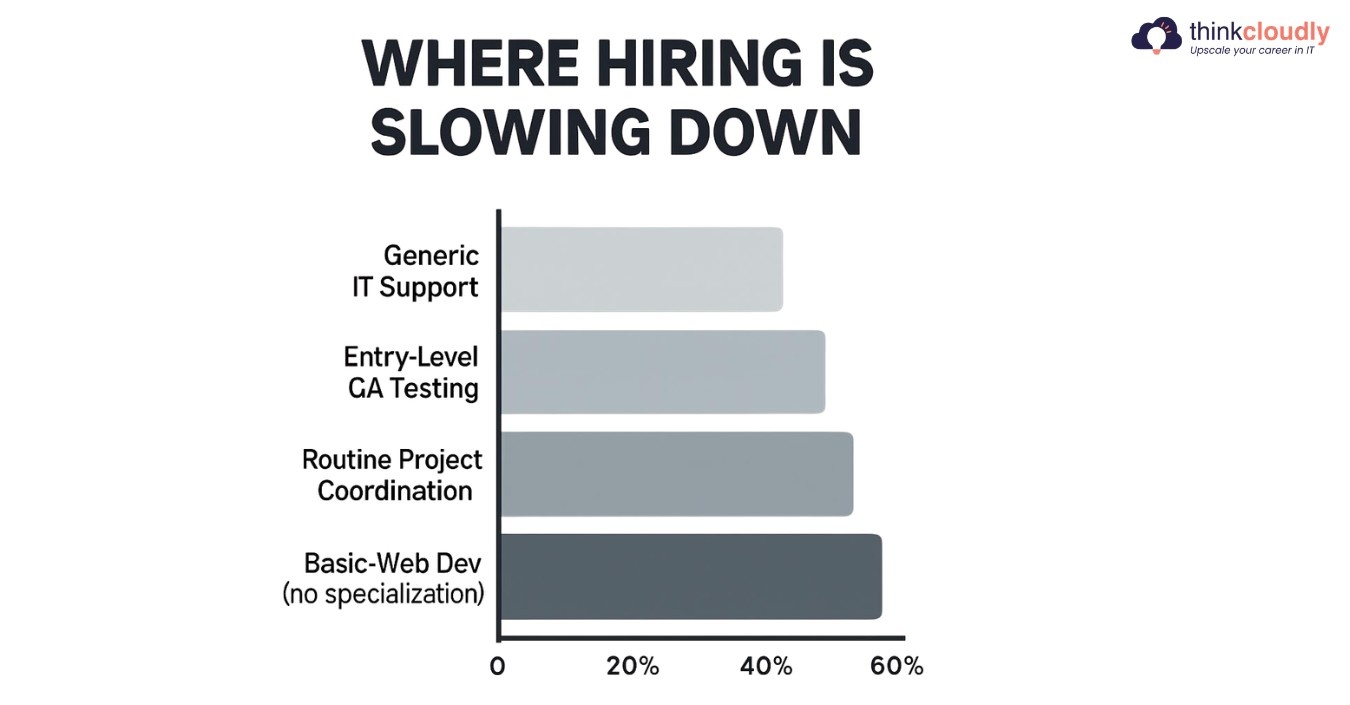
It is just as useful to know what not to invest your time in. Generic technical support, basic web development without a modern framework, routine project coordination, and entry-level QA testing are all seeing the sharpest declines. According to CompTIA’s 2026 workforce data, generalist IT support roles saw the steepest year-over-year drop in job postings among all tech categories—down significantly even as total tech employment rose. Entry-level QA has faced similar pressure as automated testing tools absorb routine test case execution.
The pattern across declining roles is consistent: wherever the work is procedural, repeatable, and well-documented enough for AI to follow, hiring has slowed or stopped. What that means practically is that being in one of these roles is not a dead end, but it is a starting line, not a destination. The clearest path is to layer a specialization on top of existing experience rather than wait for conditions to reverse. The roles that are shrinking are not coming back in the same form.
How Long Does It Actually Take to Build These Skills?
This is the question most people are afraid to ask, because they assume the answer is “years.” The truth is more nuanced. Certifications in cybersecurity, like CompTIA Security+, can be completed in a few months of focused study. Entry-level data analytics roles in markets like the US, UK, Canada, and Australia are being filled by people who trained for six to twelve months through structured programs — no prior IT background required in many cases.
Senior and specialized roles do take longer to reach, and employers at that level want to see real experience — not just credentials. The barrier to entry has genuinely dropped. Hiring managers who were strict about degree requirements five years ago are now reviewing portfolios and certification records instead. What changed is that the talent gap got large enough that companies stopped having the luxury of being selective about how someone learned, only about whether they could perform.
Here is the honest reality — the people who are going to be well-positioned when hiring picks back up are the ones already building skills right now, not the ones watching and waiting for certainty. The gap between what companies need and what is available has been wide for years. It is not closing fast enough to make waiting a smart strategy.
Sources & References
- CompTIA – State of the Tech Workforce 2026
“After a modest dip in 2025, the tech workforce is expected to expand again in 2026. Net tech employment in the US is currently projected to increase by 1.9% to hit 9.8 million.”- Used in sections on overall market outlook and AI role growth.
- Bureau of Labor Statistics – Occupational Outlook Handbook
“317,700 annual openings across computer and IT occupations through 2034” and “33% growth for information security analysts from 2024 to 2034.”- Used in cybersecurity and overall job growth sections.
- Robert Half – Demand for Skilled Talent / 2026 Salary Guide
“87% of technology leaders feel confident about their business outlook for 2026, and 61% plan to increase permanent headcount in the first half of the year.”- Used in the hiring outlook section.
- ISC2 – Cybersecurity Workforce Study 2025
“The total workforce needed is 10.2 million against a current base of 5.5 million.” ISC2 also reports AI/ML and cloud security as the top two skill demands in 2026.- Used in the cybersecurity skills shortage section.
- TechTarget / Interview Query – 2026 Tech Job Market Outlook
“More than 90% of organizations say IT skills shortages will affect them by 2026, with an estimated $5.5 trillion in lost productivity tied to the gap.”- Used in the opening statistics section.
- Splunk – 2026 IT and Technology Salary Guide
“Overall IT salaries are shaped by a mixed market where baseline roles face slow growth while specialized skills — especially in AI, cloud, and cybersecurity — drive higher compensation.”- Used in salary data and skill segmentation sections
- Motion Recruitment – Cybersecurity Job Market 2026
“Information security analysts and engineers both saw significant gains, with each profession seeing 4.7% raises on average.”- Used in salary growth data for cybersecurity roles.
- Tech-Insider.org – Tech Layoffs 2026: AI Workforce Impact
Context on companies simultaneously cutting and hiring for different roles, including the cited enterprise software company example.- Used in the layoffs vs. hiring paradox section.