

If you’re a student or fresher trying to figure out which IT skills to actually focus on, this blog will save you a lot of confusion.
Because here’s the thing—not all “hot skills” are equal. Some skills show up in almost every job description. Others sound exciting but appear in only a small fraction of postings. If you spend a year learning the wrong skill, you’ll have a tough time finding a job. If you learn the right one, opportunities open up everywhere.
To figure out what really matters in 2026, I went through the latest hiring data—including Dice’s May 2026 US Tech Job Market Report (released just days ago), CompTIA’s State of the Tech Workforce 2026, Indeed’s hiring trends, Robert Half’s 2026 salary research, and CIO Magazine’s analysis of millions of recent job postings.
The numbers were clear. Five specific IT skills appear in most 2026 job postings — far more than any others. These aren’t “trending” skills you might need someday. These are the skills companies are demanding right now, this week, in real job descriptions.
Let’s break them down in plain English, with real numbers, salaries, and how you can start learning each one today.
Quick Look: The 5 IT Skills Showing Up Most in 2026 Hiring
Here’s a quick reference table based on data from the latest 2026 reports:
|
IT Skill |
Appearance in 2026 Job Postings | Avg US Salary (2026) |
| AI / Machine Learning | 71% of tech postings |
$135K–$200K |
|
Python Programming |
~18% of all postings | $100K–$160K |
|
Cloud Skills (AWS, Azure) |
~14% of postings (AWS leads) | $115K–$175K |
| Data Analysis & SQL | ~21% of postings |
$90K–$145K |
| Cybersecurity | 4%+ direct, 65% include security |
$95K–$175K |
Sources: Dice US Tech Job Market Report (May 2026), CIO Magazine 2026 IT Skills analysis (Indeed data); CompTIA State of the Tech Workforce 2026; and Robert Half 2026 Salary Guide.
Now let’s understand what each of these skills actually means, why employers keep asking for them, and how you can start learning them—even if you’re a complete beginner.
1. AI and Machine Learning Skills — Found in 71% of Tech Job Postings
What it is in simple words: AI (artificial intelligence) skills mean knowing how to use, build, or work with tools like ChatGPT, Claude, Copilot, image generators, and AI-powered software. Machine Learning (ML) is the engine behind these tools — it’s the math and code that let computers learn from data.
Why it’s everywhere now: According to Dice’s May 2026 report, AI skill requirements reached 71% of all US tech job postings in April 2026 — up from 67% in March and 61% in February. Year-over-year, that’s a 181% increase from April 2025. AI is no longer a special skill. It has become a baseline expectation for almost every tech role.
Who needs AI skills?
Almost everyone in tech now. AI is showing up in job descriptions for:
- Software developers — using AI to write and check code
- Data analysts — using AI to spot patterns in data
- Marketers — creating content with AI tools
- Customer service roles — building or running AI chatbots
- Even non-technical roles — HR, finance, operations
Salary range
Average US salary: $135,000–$200,000 per year for AI-focused roles. Even non-AI roles that list AI as a skill pay 15–30% more than the same role without AI skills, according to Indeed data. In the UK, AI roles pay £75,000–£140,000. In Germany, €80,000–€130,000.
How to start learning AI
Good news — you don’t need a PhD. Here’s the simple path for beginners:
- Start with prompt engineering — learn how to write clear instructions to AI tools like ChatGPT or Claude. Free courses on deep learning. AI works well. 2 to 4 weeks of practice.
- Learn Python basics if you want to go beyond using AI to build with it. freeCodeCamp’s free Python course is enough to start.
- Try free AI courses from Andrew Ng on Coursera, Google’s AI Essentials, or Microsoft’s AI Fundamentals.
- Build 2 small AI projects — a chatbot for a topic you know or a small tool that summarizes articles. Push them to GitHub.
- Add “AI” to your resume the right way — specify the tools you’ve used (ChatGPT, Claude API, LangChain), not just the word “AI.”
2. Python Programming — The Most In-Demand Language of 2026
What it is in simple words: Python is a programming language used to tell computers what to do. It’s known for being easy to read and write compared to languages like C++ or Java. Almost everything in modern tech — websites, AI tools, data analysis, automation — can be built in Python.
Why it’s everywhere: According to CIO’s 2026 IT skills analysis (based on Indeed data), Python saw a 7 percentage point increase in job postings from 2024 to 2025 — the largest single-year jump for any major programming language. Python now appears in roughly 18% of all tech job postings. It’s also the foundation language for AI, machine learning, and data science — three of the fastest-growing IT fields.
Where Python is used
- AI and machine learning (the standard language)
- Data analysis and data science
- Web development (Django, Flask)
- Automation and scripting
- Scientific computing and research
- Cybersecurity tools and scripts
Salary range
Average US salary: $100,000–$160,000 per year for Python developers. Senior Python engineers at AI-first companies cross $180K. The salary jumps higher when Python is paired with AI/ML, cloud, or data engineering skills.
How to start learning Python
Python is probably the easiest “real” programming language to learn. Plan for 2 to 4 months:
- Start with free interactive courses — freeCodeCamp’s Python course, Codecademy’s free Python tier, or Python.org’s official beginner tutorial.
- Practice small problems daily on HackerRank, LeetCode (Easy section), or Codewars. Even 30 minutes a day adds up fast.
- Build 3 real projects — a budget tracker, a simple web scraper, or a small chatbot. Skip the famous tutorial projects that everyone has done.
- Learn one library deeply — Pandas for data, FastAPI for web, or LangChain for AI. Recruiters love seeing specific library experience.
- Push everything to GitHub with clear README files. Your GitHub becomes your portfolio.
3. Cloud Skills (AWS, Azure, Google Cloud)—Appearing in ~14% of Postings
What it is in simple words: Cloud skills mean knowing how to use online platforms like Amazon Web Services (AWS), Microsoft Azure, or Google Cloud to run, store, and manage software and data. Instead of companies buying their own physical servers, they rent space and computing power from these cloud platforms.
Why it’s everywhere: Nearly every modern company runs on the cloud now. According to CIO’s 2026 analysis, AWS appears in roughly 14% of US tech job postings, Azure in 11%, and Google Cloud in around 5%. The total cloud market is growing at a steady rate, but more importantly, cloud skills are now bundled with AI work — 80% of new generative AI applications in 2026 are deployed on cloud platforms.
What employers want you to know
Cloud skills usually mean comfort with:
- Storage services like Amazon S3 or Azure Blob Storage
- Compute services — virtual machines, container services like Kubernetes
- Networking basics — Virtual Private Clouds (VPCs), security groups
- Identity management — controlling who can access what
- Cost optimization — making cloud usage affordable
Salary range
Average US salary: $115,000–$175,000 per year for cloud engineers. Cloud architects and senior roles can hit $200K+. AWS continues to pay slightly more than Azure for similar roles, while GCP pays the most per certification on average. In the UK, cloud engineers earn £62,000–£85,000. In Germany, €70,000–€95,000.
How to start learning cloud
Most beginners should start with AWS because it has the biggest job market. Plan for 3 to 6 months:
- Create a free AWS account — AWS gives 12 months of free tier access for hands-on practice.
- Get AWS Cloud Practitioner certification first — this is the entry-level cert. Takes 4 to 8 weeks of focused study and costs about $100.
- Move to AWS Solutions Architect Associate — this is the certification recruiters actually look for. Adds 8 to 12 weeks more study.
- Build 2 real cloud projects — host a website using AWS S3 and CloudFront, or build a simple API using AWS Lambda.
- Document everything in your portfolio — architecture diagrams, what you built, and how. This is what gets you interviews.
4. Data Analysis and SQL — In ~21% of All Tech Job Postings
What it is in simple words: Data analysis is the skill of looking at numbers and information to find useful patterns. SQL (Structured Query Language) is the most common tool used to pull data from company databases. Together, these skills help businesses make better decisions — what to sell, where to invest, and how customers behave.
Why it’s everywhere: According to CIO’s 2026 analysis of Indeed data, analytical thinking and data analysis skills appeared in over 21% of US tech job postings — making it one of the most consistently requested skills across all IT roles. Every modern company generates data. Most don’t know how to use it. So they hire people who can.
What data analysis actually means at work
In real jobs, data analysts and analytics-focused roles do things like:
- Write SQL queries to pull data from databases
- Clean and organize messy data
- Create dashboards in tools like Tableau, Power BI, or Looker
- Find trends — for example, why customer signups dropped last week
- Present findings to business teams in plain language
Salary range
Average US salary: $90,000–$145,000 per year for data analysts. Senior data analysts and analytics engineers can hit $170K+. Data engineers (who build the data pipelines) earn $120,000–$185,000. The US Bureau of Labor Statistics projects 34% growth for data science careers over the next decade — far above average.
How to start learning data analysis and SQL
Data analysis is one of the most beginner-friendly high-paying IT paths. Plan for 4 to 6 months:
- Learn SQL first — it’s simpler than people think. Free courses on Mode Analytics, SQLBolt, or Khan Academy work great.
- Practice with real datasets on Kaggle. Pick a topic you care about — sports, movies, finance — and try to answer real questions with data.
- Learn Excel + one BI tool (Power BI is the most in-demand in corporate jobs; Tableau is the most popular for visualizations).
- Add Python basics with the Pandas library — this opens doors to more advanced analyst and data scientist roles.
- Build 3 portfolio projects — show your full process: question, data cleaning, analysis, visualization, and conclusion. Document on GitHub or a personal site.
5. Cybersecurity — Required in Over 65% of Technical Roles
What it is in simple words: Cybersecurity is the skill of protecting computer systems, networks, and data from attacks. In 2026, this includes traditional security work plus the newer task of protecting AI systems from new types of attacks like prompt injection and model poisoning.
Why it’s everywhere: According to industry research, by 2026, 65% of technical job postings include cybersecurity as a core or required skill. Even non-security roles now ask for basic security knowledge — “secure coding practices,” “access management,” or “compliance awareness.” The US faces an estimated 750,000 unfilled cybersecurity positions, while the global gap stands at 3.4 to 4.8 million open jobs (depending on the source). That shortage isn’t closing soon.
Most in-demand cybersecurity roles
- SOC Analyst — monitor security alerts and respond to threats. Common entry-level role.
- Cloud Security Engineer — protect AWS, Azure, or GCP environments. Highest-paying entry path.
- GRC Analyst — Governance, Risk, and Compliance. Great for non-technical career switchers.
- Penetration Tester — ethically hack systems to find weaknesses before real attackers do.
- AI Security Specialist — protect AI models from new types of attacks. Brand new role in 2026.
Salary range
Average US salary: $95,000–$175,000 per year. Senior security architects and cloud security engineers earn $200K+. Entry-level SOC Analyst Tier 1 averages $90,462 in the US (Glassdoor 2026). In the UK, entry cybersecurity pays £42,000–£55,000. In Germany, €55,000–€70,000.
How to start learning cybersecurity
Cybersecurity is one of the most accessible high-paying IT paths because employers care more about certifications and projects than degrees.
Plan for 6 to 9 months:
- Learn the basics first — networking, Linux, and Windows. CompTIA Network+ is the standard foundation.
- Get CompTIA Security+ certification — this single certification opens almost every entry-level door, including US Department of Defence roles.
- Practice on TryHackMe and Hack The Box — these give you real, safe environments to learn hands-on hacking and defence.
- Build a home lab using the free AWS tier or old hardware. Document your projects on GitHub.
- Apply while “underqualified” — if a job description is 60% a match, apply. Most cybersecurity employers in 2026 want Security+ plus a portfolio over a 5-year resume.
Notice the Pattern? Most IT Jobs Need 2 or 3 of These
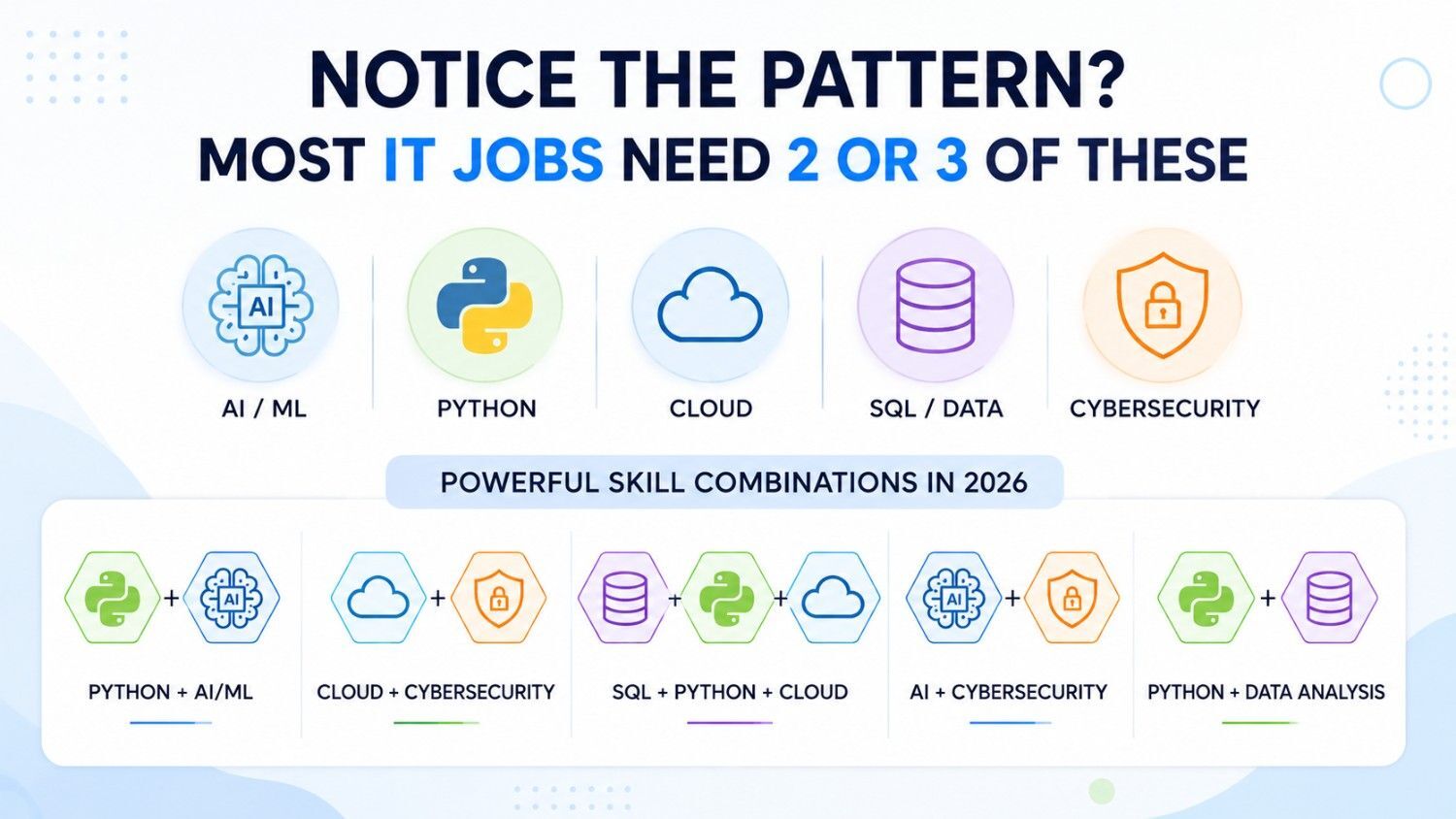
Here’s something important to understand: these five skills don’t exist in isolation. The highest-paid IT jobs in 2026 want you to combine them.
Look at real 2026 job descriptions, and you’ll see patterns like:
- Python + AI/ML — for AI engineer roles paying $150K+
- Cloud + Cybersecurity — for cloud security engineer roles paying $180K+
- SQL + Python + Cloud — for data engineer roles paying $140K+
- AI + Cybersecurity — for the brand-new AI security specialist roles
- Python + Data Analysis — for data analyst and scientist roles paying $100K+
This is great news for students. You don’t need to master all five skills. You need to pick one core skill, get strong at it, and then add a complementary second skill. That combination is what gets you hired.
What Should You Actually Do Next? (Simple 4-Step Plan)
Reading about hiring data is interesting, but it doesn’t change anything unless you act on it. Here’s a simple plan based on where you are right now:
Step 1: Pick one core skill (Week 1). Don’t try to learn all five at once. That’s how people end up learning nothing. Pick one based on your interest: if you like building things, choose Python. If you like infrastructure, choose Cloud. If you like data, choose SQL and data analysis. If you like protecting things, choose Cybersecurity. If you want flexibility, start with AI/prompt engineering.
Step 2: Set a 4- to 6-month focused learning window (Months 1–6). Spend 1 to 2 hours a day learning. Take one quality course, follow it through to completion, and practice daily. Skip switching between courses — finish one before starting another.
Step 3: Build 3 real projects (Months 3–6). Certifications alone are no longer enough. Build something real. A chatbot, a data dashboard, a small web app, a security analysis report — anything that proves you can actually do the work. Push it to GitHub with clear README files.
Step 4: Start applying with a portfolio (Month 6 onwards). Apply to 10 to 15 tailored jobs per week, not 100 generic ones. Use referrals through LinkedIn — referred candidates are 4 times more likely to get hired. Add your second complementary skill while you’re applying. Most people land their first role in 2 to 4 months of focused job hunting.
The Bottom Line
In 2026, the IT job market is doing two things at once. It’s competitive — companies are pickier than ever. And it’s wide open — these five skills are showing up in so many job postings that companies cannot find enough qualified people.
If you’re a student or fresher, that’s the opportunity. The skills employers want are clearly defined. The learning paths are accessible. The salaries are real. The only thing standing between you and your first IT job is consistent effort over 6 to 9 months.
Don’t try to do everything. Pick one of these five skills. Go deep. Build projects. Get one certification if your skill has one. Show your work publicly. Apply smartly with referrals.
People who do exactly this in 2026 are landing $90,000+ jobs at companies they used to think they couldn’t even apply to. The framework is simple. The execution takes patience. The reward is one of the most stable, well-paid careers available today.
The IT field rewards people who pick the right skills and stick with them. These five skills are the right ones for 2026.
Sources & Further Reading
The data and statistics in this article are drawn from the following sources:
- Dice US Tech Job Market Report (May 2026) — 71% of US tech postings require AI skills in April 2026; 181% year-over-year growth; 21% YoY increase in total tech postings
- CIO Magazine 2026 Hottest IT Skills (Indeed Data) — Python largest single-year language growth (7 percentage point increase); data analysis in 21% of postings; cybersecurity demand doubled from 2024 to 2025
- CompTIA State of the Tech Workforce 2026 — 275,000+ active US AI job postings in January 2026; 1.9% projected tech employment growth; median tech wage $112,805
- Robert Half 2026 Demand for Skilled Talent — AI/ML, cybersecurity, and cloud as top 2026 hiring priorities; salary benchmarks for entry to senior roles
- Indeed Hiring Lab Trends — AI-related postings rose from 5% to 9% (2024 to 2025); Python 7 percentage point gain; top 5 fastest-growing tech skills include Python, AWS, APIs, CI/CD, AI
- Cisco AI Workforce Consortium 2025 Report — 78% of ICT roles now include AI technical skills; AI governance demand up 150%; AI ethics demand up 125%
- US Bureau of Labor Statistics Occupational Outlook — 33% growth projection for information security analysts through 2034; 34% growth projection for data science careers
- Glassdoor 2026 Salary Database — SOC Analyst Tier 1 average $90,462; salary benchmarks across IT roles
- Synergy Research Group 2026 Cloud Market Share — AWS 30-32% global cloud market share; Azure 22-23%; Google Cloud 11-13%
- World Economic Forum Future of Jobs Report 2025 — 39% of skill sets will be transformed or outdated by 2030; AI and big data top fastest-growing skills globally
- Lightcast Generative AI Job Market Analysis—Generative AI postings grew from 55 (Jan 2021) to ~10,000 (May 2025); 51% of AI postings now outside core IT roles
- LinkedIn Economic Graph — Multi-cloud salary premium of 18-25% for engineers with two complementary skills; referred candidates 4x more likely to get hired
All data verified as of May 2026. AI skills statistics and job posting percentages reflect Q1-Q2 2026 reports from leading job market research firms.