
Most people assume that if you know one cloud platform well, you know enough. Learn AWS, get certified, land a job, done. That thinking made sense five years ago. In 2026, it is leaving a significant amount of money on the table.
There is a specific type of cloud professional who is commanding salaries roughly 35% higher than their single-platform peers. They are not necessarily more experienced. They do not always have more certifications. What they have is the ability to work fluently across more than one cloud platform at the same time, and organizations are paying a serious premium for exactly that skill.
Here is the full story of why that gap exists, what it actually means in practice, and what it takes to be on the right side of it.
The World Ran Toward the Cloud and Then Complicated It
When enterprises first moved to the cloud, most of them picked one platform. AWS was the dominant choice. Microsoft Azure made sense for organizations already running on Microsoft infrastructure. Google Cloud attracted data and analytics-heavy teams. The logic was straightforward: pick one, go deep, keep it simple.
That simplicity did not last. As businesses grew, merged with other companies, acquired new divisions, and expanded into new markets, their cloud environments grew with them. A company that started on AWS might acquire a business running entirely on Azure. A legal requirement in a specific country might mean certain data has to stay on a particular platform. A specific AI capability available only on Google Cloud might become strategically essential.
By 2026, the majority of large enterprises are not running on one cloud. They are running on two, three, or sometimes more, simultaneously. Surveys consistently show that more than 85% of enterprises now operate in multi-cloud environments. The question for these organizations is no longer which cloud to use. It is how to manage all of them together without everything becoming an expensive, unmanageable mess.
That question requires a specific kind of engineer, and there are not enough of them.
What a Multi-Cloud Engineer Actually Does
The term gets thrown around loosely, so it is worth being precise about what this role actually involves day to day.
A multi-cloud engineer does not just have certifications on multiple platforms. Anyone can collect badges. What they actually do is design, build, and maintain infrastructure that runs across different cloud environments in a way that is coherent, secure, cost-effective, and reliable.
In practice this means understanding the architecture of AWS, Azure, and Google Cloud well enough to make intelligent decisions about which workload belongs on which platform. It means writing infrastructure code that provisions resources consistently regardless of which cloud it is deploying to. It means understanding how to move data between platforms without creating security gaps or compliance violations. It means knowing how to monitor the health and cost of all of it from a unified perspective.
It also means being the person in the room who can translate between teams that have grown up on different platforms and do not naturally speak the same technical language. That translation ability, technical and human simultaneously, is rarer than any certification suggests.
Why the Salary Premium Is So Significant
The 35% salary premium that multi-cloud engineers command over single-cloud specialists in 2026 comes down to three interlocking factors: scarcity, complexity, and business risk.
On scarcity: learning one cloud platform deeply takes years. Learning two or three deeply enough to architect across all of them takes considerably longer. The pool of engineers who have genuinely done this work, not just studied it, is small and is not growing fast enough to meet demand.
On complexity: multi-cloud environments are harder to manage than single-cloud ones in ways that are not obvious until you are inside them. Networking between clouds, unified identity and access management, consistent security policy enforcement, and cost visibility across platforms are all genuinely difficult problems that require specialized knowledge.
On business risk: when a multi-cloud environment breaks or is poorly designed, the consequences are severe. Outages affect more systems. Security gaps span more platforms. Cost overruns are harder to detect and correct. Organizations pay more for engineers they trust to prevent those scenarios because the cost of getting it wrong is so much higher than the salary difference.
What the Numbers Actually Look Like
Here is where the salary gap becomes concrete:
Single-Cloud vs. Multi-Cloud Engineer Salaries (US, 2026)
|
Role |
Single-Cloud Salary Range | Multi-Cloud Salary Range |
Premium |
|
Cloud Engineer |
$110,000 to $140,000 | $145,000 to $190,000 |
32 to 36% |
|
Cloud Architect |
$150,000 to $185,000 | $200,000 to $250,000 |
33 to 35% |
|
Cloud DevOps Engineer |
$125,000 to $160,000 | $165,000 to $215,000 |
32 to 34% |
|
Cloud Security Engineer |
$135,000 to $170,000 | $180,000 to $230,000 |
33 to 35% |
|
Cloud Data Engineer |
$120,000 to $155,000 | $160,000 to $205,000 |
33 to 35% |
|
FinOps Specialist |
$115,000 to $145,000 | $155,000 to $195,000 |
34 to 35% |
|
Cloud Platform Engineer |
$120,000 to $150,000 | $160,000 to $200,000 |
33 to 35% |
The gap is consistent across every role type. It is not a quirk of one specialism or one corner of the market. It reflects a structural supply and demand imbalance that is present across the entire cloud engineering profession.
What is also worth noting is where these roles are being filled. It is not just at technology companies. Banks, insurance firms, hospital networks, retail chains, and government agencies are all building multi-cloud capability into their operations, which means the demand is spread across virtually every sector of the economy.
The Three Platforms Every Multi-Cloud Engineer Needs to Understand
Not all cloud knowledge is created equal when it comes to multi-cloud work. The three platforms that matter most, and that appear most frequently in multi-cloud job requirements, are AWS, Microsoft Azure, and Google Cloud Platform.
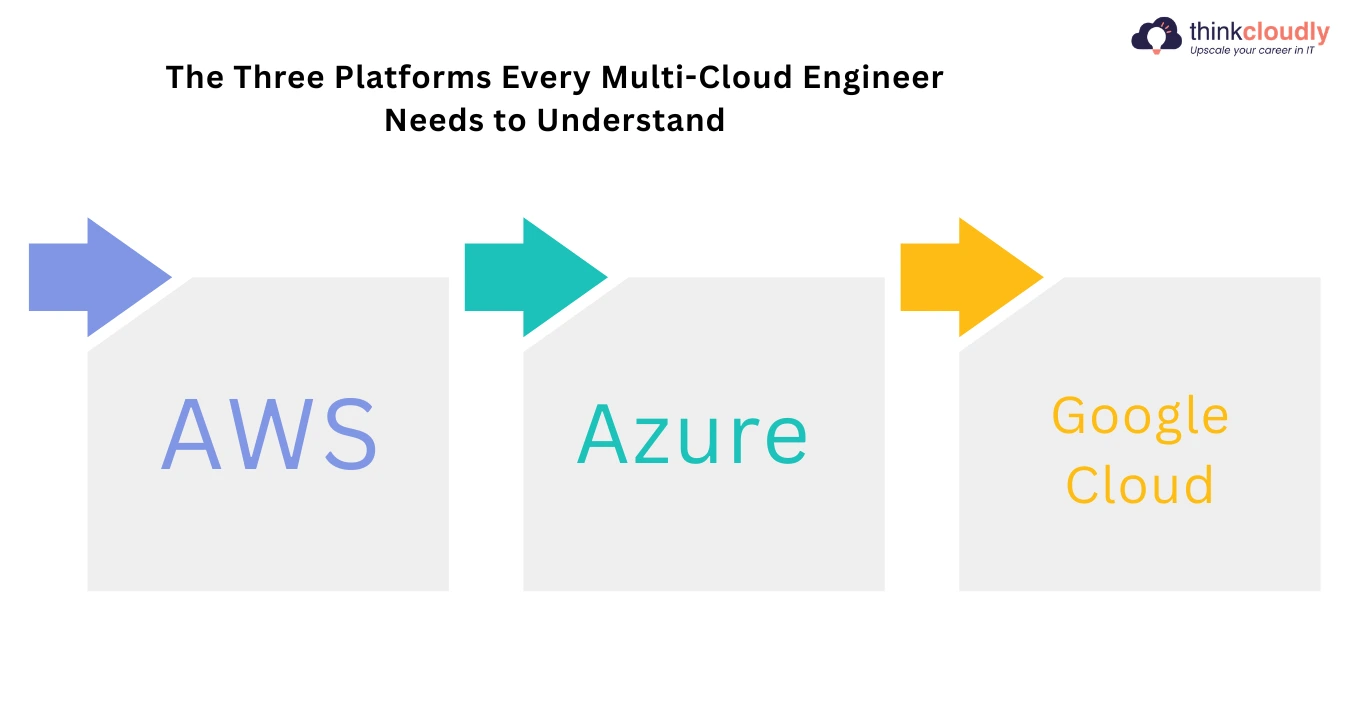 AWS remains the largest single cloud platform by market share, sitting at approximately 31% of global cloud infrastructure spending. For most engineers, it remains the logical starting point because proficiency in AWS is required by more job listings than any other platform.
Azure is the dominant choice in enterprise environments built on Microsoft infrastructure, which represents a very large proportion of large organizations globally. Understanding Azure is particularly valuable for engineers working with financial services, healthcare, and government clients where Microsoft ecosystems are deeply embedded.
Google Cloud has carved out a genuine leadership position in data analytics, machine learning infrastructure, and AI workloads. For engineers working in data-intensive roles or organizations building AI capabilities, Google Cloud fluency is increasingly expected rather than optional.
Multi-cloud engineers who understand all three do not just know three sets of commands. They understand the architectural philosophy behind each platform, where each excels, where each has limitations, and how to design systems that use each platform for what it does best while integrating them into a coherent whole.
The Tools That Make Multi-Cloud Work Possible
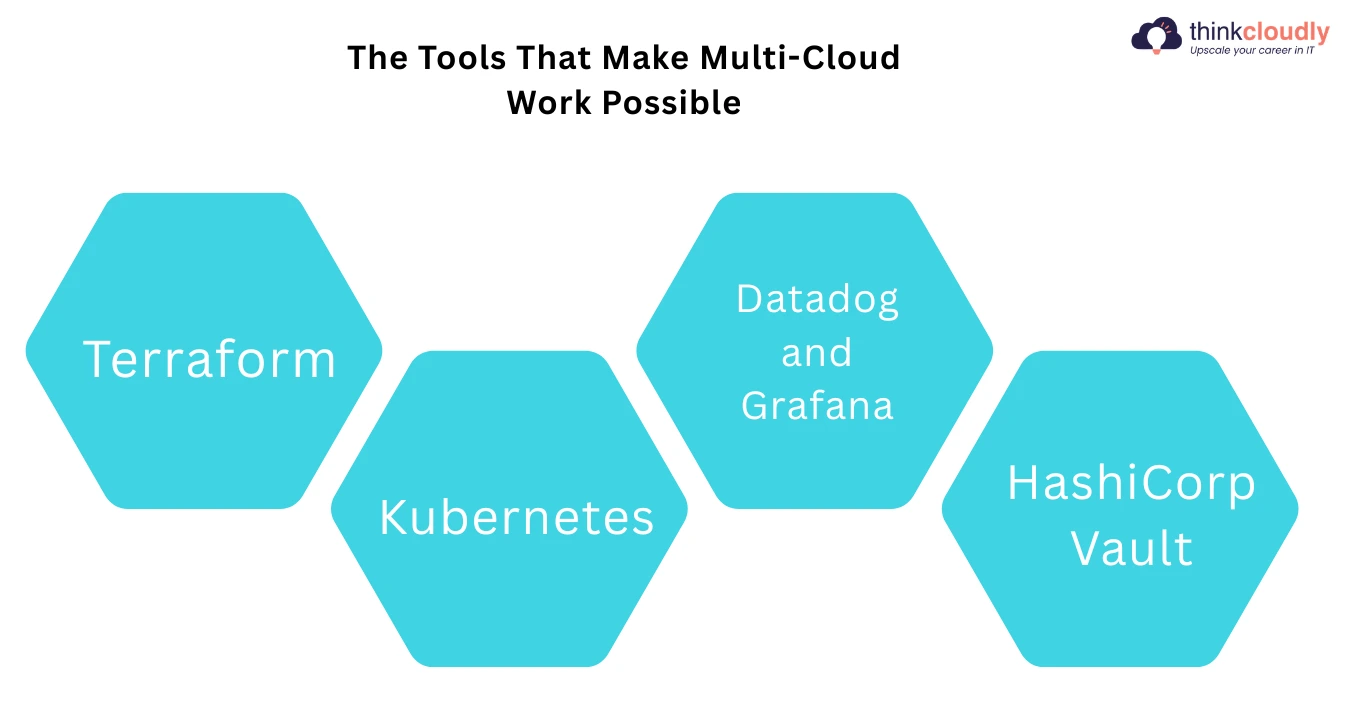 Terraform
Terraform is the most widely used infrastructure-as-code tool in multi-cloud environments. It allows engineers to write infrastructure definitions once and deploy them to AWS, Azure, or Google Cloud without rewriting the logic for each platform. Proficiency in Terraform is considered nearly essential for serious multi-cloud work.
Kubernetes
Kubernetes has become the standard for container orchestration in multi-cloud environments. Because containerized applications can run consistently regardless of the underlying cloud, Kubernetes is a key enabler of genuine multi-cloud portability across platforms.
Datadog and Grafana
Datadog, Grafana, and similar observability platforms provide unified monitoring across multiple cloud environments. They solve one of the most practical day-to-day challenges of multi-cloud operations, which is knowing what is happening everywhere from a single, consolidated view rather than switching between separate dashboards for each platform.
HashiCorp Vault
HashiCorp Vault handles secrets management and access control across clouds. It directly addresses one of the most significant security challenges in multi-cloud environments, which is maintaining consistent, centralized control over who and what can access sensitive credentials across different platforms.
Engineers who combine platform knowledge with fluency in these cross-cloud tools are the ones commanding the highest salaries in the current market. The platform knowledge tells organizations what can be done. The tooling knowledge tells them how it gets done reliably at scale.
How to Move from Single-Cloud to Multi-Cloud Without Starting Over
The good news for engineers who are already working with one cloud platform is that transitioning to multi-cloud is more of an extension than a reinvention. The foundational concepts of networking, compute, storage, security, and identity management translate across platforms. What changes is the syntax, the specific services, and the design patterns.
The most practical path for a working AWS engineer adding Azure capability, for example, is to start with the Azure equivalent of services they already use daily. Compute, storage, networking, and identity are all present on every major platform. Learning the Azure versions of familiar AWS concepts provides a structured entry point rather than starting from zero.
The same approach applies in reverse for Azure-first engineers adding AWS knowledge, or for either group adding Google Cloud.
What accelerates the transition more than any coursework is hands-on project work. Building a small multi-cloud deployment personally, even outside work, provides the kind of practical understanding that reading documentation never does. Free tiers on all three major platforms make this accessible without significant financial investment.
Community engagement also matters significantly. Multi-cloud practitioners are an active community with a substantial presence on platforms like Reddit, LinkedIn, and Discord. The practical knowledge circulating in those communities, about real gotchas, current best practices, and what employers are actually evaluating, is often more current and more useful than formal training materials.
Which Industries Are Hiring the Most Multi-Cloud Engineers
The demand is not evenly distributed across all sectors, and knowing where concentration is highest is useful for career planning.
Financial services is currently the most active sector for multi-cloud hiring. Banks and insurance companies operate at a scale and under a level of regulatory scrutiny that makes multi-cloud architecture both necessary and complex. They also have the budget to pay well for it.
Healthcare is growing rapidly as patient data infrastructure moves to the cloud under strict regulatory frameworks. Organizations managing health data across multiple systems and geographies frequently require multi-cloud setups to meet regional compliance requirements.
Retail and e-commerce represents significant demand, particularly at the enterprise level, where organizations need to maintain high availability across different geographic markets with different platform footprints.
Government and public sector is an emerging growth area as agencies modernize legacy infrastructure. Multi-cloud requirements in government are often driven by sovereignty and compliance rules that mandate using different platforms for different types of data.
Technology companies themselves obviously represent major demand, but the spread across non-technology industries is what makes the multi-cloud skillset genuinely durable. It is not dependent on one sector staying healthy.
Sources & Further Reading
The data and statistics in this article are drawn from the following sources:
- Gartner — Forecast: Public Cloud Services, Worldwide, 2026 — Global cloud market size projections and enterprise cloud spending forecasts
- Flexera — 2026 State of the Cloud Report: Multi-Cloud Adoption, Costs, and Strategy — Multi-cloud adoption rates, enterprise cloud strategy trends, and cost management data
- Synergy Research Group — Cloud Market Share Q1 2026: AWS, Azure, and Google Cloud — Market share percentages and platform positioning across the three major cloud providers
- HashiCorp — 2026 State of Cloud Strategy Survey: Multi-Cloud Adoption and Challenges — Real-world multi-cloud adoption challenges, Terraform usage data, and infrastructure-as-code trends
- LinkedIn Talent Insights — 2026 Most In-Demand Cloud Skills and Salary Data — Fastest-growing multi-cloud skill sets and compensation benchmarks across industries
- Glassdoor — Multi-Cloud Engineer Salary Trends and Compensation Data 2026 — Salary ranges and pay gap data comparing single-cloud and multi-cloud engineering roles
- ZipRecruiter — Cloud Engineering Salary Report: Single vs. Multi-Cloud Specialist Pay Gap 2026 — Compensation benchmarks and the measurable salary premium for multi-cloud professionals
- Dice — 2026 Tech Salary Report: Cloud, DevOps, and Multi-Platform Engineering — Role-by-role salary data for cloud and DevOps professionals across experience levels
- CompTIA — State of the Tech Workforce 2026: Cloud Skills, Hiring, and Compensation — Employer hiring expectations, cloud skills demand, and workforce gap analysis
- McKinsey Global Institute — Multi-Cloud Strategy and the Enterprise: Adoption Drivers and Talent Gaps — Enterprise multi-cloud adoption drivers, strategic rationale, and talent shortage insights
- IBM Institute for Business Value — Cloud Transformation Index 2025: Multi-Cloud Complexity and the Skills Shortage — Multi-cloud complexity challenges and the growing skills gap facing enterprises globally
- Stack Overflow — Developer Survey 2025: Cloud Platforms, Multi-Cloud Usage, and Career Outcomes — Developer insights on multi-cloud platform usage, tooling preferences, and career progression
All salary figures, market share data, and adoption statistics referenced in this article reflect United States-based and global research published between 2025 and 2026. Figures may vary by region, employer size, industry sector, and individual experience level.