
I still remember the exact moment I got overwhelmed picking my first cloud exam. I opened five browser tabs; three of them contradicted each other, and I closed my laptop more confused than when I started. If you’re standing where I once stood, trying to figure out which cloud engineer certification actually deserves your time and money, this guide is the conversation I wish someone had with me back then.
There’s no shortage of options out there—AWS, Azure, Google Cloud, vendor-neutral tracks, and specialty badges. Every one of them promises to be “the one that gets you hired.” Some of that is marketing. Some of it is genuinely true, just not for everyone. Let’s cut through it together.
Before we get into specific exams, it helps to understand why this decision feels so heavy in the first place. Unlike a lot of IT credentials, cloud certifications aren’t cheap, and they aren’t quick either.
You’re looking at real study hours, exam fees that can run into the hundreds of dollars, and the very real risk of picking a path that doesn’t match what recruiters in your area are actually asking for. So instead of treating this like a checklist exercise, treat it like a career conversation—because that’s really what it is.
Why Does a Cloud Engineer Certification Actually Matter in 2026?
Cloud adoption isn’t slowing down. Companies across finance, healthcare, retail, and tech are actively hiring people who can build, secure, and scale infrastructure without needing a data center down the hall. A cloud engineer certification works like a fast-track signal to recruiters—it tells them you’ve validated a specific set of skills instead of just claiming them on a resume.
That said, a certification is not a magic ticket. It’s a credibility multiplier. Pair it with hands-on practice, and it opens doors. Treat it as a standalone trophy, and it gathers dust. Keep that distinction in mind as we go through the options.
The Big Three: AWS, Azure, and Google Cloud
Most people narrow their choice down to these three ecosystems first, because they cover the overwhelming majority of job listings.
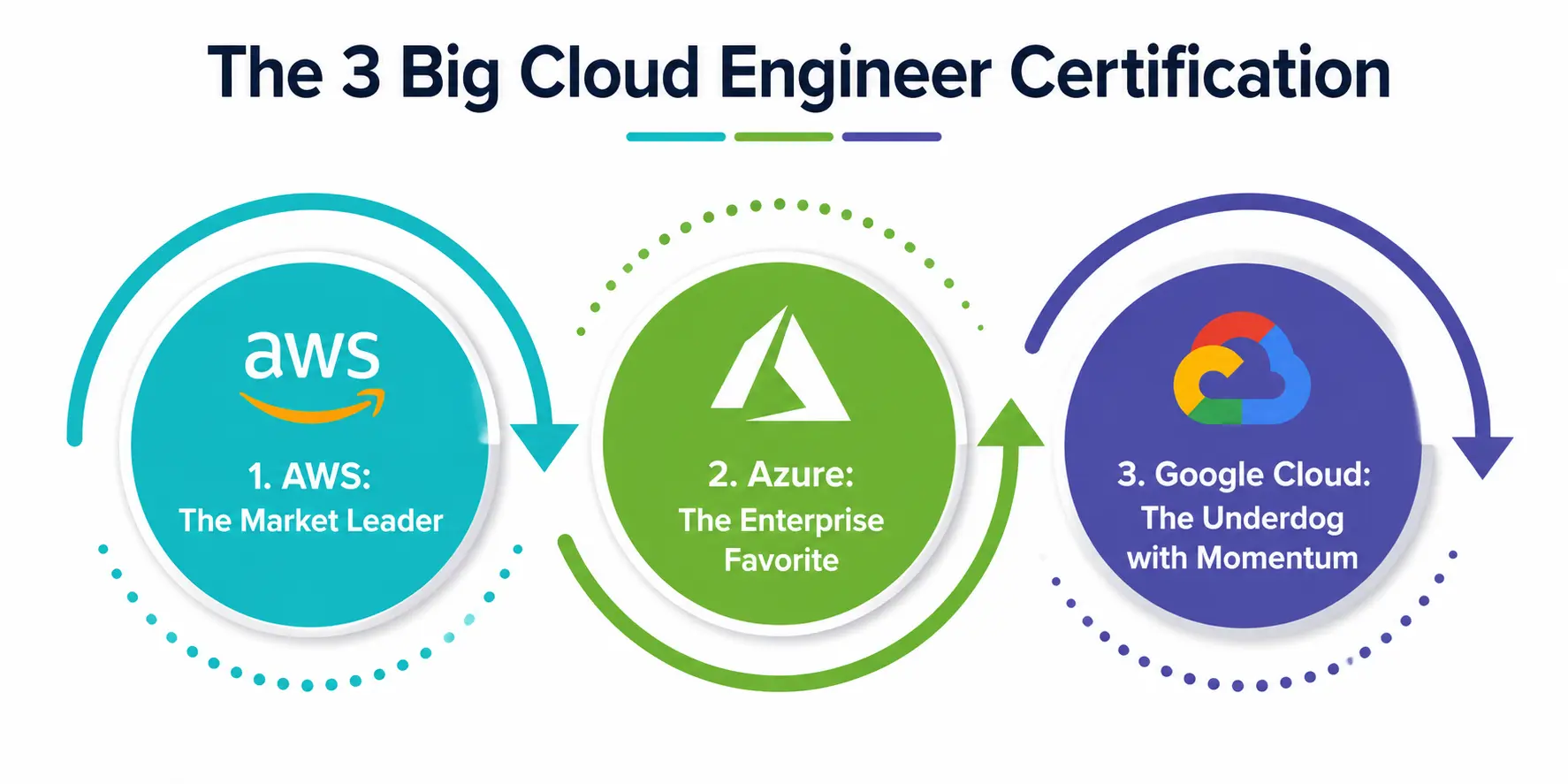
1. AWS: The Market Leader
Amazon Web Services still commands the largest share of the public cloud market, and that shows up directly in job postings. If you’re aiming to become an AWS engineer, the AWS Certified Solutions Architect – Associate (SAA-C03) is usually the first serious stop after the entry-level Cloud Practitioner exam.
This exam is built for people with at least a year of hands-on experience designing available, cost-efficient, fault-tolerant, and scalable systems, and it tests your ability to architect solutions that are secure, resilient, and cost-optimized across services rather than testing any single tool in isolation.
You’ll be tested on core building blocks like compute, storage, databases, and — importantly — load balancing, since distributing traffic efficiently across resources is a recurring theme in real AWS architectures. If your goal is to specifically move into architecture-focused work rather than staying in a purely operational role, this exact certification is the one hiring managers look for by name.
It’s less about memorizing service names and more about understanding trade-offs—when to use one database over another, when traffic distribution solves a bottleneck versus when auto-scaling does, and when it’s smarter to redesign the whole flow instead of patching one piece of it.
Practice exams built around the SAA-C03 format also tend to include detailed rationale for each answer along with reference links back to AWS documentation, which is a genuinely useful way to study since it forces you to understand why an answer is correct rather than just memorizing it as demonstrated by feedback from hundreds of thousands of students who have used this approach to prepare.
Many people who start out chasing a plain infrastructure title eventually discover that the exam content itself nudges them toward architecture-level thinking, simply because AWS structures the test around designing full systems rather than configuring isolated services.
2. Azure: The Enterprise Favorite
If you work in or want to work in a Microsoft-heavy shop, becoming an Azure engineer usually starts with the AZ-104 (Azure Administrator Associate). It’s priced at $165 USD in the United States, runs for roughly 100 to 120 minutes, and covers 40 to 60 questions with a passing score around 700 out of 1000.
Certified professionals in this track report salaries generally in the $110K–$140K range based on aggregated data, and the credential shows up frequently as a required or preferred qualification in cloud computing job listings. Salary data from sources like Glassdoor and BLS.gov consistently documents a measurable premium for AZ-104 holders over non-certified peers in equivalent roles, according to the AZ-104 certification guide.
The exam itself digs into identity management, governance, storage, virtual networks, and yes—load balancing configurations across Azure’s networking stack, including load balancers, application gateways, and traffic manager setups. If you eventually want to move up toward Azure’s own architecture-level track (AZ-305), AZ-104 is the natural stepping stone, and the transition tends to feel smoother than jumping straight from a fundamentals-level exam.
One thing worth knowing before you register: the $165 exam fee is rarely the whole story. Between prep courses, practice tests, and the possibility of a retake, many candidates end up spending closer to $400–$700 by the time they walk out with the credential in hand.
Budgeting for that upfront saves you from an unpleasant surprise halfway through your study plan, and it’s worth asking your employer about reimbursement before you pay out of pocket — a lot of companies will cover it if you simply ask.
3. Google Cloud: The Underdog with Momentum
Google Cloud doesn’t get talked about as much, but its Associate Cloud Engineer certification has built a loyal following, especially among people working with Kubernetes-heavy or data-focused workloads.
The exam runs about two hours and is priced at $125, positioning it as a more affordable entry point compared to AWS and Azure’s associate-level exams, according to Google ACE exam breakdown. It pairs well if your organization already leans on BigQuery, GKE, or other Google-native tools.
What makes this exam a little different is its emphasis on day-2 operations—deploying applications, monitoring them, and managing services after they’re already live, rather than just designing them from scratch.
If your day job involves more maintaining infrastructure than architecting it, this exam maps closer to your actual responsibilities than a heavier design-focused exam would.
Vendor-Neutral and Specialty Options
Not every path has to run through a single vendor. If you’re an infrastructure generalist, certifications like CompTIA Cloud+—which costs around $370 and runs 90 minutes, per CompTIA’s certification breakdown on Course Report—or the Linux Foundation’s Kubernetes and Cloud Native Associate (KCNA) validate skills that transfer across providers.
These won’t replace a vendor-specific credential if you’re chasing a particular job title, but they’re excellent if you’re still deciding which ecosystem to commit to. Vendor-neutral certifications also come in handy if you work in a consulting role or at a company that runs a genuinely multi-cloud environment.
In those situations, being fluent in cloud concepts broadly—networking, traffic distribution, storage tiers, and identity models—often matters more than being deeply specialized in any single provider’s console.
Quick Comparison Table
|
Certification |
Best For | Typical Cost (USD) |
Focus Area |
| Becoming a Solutions architect | ~$150 |
Architecture design, traffic distribution, scalability |
|
| Enterprise administration roles | $165 |
Identity, networking, traffic routing, governance |
|
| Kubernetes/data-heavy environments | ~$125 |
Deployment, monitoring, containers |
|
|
CompTIA Cloud+ |
Vendor-neutral generalists | ~$370 |
Cloud concepts across providers |
|
Linux Foundation KCNA |
Early-career, container-focused roles | ~$250 |
Kubernetes fundamentals |
How to Actually Choose?
Here’s the honest, unglamorous answer: pick based on where you already work or where you want to work, not based on which exam sounds more impressive on LinkedIn.
-
If your target companies run on AWS, chase that certification path first.
-
If you’re in a Microsoft-centric environment or your company already uses Microsoft 365 and Azure AD, that route will feel more natural and directly applicable.
-
If your ambition is architecture-level work—designing systems rather than maintaining them—aim toward becoming a solutions architect, regardless of vendor, since that title consistently commands higher pay across ecosystems.
-
If you’re unsure which cloud your future employer uses, start with the fundamentals-level exam of whichever platform your current job touches, even slightly.
Whatever path you pick, don’t skip the load balancing concepts. It comes up constantly in interviews because it’s one of the clearest ways to test whether you understand real-world traffic distribution versus just memorizing terms. Interviewers love asking about it precisely because it forces you to explain a real scenario instead of reciting a definition.
Common Mistakes People Make When Choosing a Certification
A few patterns show up again and again with people I’ve talked to over the years:
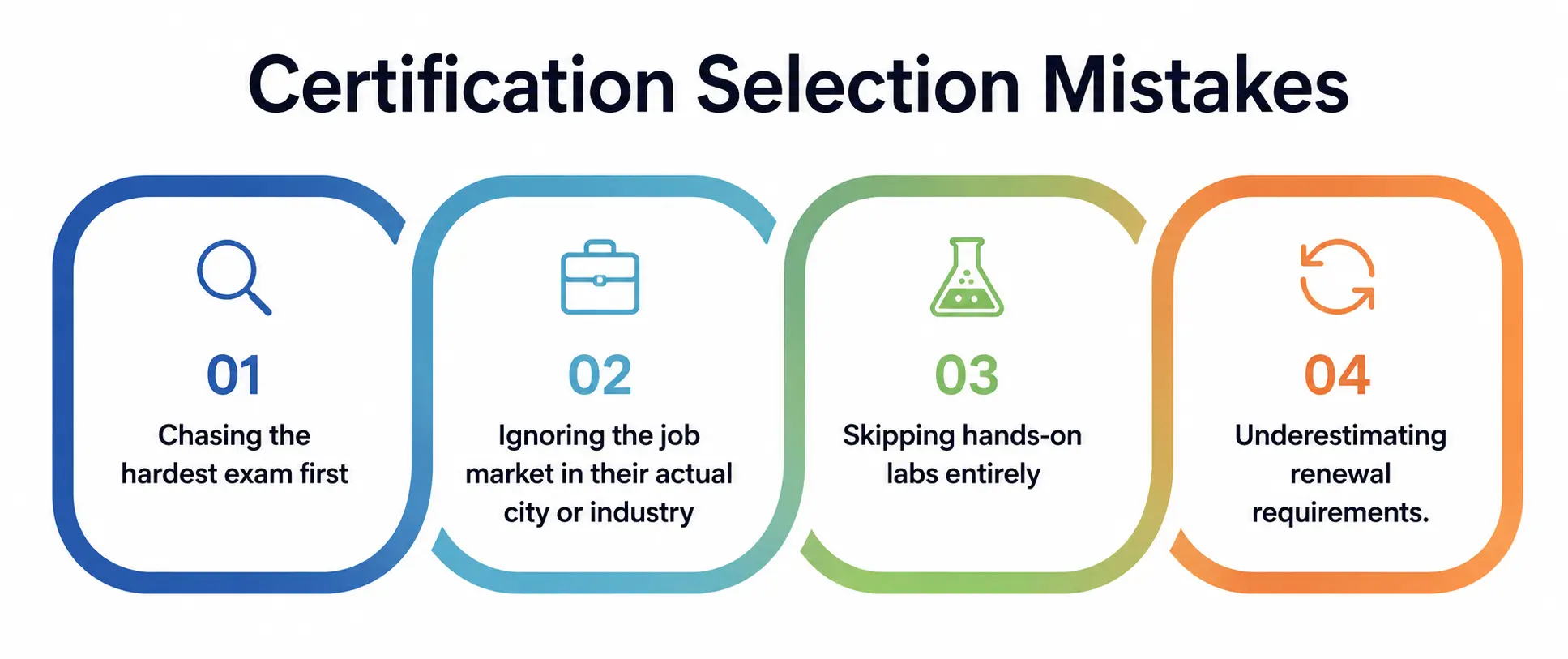
1. Chasing the hardest exam first
Jumping straight to an expert-level architecture exam without associate-level groundwork usually backfires. You end up memorizing answers instead of understanding concepts, and that gap shows up fast in real interviews.
2. Ignoring the job market in their actual city or industry
It’s easy to get swept up in “AWS is the market leader” without checking whether that’s true for the companies actually hiring around you. A smaller regional employer might run entirely on Azure, making that platform’s credential far more relevant locally than a global market share statistic would suggest.
3. Skipping hands-on labs entirely
Reading alone doesn’t build the muscle memory you need for real troubleshooting—things like configuring traffic distribution rules or debugging a networking issue rarely make sense until you’ve actually clicked through the console yourself.
4. Underestimating renewal requirements
Most credentials expire every two to three years. Factor that ongoing cost and effort into your decision, not just the upfront exam fee—TechTarget’s comparison of CompTIA cloud certifications is a useful reference if you’re weighing vendor-neutral options against renewal cycles.
The Real Value of Any Cloud Engineer Certification
At the end of the day, a cloud engineer certification isn’t about the letters after your name. It’s proof you sat down, learned the material properly, and can talk through architecture decisions without freezing up in an interview.
Employers know the difference between someone who is crammed for a multiple-choice test and someone who genuinely understands why a solutions architect picks one service over another.
If you’re stuck choosing between an AWS engineer path or an Azure engineer path, my honest advice: pick the one tied to job listings in your city or industry, not the one with better marketing. Both paths lead somewhere solid. A well-earned cloud engineer certification, backed by actual project experience, will outlast any trend in the job market.
It’s also worth remembering that no single cloud engineer certification locks you into one path forever. Plenty of people start in one ecosystem, pick up a credential from a second platform a year later once their company adopts a multi-cloud strategy, and eventually settle into an architecture-focused role that draws on both.
Certifications compound. The first one is always the hardest to commit to, and every one after that gets easier because you already know how to study for this specific kind of exam. If there’s one habit that separates people who pass on their first attempt from people who need two or three tries, it’s this: build something real while you study.
Spin up an actual environment, break it, fix it, and configure traffic distribution yourself instead of just reading about how it works. The exam questions almost always mirror decisions you’d genuinely make on the job, so the more real-world tinkering you do beforehand, the less the test will feel like guesswork on exam day.
A personal note from me
I’ve sat through my share of certification prep, late-night practice tests, and the particular kind of stress that comes from staring at a countdown timer during an exam. If there’s one thing I’d tell my past self, it’s this—don’t chase a certification because it looks good on paper.
Chase the one that actually matches the work you want to wake up and do every day. The exam fee is a small cost. The years you’ll spend in that role afterward are the real investment. Choose accordingly, and good luck out there.