What if the career move you have been putting off is one of the fastest-growing roles in the entire job market right now? That is exactly what the data says about the Scrum Master role in 2026. According to Refonte Learning’s 2026 Career Outlook, demand for Scrum Masters is projected to grow by approximately 24% by 2026 — significantly outpacing most other professional roles. If you have been working as a project manager, a business analyst, or even in a people-facing operational role, you may already be far closer to qualifying for this position than you realize. Agile leadership is no longer a niche competency—it is mainstream business practice. This guide walks you through exactly what it takes to make a successful transition, backed entirely by current data and real industry expectations—not advice from five years ago.
Why Is the Scrum Master Role One of the Smartest Career Moves in 2026?
Before diving into the how, it is worth understanding the why. The Scrum Master role is not just growing—it is becoming essential infrastructure for modern organizations.
Agile leadership has gone from being a software industry trend to a business-wide standard. By 2025, around 66% of organisations were using Scrum or other Agile frameworks — not just in technology, but in healthcare, finance, marketing, and government. The State of Agile 2026 report found that around 97% of organizations report using Agile methods to some extent, with projects managed through Agile achieving a 75% success rate compared to just 56% for traditional approaches. These are not marginal numbers — they represent a wholesale shift in how the business world operates.
Salaries reflect this demand. According to Glassdoor’s June 2026 data, the typical pay range for a Scrum Master in the United States sits between $99,887 and $162,540 annually, with top earners reaching over $202,000. Senior Scrum Masters and agile coaching professionals command $140,000 to $160,000 or more. Robert Half’s 2026 Salary Guide puts the broader range at $95,750 to $142,250—reinforcing that this is a well-compensated path regardless of where you land on the experience spectrum. The shortage of experienced practitioners is equally striking. Companies are not just competing for top talent — they are struggling to find enough qualified people at any level. That gap is your opportunity.
What Does a Scrum Master Actually Do Day-to-Day?
Before making a transition, it helps to be clear on what the job actually involves—because this is where many people have the wrong picture.
A Scrum Master is not a project manager in Agile clothing. The position sits within Agile frameworks specifically as a servant leadership role—meaning authority comes from facilitating, coaching, and removing obstacles, not from directing or assigning tasks. Refonte Learning’s research describes it plainly: a Scrum Master leads by serving, putting the team’s needs first to build trust and high performance. Agile coaching runs through everything—helping individuals improve, guiding the team toward self-organization, and coaching stakeholders on how to work with an agile team effectively. On a practical day-to-day basis, this means running sprint ceremonies—the daily standup, sprint planning, sprint review, and sprint retrospectives. It also means continuously improving how the team works together and shielding the team from external distractions.
In 2026, the role has expanded further. Skillifysolutions’ 2026 report notes that modern Scrum Masters are expected to be comfortable with data-driven decision-making—tracking sprint velocity, cycle time, and team performance metrics—and working alongside AI-enabled tools. Scrum Master skills now extend meaningfully into technology literacy, metrics interpretation, and enterprise facilitation at scale.
Who Can Transition Into This Agile Career?
One of the most encouraging things about this career path is the diversity of backgrounds it welcomes.
Research.com‘s 2026 career guide notes that professionals from operations, human resources, teaching, business analysis, quality assurance, customer success, and product roles can all transition successfully—provided they build Agile knowledge and learn how to facilitate team-level work. Agile frameworks are not exclusive to technologists—they are people-centered systems that reward communication, adaptability, and structured thinking.
If you are coming from a project manager background, you already hold a significant advantage. You understand timelines, stakeholder management, risk thinking, and delivery accountability. The key shift is moving from a command-and-control mindset to servant leadership—from directing to enabling. Refonte Learning explicitly states that many Scrum Masters come from project management backgrounds, calling it one of the most natural transition paths available. People from customer-facing roles bring equally valuable Scrum Master skills: active listening, conflict resolution, and communication across different personality types.
How to Transition Into a Scrum Master Role: A Step-by-Step Approach?
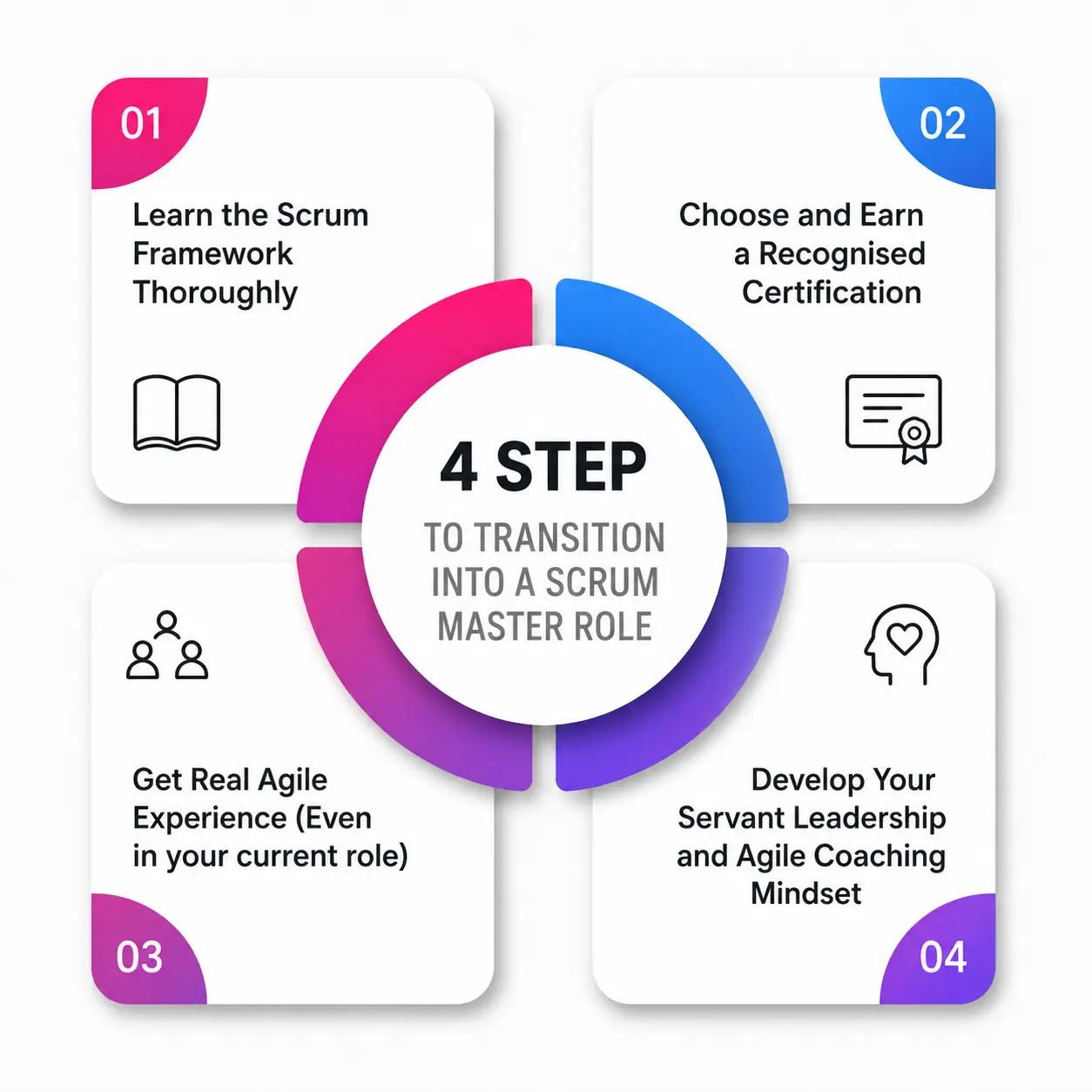
Step 1: Learn the Scrum Framework Thoroughly
The starting point for any Scrum Master role transition is a deep, genuine understanding of how Scrum works — not just the surface terminology, but the reasoning behind every element. Read the current Scrum Guide in full. Understand the three accountabilities (Scrum Master, Product Owner, Developers), the five events, and the three artifacts. Professional Scrum Master preparation goes well beyond memorizing definitions—it requires understanding why Scrum is structured the way it is and what happens when teams deviate from it. Agile frameworks reward practitioners who understand the underlying principles, not just the ceremony checklist.
Step 2: Choose and Earn a Recognised Certification
Certifications are the practical gateway to most Scrum Master opportunities in 2026. Coursera’s March 2026 certification guide identifies two that consistently dominate job postings: the Certified ScrumMaster (CSM) from Scrum Alliance and the Professional Scrum Master I (PSM I) from Scrum.org.
- CSM: Requires at least 16 hours of instructor-led training plus an exam. Cost typically runs between $500 and $2,495. Excellent for people who prefer structured learning with live instruction.
- PSM I: A $200 exam from Scrum.org with no mandatory training requirement. Widely considered the more rigorous entry-level option. Lifetime validity with no renewal fees.
Certified professionals earn 20–40% higher salaries than non-certified peers, according to 2025–2026 industry surveys—making the investment in a Professional Scrum Master credential one of the most direct career development returns available.
Step 3: Get Real Agile Experience (Even in Your Current Role)
Certification alone will not get you hired. Employers in 2026 increasingly prioritize demonstrated practical experience over badges. Skillifysolutions’ 2026 hiring report is direct on this point: companies prefer practical experience over certifications alone.
You do not necessarily need a formal job title to build this experience. You can apply Agile framework thinking in your current position—running structured team meetings, introducing retrospectives, tracking sprint-style work cycles, or volunteering to facilitate Agile ceremonies on an internal project. Every genuine interaction with an Agile team is an experience you can speak to in an interview. This practical grounding also strengthens your agile leadership credibility in ways that no certification can replicate on its own. Pair this with developing your Scrum Master skills in conflict resolution, meeting facilitation, and stakeholder communication—the three areas hiring managers probe the hardest.
Step 4: Develop Your Servant Leadership and Agile Coaching Mindset
Technical Scrum knowledge can be taught on a weekend. What takes longer — and what genuinely separates strong Scrum Masters from average ones — is the human dimension of the role.
Servant leadership is the foundational philosophy. As Refonte Learning explains, a true Scrum Master measures success by how much the team improves, not by personal recognition. This requires active listening, the ability to coach without directing, and the patience to let teams solve their own problems. Agile coaching skills—including one-on-one mentoring, facilitation under pressure, and guiding difficult conversations—are equally critical. In 2026, organizations value Scrum Masters who uplift everyone around them, not just those who run ceremonies efficiently.
Scrum Master Certification Comparison: 2026
|
Certification |
Issuing Body | Format | Cost (approx.) |
Best For |
|
CSM |
Scrum Alliance | 16hr training + exam | $500–$2,495 |
Career starters, prefer live instruction |
|
PSM I |
Scrum.org | Exam only (self-paced) | $200 |
Self-directed learners, rigorous theory |
|
PSM II |
Scrum.org | Exam only (advanced) | $250 |
Experienced practitioners |
|
A-CSM |
Scrum Alliance | Advanced training + exam | $700–$2,500 |
Mid-career Scrum Masters |
|
CSP-SM |
Scrum Alliance | Course + 24 months XP | $1,000–$2,800 |
Senior SMs with 2+ years |
|
SAFe SSM |
Scaled Agile | 2-day course + exam | $995–$1,500 |
Enterprise / large-scale Agile teams |
|
PMI-ACP |
PMI | Exam + 21hr training | $435–$495 (exam) | Broad Agile across multiple frameworks |
Sources: Scrum.org, Scrum Alliance, Coursera 2026, Practice Test Geeks 2026
Key Scrum Master Skills You Need to Build Before Applying
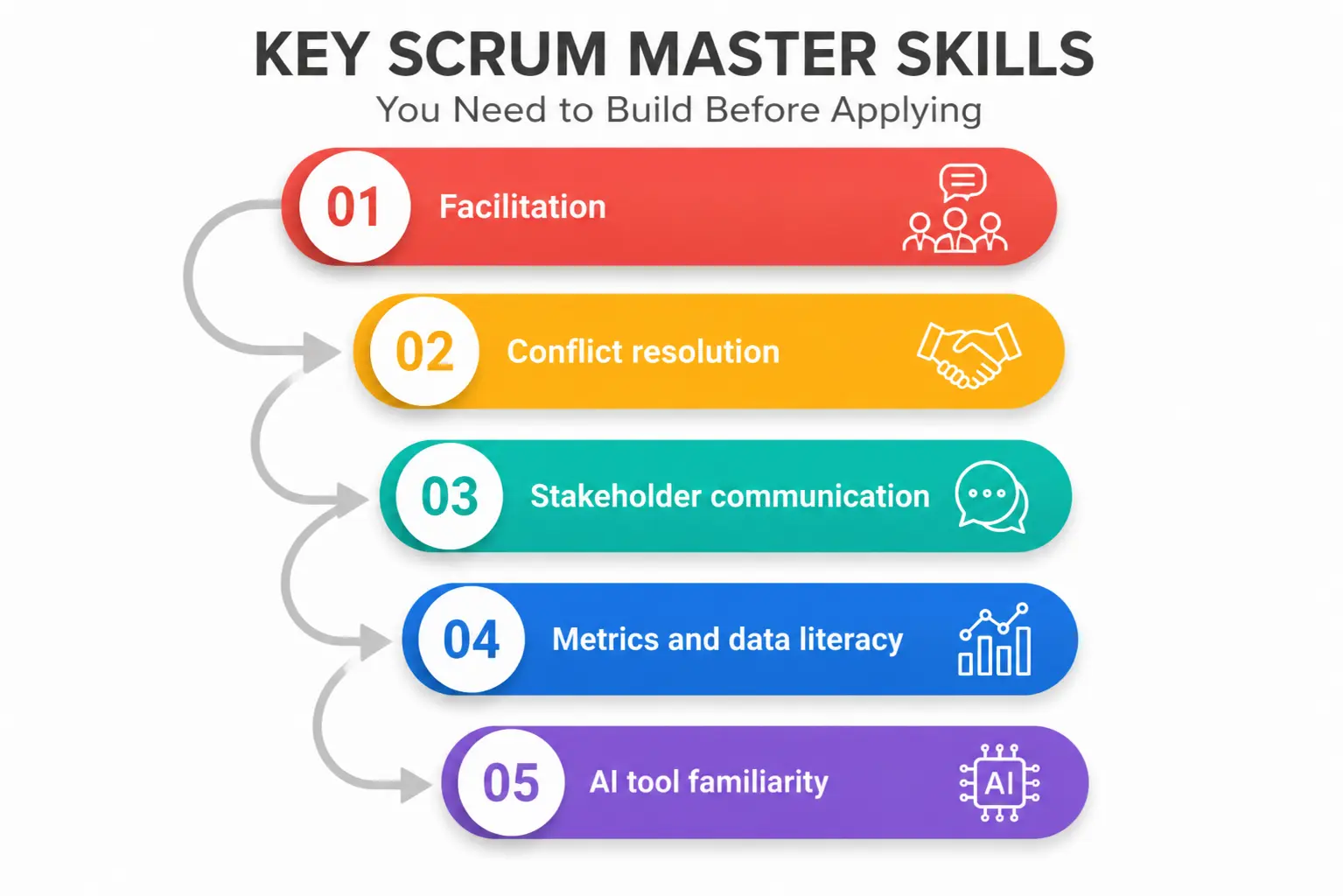
The Scrum Master skills employers actively screen for in 2026 go beyond Scrum ceremonies. KORE1’s 2026 Salary Guide notes that the gap between what companies want and what most candidates offer is growing—particularly at the experienced level.
Here are the Scrum Master skills that consistently appear at the top of 2026 job postings:
- Facilitation: Running retrospectives, planning sessions, and cross-team discussions in a way that produces genuine outcomes—not just box-ticking meetings. Strong agile leadership requires being a confident, structured facilitator even in difficult conversations.
- Conflict resolution: Teams have disagreements. Scrum Masters who can mediate without taking sides and keep focus on shared goals are highly valued.
- Stakeholder communication: Agile coaching within an organization often means translating between what a business leader wants to hear and what a development team needs to say.
- Metrics and data literacy: Tracking velocity, cycle time, burn-down charts, and team health indicators is increasingly expected. Research.com‘s 2026 guide confirms that data-driven decision-making is now a core requirement for mid-level and above Scrum Masters.
- AI tool familiarity: In 2026, Scrum Masters are expected to be comfortable working alongside AI-powered project tools. PSM-AI Essentials is now offered by Scrum.org as a specialist credential in this area — a signal that Professional Scrum Master competence is actively evolving to include AI literacy.
Common Mistakes When Making This Career Transition
Skillifysolutions’ 2026 hiring analysis identified the most frequent errors candidates make:
- Relying on the certification alone without any practical Agile exposure
- Thinking like a project manager—focusing on authority and task control rather than facilitation and Servant Leadership
- Underestimating soft skills—believing that knowing Scrum theory is sufficient when hiring managers are equally looking for human skills and Agile Leadership presence
- Generic CVs — listing responsibilities rather than outcomes. Phrases like “improved sprint delivery efficiency by 20%” outperform “managed daily standups” every time
- Skipping the mindset shift—going through the motions of Scrum without internalising the coaching mindset and values that make teams actually improve over time
Conclusion
Transitioning into a Scrum Master role in 2026 is genuinely achievable for people from a wide range of professional backgrounds — and the timing could hardly be better. With Scrum Master job growth projected at 24%; salaries ranging from $99,000 to $162,000+ nationally; and demand consistently outpacing supply, this is one of the few career moves where the market is actively working in your favor. Whether you are coming from a professional services background or a different field entirely, the path is clear: learn the Scrum framework deeply, earn a recognized Professional Scrum Master certification, build real Agile experience, and develop the servant leadership mindset that distinguishes truly effective Scrum Masters from those who merely run meetings. Ongoing learning and coaching practices compound over time—the sooner you invest in it, the faster your career trajectory changes. The Scrum Master role will not fill itself, but with the right preparation, it can absolutely be yours. Enroll in Thinkcloudly now!