
The generation that grew up online is choosing desks and commutes. The generation that fought for remote work is keeping it. Here is what is actually behind that reversal.
If you expected Gen Z, the generation that practically lives on their phones and grew up in digital spaces, to be the loudest defenders of working from home, you would have been wrong. Something unexpected has been showing up in workplace data for the past two years, and it became impossible to ignore in 2026. Young people entering the workforce are actively choosing to go into offices. Senior technology professionals, many of whom spent years arguing that productivity does not require a commute, are staying put at home.
The reversal is real, and it is not a coincidence. It reflects two very different sets of priorities shaped by two very different career situations. Understanding why it is happening tells you something genuinely useful, not just about technology careers, but about what work is actually for at different stages of a professional life.
What the data is actually showing
Microsoft’s 2026 Work Trend Index found that employees aged 18 to 26 are now the most likely group to say they prefer working in an office or a hybrid arrangement, at 58 percent, up from 39 percent just three years ago. That shift is steep enough that it caught researchers off guard. The assumption that younger workers would always push for flexibility turned out to be based on a misreading of what flexibility actually means to someone who is just starting out.
At the same time, LinkedIn’s 2026 Workforce Confidence Survey found that 72 percent of senior technology professionals, those with ten or more years of experience, are working fully remotely and have no plans to return to an office on a regular basis. Many of them negotiated remote arrangements into their contracts during the pandemic and have no intention of giving them up. Their employers, who need their expertise and cannot easily replace it, are not in a position to insist.
The simplest way to understand the split: going to an office is most valuable when you have a lot left to learn and need people around you to learn it from. Staying remote is most valuable when your reputation is established and your output speaks for itself regardless of where you produce it.
What younger workers are actually looking for
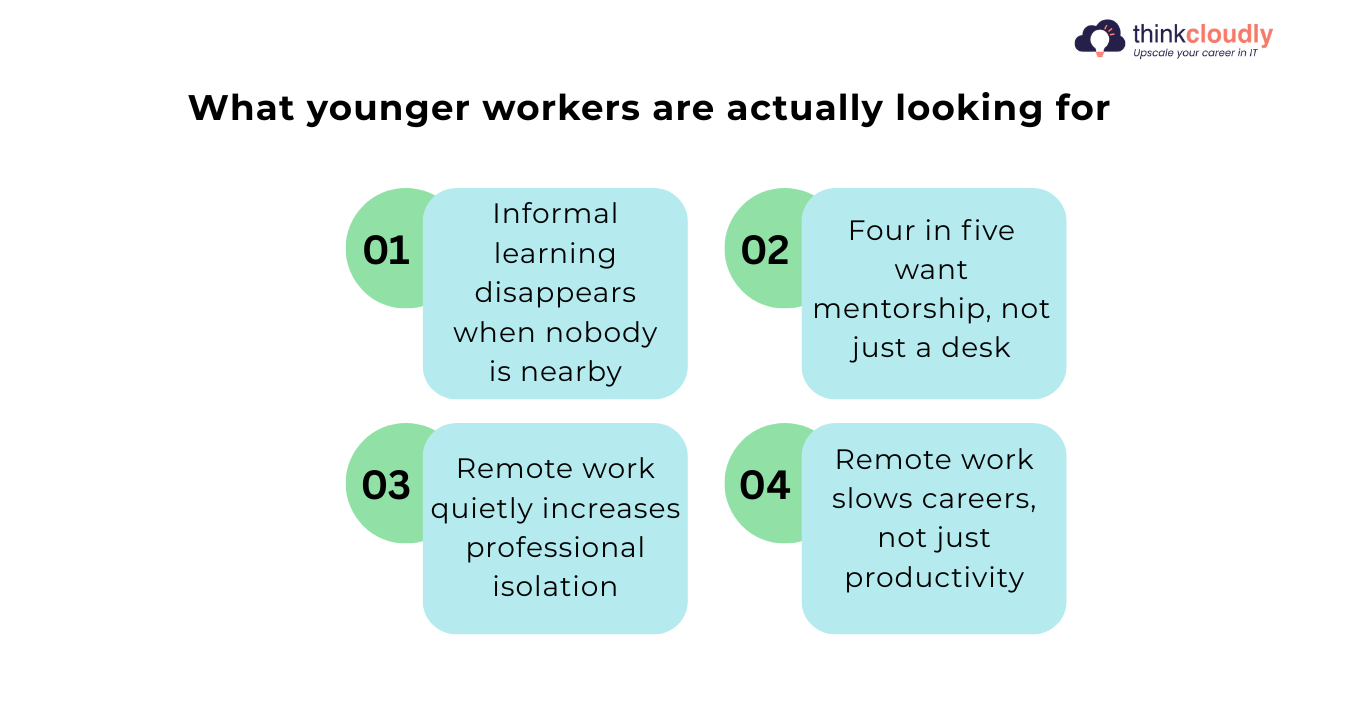
1. Informal learning disappears when nobody is nearby
Gallup’s State of the Global Workplace 2025 report is clear on this: the top reasons young workers want to be in person are not about productivity or enjoying a commute. They are about learning and connection. The kind of learning that happens when a more experienced colleague walks past your screen and notices something worth pointing out cannot be scheduled into a calendar invite. It either happens naturally, in the same physical space, or it does not happen at all.
2. Four in five want mentorship, not just a desk
Deloitte’s 2026 Global Gen Z and Millennial Survey found that four in five junior technology workers said access to mentorship and informal learning from colleagues was either important or very important to their choice of where to work. That number matters because it reframes the entire conversation. Young workers are not choosing offices because they are told to. They are choosing them because they understand, often from watching peers who did not, that proximity to experienced people is one of the fastest ways to develop professionally.
3. Remote work quietly increases professional isolation
McKinsey Global Institute’s 2025 The Future of Work report found that young workers working fully remote are significantly more likely to report feelings of professional isolation than experienced colleagues doing the same. For someone fresh out of education, an office is not simply a place to complete tasks. It is where professional identity gets shaped, where career-defining relationships get built, and where the unwritten rules of a workplace get absorbed through observation rather than through trial and error with nobody watching.
4. Remote work slows careers, not just productivity
The World Economic Forum’s Future of Jobs Report 2025 draws a distinction that most workplace debates miss entirely. Skills development and career progression are what Gen Z workers say remote work makes genuinely harder. Not the work itself. Not their output. The part that transforms a first job into a trajectory. That distinction matters because it explains why the preference for offices among this group is not about performance anxiety or pressure from managers. It is a deliberate investment in the compounding returns that come from learning in the right environment at the right stage of a career.
Why senior IT professionals are holding onto remote work
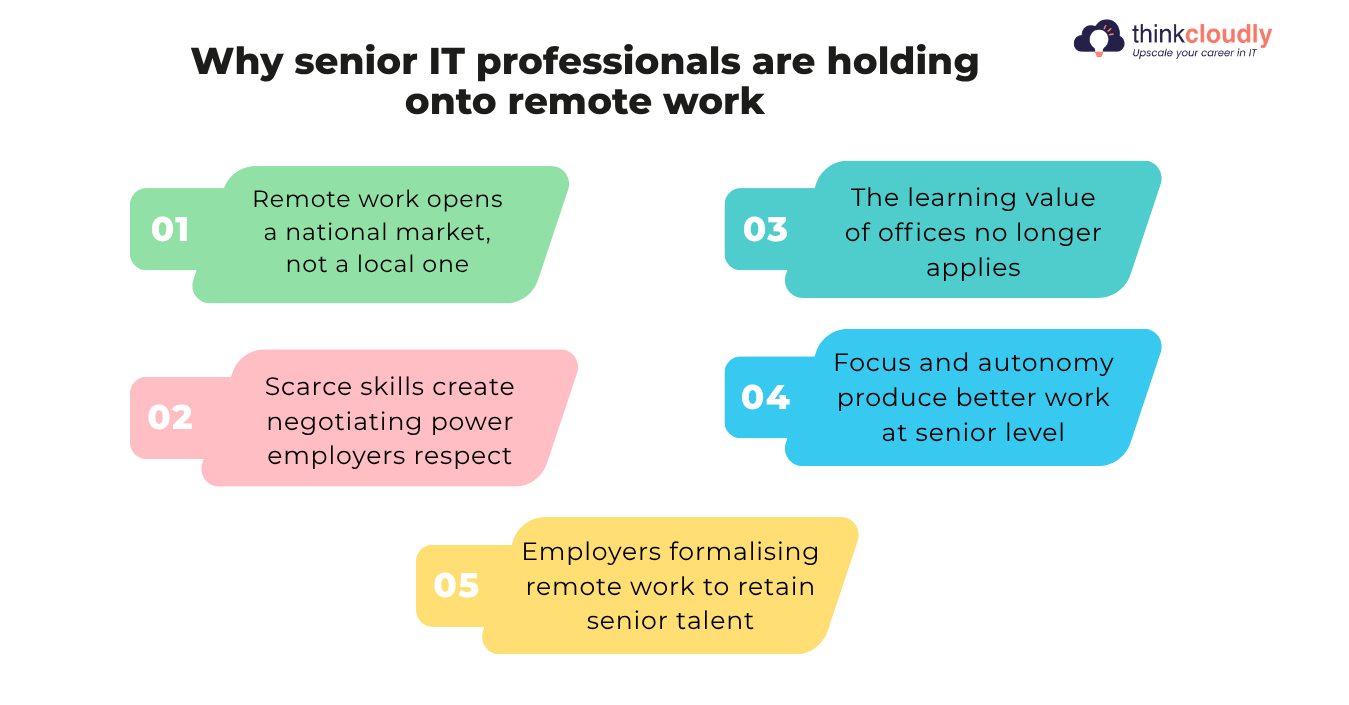
1. Remote work opens a national market, not a local one
Robert Half’s 2026 Technology Salary Guide found that senior technology professionals working fully remotely earn on average 34 percent more than office-based counterparts in equivalent roles. Remote work expands a specialist’s job market from their commuting radius to the entire country. Their employer faces the same expansion in reverse, competing nationally to keep them. Compensation moves accordingly.
2. Scarce skills create negotiating power employers respect
ISC2’s 2025 Cybersecurity Workforce Study puts the global shortfall of cybersecurity professionals at approximately 4 million, growing every year despite sustained investment in training. In fields that scarce, experienced professionals hold genuine leverage over where they work. Employers insisting on office attendance for senior roles in cybersecurity, cloud architecture, or AI engineering consistently lose candidates to those who do not. Supply and demand, not preference, is driving that outcome.
3. The learning value of offices no longer applies
The reasons offices matter most for early-career professionals—mentorship, cultural absorption, and proximity to experienced people—apply specifically to those who have not yet done that learning. A senior engineer with fifteen years of experience has already built the professional identity and relationship network a junior worker goes to an office to develop. At that stage, an office provides interruptions and a commute. Nothing more.
4. Focus and autonomy produce better work at senior level
McKinsey Global Institute’s 2025 The Future of Work report found that experienced professionals rate autonomy over their environment as one of the strongest predictors of sustained high performance. For a senior specialist whose work demands extended, uninterrupted concentration, an open-plan office is not neutral. It is actively disruptive. Remote work at that level is not a lifestyle choice. It is a structural requirement for the kind of deep technical work that makes those professionals worth competing for.
5. Employers formalising remote work to retain senior talent
Gartner’s 2026 Future of Work report identifies a clear pattern among technology companies successfully retaining senior specialists. Remote arrangements are being written into contracts rather than left as informal understandings. SHRM’s 2026 Employee Experience Report found that companies offering formalized flexibility for experienced workers report significantly higher retention in exactly the roles that are hardest and most expensive to replace. The organizations that treated remote work as a temporary pandemic concession and then tried to walk it back discovered the cost of that decision quickly. The ones treating it as a permanent feature of how senior technical work gets done are keeping the people they cannot afford to lose.
The generation gap at a glance
|
Factor |
Gen Z workers (under 28) | Senior IT pros (10+ years exp) |
Why the difference? |
|
Preferred work location |
Office or hybrid | Fully remote | Learning needs vs autonomy needs |
| Primary reason for preference |
Mentorship and informal learning |
Focus, flexibility, and salary premium |
Different career stages, different priorities |
| Isolation risk (remote) | High: professional identity still forming | Low: networks and identity already established |
Social capital takes years to build. |
|
Salary impact of remote work |
Minimal or slightly negative | Up to 34% premium over office peers | Market access widens with seniority. |
| Employer leverage | Companies can push office attendance. | Specialists can negotiate and hold firm. |
Talent scarcity shifts power balance. |
|
Skills development |
Significantly helped by being in person | Largely unaffected by location | Experienced professionals learn differently. |
| Trend direction (2023 to 2026) | Moving toward office | Staying remote |
Diverging, not converging |
What employers are doing with this information
The more forward-thinking technology organizations have started designing explicitly for this split rather than pretending it does not exist. According to Gartner’s 2026 Future of Work report, companies that are retaining both junior and senior talent effectively are running what some are calling a “dual workplace” model. Office space is being redesigned specifically for collaboration, onboarding, and mentorship, which is what younger workers actually need from it. Remote policies for experienced specialists are being formalized and protected, which is what those workers need to stay.
SHRM’s 2026 Employee Experience Report found that companies offering this kind of structured flexibility, rather than a single blanket policy, report significantly higher retention across both groups. The traditional approach of picking one policy and applying it to everyone is increasingly being recognized as a false choice that serves neither group well.
Young workers who felt isolated during the pandemic years have been quietly telling employers through their choices that they want to be around people. Experienced workers who discovered they could do their best work from home are quietly holding that line. Both groups, it turns out, are right about what they need.
What this means for anyone navigating these decisions
If you are early in a technology career or any career that involves learning a complex professional skill set, the data suggests that the office is genuinely worth the commute for a few years. Not because employers demand it or because it signals commitment, but because the informal learning, the professional relationships, and the cultural literacy you build by being physically present are genuinely hard to acquire any other way, and they compound in value over time.
If you are an experienced specialist in a field where your skills are in short supply, the data is equally clear on the other side. Remote work at your level of experience is not a compromise. It is a market advantage that is worth negotiating for and protecting, because the salary and lifestyle benefits are real, and your employer’s ability to insist otherwise depends entirely on how easy it would be to replace you.
Here is the most useful thing the data actually tells you. If you are early in your career, go in. The relationships, the mentors, and the professional fluency you build in those first few years are genuinely hard to acquire any other way, and they compound in value for the rest of your working life. If you are an experienced specialist in a field where your skills are scarce, protect your remote arrangement. Negotiate it into your contract, know your market value, and understand that your employer’s ability to insist otherwise depends entirely on how easily they could replace you. Most cannot. The answer is not the same for everyone, but for most people reading this, it is probably clearer than it feels.
Sources and references
- Microsoft—Work Trend Index 2026
- LinkedIn Economic Graph — Workforce Confidence Survey 2026
- Gallup—State of the Global Workplace 2025
- Deloitte — Global Gen Z and Millennial Survey 2026
- McKinsey Global Institute — Future of Work 2025
- Robert Half—Technology Salary Guide 2026
- ISC2 — Cybersecurity Workforce Study 2025
- World Economic Forum — Future of Jobs Report 2025
- Gartner — Future of Work Trends 2026
- SHRM — Employee Experience Report 2026
- Stanford University (Nicholas Bloom) — Work From Home Research 2025
- US Bureau of Labour Statistics—American Time Use Survey: Flexible Work Arrangements 2025