

Imagine two IT professionals applying for the same job. Both had the same certifications. Both passed the same technical tests. One gets hired in a week. The other is still waiting after a month. The only real difference? One of them knew how to talk about what they do.
That scenario plays out more than people realize. In a field that has always celebrated technical brilliance — the coder who can debug anything, the network engineer who never sleeps—something quiet has shifted. Hiring managers are now paying close attention to a skill that has nothing to do with your certifications, your GitHub profile, or how many lines of code you can write.
That skill is communication. And in 2026, it has become the single most in-demand skill across the entire job market — not just in tech, but across every industry. The twist? IT professionals are often the least prepared for it.
Why Communication Is Suddenly the Skill That Matters Most
For years, the running joke in tech was that you could be brilliant and socially awkward and still have a great career. That was fine when most IT work happened in server rooms and behind closed doors. The workplace has changed significantly since then. Projects now involve cross-functional teams, remote collaboration, presentations to leadership, and constant written communication across messaging platforms.
According to LinkedIn’s 2025 Most In-Demand Skills report—corroborated by SHRM’s 2025 Talent Trends Report—communication ranked number one for the second year running, sitting above Python, Java, and cloud platforms, with employers placing it equal to or above technical qualifications in hiring decisions. Communication is consistently listed among the top skills required for IT and tech roles.
This is not a minor trend. It is a fundamental shift in what companies are looking for when they hire someone in tech.
Why Communication Matters in Tech Jobs
|
Insight |
What it means for you |
|
92% of hiring professionals now prioritize soft skills equally with or above technical skills |
Your personality and people skills are weighed just as heavily as your resume and certifications |
|
Communication topped LinkedIn’s in-demand skills list for two years running |
Recruiters are actively searching for this, not just mentioning it as a bonus |
|
Workers with soft skills get promoted faster, per LinkedIn data |
This isn’t just about getting hired — it’s about how fast you move up once you’re in |
|
75% of organizations report struggling to hire due to soft-skill gaps in candidates, making communication one of the most sought-after qualities in applicants |
If you can communicate clearly, you immediately stand out from the majority of candidates employers are struggling to find |
What “Communication” Actually Means in a Tech Job
When hiring managers say they want someone who “communicates well,” they don’t just mean someone who sends polite emails. In the IT world, communication breaks down into a few very specific abilities that make a real difference on the job.
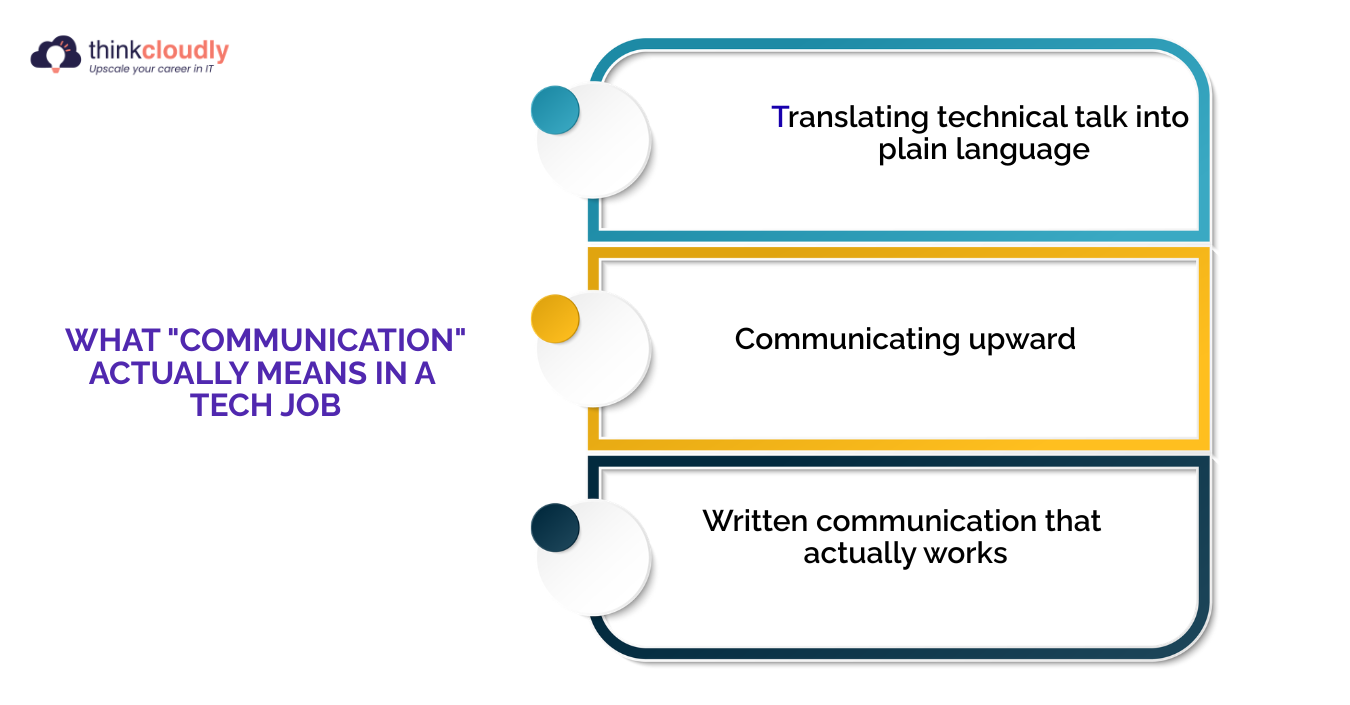
Translating technical talk into plain language
Most IT professionals spend a lot of time working alongside people who don’t understand technology the way they do—executives, clients, HR teams, and marketing departments. The ability to explain a complex system failure or a security risk in simple, calm, non-scary language is something that genuinely separates good IT professionals from great ones. Companies are not just looking for someone who can fix the problem. They want someone who can explain what happened, why it happened, and what will prevent it from happening again — without making everyone feel confused or panicked.
Communicating upward
Research into IT workforce trends consistently shows that professionals who communicate their value to leadership move up faster. Consider the difference between telling your manager, “I patched 47 vulnerabilities this month,” versus “I closed 47 security gaps that put our customer data at risk — we’re now compliant with the new regulations.” Same work. Completely different impact on how leadership perceives the IT team’s value. If that context never reaches the top, budget decisions suffer and talented people go unnoticed. The professionals who learn to present their work clearly — even in informal updates or quick Slack messages — tend to get noticed faster.
Written communication that actually works
Remote and hybrid work has made written communication more important than ever. Most teams now run across different time zones and communicate almost entirely through text. A poorly written message creates confusion, delays, and friction. A clear, well-structured message moves things forward. In 2026, this is not optional — it is a core professional competency.
Real-Life Scenario
To illustrate a pattern commonly reported by IT hiring managers, consider this composite scenario: a network engineer — let’s call him James — who had spent six years doing excellent technical work at a mid-sized firm. When a senior IT role opened up at a larger company, James applied. He passed every technical round with ease. But in the final interview, when asked to walk the panel through how he had handled a recent server outage, James launched into a detailed explanation full of technical terms.
Another candidate — let’s call her Sarah — had a slightly thinner technical background and walked through the same type of scenario in a clear, story-like way: what went wrong, how it affected the business, and what steps were taken to fix it. She got the job. James received feedback that his answers were technically impressive but difficult to follow for non-technical interviewers.
Note: Names and details in this scenario are fictional, based on commonly reported IT hiring patterns.
Why IT Professionals Struggle With This (And It’s Not Their Fault)
There’s a reasonable explanation for why communication is a weak point in tech. Most IT education — whether at university, through online courses, or via certification programs — focuses almost entirely on technical competencies. You learn how to build, configure, secure, and maintain systems. You rarely learn how to talk about what you’re doing with someone who has never touched a server in their life.
Add to that the rise of digital-first communication — where even teams working together barely speak out loud — and many IT professionals simply haven’t had the practice that builds strong communication instincts. IBM’s workforce research put the average shelf life of a technical IT skill at around 2.5 years — and given how much faster AI has accelerated technology cycles since then, that window is likely shorter today. Communication, by contrast, never expires. It is the one thing you build once and carry forever.
How to Actually Build This Skill Starting Now
The good news is that communication is not some mysterious talent you either have or don’t have. It is a learnable skill. Here are some practical ways to build it without going back to school or sitting through a generic workshop.
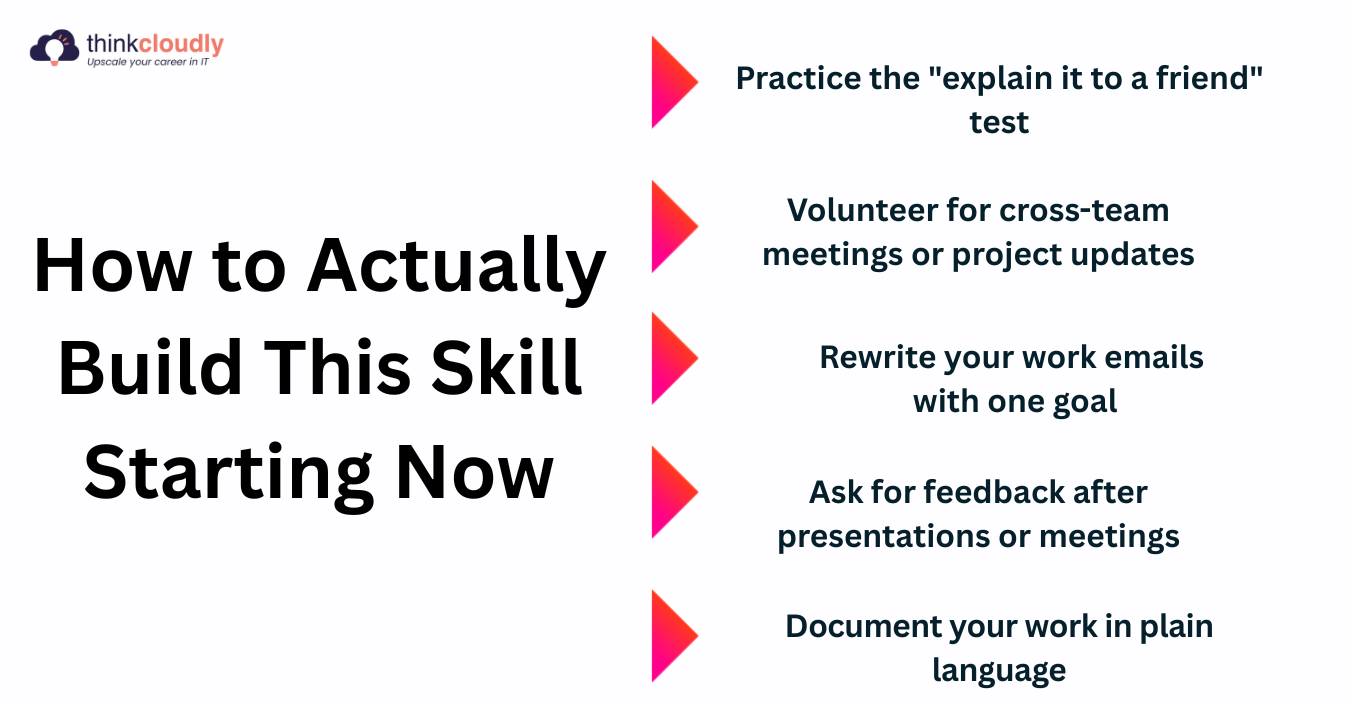
- Practice the “explain it to a friend” test: After solving a technical problem, try explaining what happened — out loud or in writing — to someone who doesn’t work in tech. If they understand it, you’ve done well.
- Volunteer for cross-team meetings or project updates: Every time you present your work to someone outside your immediate team, you build a muscle that most IT professionals rarely use.
- Rewrite your work emails with one goal: would a non-technical person reading this immediately know what you need them to do? Cut jargon. Use short sentences. State the ask clearly.
- Ask for feedback after presentations or meetings: Even informal feedback — “Did that make sense to you?” — tells you more than any online course will.
- Document your work in plain language: Writing weekly or bi-weekly notes about what you worked on, written for a general audience, builds both writing skills and the habit of communicating your value proactively.
What This Means If You’re Job Hunting Right Now
If you are actively looking for an IT role — or planning to — this is worth taking seriously before you even send your next application. Your resume, your LinkedIn profile, and your interview answers all need to reflect not just what you know, but how clearly you can talk about it.
When you describe past projects, lead with the impact. Don’t write “implemented a firewall upgrade.” Write “reduced security risk for 300 users by upgrading the firewall with zero downtime.” The second version communicates technical competence and business awareness at the same time.
In interviews, slow down. Resist the urge to prove how much you know by diving into technical detail. The best IT interview answers tell a clear story: the problem, what you did, why you made that choice, and what the result was. That structure works every time.
Conclusion
There is no shortage of technically skilled people in the world. Every year, more professionals earn certifications, complete boot camps, and master new frameworks. That’s all genuinely valuable. But the candidates who stand out — the ones who move faster through hiring processes and advance more quickly once they’re inside a company — are the ones who can bring other people along with them.
Communication is that skill. Not because technical knowledge doesn’t matter — it absolutely does — but because technical knowledge that can’t be shared, explained, or advocated for effectively is knowledge that gets undervalued. The engineer who fixes the server quietly is doing important work. The engineer who also explains clearly why that fix matters — and what it means for the business — is the one who gets promoted.
The encouraging part is that this is a skill anyone can work on. You don’t need a special gift for it. You need a bit of intention, a bit of practice, and the willingness to pay attention to how your words land on the people around you. Start small. Start today.
Sources & References
- Communication ranked #1 in-demand skill for two consecutive years.
- IT Support Group. IT Hiring Manager Insights: Communication Skills 2026. 92% of hiring professionals prioritize soft skills equally with or above technical capabilities.
- HR Dive. 3 in 5 Employers Say Soft Skills Are More Important Than Ever. Workers with soft skills get promoted faster; AI-skill demand drops.
- IBM Learning Blog — Skills Transformation for the 2022 Workplace. Technical IT skills have a shelf life of just 2.5 years; communication is classified as a durable skill that does not expire.
- SHRM (Society for Human Resource Management) — 2025 Talent Trends Report. 75% of organizations struggled to fill roles due to soft-skill gaps in candidates.
- CNBC Make It. The No. 1 Soft Skill You Need to Get Hired Right Now. LinkedIn career expert Catherine Fisher on communication as the most transferable skill.