
If you’ve ever read anything about modern app development, then you’ve probably heard the term “serverless” more than once. And if you’re like most students (or even working developers) hearing this for the first time, your first thought was probably, “Wait, there are still servers, right? Yes. There are. The name is a little misleading, but the idea behind it is actually one of the smartest changes to the way we build software today.
In this blog, I am going to explain serverless computing in simple language—no jargon overload and no confusing diagrams to make you feel dumber than when you started. By the end you’ll know what it is, how it works, why companies love it, and how it compares to the traditional way of running applications.
Let’s get into it.
What Is Serverless Computing, Actually?
Here’s the most basic way to put it: serverless computing is a cloud computing model where you write and run your code without ever having to think about the servers underneath it. You don’t provision them, you don’t patch them, you don’t scale them manually, and you absolutely don’t lose sleep over them crashing at 2 AM.
All that stuff is handled behind the scenes by the cloud provider (AWS, Microsoft, Google, etc.). All you need to do is write the function and upload it, and the platform takes care of the rest, including scaling the function up when traffic increases and scaling it down to zero when nobody is using it.
Calmops’ 2026 serverless guide defines serverless computing as a cloud execution model where the cloud provider manages the infrastructure, developers code in functions that respond to events, and the provider is responsible for scaling, capacity provisioning, and server management.
So when you encounter the term “serverless computing” that doesn’t mean servers disappear into thin air. Now they’re somebody else’s problem, not yours.”
What Is Serverless? Why Is It Called Serverless If There Are Servers?
Good question and one that many students stumble on. The name refers to the developer experience, not the physical hardware. No server to log into, configure, or maintain from your side of the screen. You only write code. And that’s the whole pitch of serverless computing — it removes the operational baggage that used to eat up so much developer time.
The Basic Idea of FaaS (Function-as-a-Service)
Most discussions about serverless come back to FaaS, Function-as-a-Service, which is really the engine room of serverless computing. You don’t deploy an entire application that is always running. Rather, you deploy small, independent functions that are only run when a particular event triggers them.
According to DEV Community’s 2026 comparison of serverless and containers, serverless (FaaS) is an event-driven compute that executes code without provisioning or managing servers; examples include AWS Lambda, Azure Functions, Google Cloud Functions, and Cloudflare Workers.
Think of FaaS as a light switch. The light does not consume electricity all the time; only when you flip the switch (the event) does it turn on and do its job and then turn off again. You’re charged only for the time the light was actually on. That’s a big shift from the old-school servers that ran all the time whether anyone was using them or not.
Getting to Know Event-Driven Architecture
It’s impossible to talk about serverless without talking about event-driven architecture, and that’s the backbone that makes the whole thing work. In this setup your code does not run on a schedule or sit waiting in an infinite loop.
Instead, it only “wakes up” when something specific happens: a file is uploaded, a database entry changes, a user submits a form, an API request comes in. This event-driven architecture approach is efficient because it doesn’t waste resources on idle processes
This is a great concept to know early on for students learning system design because it appears not just in serverless computing but also in messaging queues, IoT systems, and microservices.
The common real-world events for serverless event-driven architecture are the following:
- A new file in the cloud storage
- Updating a row in a database
- A request to an API endpoint over HTTP
- A timer that will sound
- A message that arrives in a queue
Meet The Big Three: AWS Lambda, Azure Functions and Google Cloud Functions
The three heavyweights that power most of the serverless computing industry are the following: you can’t understand serverless computing without them.
The pioneer really was AWS Lambda. Basically, Amazon kicked off the modern serverless movement with it. Signisys’ 2026 AWS Lambda guide states that AWS Lambda is a serverless compute service that automatically scales to thousands of concurrent executions to process incoming requests without provisioning or managing any servers. You pay only for the compute time you consume.
It’s deeply integrated with the rest of the AWS ecosystem, so it’s a natural choice for teams already living in AWS. Microsoft’s offering is Azure Functions, which plays the same game with its own flavor.
According to Sedai’s comparison guide, “Azure Functions is a serverless compute service that allows you to run event-triggered code without having to explicitly provision or manage infrastructure. It runs code written in lightweight functions in response to events.”
It’s a good choice for teams already using Microsoft’s cloud stack or .NET applications. Completing the group is Google Cloud Functions, which provides a comparable event-driven, pay-per-use experience but is integrated with Google’s cloud ecosystem—a handy choice if you’re already using tools like Firebase, BigQuery, or Google Pub/Sub.
The good news for students? Once you understand the concepts on one platform, it is pretty easy to pick up the others, as the basic logic of triggers, functions, and scaling is pretty consistent across all three.
How Does Serverless Computing Power Back End Services?
A lot of modern backend services run on a serverless infrastructure these days, and it’s easy to see why. Rather than running a server to handle login systems, payment processing, image resizing, or notification delivery, developers are able to break these tasks down into individual functions that only boot up when needed.
This is useful especially for backend services with unpredictable traffic. Consider an e-commerce site during a flash sale—traffic can be steady for months and then spike 50x in one hour.
A traditional server setup would crash under the load or be over-provisioned (and expensive) the rest of the year just in case. Serverless backend services scale up and down automatically so you’re never paying for capacity you don’t need.
With serverless functions, you pay only for resources you actually consume, not for pre-provisioned compute capacity or idle time. And that one pricing change is among the biggest reasons that both startups and enterprises have leaned into serverless for their backend services.
Cloud automation: A hidden superpower
One thing that doesn’t get enough attention is that cloud automation is pretty much in the DNA of serverless computing. The cloud provider automates everything in the deployment pipeline, from failover to scaling to resource allocation.
This cloud automation means developers spend more time writing actual features and less time babysitting infrastructure dashboards. It also reduces human error, as manual configuration of servers is often where things go wrong—a patch forgotten, a firewall rule misconfigured, an outdated dependency.
In serverless environments, cloud automation typically includes:
- Automatic scaling up when traffic peaks
- Automatically scales down to zero when idle
- Integrated load balancing without manual configuration
- The provider managed automatic patching and security updates.
- Automatic retries of failed function executions
If you are a student who wants to get into the DevOps or cloud engineering space, learning cloud automation is really one of the most valuable skills you can acquire right now because almost every modern cloud-native company uses it.
Serverless Computing vs Traditional Servers: A Quick Comparison
Occasionally a table can clarify things quicker than paragraphs ever could. Here’s a quick comparison of serverless computing and the traditional server model.
|
Feature |
Serverless Computing |
Traditional Servers |
|
Managing Infrastructure |
Completely handled by the cloud provider |
Run manually by your team |
|
Scaling |
Up and down, even to zero |
Manual or semi-automated, often over-provisioned |
|
Invoicing |
Pay only for the actual time of execution |
Pay for server uptime even when idle |
|
Speed of Deployment |
Quick— deploy a function at a time |
Slower — deploy full applications or VMs |
|
Maintenance |
Provider handles patches, minimal |
High, requires ongoing server upkeep |
|
Best for |
Unpredictable, event-driven workloads |
Long term consistent loads |
|
Cold start delay |
May occur on first call |
N/A, always on |
When Should You Really Use Serverless Computing?
Serverless is not a silver bullet; students should understand this nuance and not treat it as a buzzword. It shines in particular situations:
- Variable traffic APIs and microservices
- Tasks related to processing files (resizing images, transcoding video, parsing documents)
- Scheduled jobs and cron-like jobs
- Real-time data processing of streams or IoT devices
- Chatbots and Basic Backend Logic
On the flip side, it’s usually not the best fit for long-running processes, heavy stateful applications, or workloads that require consistent low-latency performance without any cold start delay. The Calmops 2026 guide points out that the best serverless workloads are event-driven processing, web APIs, and file processing and that long-running processes and stateful operations should be avoided.
The Real Benefits of Serverless Computing
So, to quickly recap why so many teams are moving over:
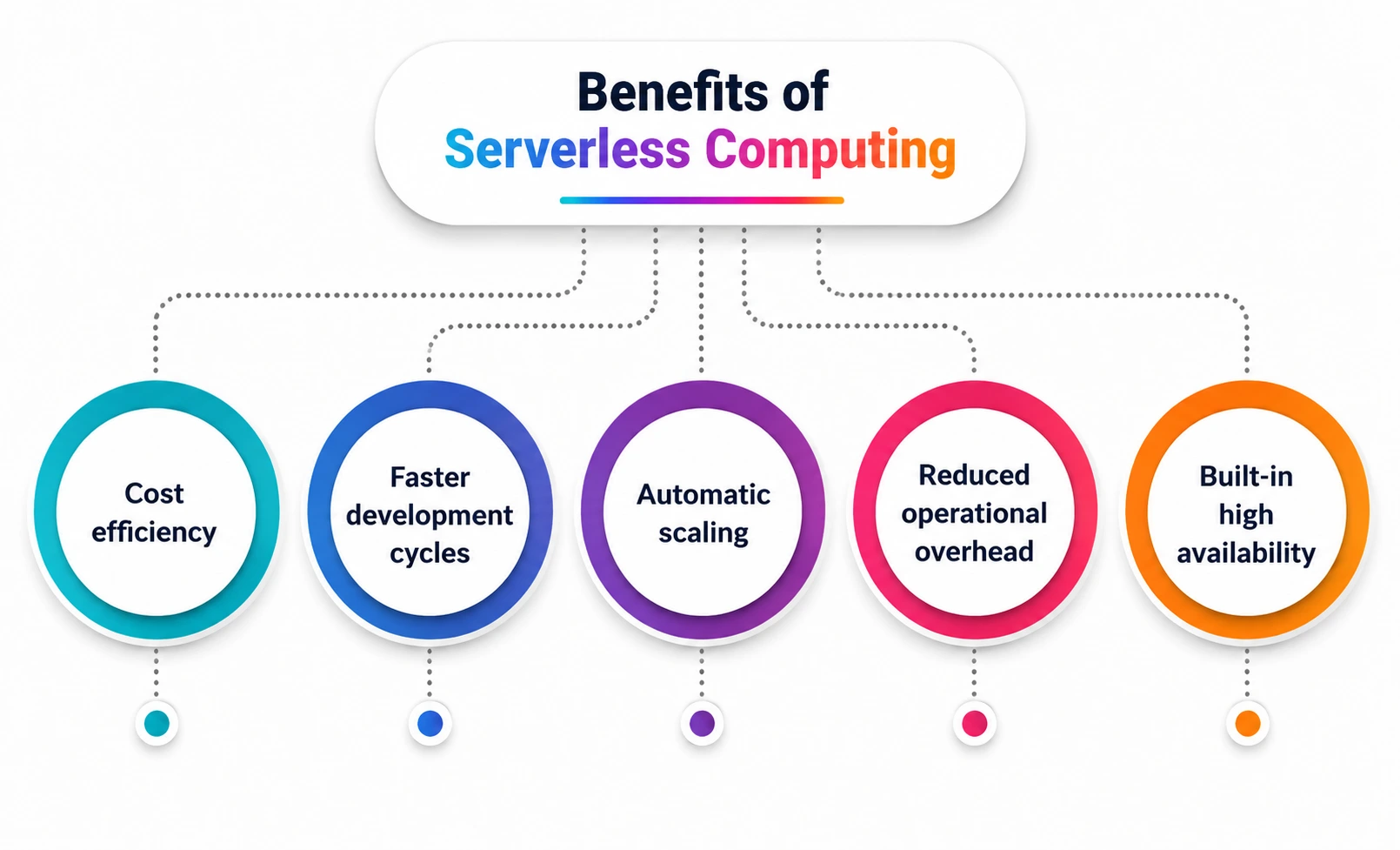
- Cost efficiency – You are billed only for what you actually use, sometimes down to the fraction of a second.
- Faster development cycles – Developers concentrate on code, not infrastructure.
- Auto-scaling – No manual intervention when traffic spikes.
- Less operational overhead – Less time maintaining and patching servers.
- Built-in high availability – Cloud providers distribute functions across multiple servers and regions.
The Trade-Offs You Should Know About
No technology is perfect, and serverless computing has its own set of challenges:
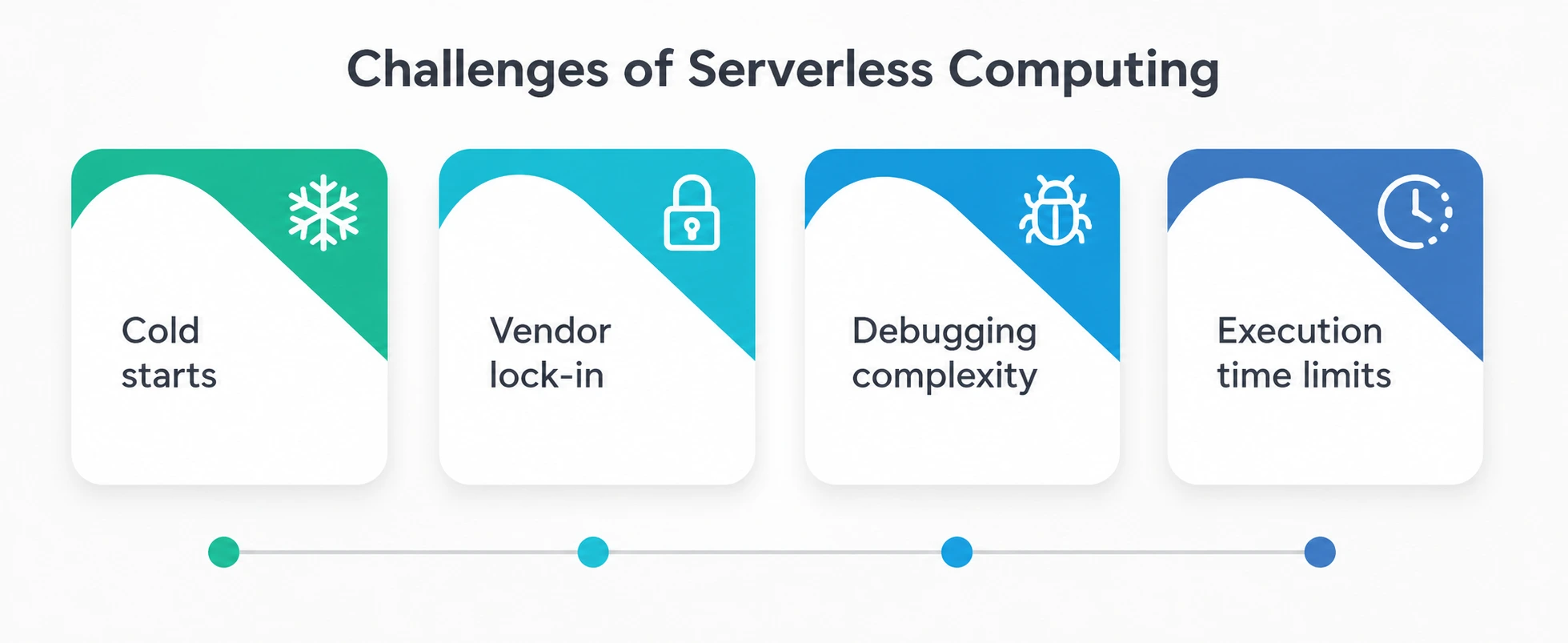
- Cold starts – The first request to an idle function is a little slower as the environment starts up.
- Vendor lock-in – It is not always a smooth transition between providers. Each provider has their own tools.
- Debugging challenges – Distributed functions are more difficult to debug than in a single monolithic app.
- Time limits for execution – Most FaaS platforms impose a time limit on the execution of a single function.
You need to know the trade-offs, not just the benefits, particularly if you are a student trying to figure out when serverless is truly the right tool for a project versus when a traditional server setup makes more sense.
Closing thoughts
Serverless computing is not a fad. It’s a fundamental part of modern application development. All of this – the FaaS platforms like AWS Lambda, the event triggers that drive event-driven architecture, the cloud automation humming away in the background – is there so developers are able to focus on what really matters: building good software, not babysitting servers.
My advice to you if you are a beginner in cloud computing is to get your hands dirty. Create a free tier account with AWS, Azure, or Google Cloud; write a tiny function; hook it to a trigger; and watch it run. You can read about serverless computing, but until you deploy your first function, it won’t make much sense.
A Personal Note
I remember deploying a function the first time with no server setup, and honestly, it felt a little too easy, like I was missing something. It’s totally normal to feel that confusion when you’re just getting started. Don’t beat yourself up if serverless computing seems abstract at first.
Try it on a small project, break something, fix it, and you’ll understand it much faster than any article (including this one) ever will.