

Not long ago, if you said someone worked in cloud computing, you could make a reasonable guess about what kind of company they worked for. A tech startup, probably. A software business, maybe. Not a bank. Not a hospital. Not a car manufacturer or a supermarket chain. Those organizations ran their own servers in their own data centers, and the cloud was somebody else’s problem.
Ask yourself when that changed, and you will struggle to name a single moment. It did not announce itself. It just happened, gradually and then all at once, until suddenly your bank was running fraud detection on AWS, your hospital was storing patient records on Microsoft Azure, your grocery chain was managing its supply chain on Google Cloud, and your insurance provider was processing claims through AI systems that cloud infrastructure made possible.
Every major industry has become a cloud operation. Finance, healthcare, retail, manufacturing, energy, and government have all completed or are completing migrations that would have seemed implausible a decade ago. Not because someone decided it should be, but because the economics made it inevitable and the pandemic made it urgent. Most people outside these industries have not quite registered how complete the shift has been, which is part of what makes this moment interesting from a career perspective.
When the entire economy reorganizes around a new way of operating, it creates something predictable: jobs that did not exist before, pressure on jobs that depended on the old model, and a window for people who understand what changed and move toward it deliberately.
How This Actually Happened
The migration was not planned. It accelerated out of necessity.
The COVID-19 pandemic forced organizations that had been slowly considering cloud migration to execute it under pressure. Remote work required cloud-based collaboration tools. Surging demand for digital services required scalable infrastructure. Supply chain disruptions required real-time data visibility that only cloud platforms could provide at the speed organizations needed.
By the time those emergency migrations stabilized, organizations discovered something that changed the calculus permanently: cloud infrastructure was cheaper, more flexible, and more capable than what they had been running on-premise. The cost of going back exceeded the cost of staying. The migration became permanent.
Then AI arrived and accelerated everything. According to Gartner’s 2026 cloud market analysis, AI workloads are now the single largest driver of new cloud adoption across all industries. A hospital that wants to use AI for diagnostic support needs cloud infrastructure to run it. A retailer that wants AI-powered inventory management needs cloud data pipelines to feed it. A manufacturer that wants predictive maintenance needs cloud-based sensor data processing to enable it.
AI did not just ride on top of existing cloud adoption. It created entirely new reasons for industries that had resisted cloud migration to accelerate it.
The Industries That Changed Most Dramatically
Healthcare moved further and faster than most observers expected. Electronic health records, telemedicine platforms, AI diagnostic tools, and genomic data processing all require cloud infrastructure at a scale that no individual hospital system could build independently. According to IDC’s 2026 Healthcare Cloud Spending Report, healthcare cloud expenditure grew 34% year over year in 2025, making it the fastest-growing sector for cloud adoption globally.
Financial services, long the most cautious industry around cloud migration due to regulatory concerns, has now largely completed its transition. JPMorgan Chase, Goldman Sachs, and most major European banks are running core systems on cloud platforms. The regulatory frameworks that once seemed like barriers, GDPR, PCI-DSS, and SOX compliance, have been addressed through platform-specific compliance tools that cloud providers built specifically to unlock financial services adoption.
Manufacturing is perhaps the most underappreciated transformation. The combination of IoT sensors, real-time production monitoring, AI-driven quality control, and predictive maintenance has turned manufacturing facilities into data-intensive operations that require cloud-scale computing. McKinsey Global Institute’s 2025 Future of Manufacturing report identifies cloud adoption as the single largest driver of productivity improvement in the sector over the past three years.
Government and public sector adoption, historically the slowest-moving category, accelerated dramatically after 2023 as multiple national governments published cloud-first infrastructure mandates. The US federal government, the UK public sector, and most major EU member states now require new systems to be cloud-based by default unless specific security exceptions are granted.
What This Means for the Job Market
When every major industry becomes a cloud company, the demand for cloud skills stops being concentrated in technology companies. It distributes across the entire economy. A cloud architect working in healthcare is not doing fundamentally different technical work from one working at a software company. But there are now ten times as many organizations that need cloud architects, and most of those organizations are not traditional technology employers.
This distribution effect is the single most important development in the technology job market over the past three years. It means that cloud skills are no longer a path into the technology industry. They are a path into every industry.
According to LinkedIn Economic Graph data, cloud-related job postings in healthcare grew 71% between 2024 and 2026. In financial services, cloud role postings grew 58%. In manufacturing, 63%. In government and public administration, 44%. The growth in traditional technology companies over the same period was 31%, the slowest of any sector.
Where the Jobs Are Concentrated
|
Industry |
Cloud Role Growth 2024-2026 | Most In-Demand Role |
Avg. Entry Salary (US) |
|
Healthcare |
+71% | Cloud Data Engineer |
$90,000 – $125,000 |
|
Financial Services |
+58% | Cloud Security Engineer |
$100,000 – $140,000 |
|
Manufacturing |
+63% | IoT Cloud Architect |
$95,000 – $135,000 |
|
Government / Public Sector |
+44% | Cloud Compliance Specialist |
$85,000 – $115,000 |
|
Retail and E-commerce |
+52% | Cloud FinOps Specialist |
$85,000 – $120,000 |
|
Energy and Utilities |
+48% | Cloud Infrastructure Engineer |
$90,000 – $130,000 |
|
Traditional Tech Companies |
+31% | Cloud Infrastructure Engineer | $115,000 – $160,000 |
The table reveals something important: traditional technology companies are actually the slowest-growing sector for cloud roles. The fastest growth is happening in industries that most people do not associate with technology careers at all. For anyone building a cloud career, the implication is clear: the strongest opportunities are in sectors most people do not think of as technology employers at all.
The Skills That Travel Across Every Industry
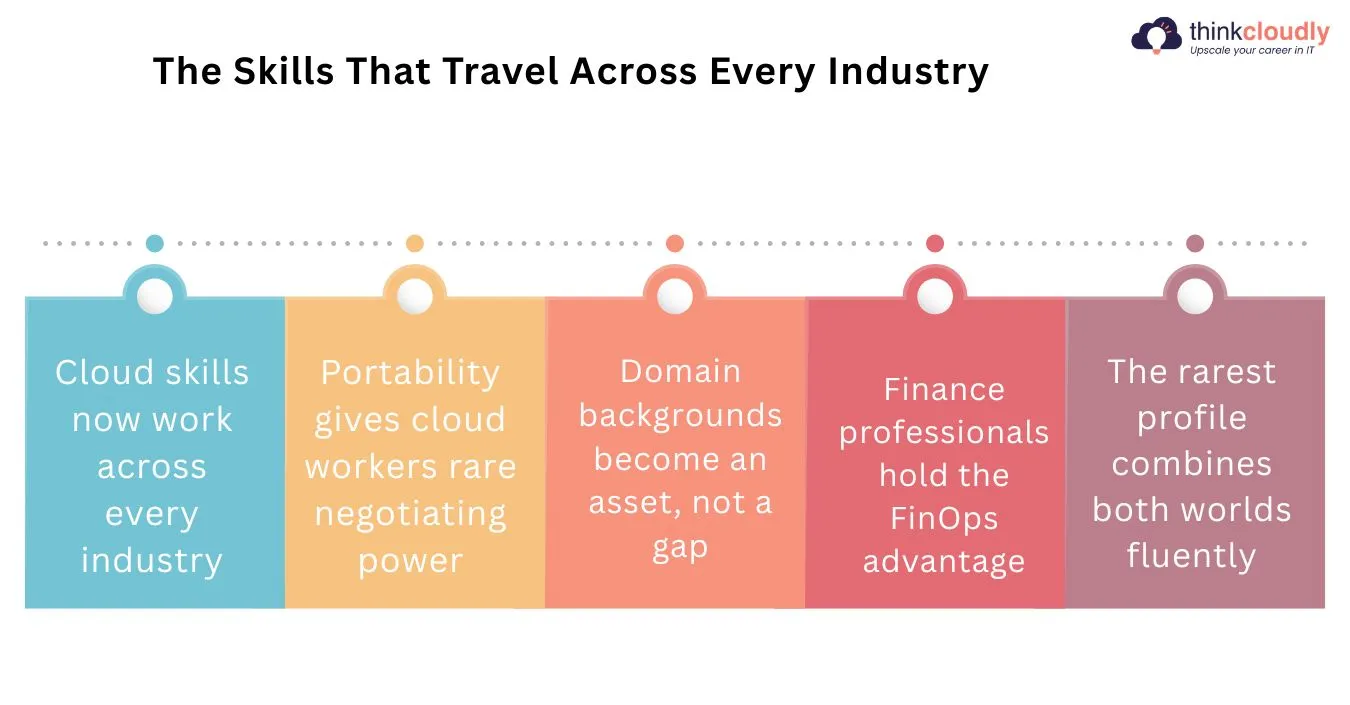
1. Cloud skills now work across every industry
Cloud infrastructure used to be concentrated inside technology companies. That is no longer true. Hospitals, banks, manufacturers, and government agencies all run on cloud platforms now, which means the person who knows how to design secure and cost-effective cloud architecture can take that knowledge anywhere. The underlying platform skills transfer completely. What shifts between industries is the regulatory environment, the compliance requirements, and the specific problems being solved. Those are learnable layers sitting on top of a foundation that stays constant regardless of where you use it.
2. Portability gives cloud workers rare negotiating power
When your skills are needed in every sector rather than one, no single employer holds much leverage over you. A cloud architect who can work in healthcare on Monday and financial services on Tuesday is not dependent on any particular company staying healthy, any particular industry staying funded, or any particular manager staying reasonable. That independence is not theoretical. It shows up in salary negotiations, in the ability to walk away from bad working conditions, and in the freedom to choose work that aligns with what you actually care about rather than what happens to be available nearby.
3. Domain backgrounds become an asset, not a gap
Here is the part that surprises most people looking at cloud careers from the outside. A pure cloud engineer competing for a healthcare deployment role is at a disadvantage compared to a nurse who developed cloud skills. The nurse already knows how a hospital operates, what clinical workflows look like, where the compliance pressure points sit, and what the people using the system actually need from it. That operational context cannot be learned from documentation. It comes from years of working inside the environment. The cloud knowledge is the learnable layer. The domain understanding is the rare and valuable part that a technical background alone cannot replicate.
4. Finance professionals hold the FinOps advantage
The same logic applies directly in financial services. A financial analyst who develops cloud cost management skills is not just a cloud professional with a finance certificate. They understand how money moves through an organization, how budgets get approved, how cost overruns get escalated, and what language resonates with the senior leaders making spending decisions. A purely technical cloud professional has to learn all of that after the fact. According to the FinOps Foundation’s State of FinOps 2026, cloud cost management specialists coming from finance backgrounds earn an average of 22 percent more than those from purely technical backgrounds. The market is not being generous. It is accurately pricing something genuinely hard to find.
5. The rarest profile combines both worlds fluently
What the current cloud market is genuinely short of is not technical depth on its own or domain expertise on its own. It is people who can operate fluently in both directions without losing competence in either. Someone who can sit in a room with clinicians, understand what they are describing, translate that into a cloud architecture decision, and then explain the cost and compliance implications back in plain terms is solving a problem that most organizations cannot solve by hiring two separate people. That combination takes longer to develop than a single skill set. It also produces a professional profile that is genuinely difficult for employers to find, which is exactly why it commands the premium it does.
What It Means for People Considering a Career Move
The practical implication of every major industry becoming a cloud company is that cloud skills are now one of the most stable and transferable career investments available. Unlike many specializations that are valuable in narrow contexts, cloud competence is relevant across the entire economy.
For someone already working in a non-technology industry, developing cloud skills in that specific sector is particularly powerful. A healthcare administrator who becomes proficient in AWS healthcare compliance frameworks does not need to leave healthcare to access technology compensation. They can stay in the field they know and add the skills that sector is desperately trying to source.
For someone entering the workforce, choosing a cloud specialization and pairing it with domain knowledge in a specific industry creates a profile that is genuinely difficult for employers to find. The barrier to entry is certification rather than degree. The AWS Cloud Practitioner certification is achievable in six to eight weeks. The Google Cloud Associate Cloud Engineer certification typically takes eight to twelve weeks. The FinOps Foundation Certified FinOps Practitioner credential, specifically valuable in industries managing significant cloud expenditure, takes six to eight weeks.
According to Robert Half’s 2026 Technology Salary Guide, professionals with industry-specific cloud certifications earn between 15 and 25 percent more than those with generic cloud credentials alone. The combination matters more than either element in isolation.
CompTIA’s State of the Tech Workforce 2026 identifies cloud skills as the most consistently in-demand capability across all sectors of the economy, a designation that reflects how completely the migration has distributed cloud needs beyond the technology industry’s traditional boundaries.
The Honest Caveat
The cloud job market is not without pressure points. The most commoditized cloud skills, basic server administration, routine cloud operations, and standard infrastructure monitoring are increasingly handled by automation and AI management tools. The roles with genuine long-term security are those that require judgment, architectural decisions, security thinking, cost optimization, and the ability to apply cloud capabilities to specific industry problems.
The distinction that matters is between someone who operates cloud infrastructure and someone who designs, secures, optimizes, or governs it. The former is under growing automation pressure. The latter is in sustained and growing demand. As with most of the technology job market in 2026, the boundary between these two categories is where the most important career decisions are being made.
Sources & Further Reading
The data and statistics in this article are drawn from the following sources:
- Gartner — Cloud Market Analysis and AI Workload Trends 2026 — Cloud market growth, AI infrastructure demand, and workload trends
- IDC — Healthcare Cloud Spending Report 2026 — Healthcare industry cloud spending and adoption insights
- McKinsey Global Institute — Future of Manufacturing 2025 — Manufacturing transformation, automation, and digital adoption trends
- LinkedIn Economic Graph — Jobs on the Rise 2026 — Employment growth, hiring trends, and emerging technology roles
- CompTIA — State of the Tech Workforce 2026 — Technology workforce size, skills demand, and IT employment insights
- FinOps Foundation — State of FinOps 2026 — Cloud cost optimization and financial operations trends
- Robert Half — 2026 Technology Salary Guide — Salary benchmarks and compensation trends for technology professionals
- ISC2 — Cybersecurity Workforce Study 2024 — Cybersecurity talent shortages and workforce demand statistics
- World Economic Forum — Future of Jobs Report 2025 — Future workforce skills, automation impact, and employment forecasts
- US Bureau of Labor Statistics — Computer and IT Occupations Outlook — Employment outlook and growth projections for IT occupations
- AWS — Cloud Adoption Framework for Healthcare and Financial Services 2025 — Enterprise cloud adoption strategies and industry best practices
- Synergy Research Group — Cloud Market Share by Vertical Industry Q4 2025 — Cloud market share analysis across major industry sectors
Data references primarily cover U.S. and global technology, cloud computing, workforce, and cybersecurity trends from 2024 to 2026.