
There is a good chance that the last time most people visited a doctor, their medical records were stored somewhere they would never physically see. Not in a filing cabinet, not on a server in the hospital basement, but floating in what the tech world calls “the cloud.” Most people have no idea how dramatically cloud technology has reshaped the way healthcare works or how many well-paying careers it is quietly creating along the way.
Let’s break it all down in plain English.
Most people have no idea how dramatically cloud technology has reshaped the way healthcare works or how many well-paying careers it is quietly creating along the way. This piece breaks that down in plain English.
The scale of what is happening is worth understanding before anything else. The healthcare cloud market is on track to grow from 74.57 billion dollars this year to over 251 billion dollars by 2034. Eight out of ten healthcare organizations are already using cloud-based services in some form. Anyone who has had a virtual doctor’s appointment, received a digital prescription, or had test results sent electronically has already benefited from it without giving it a second thought.
So what actually is the cloud in a healthcare context? The simplest comparison is Google Drive. It lets anyone access files from any device, anywhere. Healthcare cloud works on that same basic idea, scaled up to handle millions of patient records, power AI tools that scan X-rays for early signs of cancer, and keep a video consultation running smoothly between a cardiologist and a patient who cannot easily travel. For years hospitals ran everything the old way: local computers, physical servers in back rooms, and IT teams scrambling whenever something crashed. Moving to the cloud meant handing that infrastructure burden to specialists like Amazon Web Services, Microsoft Azure, and Google Cloud, freeing hospitals to focus on what they are actually there to do.
How Big Is This, Really?
The scale of what’s happening here is genuinely hard to wrap your head around. The healthcare cloud market is on track to grow from $74.57 billion this year to over $251 billion by 2034. That’s not incremental growth. That’s an industry in the middle of a full-scale transformation, pushed along by everything from AI-assisted diagnosis to smartwatches that monitor your heart while you sleep.
This is not an emerging trend. It is already here. Eight out of ten healthcare organizations are using cloud-based services in some form. Anyone who has had a virtual doctor’s appointment, received a digital prescription, or had test results sent electronically has already benefited from it without giving it a second thought.
The financial case is hard to argue with too. Organizations that have made the switch report cutting their IT costs by an average of 12.1%. For a mid-sized hospital, that’s millions of dollars a year redirected away from maintaining aging servers and toward actual patient care. Hiring more nurses. Buying better equipment. Keeping waiting times down. The cloud, in that sense, isn’t just a technology story. It’s a healthcare quality story.
What Is the Cloud Actually Being Used For?
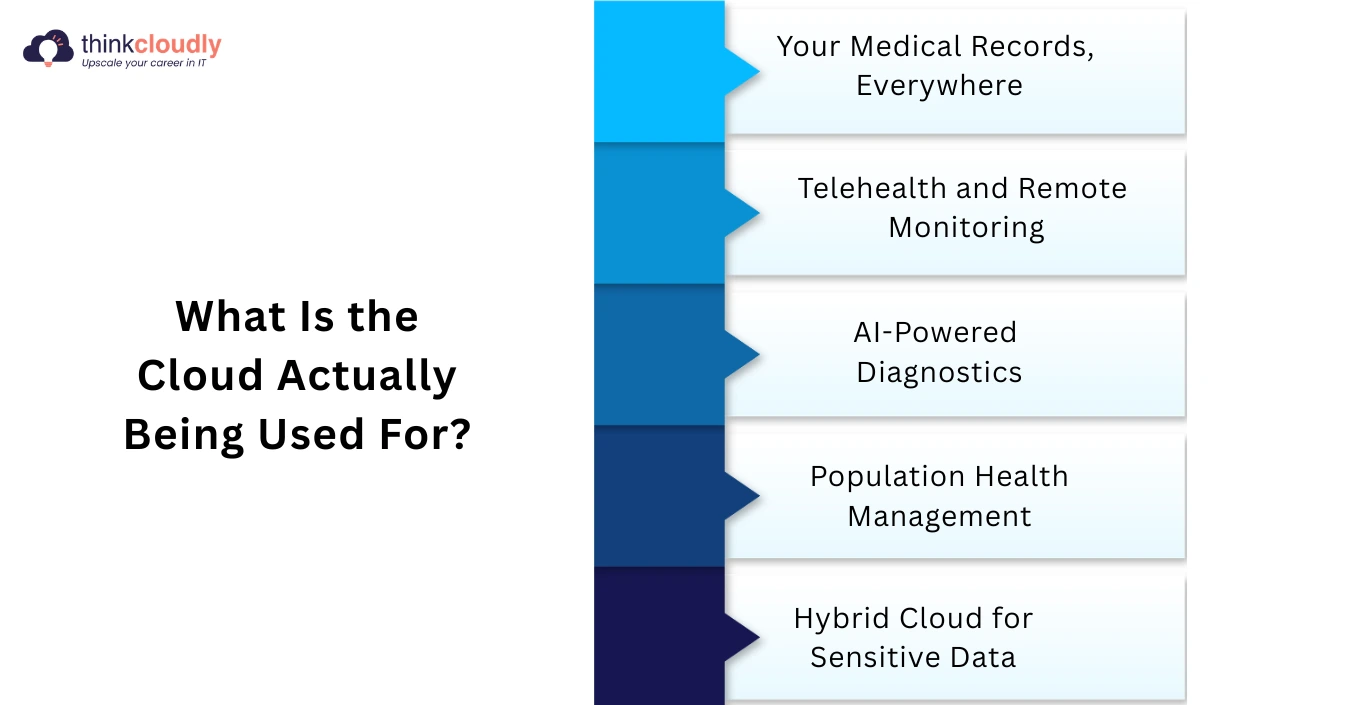
1. Your Medical Records, Everywhere
Gone are the days when your doctor needed to fax your records to a specialist across town. Electronic Health Records (EHRs), once stored in physical files or local systems, are now commonly hosted on cloud platforms, allowing doctors to securely access patient history instantly from anywhere.
This matters enormously in emergency situations. If a patient is travelling and ends up in an unfamiliar hospital, the cloud means the attending physician can pull up your allergies, medications, and history in seconds, potentially saving your life.
2. Telehealth and Remote Monitoring
World Health Expo’s research on AI and emerging healthcare technology found that approximately 75 percent of facilities using AI telehealth systems report enhanced disease treatment effectiveness, while 80 percent report reduced staff burnout rates.
3. AI-Powered Diagnostics
This is where things get genuinely remarkable. According to World Health Expo’s analysis of AI integration in healthcare, AI tools now analyze medical images with up to 98 percent accuracy, outperforming human radiologists in some specific diagnostic categories. These systems run on cloud infrastructure because they need enormous computing power that no individual hospital could reasonably maintain on its own.
At hospitals using AI telehealth systems, about 75% of facilities report enhanced disease treatment effectiveness, while 80% experience reduced staff burnout rates. That last point matters a great deal. Healthcare worker burnout is a global crisis, and AI handling documentation and diagnostics is giving clinicians their time back.
4. Population Health Management
Cloud computing’s data storage and analytics capabilities now support population health management on a new scale, helping healthcare organizations understand and improve health trends across communities, identifying patterns, addressing health disparities, and allocating resources more effectively.
In practice, this means public health agencies can spot a diabetes spike in a particular region, trace its causes in the data, and deploy targeted programs, all faster than was ever possible before.
5. Hybrid Cloud for Sensitive Data
Healthcare data is among the most sensitive in existence, and organizations aren’t rushing to put everything on public servers. The adoption of hybrid multi-cloud models in healthcare rose from 6% in 2023 to 16% in 2024, with institutions keeping sensitive patient data on private clouds while using public cloud scalability for demanding applications.
The Jobs Being Created (And What They Pay)
Here’s the part that surprises most people. The shift to cloud healthcare isn’t just changing how medicine works. It’s generating a wave of well-compensated careers that didn’t meaningfully exist a decade ago. And many of them don’t require you to be a doctor.
Graduates in cloud computing typically earn salaries 15 to 25% above the national average for IT roles, reflecting high demand and strong earning potential in sectors like finance, healthcare, and technology.
In healthcare specifically, cloud professionals managing sensitive, compliance-heavy data can expect salaries ranging from $111,000 to $122,000, driven by the shift to digital patient records and telehealth.
Here’s a look at the key roles emerging from this sector:
|
Job Title |
What They Do |
Typical Salary (US) |
|
Healthcare Cloud Architect |
Designs the entire cloud infrastructure for hospitals and health networks | $140,000 to $165,000 |
| Cloud Security Engineer | Protects patient data from breaches; ensures HIPAA compliance |
$125,000 to $150,000 |
|
Health Data Engineer |
Builds pipelines that move and process clinical data at scale | $115,000 to $140,000 |
| Telehealth Platform Engineer | Keeps virtual care systems running reliably for millions of patients |
$110,000 to $135,000 |
|
Clinical AI/ML Engineer |
Trains AI models that assist with diagnostics and treatment planning | $130,000 to $160,000 |
| Healthcare Cloud Compliance Manager | Ensures cloud systems meet legal and regulatory standards globally |
$120,000 to $145,000 |
|
EHR Cloud Integration Specialist |
Connects electronic health record systems to cloud platforms | $95,000 to $120,000 |
| Remote Patient Monitoring Engineer | Builds infrastructure for wearable and IoT device data streams |
$105,000 to $130,000 |
Senior-level cloud engineers in healthcare can pull in up to $183,000 a year, with some fully remote roles pushing close to $188,000. These are not salaries exclusive to a handful of tech giants in San Francisco. These are real positions being filled at hospital networks, health insurance companies, and government health agencies in cities and towns all over the country.
Even at the starting level, the pay is solid. Someone just entering the healthcare cloud space, managing the platforms that store patient records and keep everything compliant with health regulations, can reasonably expect to earn between $65,000 and $80,000 in their first role.
Why Healthcare Is One of the Best Industries for Cloud Careers
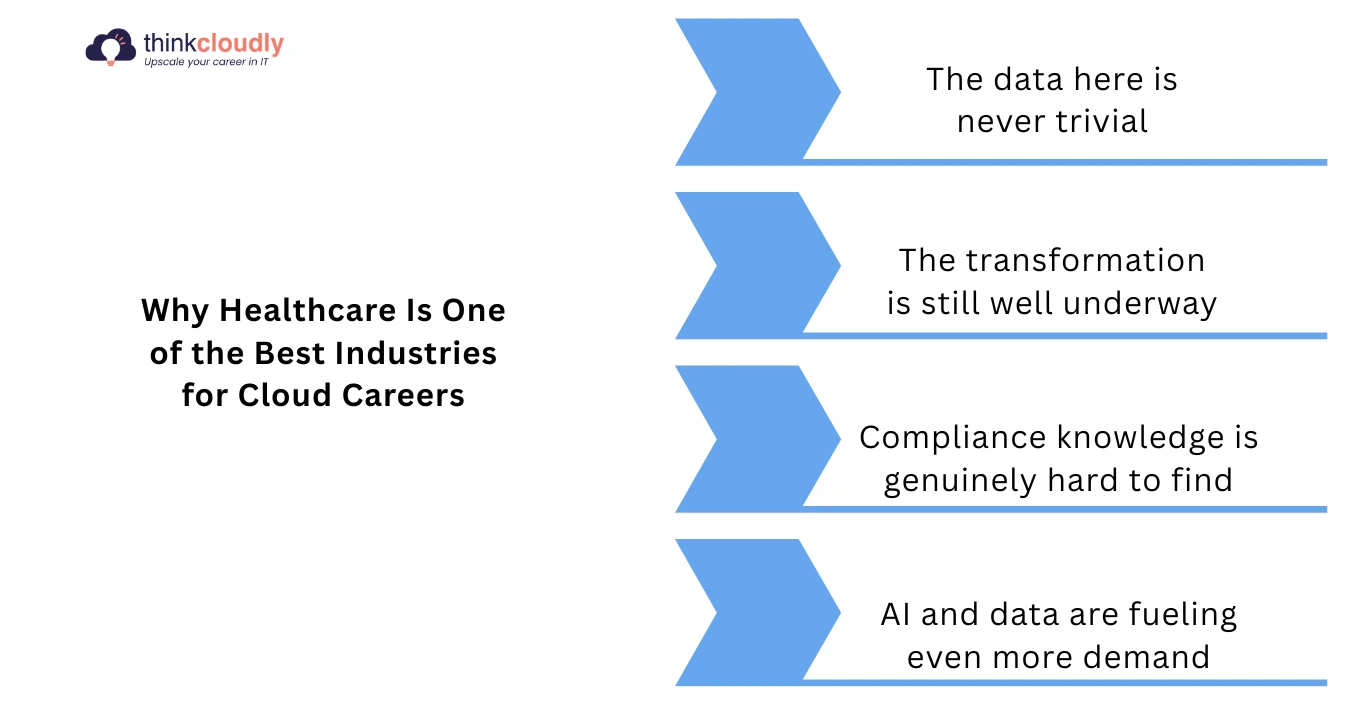
The data here is never trivial
In healthcare, it can put lives at risk. That weight attracts a different calibre of professional and commands a different level of pay. When the stakes are this high, organizations don’t cut corners on who they hire or what they pay them.
The transformation is still well underway
Finance and retail have been living in the cloud for years. Healthcare is still mid-journey. A huge number of hospitals and health systems are only partway through moving their operations across, which means the demand for skilled people isn’t peaking anytime soon. If anything, the busiest years are still ahead.
Compliance knowledge is genuinely hard to find
Knowing how to build cloud infrastructure is one thing. Knowing how to build it in a way that satisfies HIPAA in the US, GDPR in Europe, and NHS data governance rules in the UK is something else entirely. Professionals who can do both are rare, and the job market treats them accordingly.
AI and data are fueling even more demand
Modern healthcare generates extraordinary volumes of data every single day, far more than older on-site systems were ever built to handle. As hospitals lean harder into AI tools and big data analytics, the need for powerful, well-managed cloud infrastructure keeps growing, and so does the need for the people who build and maintain it.
What Does This Mean for Patients?
All the technology talk is interesting, but none of it matters more than this: what does it actually mean for the person sitting in the waiting room, or the one trying to avoid going there at all? It means your test results reach your doctor faster. It means the specialist you’re being referred to already has your full history before the patient walks through their door.
Oracle’s cloud-powered tools at AtlantiCare, for instance, cut documentation time by 41% and gave each doctor back over an hour of their day, an hour that now goes toward actually being present with patients rather than typing notes.
And then there’s the bigger picture. Predictive analytics built on cloud data have helped reduce hospital readmissions by up to 40%, meaning fewer people are ending up back in a hospital bed days after being discharged and fewer complications are slipping through the cracks.
At its core, the cloud in healthcare isn’t really a technology story. It’s about giving care back to caregivers and building a system that’s quietly working for patients even when they’re not thinking about it.
Conclusion
For anyone considering where to build a career in 2026, healthcare cloud sits at a genuinely rare intersection. The transformation is still well underway, compliance knowledge is in short supply, and the stakes of the work attract both serious professionals and serious compensation. The jobs being created here did not exist at scale a decade ago, and the demand behind them is not driven by a technology cycle.
It is driven by the permanent shift in how one of the largest industries in the world stores, processes, and acts on its most critical information. That shift is not slowing down, and neither is the need for the people who can navigate it.
Sources & Further Reading
The data and statistics in this article are drawn from the following sources:
- Fortune Business Insights — Healthcare Cloud Computing Market Size, Share & Industry Analysis, 2026 to 2034 — Market size, industry growth projections, and healthcare cloud adoption trends
- GlobeNewswire — Cloud Computing in Healthcare Research Report 2026 — Research insights, market developments, and industry forecasts
- Yahoo Finance—Healthcare Cloud Computing Research Report 2026, Global Market Size, Trends—Global market trends and healthcare cloud computing statistics
- MarketsandMarkets—Cloud Computing in Healthcare Market Report 2026 to 2031 — Forecast data and market segmentation analysis
- Carmatec — Cloud Computing in Healthcare and Medicine in 2026: Key Trends — Emerging healthcare cloud technology trends and innovations
- Precedence Research — Healthcare Cloud Computing Market Trends 2026 — Industry trends, market opportunities, and adoption patterns
- Market.biz—Cloud Computing Statistics by Access, Scalability and Facts (2026)—Cloud computing usage statistics and scalability insights
- Research.com—2026 Cloud Computing Degree Salary by Industry: Where Graduates Earn the Most—Salary benchmarks and industry earning comparisons
- Research.com—2026 Highest Paying Careers With a Cloud Computing Bachelor’s Degree—Career outlook and high-paying cloud computing roles
- CCI Training Center — Cloud Computing Salaries: A 2026 Guide to Top-Paying Jobs and Locations — Salary trends and geographic job market insights
- Motion Recruitment — 2026 Cloud Computing Salary Guide: Engineer, Developer, and Job Insights — Hiring trends, developer salaries, and cloud engineering job insights
- World Health Expo — AI and Emerging Tech Transform Healthcare — AI integration and digital transformation in healthcare
Data and projections referenced in this article primarily reflect global healthcare cloud computing trends and salary insights for 2025–2026.