
Every week, someone lands a cloud engineering job from their spare bedroom — no commute, no office, and a salary that beats most of their office-bound peers. The remote era didn’t end. It just got more selective. And if you have the right cloud skills, you are exactly who employers are still hunting for.
While some companies are pushing people back to the office, the cloud industry is quietly growing its remote workforce and hiring talent from all over the world. If you have been wondering whether a remote cloud career is still worth chasing, the answer is a firm yes — and the data backs it up.
The Big Picture: Where Remote Work Stands Right Now
Before we talk specifically about cloud jobs, it helps to understand the wider picture of remote work in 2026.
According to research from Stanford and multiple global workforce surveys, remote work has not collapsed. In fact, it has stabilized at a level far above where it was before the pandemic. In 2019, only about 5 to 7 percent of paid workdays were done from home in the United States. Today, that number sits at around 25 percent — more than three times higher than pre-pandemic levels.
Globally, around 48 percent of the workforce now engages in some form of remote or hybrid work. In the United States alone, over 34.6 million people were teleworking as of August 2025. That is not a shrinking trend. That is a new normal.
Yes, return-to-office mandates have been making news. But here is what those headlines often miss: planned shifts back to in-person work would reduce the overall share of remote workdays by less than half a percentage point, according to Stanford’s WFH Research Group. The numbers simply are not moving in the direction that RTO headlines suggest.
And when it comes to cloud roles specifically, the story is even more encouraging.
Why Cloud Jobs Are Different from the Rest
Not every job can be done remotely. A nurse needs to be in a hospital. A chef needs to be in a kitchen. But a cloud engineer, a DevOps professional, a cloud security analyst, or a solutions architect? Their entire workplace lives inside a browser, a terminal, or a cloud console. The work itself is designed to be location-independent.
This is the key reason cloud roles have held on to remote flexibility even as other industries tighten up. The tools of the trade are already digital. Collaboration happens through platforms like Microsoft Teams, Slack, and Zoom. Infrastructure is managed through dashboards and command lines. There is no physical component that demands someone sit in a specific building.
Technology fields, including cloud computing, have consistently ranked among the top sectors offering remote and hybrid opportunities. According to Robert Half’s Q1 2026 analysis, the technology sector has one of the highest rates of hybrid and remote job postings among all professional fields, with 26 percent of tech roles offering some form of flexible work arrangement.
The Hiring Numbers Tell a Clear Story
Here is a look at where remote and hybrid hiring actually stands across key industries in 2026:
|
Professional Field |
Fully on-site |
Hybrid |
Fully remote |
|
Marketing & creative |
70% |
21% |
9% |
|
Legal |
72% |
23% |
5% |
|
Technology |
74% |
18% |
8% |
|
Finance & accounting |
76% |
19% |
5% |
|
Human resource |
76% |
21% |
3% |
|
Healthcare |
85% |
6% |
9% |
|
Admin & customer support |
87% |
8% |
5% |
Technology stands out as one of the most flexible fields compared to others. While fully remote roles are competitive and fewer in number, the combination of hybrid and remote options gives cloud professionals more choices than almost any other sector.
It is also worth noting that remote job postings remain three times higher than they were before 2020, even after the 2023 pullback. Cloud roles account for a significant portion of that number, with computer and mathematical occupations showing a 5.4-fold increase in remote availability since 2019.
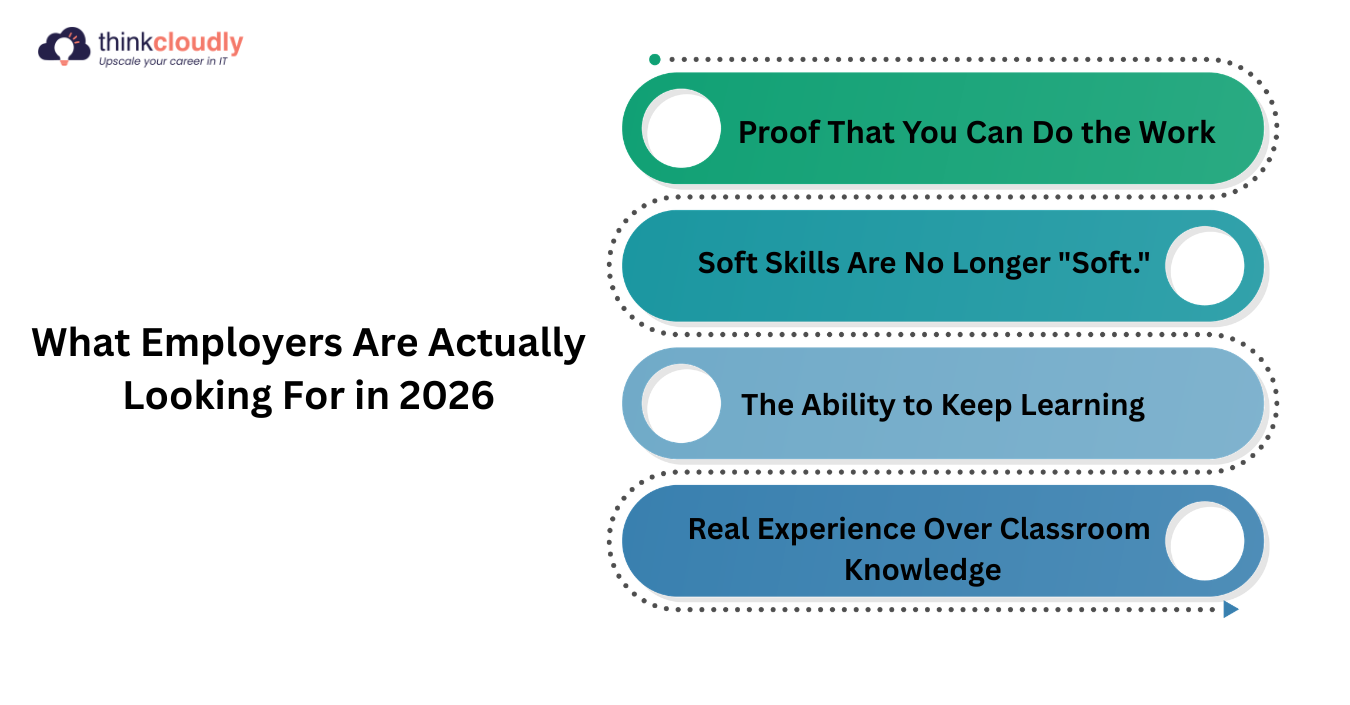
What Employers Are Actually Looking For
Remote cloud hiring in 2026 is not just about knowing how to set up a server. Employers want a specific combination of technical skill and professional maturity.
- Cloud platforms and certifications are the foundation. AWS, Microsoft Azure, and Google Cloud are the three dominant platforms. Certifications like AWS Solutions Architect, Azure Administrator, and Google Professional Cloud Architect are consistently listed in job requirements These credentials signal to employers that a candidate can handle real infrastructure without constant supervision, which is exactly what a remote hire needs to prove.
- Security knowledge has become non-negotiable. With distributed teams accessing systems from home offices around the world, companies need people who understand identity management, access controls, encryption, and compliance. Cloud security roles are among the fastest-growing remote positions available right now.
- Communication and documentation skills matter more in remote work than in any office setting. Employers hiring cloud professionals remotely want people who can write clearly, explain technical decisions, and work asynchronously with teams across time zones. This is a soft skill that hiring managers actively screen for.
- Experience with DevOps and automation tools like Terraform, Kubernetes, and CI/CD pipelines is highly valued. These tools allow distributed teams to build and manage infrastructure with minimal back-and-forth, making them especially well-suited for remote work environments.
The Pay Is Still Strong
One concern people have about remote cloud roles is whether employers use remote work as an excuse to lower salaries. In most cases, the data does not support this fear.
Remote workers in technical fields typically earn as much as or slightly more than their in-office counterparts. Some companies do apply location-based pay adjustments, particularly for candidates in lower cost-of-living areas, but this is not universal.
Beyond base salary, remote cloud workers save significant money by avoiding commuting costs, work wardrobe expenses, and costly city lunches. Remote work saves the average employee around $7,000 a year on these types of expenses. When you factor that into a total compensation picture, remote cloud roles compare very well to office-based alternatives.
Senior-level cloud roles also tend to carry the highest remote flexibility. Thirty percent of senior-level positions offer hybrid arrangements, and 15 percent are fully remote — higher rates than entry-level roles. For experienced cloud professionals, the negotiating power is real.
A Real-World Story: From Office Cubicle to Cloud Career
Tom had spent seven years as an IT helpdesk technician at a mid-sized insurance firm in Manchester. He was good at his job — reliable, methodical, well-liked. But the ceiling was low, the salary hadn’t moved in two years, and every morning he spent 90 minutes on a train to sit in front of a computer that could have been anywhere.
In early 2024, he started spending his lunch breaks on free cloud training content. Six months later, he sat his AWS Cloud Practitioner exam — and passed. Six months after that, he added the Solutions Architect Associate certification. He didn’t leave his job during this time. He just kept building.
By early 2025, he applied for a junior cloud infrastructure role at a UK-based fintech company. The role was fully remote. They hired him. His salary increased by 34 percent. He now works from a converted spare room at home, manages cloud environments for a team of developers, and hasn’t touched a commuter train since.
Tom’s story isn’t exceptional. It’s increasingly typical for people who treat cloud learning as a deliberate, patient investment rather than a quick fix.
Privacy note: The name and certain personal details in this account have been changed to protect the individual’s identity. The professional journey, timeline, and outcomes reflect real experiences shared during research for this article.
Why Companies Still Want Remote Cloud Talent
From the employer’s side, the case for remote cloud hiring is just as strong.
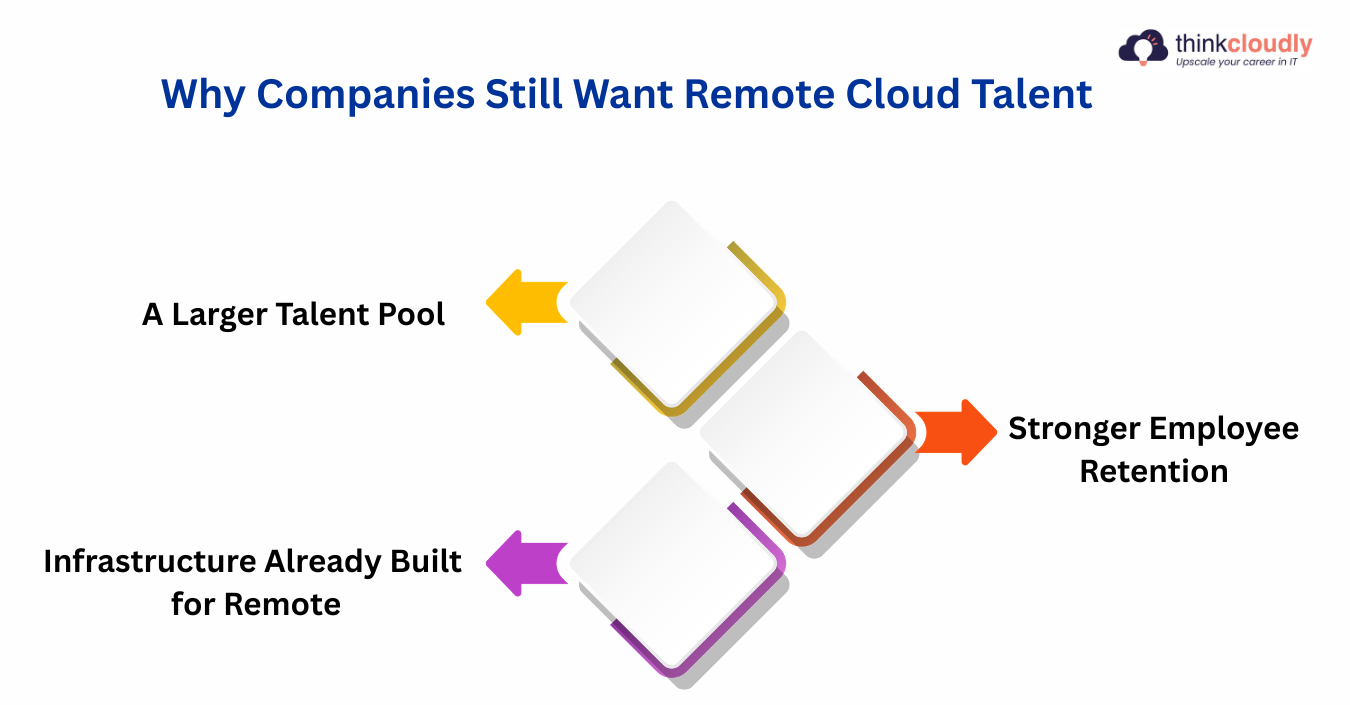
A Larger Talent Pool
When a company limits hiring to one city or region, it competes with every other local employer for a small number of candidates. When it opens up remote hiring, it can recruit from anywhere in the country or the world. For cloud roles that require rare specializations, this matters enormously.
Stronger Employee Retention
The numbers on this are hard to ignore. Around 57 percent of workers say they would consider leaving a job if remote work were taken away. In the UK, around 93 percent of workers said they would consider quitting if remote flexibility was revoked. For companies that want to hold on to skilled cloud professionals, offering remote options is not a perk — it is a retention strategy.
Infrastructure Already Built for Remote
When your systems are on AWS or Azure, your engineers can access, monitor, and manage everything from a laptop anywhere in the world. There is no operational reason to demand physical presence.
The Demand Side: Cloud Is Still Growing Fast
Remote cloud roles exist because demand for cloud services is still growing at a significant pace. Businesses everywhere — from small startups to large governments — are moving their systems to the cloud. Each of those migrations requires skilled professionals to design, build, and maintain the infrastructure.
The remote workplace services market, which includes cloud-based work tools and infrastructure, is projected to reach $58.5 billion by 2027, up from $20.1 billion in 2022. That kind of growth does not happen without a corresponding demand for the people who make it possible.
Cloud computing, AI integration, and cybersecurity are the three areas where employers are hiring the most aggressively in the tech sector right now. All three are remote-compatible by nature. If you have skills at the intersection of cloud and any one of these areas, your hiring prospects in 2026 are strong.
What the Future Looks Like for Remote Cloud Professionals
The long-term trajectory of remote work is upward, even if 2023 and 2024 felt like a step backward. Research from the World Economic Forum’s Future of Jobs Report and McKinsey Global Institute both point to continued expansion of remote and flexible work through the end of the decade. By 2030, an estimated one billion people globally are expected to work remotely at least part of the time.
For cloud professionals specifically, the outlook is particularly good. The skills are portable, the tools are fully digital, and the demand is global. Whether a company is based in New York, London, Toronto, or Singapore, it faces the same cloud talent shortage and the same operational reality: its infrastructure lives online, and so can its engineers.
Employers that offer remote flexibility will continue to attract the best cloud talent. Those who do not will find themselves losing ground in the hiring market. That competitive dynamic works in favor of remote cloud workers for years to come.
Conclusion
The Cloud Is Still Hiring Remotely — And That’s Not Changing
The return-to-office headlines are real. But they tell only half the story — and not the half that matters most to cloud professionals.
The data is clear. Remote work has stabilized at levels nobody would have imagined five years ago. Cloud infrastructure, by its very nature, is built to be managed from anywhere on earth. Demand for cloud skills is not slowing down — it is accelerating. And employers who want to stay competitive know that the best cloud talent will choose flexibility every single time.
This is not a window that is about to close. It is a structural shift in how technical work gets done. The engineers building tomorrow’s cloud infrastructure are doing it from kitchen tables in Bristol, home offices in Toronto, and spare rooms in Auckland — and companies are actively hiring them.
If you are building a career in cloud right now, you are not chasing a trend that is fading. You are planting your flag in one of the most durable, location-independent, well-compensated career paths in the modern economy. The only move left is to start — and to start today.
Sources and References
- Remote work has stabilized at around 25 percent of paid workdays in the US, more than three times higher than pre-pandemic levels — Stanford WFH Research Group
- Over 34.6 million people were teleworking in the United States as of August 2025 — Bureau of Labor Statistics (BLS)
- Planned RTO shifts would reduce remote workdays by less than half a percentage point globally — Stanford WFH Research Group
- 26 percent of tech roles offer some form of flexible work arrangement, ranking technology among the highest for hybrid and remote postings — Robert Half — Demand for Skilled Talent Report, Q1 2026
- Remote job postings remain three times higher than pre-2020 levels, with computer and mathematical occupations showing a 5.4-fold increase in remote availability since 2019 — DailyRemote — Remote Work Statistics 2026
- Remote work saves the average employee around $7,000 a year on commuting and office-related expenses — FlexJobs — Remote Work Survey, 2026
- 30 percent of senior-level positions offer hybrid arrangements and 15 percent are fully remote — Yomly — Remote Work Statistics 2026
- Around 57 percent of workers say they would consider leaving a job if remote work were taken away; 93 percent of UK workers said they would consider quitting if remote flexibility was revoked — Achievers — Remote Work Statistics 2026
- The remote workplace services market is projected to reach $58.5 billion by 2027, up from $20.1 billion in 2022 — Vena Solutions — Remote Work Statistics and Trends
- By 2030, an estimated one billion people globally are expected to work remotely at least part of the time — World Economic Forum — Future of Jobs Report & McKinsey Global Institute — Future of Work Research