
There’s a good chance you didn’t think about it this morning, but the moment you checked the weather on your phone, adjusted your thermostat from the sofa, or glanced at a fitness tracker on your wrist, you were touching the edges of two technologies that are, right now, quietly reshaping the job market in a very significant way.
IoT and cloud computing. On their own, each is a big deal. Together, they’ve become one of the most in-demand and well-compensated skill combinations in the modern economy. And the people who understand both, regardless of whether they have a traditional tech background, are finding themselves in a job market that’s actively competing for their attention.
So What Are IoT and the Cloud, Really?
IoT stands for the Internet of Things. It’s a slightly clunky name for a genuinely simple idea: everyday physical objects connected to the internet, sending and receiving data. Your smart doorbell, your car’s GPS, the sensors in a hospital ward tracking patient vitals, and the temperature monitors in a supermarket’s cold storage aisle. All of these are IoT devices. Global IoT connections are projected to reach 21.9 billion in 2026. That’s roughly three connected devices for every person alive on earth.
The cloud is the infrastructure that makes all of this useful. A sensor can collect data, but it needs somewhere to send it, something to process it, and a system to turn it into a decision or an alert. That’s what cloud platforms do. Without the cloud, IoT is just a bunch of devices talking into the void. With it, those devices become genuinely intelligent.
The pairing of the two is what’s creating the opportunity.
How Large Is This Market, and Why Does It Matter?
The scale here is hard to overstate. The IoT cloud platform market is growing from $29.17 billion in 2025 to $34.62 billion in 2026, at a compound annual growth rate of 18.7%, and is expected to reach $68 billion by 2030. The broader IoT solutions and services market sits at an estimated $400 billion in 2026, heading toward $1.29 trillion by 2033, with cloud-based deployment already holding the largest share at 54.3%. In other words, more than half of all IoT solutions today run on cloud infrastructure. The two aren’t just complementary. They’re practically inseparable.
The global IoT market overall is now valued at $714.48 billion, with the US alone contributing $342.5 billion, and 54% of enterprises are already using IoT to cut operational costs. This isn’t niche. It’s happening in manufacturing floors, hospital corridors, shipping ports, apartment buildings, and city streets. IoT-powered traffic lights and sensors are now operational in 145 US cities, reducing congestion by an average of 12%, while municipal spending on smart city systems is expected to exceed $300 billion by 2026.
Where Is This Technology Actually Being Used?
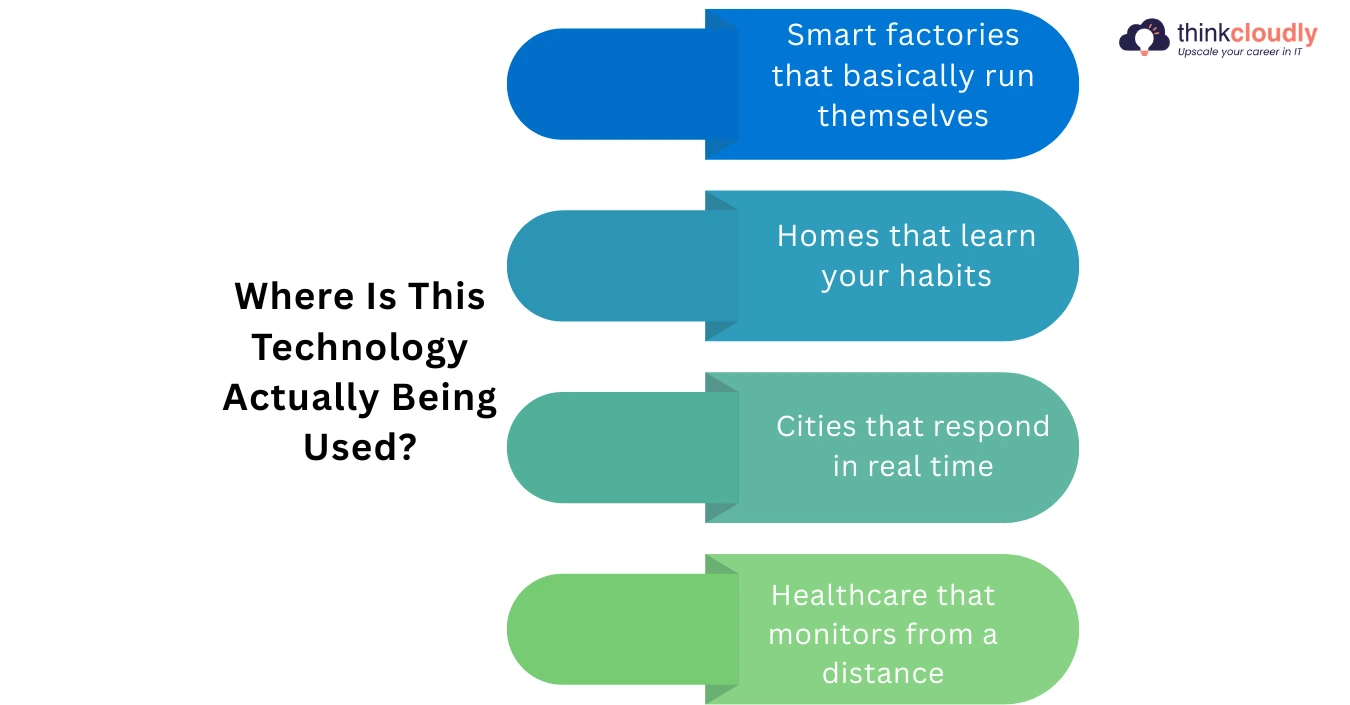
Smart factories that basically run themselves
Walk into a modern manufacturing plant and you’ll find machines covered in sensors, continuously feeding data into cloud platforms. Industrial IoT solutions collect real-time data from equipment, enabling remote monitoring and helping predict potential failures before they happen, giving maintenance teams time to act rather than react. Engineers can now simulate an entire factory floor in a virtual environment before making a single physical change, saving weeks of disruption and millions in potential errors.
Homes that learn your habits
The average US household now uses 21 IoT-connected devices, up from 15 just two years ago, and 72% of homes with smart assistants have integrated them into their daily routines. Behind every voice command to dim the lights or set a morning alarm is a cloud server processing the request, learning preferences, and updating settings in real time.
Cities that respond in real time
Traffic management, waste collection, street lighting, and flood monitoring. A survey found that 81% of people believe IoT will be the key to building smarter cities and improving solutions for public infrastructure. When a pipe bursts at 3am, IoT sensors in the water system can detect the pressure drop, send an alert to the cloud, and notify the maintenance crew before a single resident notices anything is wrong.
Healthcare that monitors from a distance
Medical facilities are expected to employ approximately 7.4 million IoT devices by 2026, from bedside monitors to wearable patches tracking patient vitals around the clock. A nurse no longer needs to physically check every patient every hour. The data flows continuously into the cloud and flags anomalies the moment they appear.
The Jobs Being Created, and What They Pay
Here’s the part that surprises most people outside the tech world. The IoT and cloud combination isn’t just changing how industries operate. It’s generating a category of well-paying jobs that genuinely didn’t exist in meaningful numbers a decade ago. And many of them don’t require a computer science degree to enter.
As of early 2026, the average annual salary for an IoT professional in the United States is $129,899, with top earners reaching $179,500 or more. IoT engineers specifically average $151,730 per year, with top earners reporting up to $260,762. IoT developers with specializations in cloud platforms or cybersecurity typically command higher wages than colleagues with more traditional skill sets, and the jump between junior and mid-level IoT roles in the US is around $34,905 a year.
High-Paying IoT + Cloud Jobs in 2026
|
Job Title |
What They Actually Do |
Typical US Salary |
|
IoT Solutions Architect |
Designs large-scale connected systems for enterprises and cities |
$145,000 to $175,000 |
|
Cloud IoT Engineer |
Builds and manages cloud infrastructure that powers IoT networks |
$130,000 to $160,000 |
|
IoT Security Specialist |
Protects connected device ecosystems from cyberattacks |
$125,000 to $155,000 |
|
Embedded Systems Developer |
Writes the software that lives inside IoT devices themselves |
$110,000 to $140,000 |
|
IoT Data Engineer |
Manages the pipelines that move sensor data into usable analytics |
$115,000 to $145,000 |
|
Smart City Infrastructure Engineer |
Plans and deploys connected public infrastructure |
$120,000 to $150,000 |
|
Industrial IoT Analyst |
Monitors factory and supply chain data to prevent failures |
$100,000 to $130,000 |
|
IoT Platform Integration Manager |
Connects disparate IoT systems and cloud platforms together |
$105,000 to $135,000 |
Why This Particular Combination Pays So Well
There’s a straightforward reason why IoT-plus-cloud skills command premium salaries compared to either skill alone.
Most engineers understand software. Fewer understand hardware. Even fewer understand how to build systems where hardware, software, cloud platforms, and real-world physical environments all need to work together reliably, securely, and at scale. Employers now expect a blend of hardware knowledge, software engineering, cloud platforms, data analytics, and security awareness from IoT professionals. That breadth creates a natural scarcity. You can’t manufacture it quickly. It comes from experience across multiple domains, which means the people who have it get paid accordingly.
The IoT integration market is growing at 28.05% annually between 2026 and 2031, with healthcare showing the fastest growth at 31.60% and North America dominating with 38.45% of global market share. Fast-growing markets with high complexity and scarce talent are, historically, excellent places to build a career.
You Don’t Have to Be a Programmer to Get In
This is probably the most important thing to say to anyone reading this who doesn’t consider themselves a tech person.
The IoT-cloud world needs more than engineers. It needs project managers who understand connected systems well enough to lead deployments. It needs compliance specialists who understand the regulatory landscape for connected devices in healthcare, energy, and transport. It needs technical writers who can explain complex systems to non-technical stakeholders. It needs sales engineers who can translate what a product does into a problem it solves for a client.
IoT roles extend across a wide range of industries, from medicine and transportation to manufacturing and smart cities, with responsibilities varying significantly based on the project and the specialization. The entry point for many of these adjacent roles isn’t a four-year computer science degree. It’s curiosity, a willingness to understand the fundamentals, and a domain skill you already have from a previous career applied in a new context.
What This Means for the Next Five Years
The trajectory here is clear, and it isn’t slowing down. The number of connected IoT devices is expected to double from roughly 19.8 billion today to 40.6 billion by 2034. Every one of those additional devices needs cloud infrastructure to be useful. Every deployment needs people who understand both sides of the equation.
The industries driving this growth, manufacturing, healthcare, energy, logistics, and smart cities, are not peripheral. They’re the backbone of the global economy. And they are all, right now, in the middle of a transformation that will take time. To understand how to connect physical things to cloud infrastructure and make that connection reliable, secure, and genuinely useful isn’t a bubble. It’s a structural shift in how the world works.
Sources & Further Reading
The data and statistics in this article are drawn from the following sources:
- SQ Magazine — Internet of Things Statistics 2026: Devices, Security, and Adoption — IoT device adoption figures, security trends, and market statistics
- Demand Sage — Internet of Things (IoT) Statistics: Market and Growth Data — Market growth data, IoT usage statistics, and industry expansion insights
- Demand Sage — How Many IoT Devices Are There (2026 Statistics) — Global IoT device count estimates and adoption forecasts
- The Business Research Company / GII Research — Internet of Things (IoT) Cloud Platform Global Market Report 2026 — Cloud platform market size, global forecasts, and industry analysis
- Coherent Market Insights — IoT Solutions and Services Market Size, YoY Growth Rate, 2033—Year-over-year growth trends and IoT solutions market projections
- Mordor Intelligence — IoT Integration Market Size, Growth, Share and Competitive Landscape 2031—Competitive landscape analysis and market growth projections
- Precedence Research — IoT Integration Market Size to Hit USD 89.89 Billion by 2035 — Long-term market forecasts and integration industry valuation data
- ZipRecruiter — IoT Salary: Average Pay and Trends 2026 — Salary benchmarks and IoT job market trends
- Glassdoor — IoT Engineer: Average Salary and Pay Trends 2026 — IoT engineer salary averages and compensation insights
- Qubit Labs — IoT Developer Salary Guide (2026): Average Pay by Country, Role and Experience — Country-wise salary comparisons and developer compensation trends
- The Network Installers — IoT Device Growth Statistics and Trends (2026) — Device growth patterns, deployment trends, and industry adoption statistics
- Techiesin — Top 10 IoT Skills to Learn for Jobs in 2026 — In-demand IoT skills, career readiness, and industry learning priorities
Data and projections referenced in this article primarily reflect global Internet of Things (IoT) market, salary, and adoption trends for 2025–2026.