
Did you know that by the beginning of 2026, the global market for business agile transformation services had exceeded $57 billion?
If you still think Scrum is some quirky software development framework used just in the basements of tech firms, the present business landscape is one massive wake-up call. The world now is not simply moving faster but quicker with a volatile unpredictability that makes old, rigid company planning totally useless.
Non-tech companies have to adjust massively structurally to survive at fast speed. From hospital systems that optimize real-time patient care to global banks that are modernizing antiquated compliance programs, organizations are throwing out old blueprints. They are aggressively embracing the core Scrum in business to stay ahead of the market shifts, deal with complex workflows, and endure an era that’s strongly influenced by automated technologies.
The Cross-Industry Shift: Why Non-Tech Sectors Are Embracing Scrum in Business 2026
For decades, the “Waterfall” process was the dominant approach in traditional company models. This meant six months of planning, six months of creating, and then presenting a completed product to market only to realize that consumer needs had changed dramatically during that time.
In 2026, that slow approach is a financial liability. According to the Enterprise Agile Transformation Services Market Report 2026, the enterprise agile transformation industry is growing at a growth rate of CAGR of 18.5%. That expansion is no longer led by IT departments. Rather, it’s being pushed by the desperate corporate desire for more operational efficiency and quicker delivery times in highly regulated customer-facing businesses.
The organizations that use Scrum in business take their big, year-long goals and break them down into small, manageable pieces called sprints. A sprint normally lasts from one to four weeks. The team delivers a concrete, functioning piece of functionality at the conclusion of each cycle. This structural evolution is largely reliant on cross-functional teams, groupings of experts with very different skill sets—a marketer, a compliance lawyer, and a data analyst, for example—all working together every day without typical corporate silos.
By focusing on an iterative development approach, firms can get rapid feedback, adjust their course early, and make sure they’re producing products that their customers genuinely want right now.
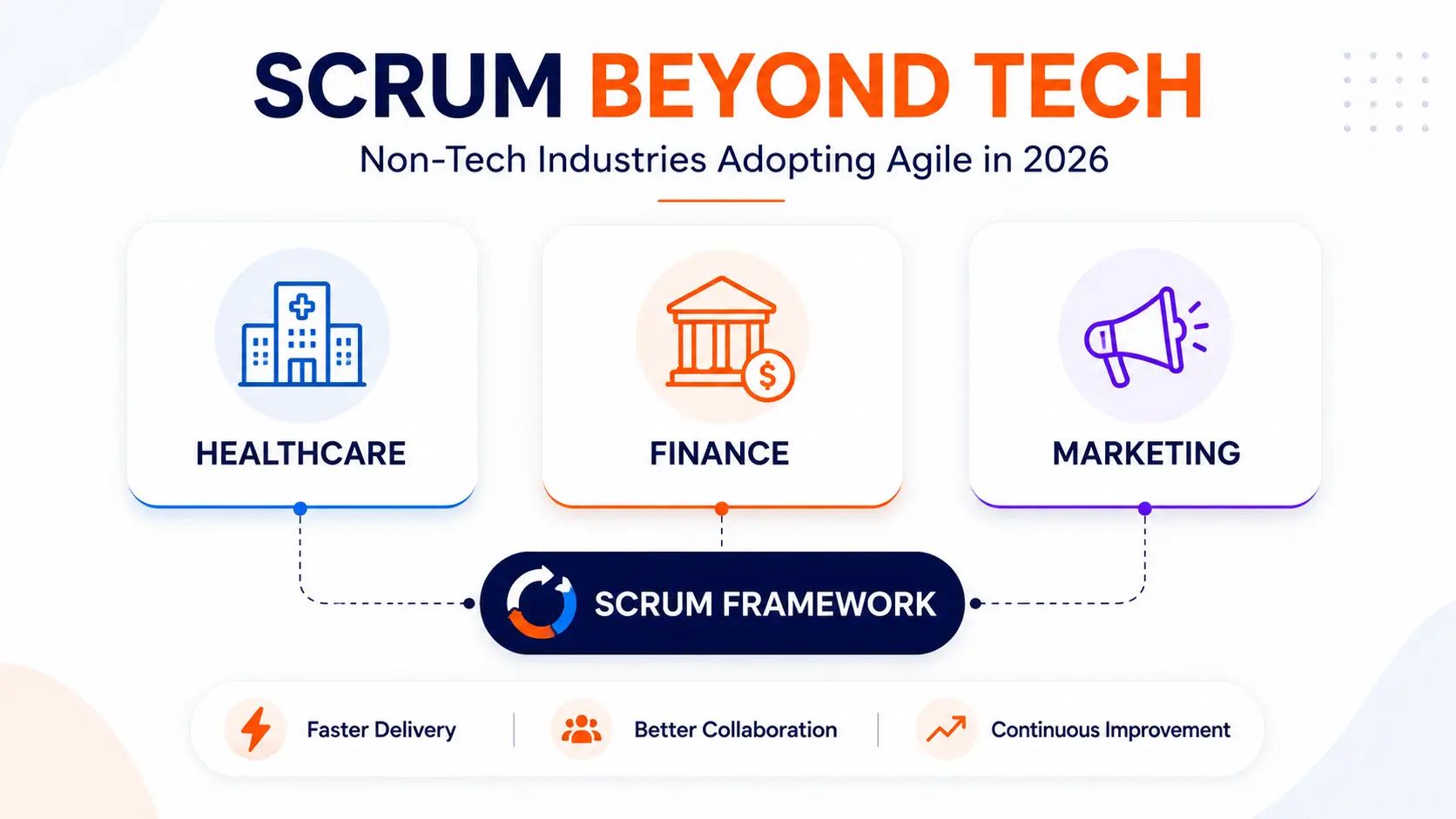
1. Healthcare: Sprints, Sprints, and Smart Diagnostics
In 2026, the healthcare industry will face a strong combination of increased labour costs, continued physician fatigue, and a tsunami of automated data tools. According to the comprehensive Slalom Healthcare Industry Trends 2026 Report, more than half of all primary care practitioners are experiencing long-term structural burnout, leading to a growing push for enhanced operating models. To counteract this friction, innovative hospital networks are using Agile frameworks to reimagine patient experiences and deploy advanced digital health solutions securely.
Traditional System ──► 12-Month Redesign ──► High Risk of Process Mismatch
Scrum Implementation ── ► 2-Week Sprints ── ► Continuous Testing & Adjustments
Instead of trying to overhaul the operating process of a complete network of hospitals all at once, healthcare administrators are employing a step-by-step Scrum implementation plan. They are divided into specialist teams of doctors, clinical nurses, IT managers, and hospital administrators. These teams tackle very particular bottlenecks, including lowering emergency room wait times or rolling out patient-facing telemetry apps. The hospital can then address these difficulties in two-week cycles in isolation, testing a new scheduling framework on a single floor, gathering real-world data and tweaking the setup before rolling it out throughout the full hospital system.
Moreover, as healthcare organizations invest more in medical technology, they are relying on Agile project delivery for the implementation of new systems. Sprints enable medical teams to evaluate data privacy gates, train small pilot groups of physicians, and securely detect data mapping flaws long before a system goes fully live, ensuring corporate compliance and patient safety.
2. Finance: Striking the Balance Between Velocity and Global Compliance
If there is one industry historically known for being slow, cautious, and intensely bureaucratic, it is corporate banking and finance. Yet, by mid-2026, financial institutions are facing heavy pressure to automate their platforms while keeping up with changing data laws and fluctuating market rates. The latest CommerceHealthcare Finance Trends for 2026 Report highlights that financial risks and shifting economic indicators have forced leadership to completely move away from static, rigid annual strategy cycles.
To remain competitive, global banks use Scrum in business to balance the need for fast product delivery with absolute legal security. Financial institutions build specialized groups where a risk officer and a compliance lawyer sit side-by-side daily with application developers and product managers.
When building a new mobile payment gateway or an automated credit scoring tool, the team works in highly structured iterations. In traditional systems, compliance checks happened at the very end of the project, often resulting in months of delays if a legal issue was uncovered.
Through iterative development, the compliance officer reviews the data privacy settings and credit check parameters during the bi-weekly sprint review. This collaborative format ensures that security, regulatory compliance, and functional code are baked directly into the product from day one.
3. Marketing: Omnichannel Agility and Real-Time Campaign Personalization
Over the past year, the marketing landscape has undergone a complete shift in consumer behaviour. Today’s audiences no longer engage with fixed, one-size-fits-all mass-media ads. As the Healthcare Marketing Trends Report reveals, modern consumers expect highly customized, cross-platform digital experiences that adjust to their preferences instantly.
For a marketing agency, planning a massive six-month campaign is no longer feasible. If a new cultural trend or a competitor’s offering surfaces next week, your costly, pre-planned campaign quickly becomes outdated. This shift has driven a widespread agile transformation across international marketing teams.
The marketing team now uses Scrum to manage their full operational schedule. Rather than working in isolated creative groups, team members form dedicated units that include graphic designers, copywriters, data analysts, and media buyers. The team keeps a central list of tasks, called a product backlog. Every two weeks, they pick a small set of high-priority content experiments to launch.
After the sprint, the data analyst tracks live performance metrics, and the team decides whether to expand the campaign, adjust the creative approach, or scrap the idea entirely. According to global agency data from CertiProf’s latest Agile Adoption Report, marketing teams using Scrum in business see a 32% boost in campaign delivery speed and a 28% improvement in client alignment.
Comparative Matrix: Scrum Framework Components Across Industries
To clearly understand how these distinct sectors translate identical Scrum concepts into unique real-world workflows, examine the comparative matrix below:
|
Industry Sector |
Primary Product Backlog Item | Sprint Goal Objective |
The Cross-Functional Team Blueprint |
|
Healthcare |
Patient intake workflows, digital portal features, clinical telemetry integrations. | Reduce patient check-in wait times by 15% via a digital application pilot. |
Doctors, head triage nurses, hospital IT architects, and compliance officers. |
|
Finance |
Payment gateway APIs, automated risk assessment modules, credit underwriting logic. | Launch an updated, secure multi-factor authentication portal for commercial accounts. |
Software Developers, Cybersecurity Engineers, Risk Managers, and Legal Advisors. |
|
Marketing |
Short-form educational videos, regional search engine optimization assets, ad graphics. | Deploy and analyze three targeted multi-channel ad variants for a new wellness service. | Creative copywriters, Graphic Designers, Performance Data Analysts, SEO specialists. |
Four Operational Pillars of Modern Scrum Implementations
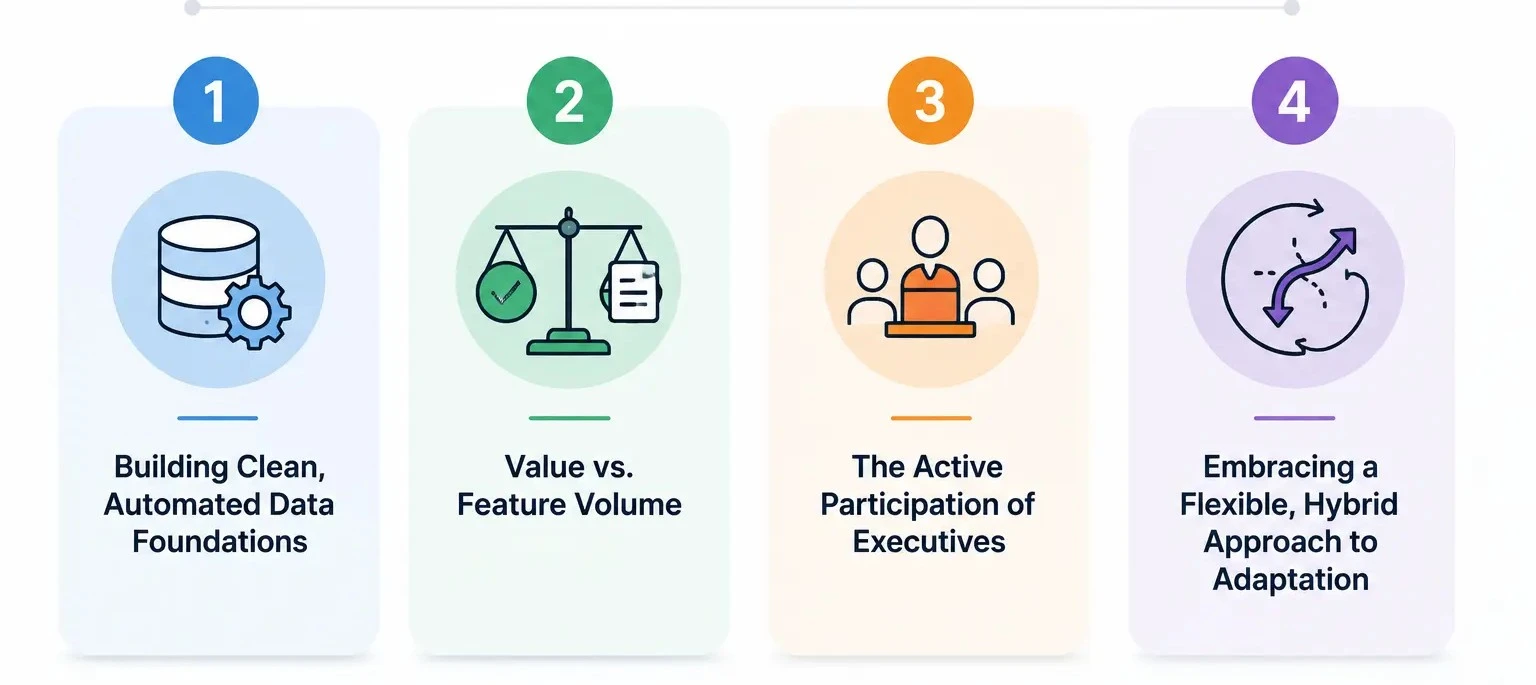
Successful agile transformation is no casual exercise. To undertake an agile transformation and achieve true, measurable business benefits, there are four core pillars for leadership to focus on. This isn’t just about post-it notes or building out digital project boards. Agility is a structural transformation in the way teams function, communicate, and assess success.
1. Building Clean, Automated Data Foundations
The better the data an agile team has, the better the team will be. The 18th State of Agile Report points to a major current operational bottleneck: 44% of firms still use manual, disconnected spreadsheets for at least half of their strategic business insights, leading to more than 53% of teams unable to prioritize their daily work.
To operate rapid sprints successfully, management needs to invest in centralizing and automating their operational data. If your metrics are slow, imprecise, or untrusted, your team will be running fast in the wrong direction entirely.
2. Value vs. Feature Volume
Real efficiency is not about how many things your team ticks off a list. It’s about the real business value that is created by those tasks. In a mature Scrum business structure, the Product Owner grooms the backlog such that the team is always working on high-impact items. A financial Scrum team, for example, may learn that changing one step in a loan application form reduces drop-off rates by 30%. That tiny change generates way more cash than implementing five new software capabilities nobody asked for.
3. The Active Participation of Executives
If leaders in traditional organizational structures are out of touch and only frontline people are using agile frameworks, they can’t succeed. Industry data shows that only 15% of firms have executive leaders that are actively involved in defining their agile frameworks; however, more than 76% of those same teams are under significant pressure to show a clear return on investment. To bridge this gap, business leaders should attend sprint reviews, offer direct input, and assist in aligning the team’s output with the long-term strategic vision of the organization.
4. Embracing a Flexible, Hybrid Approach to Adaptation
There is no prize for running a “perfectly pure” textbook version of Scrum. Today, 74% of successful firms are using highly customized, hybrid frameworks, built to serve their particular regulatory and operational requirements.
You can’t run a hospital network or an international investment bank with the same casual flexibility as a five-person software business. The real measure of corporate maturity is taking Scrum in business traditions, such as daily standups and retrospectives, and adjusting them to match your company’s regulatory compliance demands while still keeping the basic benefits of iterative execution.
Conclusion: Driving Long-Term Growth with Agile Foundations
As we head into 2026, the widespread adoption of Scrum in Business has demonstrated that agility is not an optional experiment for non-tech companies but an unavoidable operational need. The essential concepts of iterative execution are the same whether a business wants to improve clinical care pathways, defend complex financial applications from security risks, or build highly responsive marketing campaigns.
Dedicated cross-functional teams, breaking down big projects into smaller sprints, and a strong focus on operational efficiency may readily safeguard modern organizations against unforeseen market upheavals. The future belongs to companies equipped to adapt. By building your business processes on collaborative, transparent, and iterative frameworks, you make sure that your firm remains robust, inventive, and highly competitive for years to come.