


Why Do 47% of Distributed Teams Still Get Their Estimates Wrong?
Here’s a number that should make any project manager pause: nearly half of distributed engineering teams report estimation variances exceeding 35% between locations. That means almost one in two teams is planning sprints on numbers that are, frankly, closer to guesswork than forecasting—a problem that the right Agile estimation techniques are specifically designed to solve.
If you’ve ever sat in a sprint planning meeting where half the room thinks a task is “small” and the other half thinks it’s a multi-day nightmare, you already know this problem firsthand. The truth is, most teams don’t fail at Agile because they lack discipline. They fail because they never properly learned the estimation methods that turn planning into something predictable instead of chaotic. This blog breaks down the methods real Scrum teams are using in 2026, backed by current data, so you can stop guessing and start planning with confidence.
What Are Agile Estimation Techniques, and Why Do They Matter So Much Right Now?
Agile estimation techniques are formal ways of estimating the effort, time, or complexity of a task, not by predicting a set number of hours but by relative comparison. These Agile estimation methods ask a fundamentally different question than traditional planning: instead of “how many hours will this take?” Agile teams ask, “Is this bigger or smaller than the last thing we built?” That subtle shift in framing turns out to be enormously powerful.
Teams that use standardized story point methodologies are 2.8 times more likely to meet project deadlines compared to teams using ad-hoc, unstructured approaches, based on Gartner’s Software Development Productivity Analysis. And it’s not just about deadlines. Scrum teams that estimate workload properly report up to 250% higher work quality than teams skipping estimation altogether, largely because structured estimation reduces defect density—teams without estimates average more than 20 errors, while disciplined Scrum teams cut that below 10.
In short, agile estimation techniques aren’t a bureaucratic checkbox. They’re one of the clearest predictors of whether a sprint succeeds or quietly falls apart.
The Core Agile Estimation Techniques Scrum Teams Rely On
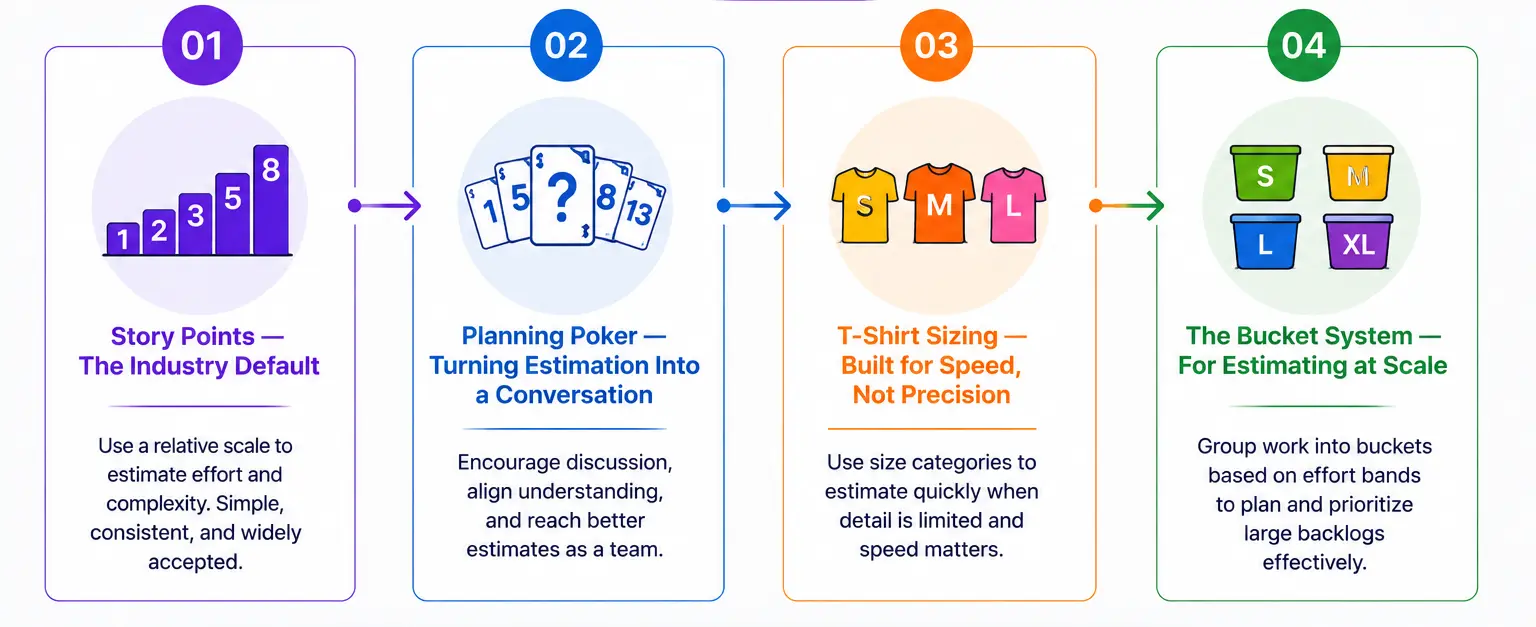
1. Story Points — The Industry Default
For example, story points are still the most often utilized estimation unit in Scrum teams today. They integrate three things into a single number: amount of work, technological complexity, and amount of uncertainty.
More than 78% of Scrum teams reported using story points or another related estimating technique to plan product development in a 2026 Agile industry survey. The reason for this popularity is simple—humans are much better at comparing two things than forecasting how long something will last. It’s much easier for a team to agree that Feature A is roughly twice as complex as Feature B than to pin an exact number of hours on either one.
Most teams assign story points using a Fibonacci-like scale—1, 2, 3, 5, 8, 13, 20—because effort and uncertainty rarely grow in neat, linear steps. As a task’s size increases, the coordination and ambiguity around it usually grow even faster than the actual work.
2. Planning Poker — Turning Estimation Into a Conversation
Planning Poker is one of the most collaborative of all the agile estimation techniques, and that’s precisely its strength. Each team member privately selects a card representing their estimate, and then everyone reveals it simultaneously. When estimates differ significantly, the team discusses the disagreement—not to argue, but to surface assumptions nobody had spoken aloud yet.
This single mechanic — forcing a conversation about why two people see the same task so differently — is often where the real value of estimation lives. It’s rarely the number itself that helps a team. It’s the misalignment the number exposes.
3. T-Shirt Sizing – Designed for Speed, Not Precision
T-shirt sizing is a simplified estimation method where we give a size of S, M, L, or XL to a work based on its difficulty and labor required, instead of exact numbers. It’s quite helpful in the early stages of backlog grooming when a team needs a basic idea of the scope before jumping into extensive planning poker sessions.
T-shirt size, because it trades off granularity for speed, is generally best used as a first-cut filter—a way of sorting a vast, jumbled backlog into broad buckets before more accurate techniques take the wheel.
4. The Bucket System – Estimation at Scale
Story points and planning poker are great for small, focused teams. The bucket method is excellent when there are dozens, or even hundreds, of objects that need to be sized relative to each other quickly. Items are either physically or digitally classified into “buckets” that reflect different levels of effort—one of the few Agile Estimation Techniques that was designed primarily for teams with experience and large-scale backlogs. Story points tend to work for less experienced teams who are still learning the ropes. The bucket system works well for teams that have a solid shared knowledge of proportional effort.
Why Relative Estimation Beats Time-Based Estimation?
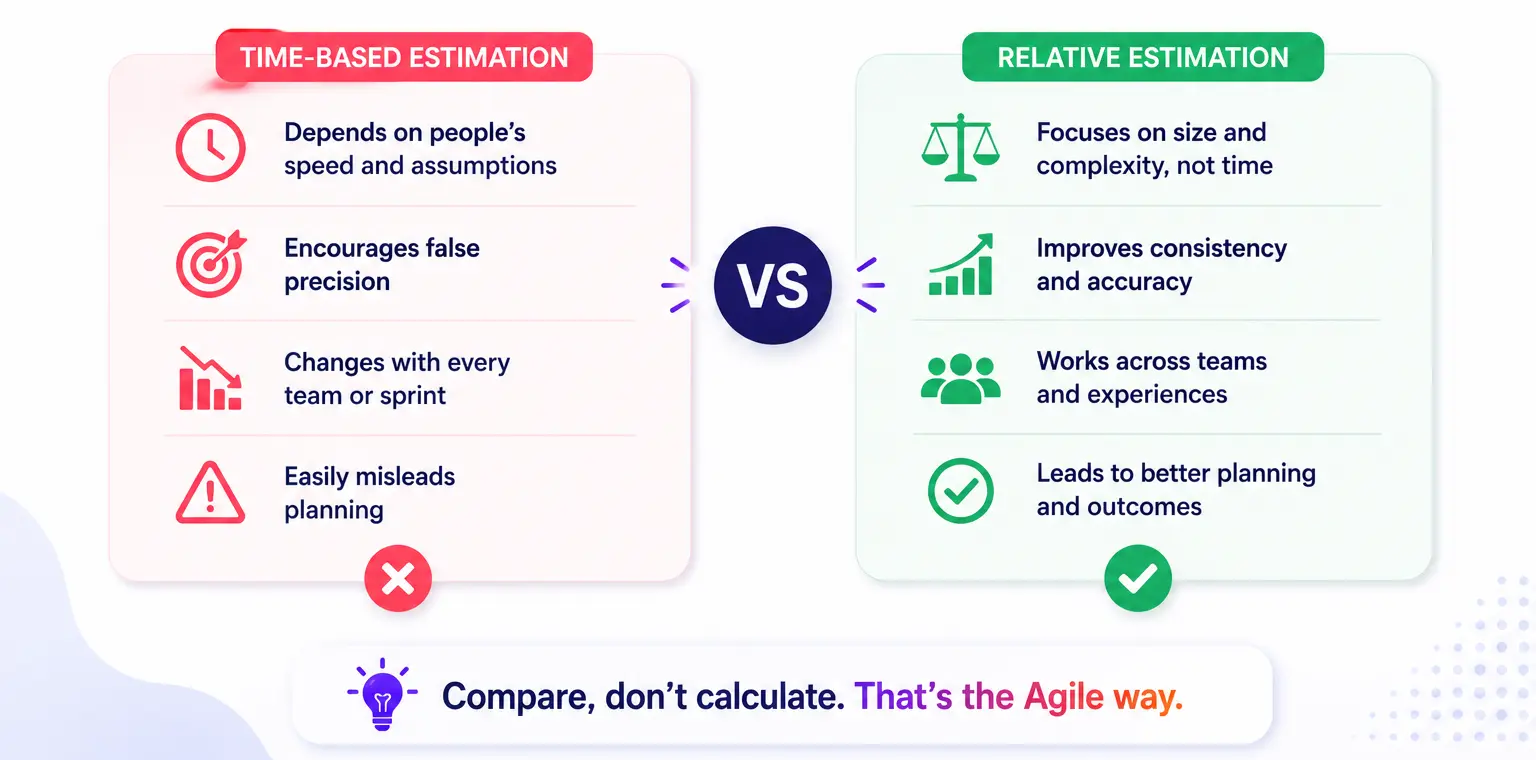
Traditional Agile effort estimation once mirrored old-school project management, where every task was assigned a fixed number of hours. That approach looked precise on paper, but it rarely held up once real development work began.
Estimating in hours assumes tasks can be predicted with a high degree of accuracy—but that assumption rarely survives contact with real software development. When teams lean too heavily on time-based estimates, they often spend more energy adjusting plans than actually delivering value. Worse, hour-based estimates can quietly pressure developers into unrealistic deadlines, which tends to either degrade code quality or discourage honest conversations about technical risk.
Relative estimation sidesteps this entire problem. And remember — the goal was never perfect precision in the first place. The real purpose of effort estimation is to facilitate planning and decision-making, not to produce a flawless prediction.
A Quick Comparison: Choosing the Right Agile Estimation Technique
|
Technique |
Best For | Speed | Precision Level |
Ideal Team Experience |
|
Story Points |
Sprint-level planning | Moderate | High |
Beginner to Intermediate |
|
Planning Poker |
Surfacing hidden assumptions | Slower | High |
Any experience level |
|
T-Shirt Sizing |
Early backlog estimation | Fast | Low |
Beginner |
|
Bucket System |
Large-scale backlog sizing | Very Fast | Moderate |
Experienced |
|
Affinity Mapping |
Grouping similar-sized items | Fast | Moderate |
Intermediate |
|
Monte Carlo Simulation |
Forecasting with historical data | Slow (setup-heavy) | Very High |
Advanced |
Estimation Challenges Unique to Remote and Distributed Teams
It’s worth calling out a problem that’s only grown more relevant since 2025: distributed teams face estimation challenges that co-located teams simply don’t. When engineers are spread across different time zones and offices, the informal, in-person cues that normally help a team align on complexity disappear entirely.
This isn’t a minor inconvenience. Nearly half of distributed engineering teams — 47%, to be exact — report estimation variances exceeding 35% between locations. That gap usually traces back to one root cause: different offices interpreting the same user story through different cultural and contextual lenses, without enough shared context to correct for it.
The fix isn’t complicated, but it does require discipline. Teams that succeed at distributed sprint estimation techniques tend to over-invest in written context—turning vague tickets into detailed, example-rich user stories before estimation even begins and rotating meeting times so no single office is always estimating half-present late at night.
How Backlog Estimation Differs From Sprint Estimation
It’s easy to conflate backlog estimation with sprint estimation, but they serve different purposes and often call for different techniques entirely.
Backlog estimation happens earlier and at a coarser level of detail — the goal is simply to get a rough sense of scope across dozens or hundreds of items, often using T-shirt sizing or the bucket system for speed. Sprint estimation, by contrast, happens right before commitment, when the team has far more context and can afford the slower, more deliberate process of planning poker or detailed story pointing.
Treating both stages identically is a common source of frustration. Forcing precise story points onto a 200-item backlog wastes enormous time on items that may never even make it into a sprint. Conversely, using loose T-shirt sizes for the items a team is about to commit to in the next two weeks leaves too much room for misalignment. Matching the right technique to the right stage of planning is, in many ways, half the battle.
Even teams that understand the techniques above often stumble in execution.
Here are the recurring mistakes worth watching for:
- Treating story points like hours in disguise. Once a team starts mentally converting points back into hours, the entire benefit of relative sizing disappears.
- Skipping the discussion phase in Planning Poker. The conversation matters more than the consensus number — rushing past disagreement defeats the purpose.
- Re-estimating instead of recalibrating. Comparing actual effort to original estimates after each sprint helps teams calibrate their shared understanding of size over time.
- Letting technical debt go unaccounted for. A IEEE study on global software development patterns found that technical debt increases estimation inaccuracy by roughly 32% in distributed teams.
Will there be AI involved in Agile estimation in 2026?
Speaking of current agile estimation techniques, the increasing influence of AI should not be overlooked. Built-in AI is now available across Several platforms that analyze team capacity, review backlog health, and suggest ideal sprint scopes, allowing Scrum Masters and Product Owners to discover problematic overcommitments before they happen.
Researchers have even begun testing large language models directly on story point estimation tasks, training them to forecast effort the way a human team might. Early results are promising for pattern recognition, but the consensus among practitioners remains clear: AI can improve estimation accuracy by using historical data and pattern recognition, but it cannot fully replace team judgment and shared context.
That distinction matters. AI is becoming a useful input to estimation conversations — surfacing patterns a human might miss — but the conversation itself, where a team negotiates shared understanding of complexity, still belongs to people. For teams managing large product backlogs, this is especially relevant: Backlog estimation at scale often involves hundreds of items with varying levels of detail, and AI tools are proving genuinely useful at flagging which items lack enough information to size accurately, long before a sprint planning meeting ever starts. That alone can save a team hours of back-and-forth clarification mid-sprint.
How to Build Strong Agile Project Estimation Habits as a Team?
Getting better at this isn’t about picking the “correct” technique once and sticking with it forever. It’s about building habits that compound over multiple sprints—the kind of disciplined Scrum planning techniques that separate teams who hit their commitments from teams who are constantly firefighting:
- Anchor every estimate to reality: Choose a reference story your team has already delivered and understands, then size new work relative to that baseline.
- Name the uncertainty early: Estimation meetings are there to clarify requirements that are not obvious before they become a surprise mid-sprint, not later.
- Participate in estimation meetings: Above all, these sessions thrive on open conversation, ensuring that every voice, even the quietest engineer, is heard (cloudwards.net, 2026).
- Track velocity over time: With Dashboards with burndown charts and velocity trends, Scrum Masters can see how accurate their estimates are and spot drift before it becomes a pattern.
- Revisit & recalibrate after every sprint: The simplest way to improve a team’s shared sense of scale is to compare actual results to original estimates.
Final Thoughts: The importance of getting Agile estimation techniques right in 2026
Sprint estimation methodologies will never give perfect predictions—and that was never really the aim. What good Agile estimation techniques actually provide is a shared language for complexity, a structured way to surface disagreement, and a foundation for realistic commitments. Teams that take this seriously see measurably better quality, fewer defects, and far more predictable delivery than teams treating estimation as an afterthought.
Whether your team is just starting with story points or already experimenting with AI-assisted forecasting, the underlying principle hasn’t changed: estimation is less about being right and more about building a team that works the same way, sprint after sprint. Master that, and reliable, sustainable software estimation techniques follow naturally.