
A few months ago, a client of mine turned down a job offer she was genuinely excited about — not because the role was wrong, but because she had no idea if $92,000 was a fair number for a mid-level cloud analyst in her market. She hadn’t used a salary predictor before walking into that negotiation. Two weeks later, after running her numbers through a few tools and cross-checking them against industry salary guides, she went back and asked for $108,000. She got $104,000. That sixteen-thousand-dollar gap she nearly left on the table is the entire reason this article exists.
I’ve spent the better part of a decade reviewing compensation data for clients and hiring teams, and 2026 has been one of the strangest years I’ve tracked. Tech layoffs dominate headlines, yet the U.S. Bureau of Labor Statistics quietly confirmed that the average IT professional now earns $104,420 — hardly a sign of a shrinking field, according to Splunk’s 2026 technology salary analysis. That contradiction is exactly why a good salary predictor has become a basic career survival tool, not a nice-to-have.
Why Does Everyone Suddenly Need a Salary Predictor in 2026?
Here’s the uncomfortable truth nobody tells you when job hunting: the published “average salary” for your role is almost meaningless on its own. Pay now splits sharply by specialization, location, and whether you can prove AI fluency. While baseline IT roles face slowdowns, demand for specialized areas keeps growing, with the market showing modest growth generally but significant premiums for specialists in AI, cloud, and security. That split is precisely what a modern salary predictor is built to capture—adjusting for your specific skills, city, certifications, and the current temperature of your niche, rather than handing you one flat number.
I started recommending salary predictor tools to clients about two years ago, once it became clear that generic annual surveys were going stale within months. A 2026 salary predictor pulls from live job postings, reflecting what companies are actually offering this quarter, not last year—because companies are quietly bidding up pay for in-demand skills faster than annual reports can keep up.
What a Salary Predictor Actually Measures and What It Misses?
Most people assume a salary predictor just spits out one number tied to a job title. The better tools do far more. Modern AI-driven calculators analyze your resume, extract your specific skills and certifications, and cross-reference them against real-time job posting data rather than outdated annual surveys. One widely used calculator analyzes millions of job postings, industry reports, and compensation data to give current market rates, then returns a range broken into percentile bands so you can see where you sit — not just an average that flattens out the real spread.
That percentile detail is the single most useful feature buried inside most salary predictor tools, and almost nobody uses it. A good calculator shows you the 25th percentile (what someone underqualified for the role earns), the median, and the 75th percentile (top performers with negotiating leverage). If you’re sitting at the 25th percentile despite five years of experience, that’s not a personal failing — it’s a sign your resume or negotiation approach needs work.
Where these tools fall short is context they simply cannot know: your manager’s budget flexibility or how badly a team needs to fill your exact seat this month. No salary predictor replaces a real conversation with a recruiter who has placed people in your target company recently. Use the tool to walk in informed—not to walk in with a number you’ll defend to the death.
2026 Salary Trends: What’s Actually Driving the Numbers
I want to be specific here, because vague “salaries are rising” statements don’t help anyone negotiate. Overall salaries are rising 8 to 10 percent according to the Addison Group via Auxis, while AI-specific roles are bucking that trend entirely at a 9.2 percent rise compared to a 0.8 percent average elsewhere. That’s the difference between a modest cost-of-living adjustment and a meaningful raise.
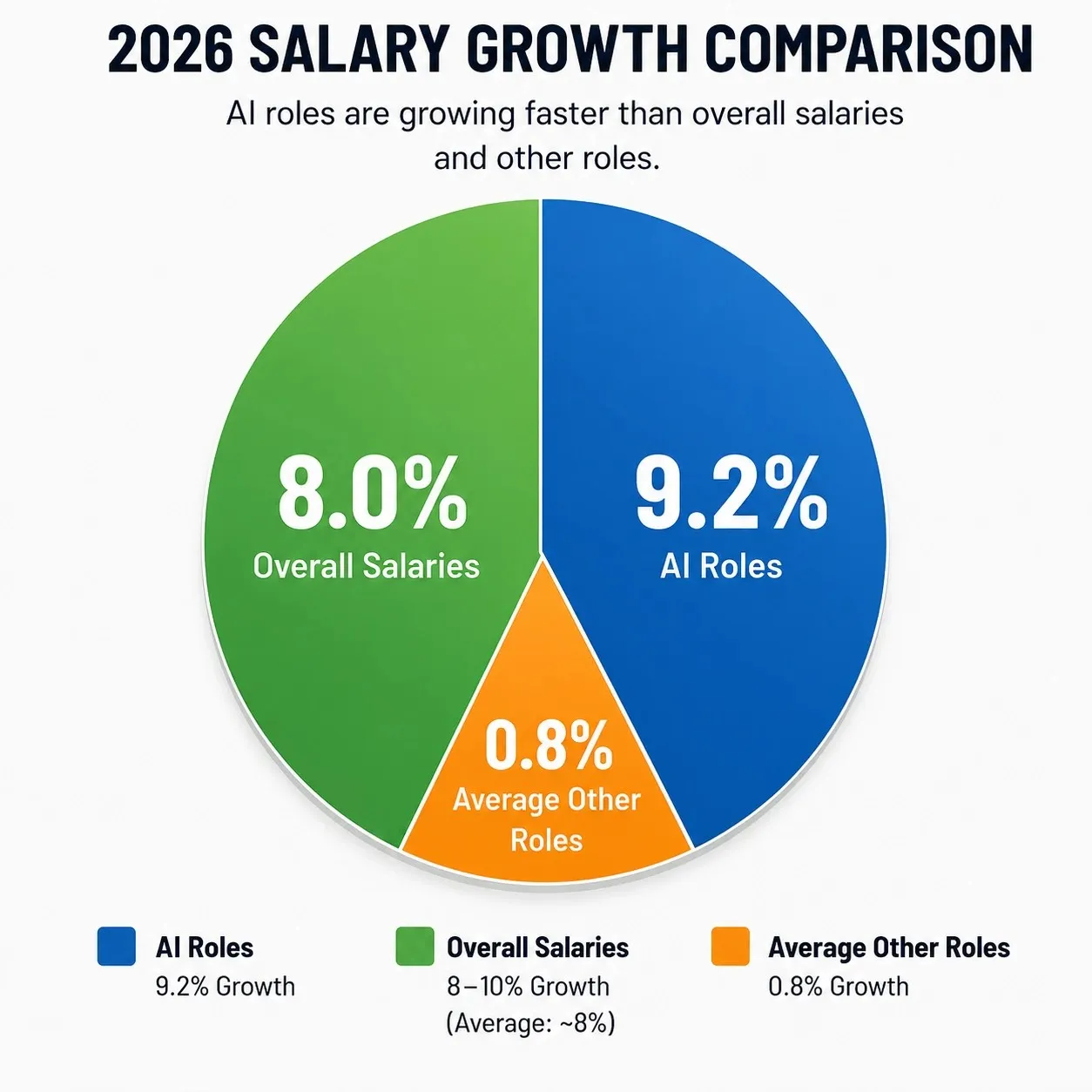
The 2026 salary trends I’m tracking with clients fall into three buckets. AI and cloud-adjacent roles are pulling away from the pack, with roles tied to cybersecurity architecture, site reliability engineering, and hybrid cloud-and-AI skills ranking among the top-paying career paths this year. Generalist and legacy IT roles are essentially flat once inflation is factored in. And — the part most career advice skips — hybrid skill combinations command premiums neither skill alone would justify. A security analyst who also understands cloud architecture isn’t earning the average of two salaries; they’re earning a multiplier on both.
This split is why a one-size-fits-all number from a national survey can mislead you badly. Two people with the same identity—the IT Project Manager—might miskips—hybrid 145,000, respectively—depending on whether one can speak fluently about it.
Highest Paying IT Jobs in 2026: A Reality Check
Let me walk you through where the real money sits right now, based on a synthesis of multiple 2026 industry salary guides rather than any single source.
The Chief Technology Officer remains the single highest-paying IT job in 2026, with total compensation reaching $750,000 to $1.2 million or more at companies including Meta, Google, Amazon, and Apple. That figure includes base salary, bonus, and equity — and very few people reading this are one promotion away from that seat, so let’s talk about roles that are actually attainable within the next two to five years.
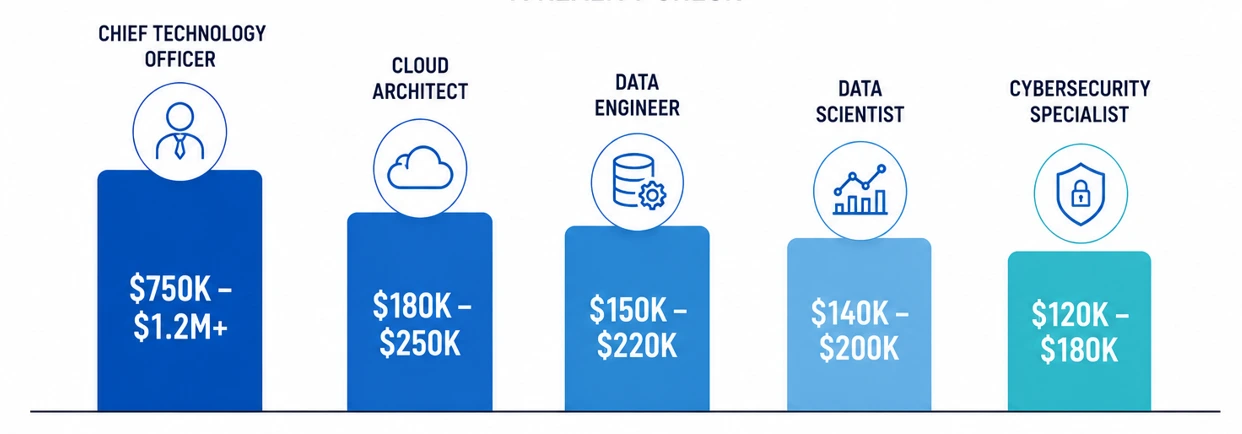
Cloud architects currently rank first among the broader top ten highest-paying IT jobs of 2026, a position they’ve held as companies finish migrating legacy infrastructure to multi-cloud environments. Close behind, data engineers are now frequently out-earning data scientists, because without reliable, well-structured data pipelines, analytics and AI initiatives simply don’t function — a shift that surprised even seasoned recruiters who spent the last decade treating data science as the glamour role.
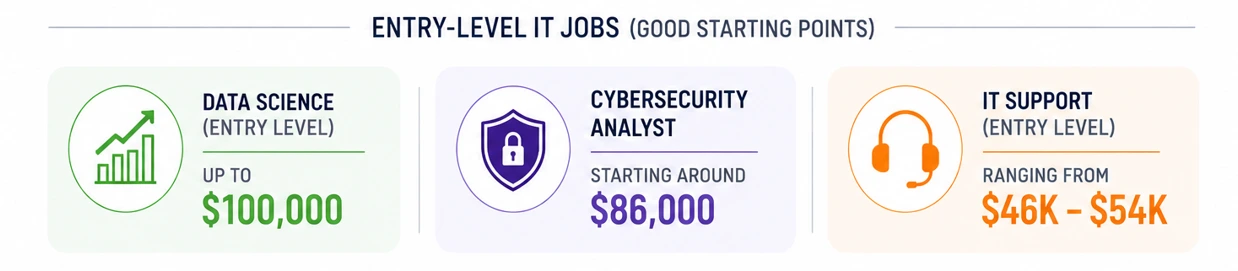
On the entry-level side, the numbers are encouraging for newcomers. Big function—a into data science with salaries up to $100,000, while cybersecurity analyst roles start around $86,000 and IT support roles range from $46,000 to $54,000—is a spread that tells you exactly where employer demand is concentrated.
Average Salary by Job Role — 2026 Snapshot
|
IT Role |
Entry-Level Average | Mid-Career Average |
Senior/Specialist Average |
|
IT Support Specialist |
$46,000–$54,000 | $61,000–$75,000 |
$80,000+ |
|
Cybersecurity Analyst |
$86,000 | $99,000–$110,000 |
$150,000–$200,000 (CISSP-certified) |
|
Cloud Architect |
$85,000 | $105,000 |
$125,000–$155,000 |
|
Data Scientist |
$100,000 | $120,000–$140,000 |
$160,000+ |
|
AI/ML Engineer |
$125,000 | $150,000 |
$180,000+ |
|
Project Manager (PMP) |
$93,000 (uncertified) | $115,000–$123,000 |
$150,000+ |
|
IT Director |
— | — |
$175,000+ |
|
VP of Engineering |
— | — |
$750,000+ (total comp) |
Figures compiled from multiple 2026 US industry salary guides cited throughout this article. Actual offers vary by city, company size, and specific skill stack.
Expected Salary After Certification: Does the Investment Actually Pay Off?
This is the question I get asked more than almost any other, usually framed as “Is it worth the money and the weekends studying?” The honest answer, based on the data I review every year, is it depends enormously on which certification—but for the right ones, yes, dramatically so.
IT professionals who hold a top-tier certification earn an average of $138,800 per year, roughly 25 percent higher than uncertified peers, according to the Global Knowledge IT Skills and Salary Report. That’s a meaningful career inflection point, though the premium varies sharply by credential.
Security and project management certifications show some of the clearest documented returns. CISSP holders earn an average of $15,000 to $25,000 more than non-certified security professionals, while PMP-certified project managers earn $10,000 to $20,000 more than those without the credential. The PMP premium reached 33 percent over non-certified peers in 2026 data, with the median US salary for PMP holders sitting at $123,000 versus $93,000 for non-certified professionals—and that premium compounds: professionals holding the credential for over five years earn 44 percent more than those certified within the last twelve months.
If you’re weighing which certification to pursue, here’s how I’d prioritize based on documented 2026 impact:
- Cloud certifications (AWS, Google Professional Cloud Architect) — highest absolute ceilings, averaging $150,000–$200,000
- CISSP—clearest cybersecurity premium; its five-year experience requirement filters out resume-padders
- PMP — most versatile, with the longest documented compounding return across industries
- Security+ — most accessible entry point, with holders averaging $99,446 in total compensation
- AI and agentic certifications — newest, but tracking the fastest year-over-year demand growth I’ve monitored
One thing I always tell clients before they enroll in a $1,500 exam prep course: run the expected salary after certification through a salary predictor first. If the lift is minimal for your target role, that’s worth knowing before you commit the time.
Career Salary Calculator vs. Salary Predictor: Is There a Difference?
People use these terms interchangeably, and the line has blurred. A traditional career salary calculator typically asks for your job title, experience, and location, returning a static range from a database that might be six to twelve months old. A modern salary predictor layers in AI analysis of your actual resume and current postings—adjusting for your specific skill combination, not just your title.
In practice, I recommend clients use both: a career salary calculator for the general market band and then a more detailed salary predictor that factors in certifications and tech stack to see where you land within that band. The gap between the two numbers often reveals exactly how much your skill set is worth above the generic market rate.
A Four-Step Way to Use a Salary Predictor Before Your Next Negotiation
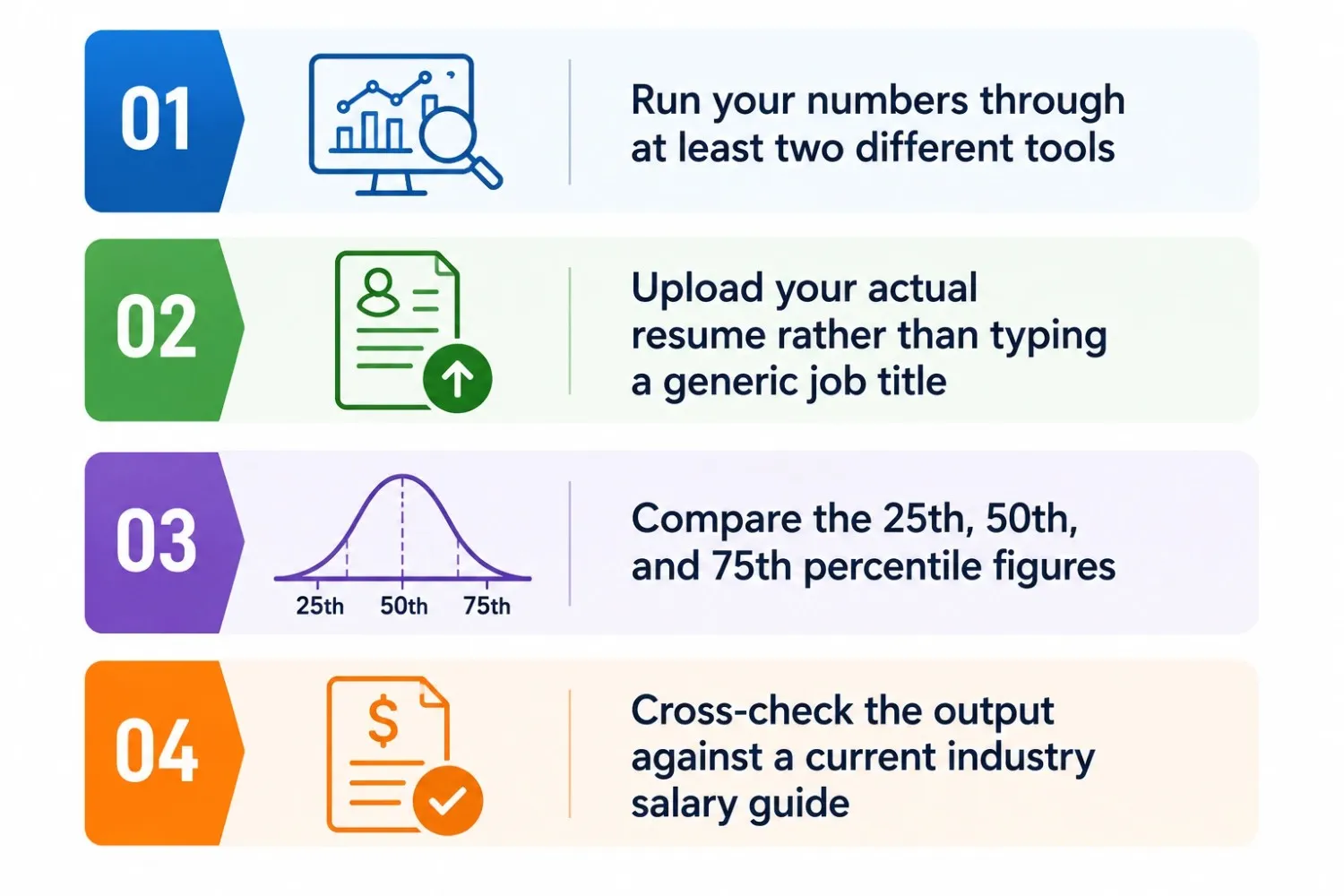
- Run your numbers through at least two different tools, not just one—methodology varies enough that a single source can mislead you by ten percent or more.
- Upload your actual resume rather than typing a generic job title, since most modern tools extract your specific certifications and skills to refine the estimate.
- Compare the 25th, 50th, and 75th percentile figures, not just the median, so you understand whether you’re aiming too low or have real room to push higher.
- Cross-check the output against a current industry salary guide for your sector, since predictors are excellent at reflecting broad market data but can lag on fast-moving niches like agentic AI roles.
Final Thoughts From Someone Who Reviews This Data Every Day
If there’s one thing fifteen-plus years of compensation conversations have taught me, it’s that the best negotiators aren’t the most aggressive—they’re the most informed. A salary predictor won’t win the negotiation for you, but it puts a real number in your hand instead of a guess, and in a market this fragmented between AI-adjacent premiums and flat legacy roles, that matters more than ever. Before your next interview or certification decision, run the numbers. The fifteen minutes it takes could be worth thousands of dollars — my client’s sixteen-thousand-dollar gap is proof enough of that.