
Here is a number that stopped me mid-sentence during a team call earlier this year: AWS still holds about 28 percent of the global cloud infrastructure market, ahead of Microsoft at 20 percent and Google Cloud at 15 percent, according to Synergy Research Group’s Q2 2026 data. So the real question is “Why haven’t I started AWS certification training yet?” I asked myself that same thing eighteen months ago, sitting in a job that had quietly stopped teaching me anything new. This guide is the honest answer I wish someone had handed me back then: which AWS certification to take first, what each exam costs, how long it takes, and what it is worth.
Why AWS Certification Training Matters More in 2027 Than Ever Before
I’m not writing this as a marketer. I’m a working cloud engineer who has sat three AWS certification exams in the past two years, failed one on the first attempt, and rebuilt my career path around what I learned along the way. When I tell you AWS certification training changed how recruiters responded to my profile, I mean it changed within three weeks of posting my badge on LinkedIn. That’s not hype; that’s what happened to my inbox. (If you’re still comparing providers, see our guide to the best AWS training online.)
The market backs this up. Gartner expects worldwide IT spending to hit $6.31 trillion in 2027, up 13.5 percent from last year, with cloud and data-center investment leading that growth. Every one of those dollars needs someone who can run the infrastructure, and that’s the gap an AWS certification is built to close. Among IT certifications tracked by industry surveys, AWS badges consistently rank at or near the top for salary impact, which is why the Solutions Architect role stays one of the highest-volume hires in cloud job postings.
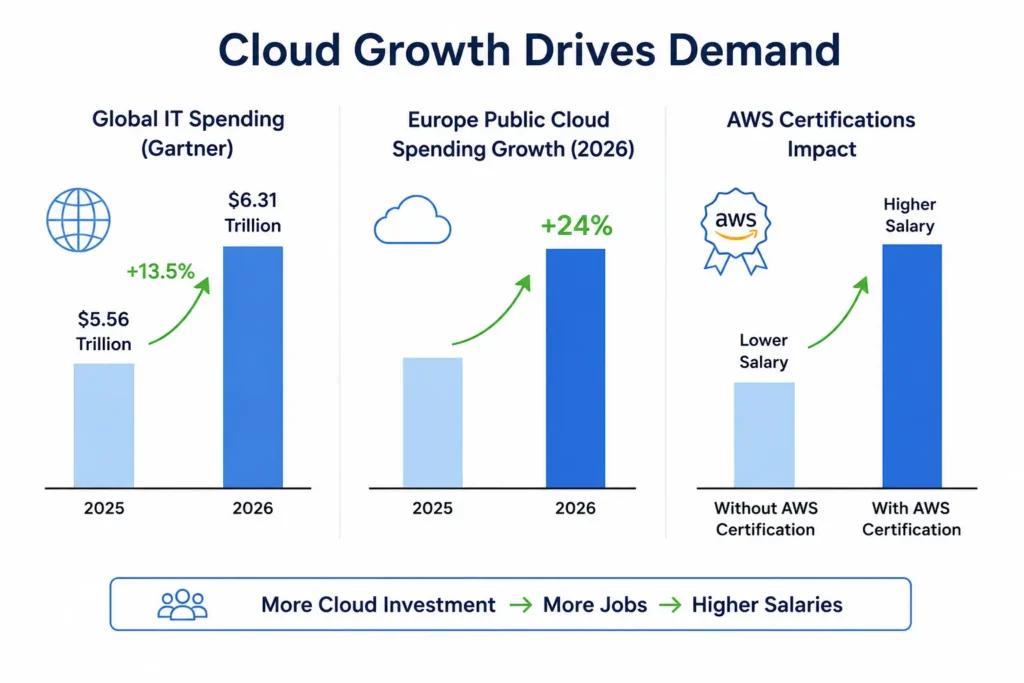
Cloud infrastructure spending reached $143.4 billion in Q2 2027, up 43 percent year over year and the fastest growth in eight years, per Synergy Research Group. None of that growth runs itself. It runs on people who understand scalability, security, and cost control on AWS.
AWS Certifications List 2027: What the Catalog Covers Now
Amazon restructured parts of its exam catalog this year, so if you last looked two or three years ago, some of what you remember is out of date. AWS now offers twelve active certifications across Foundational, Associate, Professional, and Specialty levels, plus a new Business category that opened with the AI Business Strategist beta in September 2027. AWS remains the most recognized name in cloud certification, largely because of its market share lead.
2027 changes to know before you book an AWS certification exam:
-
SysOps Administrator Associate (SOA-C02) retired September 29, 2025, replaced by CloudOps Engineer Associate (SOA-C03), which weighs automation and incident response more heavily.
-
Cloud Practitioner (CLF-C02) had its question pool refreshed in February 2027, adding generative AI as a distinct exam domain.
-
Machine Learning Specialty (MLS-C01) retired on March 31, 2027. AWS now points AI learners to AI Practitioner, Machine Learning Engineer Associate, and Generative AI Developer Professional.
-
Machine Learning Engineer Associate is moving from MLA-C01 to MLA-C02, with deeper coverage of Amazon Bedrock and responsible AI.
-
Generative AI Developer Professional (AIP-C01) moved out of beta in March 2027, adding coverage of Amazon Bedrock AgentCore.
-
Developer Associate DVA-C02 retires December 1, 2027 (replaced by DVA-C03), and Advanced Networking Specialty (ANS-C01) retires December 31, 2027.
If you’re deciding where to start, don’t chase all twelve. I made that mistake early, collecting badges instead of depth, and it slowed me down. Two well-chosen certifications plus real hands-on projects beat a wall of badges when a hiring manager actually reads your resume.
AWS Certification Path: Which Certification Should You Take First?
The best AWS certification for beginners depends on your background, not on which exam looks easiest. This is the AWS certification path I recommend to colleagues:
-
No IT background: Start with Cloud Practitioner (CLF-C02) or AI Practitioner (AIF-C01), then move to Solutions Architect Associate.
-
Some IT or networking experience: Go straight to Solutions Architect Associate (SAA-C03). It is the most requested AWS certification in job postings.
-
Developers: Developer Associate, then DevOps Engineer Professional.
-
Operations and support: CloudOps Engineer Associate, then DevOps Engineer Professional.
-
Data and AI: AI Practitioner, then Data Engineer Associate or Machine Learning Engineer Associate, then Generative AI Developer Professional.
-
Security: Solutions Architect Associate, then Security Specialty (SCS-C03).
Learning AWS the Right Way: My Study Approach
I want to be blunt: learning AWS from video courses alone did not work for me. I passed practice exams comfortably, then blanked on the real thing because I’d memorized answers instead of understanding architecture. What worked was rebuilding small, real projects (a serverless API, a static site behind a CDN, a small data pipeline) and breaking them on purpose so I had to fix them. That small serverless project taught me more about serverless trade-offs than any course module. I also watched my projects buckle under simulated load and had to redesign them, which taught me scaling lessons no slide deck could.
AWS’s own free hub for this is AWS Skill Builder, and if you’re serious about AWS certification training in 2027, it should be the center of your study plan. AWS Skill Builder now includes Lab Maker, launched this year, which uses AI to generate an instant, personalized hands-on lab for almost any AWS service just by describing what you want to build. I used it to practice cloud-native patterns I hadn’t touched at work, and it filled gaps no static video course would have caught.
AWS Skill Builder also runs structured four-step exam prep plans, free practice question sets, domain review courses, and paid extras like official practice exams and AWS Cloud Quest, a scenario-based game that teaches architecture and cost-optimization thinking. If your employer offers a subscription, use it. If you want structured, instructor-led AWS certification training with labs and interview prep, our AWS Job Seeker’s Package bundles both.
Career Paths AWS Certification Training Opens Up
Here’s where the guide gets personal again, because these paths aren’t theoretical to me.
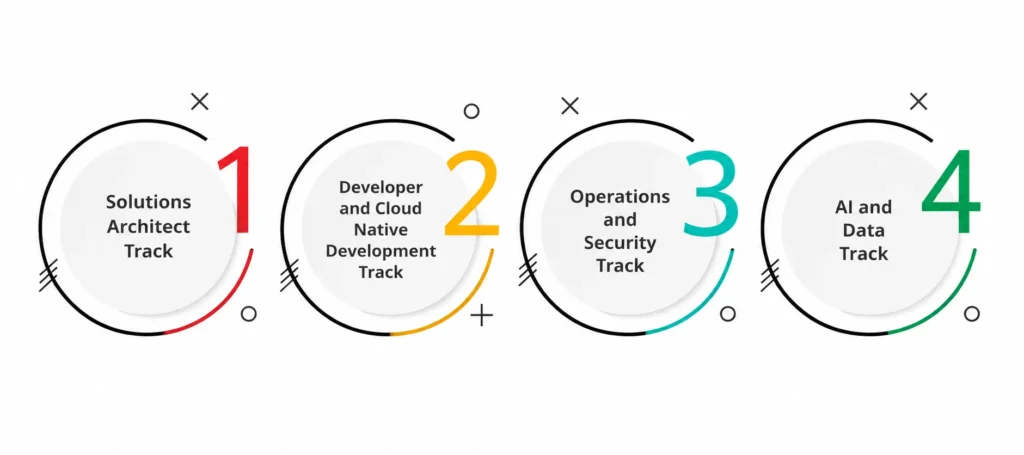
1. Solutions Architect track
This was my second certification, and it remains the single most requested credential in AWS job postings. A solutions architect designs the systems other engineers build on: how services connect, where data lives, and how a system survives a regional outage. If you enjoy the big picture more than deep coding, this track fits.
2. Developer and cloud-native track
Built for people who write and deploy code regularly. This path leans hard into serverless computing, containers, and CI/CD rather than infrastructure design. I know two former junior developers who moved into this track and were leading serverless migrations within a year. It pairs well with a Solutions Architect credential later if you move toward system design.
3. Operations and security track
Covers monitoring, automation, incident response, and compliance mapping to frameworks like NIST, a detail that matters a great deal for anyone eyeing government or regulated-industry contracts.
4. AI and data track
The fastest-growing lane in 2027 by a wide margin, covering machine learning pipelines, generative AI deployment on Bedrock, and responsible AI practices. The AWS AI Practitioner certification is the low-cost entry point, and AWS Skill Builder’s microcredentials are a fast, free way to test this track before committing to a professional exam.
AWS Certification Cost, Level, and Study Time (2027)
Below is a snapshot of where each major AWS certification sits on cost, difficulty, and study time, based on my own experience and the current 2027 exam guides. Exam codes change often, so confirm the current version on the official AWS Certification page before you book.
|
Certification |
Level | 2027 Exam Fee (USD) | Typical Study Time |
Best For |
|---|---|---|---|---|
|
Cloud Practitioner (CLF-C02) |
Foundational | $100 | 3–5 weeks |
Total beginners, non-technical roles |
|
AI Practitioner (AIF-C01) |
Foundational | $100 | 3–4 weeks |
Beginners targeting AI roles |
|
Solutions Architect Associate (SAA-C03) |
Associate | $150 | 6–10 weeks |
Most popular first “real” certification |
|
Developer Associate (DVA-C02 → DVA-C03) |
Associate | $150 | 6–8 weeks |
Developers, cloud-native work |
|
CloudOps Engineer Associate (SOA-C03) |
Associate | $150 | 6–9 weeks | Operations, monitoring, automation |
| Data Engineer Associate (DEA-C01) | Associate | $150 | 6–10 weeks |
Data pipelines, analytics |
|
Machine Learning Engineer Associate (MLA-C02) |
Associate | $150 | 8–12 weeks |
AI/ML-focused roles |
|
Solutions Architect Professional (SAP-C02) |
Professional | $300 | 10–16 weeks |
Senior solutions architect roles |
|
DevOps Engineer Professional (DOP-C02) |
Professional | $300 | 10–14 weeks |
DevOps and platform engineers |
|
Generative AI Developer Professional (AIP-C01) |
Professional | $300 | 10–14 weeks |
GenAI application builders |
|
Security Specialty (SCS-C03) |
Specialty | $300 | 8–12 weeks |
Cloud security careers |
Every AWS certification stays valid for three years, and passing a higher-tier exam automatically recertifies the associate-level exam beneath it, so the ladder rewards people who keep climbing rather than starting over.
AWS Certification Salary: Is AWS Certification Worth It in 2027?
I’ll answer this with ranges, not a single flattering number. According to Skillsoft’s global IT skills and salary survey, average reported salaries for certified professionals run from roughly $105,000 for Cloud Practitioner holders up to $164,000 for DevOps Engineer Professionals. ZipRecruiter’s 2027 wage data pegs the broader US average for AWS-certified roles at roughly $112,000, with the top ten percent clearing $152,000, drawn from live job postings rather than a survey.
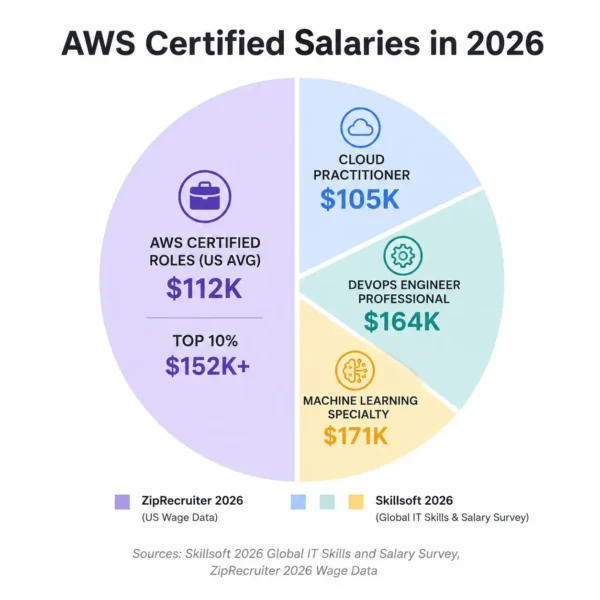
Those two numbers won’t match exactly. Salary depends on which certification you have, how much real experience backs it, and which country or city you’re in. What both data sets agree on is direction: certified professionals consistently out-earn uncertified peers, and the gap widens further up the tier ladder. Solutions Architect roles command a premium in nearly every regional salary survey I reviewed, and employers pay more for people who can prove architecture judgment under real load, not just multiple-choice recall.
The AWS certification cost itself is almost a rounding error by comparison. Even the priciest professional-level exam costs $300. Set that against a salary bump that commonly runs into five figures, and AWS certification training pays for itself faster than almost any other credential I’ve looked at in tech.
Common AWS Certification Exam Mistakes to Avoid
I’ll keep this section practical. These are the points where I lost weeks of study time.
-
I skipped hands-on labs early on and relied on flashcards, which helped with none of the scenario-based questions on the real exam.
-
I underestimated how much professional-level exams assume real-world experience. You cannot bluff your way through SAP-C02 with theory alone.
-
I skimmed past serverless scenario questions in practice tests, assuming they were rare, then found them woven into nearly every exam domain.
-
I didn’t build my study schedule around scaling and cost-optimization scenarios, which show up constantly across associate and professional exams.
-
I ignored AWS Skill Builder’s free Domain Review courses at first, assuming paid courses were automatically better. They weren’t; the free material mapped more tightly to the actual exam guide.
Final Thoughts
Eighteen months ago I was the person reading a guide like this one, unsure whether AWS certification training was worth the evenings it would eat up. Looking back, the exams were genuinely difficult in places, and I won’t pretend otherwise. But between the demand documented by Gartner and Synergy Research Group, the salary data from Skillsoft and ZipRecruiter, and what I’ve watched happen to my own career and to colleagues on the same path, an AWS certification is one of the more reliable bets you can make in tech today. Whether your goal is a solutions architect title or a security-focused role, start with one associate-level exam, lean on AWS Skill Builder instead of guessing at study materials, build something real, and let the badge follow the skill.