
Here’s a number that stopped me in my tracks: ServiceNow’s own learning platform now has almost 2 million learners on it worldwide, and that figure grew roughly 80% in a single year, according to ServiceNow’s 2026 announcement. So if you’ve been wondering whether it’s too late to learn ServiceNow, the data says the opposite — the wave is still building, and beginners are welcome on it.
This guide walks you through exactly how to learn ServiceNow from scratch, using only 2026 data, real certification paths, honest salary numbers, and the same steps I used when I started. No fluff, no recycled advice from five years ago.
I’ll be upfront about something most guides won’t tell you: I didn’t come from a computer science background. I was working an unrelated IT support job, bored out of my mind, when a colleague mentioned ServiceNow training was the reason he’d doubled his salary in three years.
I was skeptical. I spent a weekend poking around the free learning portal and got mildly obsessed with how workflows could be built without traditional coding, and six months later I was in an entry-level ServiceNow role. I still remember how confusing the platform looked on day one, and I still remember exactly which resources actually helped versus which ones just wasted time. That’s the version of this guide I wish someone had handed me.
Why Learn ServiceNow in 2026?
The honest answer is demand. The global ITSM software market is on track to reach roughly $14.95 billion in 2026, expanding at a compound annual growth rate of about 16.45% through 2031, based on Mordor Intelligence’s 2026 market report.

ServiceNow itself sits at the center of that market, holding a commanding position among enterprise workflow platforms, which is one reason a career in ServiceNow keeps showing up on “future-proof tech job” lists. Companies now run HR, customer service, security, and finance on the same platform, so the skill transfers across departments instead of staying stuck in one silo.
Another reason this moment matters: employers increasingly treat a recognized ServiceNow certification as shorthand for verified skill, and that shift is part of why ServiceNow careers keep expanding even during broader tech hiring slowdowns.
There’s also the AI angle. ServiceNow has been folding generative AI features directly into its core products, and its own learning platform now includes an AI coaching layer plus a hands-on simulation tool that walks new learners from theory into practice. That means beginners in 2026 get tools that simply didn’t exist a couple of years ago—guided simulations instead of just static videos before you ever touch a live instance.
Step-by-Step: How to Learn ServiceNow from Scratch
This is the part people usually skip past, but the order actually matters. Rushing straight into a paid ServiceNow course before understanding the basics is the single biggest reason beginners quit halfway through.
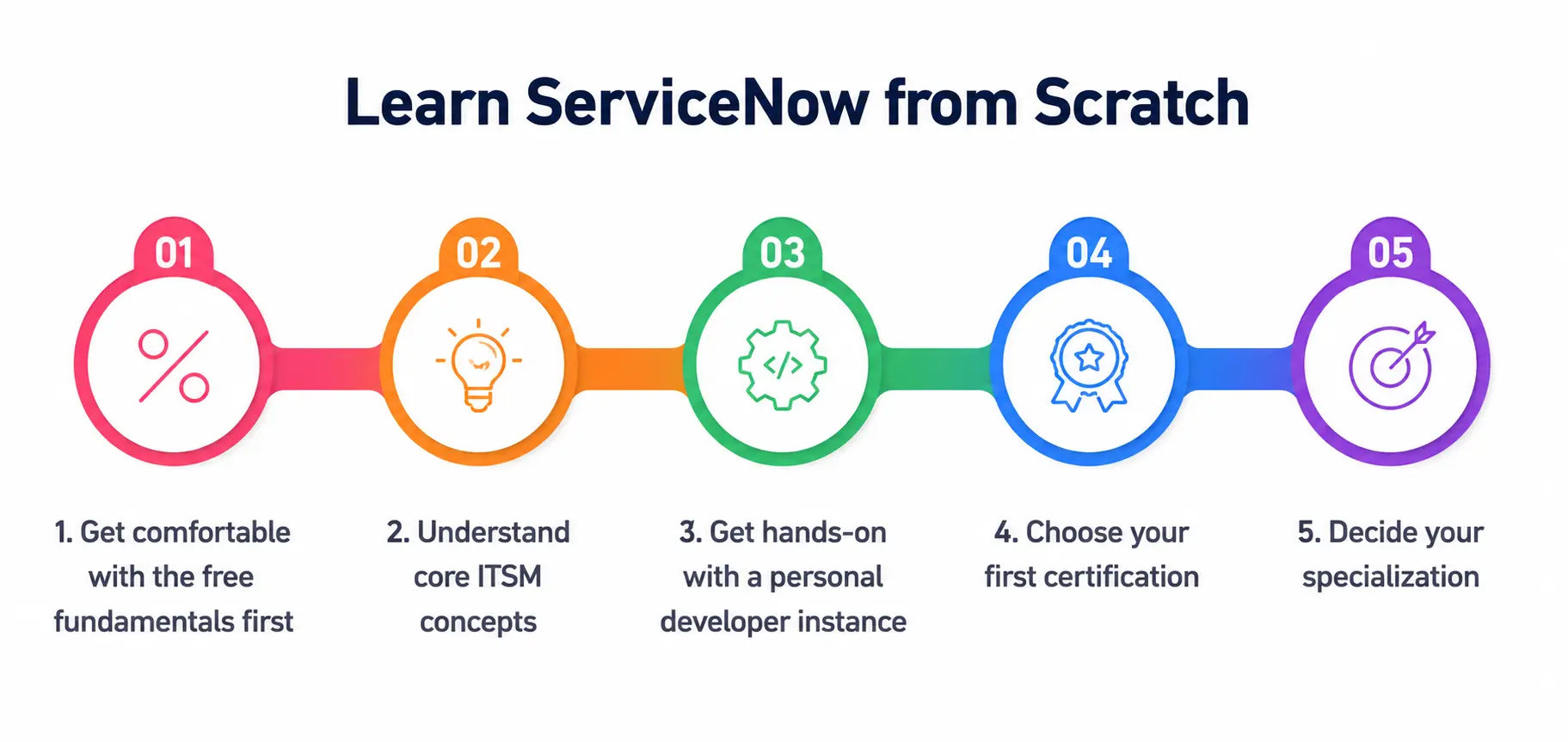
1. Get comfortable with the free fundamentals first
Before spending a cent, spend two or three weeks in ServiceNow’s own free learning environment. It covers navigation, forms, lists, and basic configuration—the vocabulary you’ll need for everything that follows. This stage is where you genuinely learn ServiceNow logic rather than memorizing button locations.
2. Understand core ITSM concepts
You don’t need to memorize a textbook, but you do need to know what incident, problem, change, and request management actually mean in a real workplace. Every ServiceNow workflow you’ll ever build is essentially automating one of these processes, so this concept work pays off immediately.
3. Get hands-on with a personal developer instance
ServiceNow offers free developer instances specifically so beginners can practice without breaking anything important. Build a simple ServiceNow workflow yourself — even something as basic as an approval chain — and you’ll retain more than a month of passive video watching.
4. Choose your first certification
Most people, myself included, start with the Certified System Administrator (CSA) path. It’s the foundation credential that around 95% of ServiceNow professionals hold, and it’s required or recommended before almost every other certification, according to SNReady’s 2026 roadmap.
Structured ServiceNow training toward this credential usually takes four to eight weeks of consistent study. Each additional ServiceNow certification you earn after this point compounds your credibility, and recruiters searching specifically for a career in ServiceNow tend to shortlist certified profiles first.
5. Decide your specialization
Once you’ve got the admin fundamentals down, pick a direction—implementation, security, customer workflows, or scripting if you want to become a ServiceNow developer. This is also the point where a genuine career in ServiceNow starts to take shape, because employers care far more about your chosen specialty than your general familiarity with the platform.
What It Actually Costs and How Long It Takes?
People rarely publish the real numbers, so here’s a straightforward table based on 2026 pricing and typical study timelines for each ServiceNow certification.
|
Certification |
Best For | Typical Study Time | Approximate Cost (USD) |
Average Salary Impact |
|
CSA (System Administrator) |
Absolute beginners | 2–4 weeks | $300–$600 |
$80K–$117K |
|
CAD (Application Developer) |
Aspiring ServiceNow developer | 4–6 weeks after CSA | $600–$800 |
$120K–$140K+ |
|
CIS (Implementation Specialist) |
ITSM, HR, or CSM specialists | 4–8 weeks after CSA | $300–$500 |
Up to $130K+ |
|
CTA (Technical Architect) |
Senior architecture roles | Several months of experience | Varies; employer-sponsored common |
40% above developer average |
That salary spread lines up with independent salary tracking too. A 2026 dataset built from over 200 real salary disclosures found architects earning significantly more than developers on average, with the gap driven largely by scarcity and ownership of solution design—several respondents even reported base pay above $200,000.
The same dataset flagged something worth knowing before you start applying: US salaries run well above UK equivalents on average, so location matters as much as certification when you’re mapping out realistic expectations for ServiceNow careers.
If you’re worried about the money running out before you land a role, the timeline is shorter than most other tech paths. Most training providers, including SMLA’s 2026 career guide, put the average at roughly two to six months from training and certification to a first job, and that number holds up whether you’re switching careers entirely or moving over from an adjacent IT role.
Building Real ServiceNow Workflow Skills
Certifications open doors, but the thing that actually keeps you employed is the ability to build and troubleshoot a working ServiceNow workflow under real conditions. A few habits make a measurable difference here:
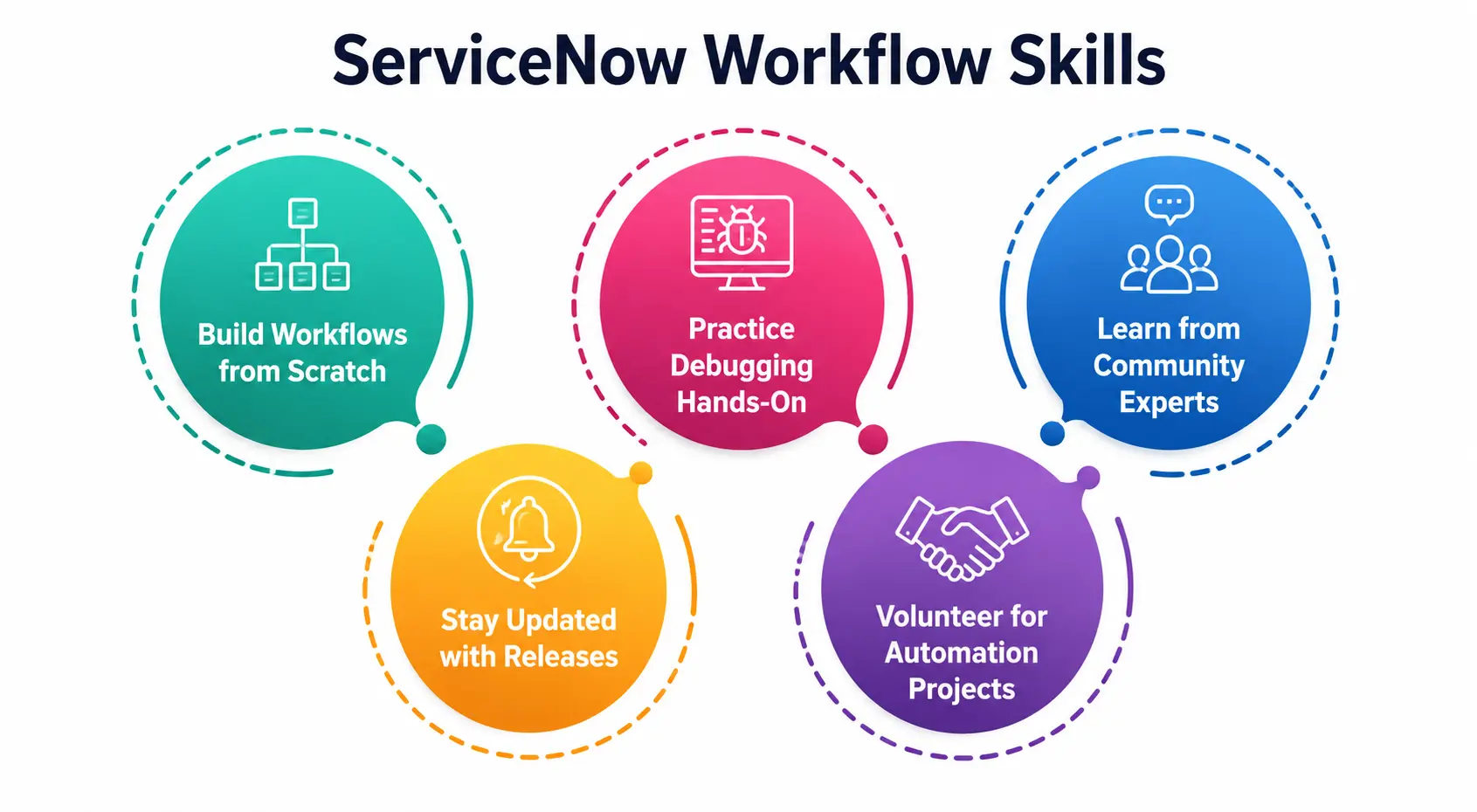
- Rebuild demo workflows from scratch instead of just watching someone else build them
- Break your own developer instance on purpose, then fix it—this teaches debugging faster than any course
- Join community forums and read how experienced admins troubleshoot live problems
- Read release notes for each new ServiceNow version so your skills don’t quietly go stale
- Volunteer for a small automation project at your current job, even outside your official title, to get real-world reps
Doing even two or three of these consistently will put you ahead of most people who only study for the exam and stop there.
Beyond Your First Job: Long-Term Growth
Landing your first role is just the opening chapter. Long-term, most people who build a lasting career in ServiceNow keep stacking specializations instead of stopping at one credential.
A ServiceNow developer who also picks up integration skills becomes far more valuable than one who only builds isolated forms, and the people earning the highest numbers in ServiceNow careers are almost always the ones who kept investing in ServiceNow training years after their first certification, not the ones who stopped early.
A few practical ways to keep growing: mentor a newer teammate on ServiceNow workflow design, take on a cross-department automation project, or shift from pure administration into a specialist ServiceNow developer track.
None of this means starting over — it’s simply an extension of the fundamentals you built in your first few months. Treat every finished project as proof you can point to the next time you’re negotiating pay or applying for a more senior career in ServiceNow.
Is a Career in ServiceNow Still Worth It?
Given everything above, yes — and the market data backs it up. ServiceNow holds a leading position among enterprise workflow platforms, with one 2026 industry comparison putting its market share at around 44.4% among competing ITSM tools. That kind of dominance means demand for trained professionals isn’t a short-term blip.
Certified professionals also tend to out-earn non-certified peers by a wide margin, particularly early on, which makes the initial investment in ServiceNow training easier to justify. Employers posting roles in 2026 increasingly list a ServiceNow certification as a baseline requirement rather than a nice-to-have, and that shift alone has pushed ServiceNow careers into steadier long-term demand than many adjacent IT specialties.
Even a single ServiceNow certification changes how recruiters filter candidates, and pairing it with a portfolio of ServiceNow workflow projects or a small ServiceNow developer side project helps your profile stand out inside crowded ServiceNow career pipelines.
Whichever direction you choose, the underlying ServiceNow careers path rewards people who keep building rather than people who stop after the first certificate. None of this is effortless. You’ll hit weeks where nothing makes sense, a workflow breaks for no clear reason, and you question whether you picked the right field.
I hit all three. What got me through was treating the free resources as seriously as I’d have treated a paid boot camp and giving myself a real deadline for the first certification instead of “someday.”
Final Thoughts
If you take one thing from this guide, let it be this: you don’t need a technical degree, a huge budget, or perfect timing to learn ServiceNow. You need a structured order of operations, a handful of reliable resources, and the discipline to actually build things instead of only watching tutorials.
The demand is real, the 2026 numbers back it up, and the path from complete beginner to a paying role is shorter than most people assume. Start with the fundamentals, pick your first certification, and give yourself permission to be a beginner for a few weeks — that’s genuinely how every experienced professional you’ll meet in this field got started.
Once you learn ServiceNow fundamentals properly, everything else in this ecosystem becomes far easier to pick up.