

If you’ve ever sat through a regulatory review and gotten blindsided by a finding nobody saw coming, you already understand why a Compliance Gap Analysis deserves more attention than it usually gets.
It isn’t a box-ticking exercise. It’s the difference between assuming your policies work and actually knowing whether they hold up when a regulator, a client, or a court starts asking hard questions.
This guide is written for students learning governance and audit concepts, and for business owners who want a plain-English walkthrough of how this process works, why it matters, and how to run one without hiring a six-figure consulting firm to get started.
What Is a Compliance Gap Analysis?
At its core, this review is a structured comparison between what your organization is actually doing and what laws, regulations, contracts, or industry standards say you should be doing. The output is a clear, prioritized list of “gaps” — the specific places where current practice falls short of the required standard.
It’s related to, but not identical to, a compliance audit. A compliance audit is usually a formal, often independent, verification exercise that checks whether you’re meeting a defined set of rules at a specific point in time, and it typically produces a pass/fail or rated outcome.
As IBM explains in its overview of this topic, such reviews can cover areas ranging from cybersecurity and data privacy to financial reporting and workplace safety, and they’re frequently carried out by an independent party rather than the internal team itself.
This kind of gap-focused review, by contrast, is more diagnostic than judgmental — its job is to map the distance between where you are and where you need to be, not to hand out a grade or a pass/fail verdict.
Think of it this way: a formal review like that tells you that you failed a requirement. This exercise tells you why, by how much, and what it will take to close the distance — and which fix to tackle first.
Why Does It Matters — For Businesses and Students Alike?
Skipping this step is a bit like driving without checking your mirrors. You might be fine for a while, but you’re operating blind to risk exposure that’s quietly building up around you. Regulatory penalties, lost contracts, damaged reputation, and even personal liability for executives in some sectors can all trace back to a gap nobody flagged until it was too late.
For students, this topic matters because risk identification is one of the most transferable skills in governance, auditing, and cybersecurity careers. Whether you end up in internal audit, compliance, IT security, or operations, you’ll eventually be asked to compare “what we’re doing” against “what we’re supposed to be doing” — exactly the skill this exercise builds.
A well-run gap assessment also protects an organization’s growth plans. Investors, acquirers, and larger business partners routinely ask for proof of compliance maturity before signing deals, and a messy internal review process is often read as a red flag all on its own — even before anyone looks at the underlying numbers.
A business that can produce a recent, well-documented review of this kind signals real governance discipline to everyone on the other side of the table. Catching problems while they’re still cheap to fix is, in short, the entire point of a Compliance Gap Analysis.
Compliance Gap Analysis vs. Related Terms
Students and working professionals alike often mix up these terms. Here’s a quick side-by-side breakdown.
|
Term |
Primary Focus | When It Happens |
Typical Output |
|
Compliance Gap Analysis |
Comparing current practice to required standards | Proactive, often before a formal review |
List of gaps with priority and remediation plan |
| Verifying adherence to a defined rule set | Scheduled or triggered, often independent |
Formal report with a rating |
|
| Broader term; can apply to compliance, skills, or process gaps | Anytime a baseline needs checking |
Comparison document, not always compliance-specific |
|
| Identifying and scoring potential threats | Ongoing or periodic |
Risk register ranked by likelihood and impact |
The overlap between these terms is real, which is exactly why the gap-focused review is often used as the first phase of a broader risk assessment, or as preparation before a formal audit.
Step-by-Step: How to Conduct a Compliance Gap Analysis
You don’t need exotic tools to run this well — you need discipline and a clear sequence. Here’s a practical process students and small business teams can both follow.
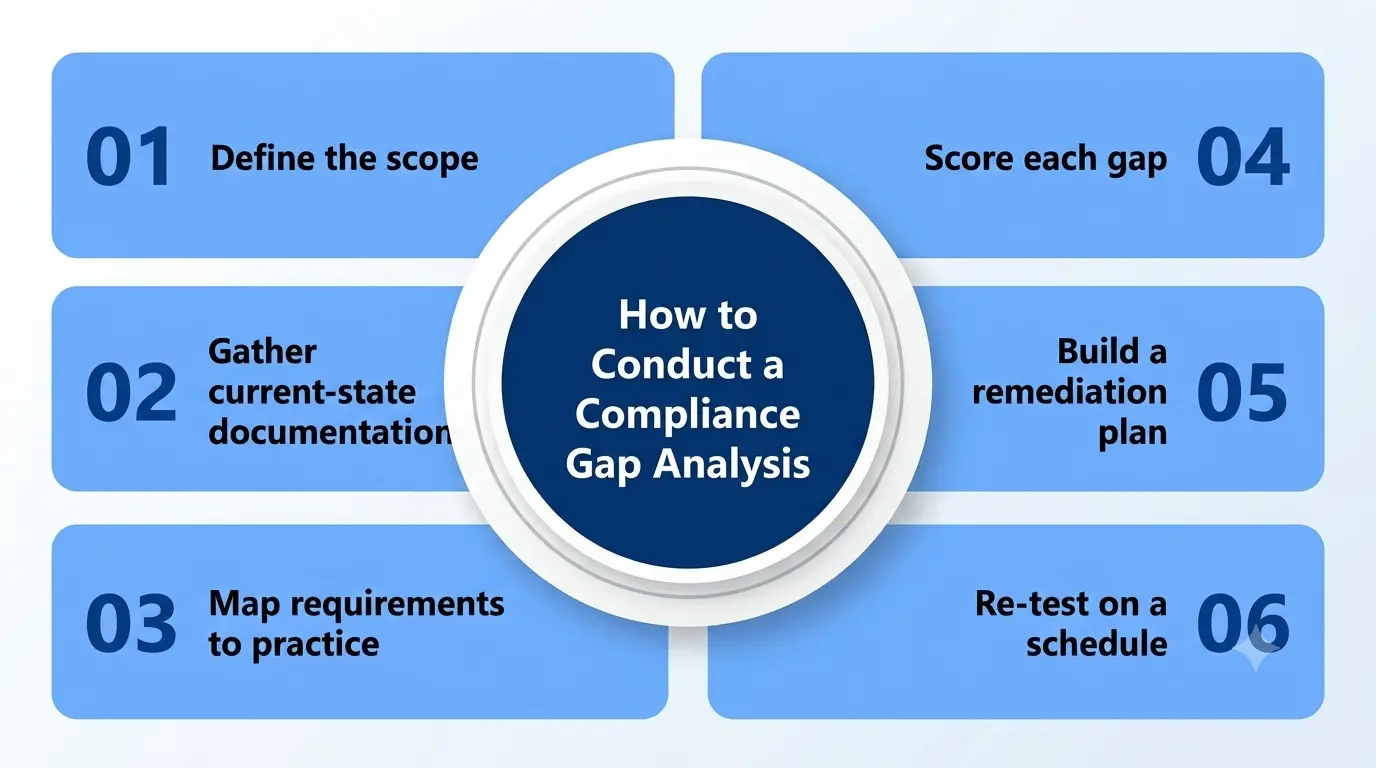
- Define the scope. Decide which regulations, standards, or contractual obligations you’re measuring against — data privacy law, workplace safety rules, financial reporting standards, or all of the above.
- Gather current-state documentation. Pull together existing policies, procedures, training records, and prior review notes so you have a real baseline instead of assumptions.
- Map requirements to practice. For every rule in scope, ask: do we have a documented policy for this, and is it actually being followed? This is where risk identification really happens — you’re checking behavior, not just paperwork.
- Score each gap. Rate the severity and risk exposure of each gap you find. A missing signature on a form is not the same magnitude of problem as an unencrypted customer database.
- Build a remediation plan. Assign owners, deadlines, and resources to close each gap, starting with the highest-risk items first.
- Re-test on a schedule. A gap assessment isn’t a one-time event — revisit it periodically, and especially after any regulatory change or major business shift.
This sequence lines up closely with recognized international guidance, including ISO 19011, which sets out principles for auditing management systems and for structuring exactly this kind of comparison work in a repeatable, defensible way.
Common Audit Findings You Can Catch Early
Auditors tend to see the same categories of problems repeat across industries, regardless of sector. Reviewing typical audit findings before you’re formally audited is one of the smartest ways to use this kind of internal review. Recurring problem areas include:
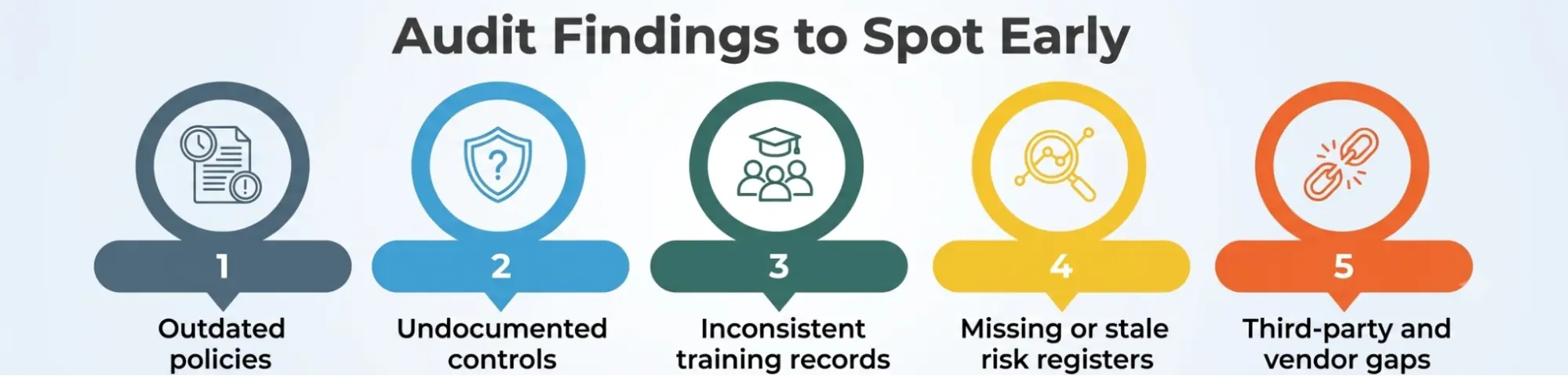
- Outdated policies that no longer reflect current law or current operations.
- Undocumented controls — the team may be doing the right thing, but with no record to prove it, which auditors treat as a gap regardless of intent.
- Inconsistent training records, especially around data protection and workplace safety.
- Missing or stale risk registers that haven’t been updated in over a year.
- Third-party and vendor gaps, where your own policies are solid but a vendor’s practices quietly create hidden exposure.
Catching these audit findings internally is far cheaper than having a regulator or client discover them for you.
Frameworks That Support the Process
You don’t need to invent your own methodology from scratch. Several established frameworks can anchor your Compliance Gap Analysis in something more solid than personal judgment:
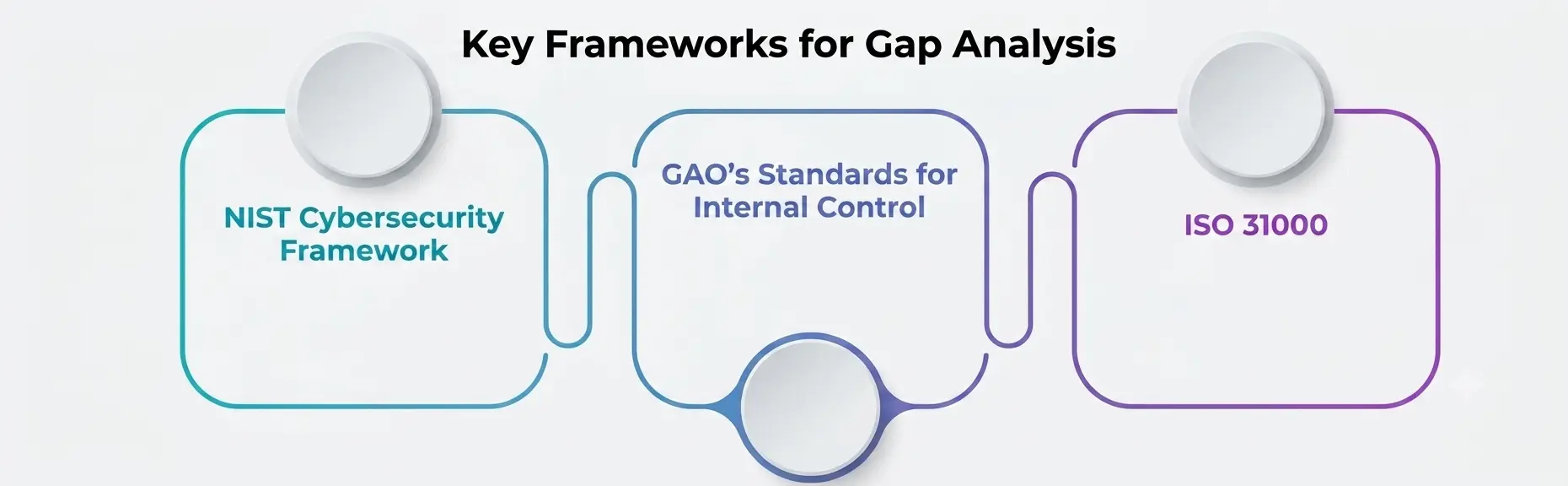
- The NIST Cybersecurity Framework offers a widely adopted structure for identifying, protecting against, and responding to cybersecurity risk — useful even outside the U.S. federal context it originated in.
- The GAO’s Standards for Internal Control (the “Green Book”) lays out five components of internal control — control environment, risk assessment, control activities, information and communication, and monitoring — that map directly onto how a strong gap review should be structured.
- ISO 31000 supports the risk identification and evaluation stage that sits at the center of this entire process, from the first review through ongoing monitoring.
Borrowing structure from these frameworks means your findings won’t just be a personal opinion of what’s wrong — they’ll be defensible against recognized, external standards.
Risk Exposure: What Happens If You Skip It
Here’s the uncomfortable part. Organizations that never run this kind of review don’t avoid risk exposure — they simply stop measuring it. That’s arguably worse than a poor score, because you can’t prioritize what you can’t see.
Unmanaged exposure tends to surface at the worst possible moment: during a surprise audit, after a data breach, or right before a major funding round when a buyer’s due-diligence team starts asking pointed questions.
A single overlooked gap — an expired certification, an unencrypted file share, a missing consent record — can escalate into fines, lawsuits, or a collapsed deal. The entire purpose of this exercise is to convert that invisible risk exposure into a prioritized, manageable list.
Tools and Methods for a Practical Gap Assessment
You don’t need enterprise software to start. A basic review can be built using:
- A spreadsheet mapping each requirement, current status, gap description, owner, and deadline.
- Interviews with department heads to compare documented policy against actual daily practice.
- A review of prior findings and complaint logs, which often point directly to unresolved gaps.
- Free or low-cost checklist templates tied to the specific regulation you’re targeting — data privacy, workplace safety, or financial reporting.
As an organization grows, many teams move to dedicated governance, risk, and compliance (GRC) software — but the underlying logic of the review stays the same regardless of the tool.
Who Should Own This Process?
In a larger company, this work usually sits with a compliance officer, internal audit team, or a designated risk manager who reports findings up to leadership or the board. In a small business, it might just be the owner and a trusted operations lead working through a checklist together on a slow afternoon.
Neither approach is wrong — what matters is that someone is clearly accountable for the outcome, that findings get written down instead of just discussed, and that the resulting action items actually get assigned deadlines and owners rather than sitting in a forgotten email thread.
For students building a career in this space, it’s worth noting that this work rarely happens in isolation. A single reviewer checking policy documents can flag obvious paperwork gaps, but the more valuable insight usually comes from cross-functional interviews — talking to the people who actually run daily operations, not just reading the manual they’re supposed to follow. That gap between documented policy and lived practice is where the real findings tend to live.
A Quick Example
Picture a mid-sized online retailer preparing for an upcoming compliance audit tied to data protection law. Before the auditors arrive, the compliance team runs its own Compliance Gap Analysis.
Through risk identification interviews with the customer service and IT teams, they discover that support staff have been exporting spreadsheets of customer data to personal laptops for “convenience” — a practice never covered by any written policy.
That single discovery, caught internally, lets the company fix the gap, retrain staff, and document the correction weeks before the formal review begins. When the real audit findings come in, that particular issue simply isn’t there. That’s the entire value of finding your own problems before someone else finds them for you.
A Personal Note
I’ve watched more than one small business treat compliance like a fire extinguisher — something you only think about once smoke is already in the room. The teams that fare best are the ones that treat this kind of review as routine maintenance, not crisis response.
It doesn’t need to be perfect on the first pass. It just needs to be honest. The businesses I’ve seen get burned weren’t the ones with messy audit findings — they were the ones who never looked in the first place.
Conclusion
A Compliance Gap Analysis is one of the most practical governance tools available to any organization, regardless of size. It won’t eliminate risk entirely, but it replaces guesswork with a clear, prioritized view of where real exposure sits, before a regulator, client, or courtroom finds it for you.
For students, mastering this skill opens doors across audit, compliance, and risk management careers. For businesses, it’s simply good discipline, practiced early and often.