
If you search “cloud architect job description,” you’ll get a wall of buzzwords—multi-cloud strategy, enterprise scalability, stakeholder alignment. None of it tells you what the person actually does between 9 am and 5 pm.
Here’s the honest answer: a cloud architect is the person who decides how a company’s technology runs in the cloud — which services to use, how they connect, how much they cost, and how to keep them secure. They sit between business leadership (who want results) and engineering teams (who build the systems). They translate one word into the other.
Think of them like an architect for a building. They don’t lay the bricks—but without their blueprint, nobody knows where the bricks go or why.
| Statistic | Insight |
|---|---|
| $175K+ | Average senior cloud architect salary (US, 2026) |
| 25% | Projected job growth for cloud roles through 2034 |
| 37,000+ | Open cloud architect job listings globally right now |
A cloud architect designs the infrastructure that modern software runs on — databases, servers, networking, security, and deployment pipelines — using platforms like AWS, Microsoft Azure, or Google Cloud.
A realistic day in the life
To make this concrete, here’s what a typical workday looks like for a senior cloud architect at a mid-sized software company. This is a composite based on real job descriptions and published accounts from practitioners — not a single real individual.
Note: The day below is an illustrative example based on common patterns across the role. It represents typical responsibilities, not one specific person’s schedule.
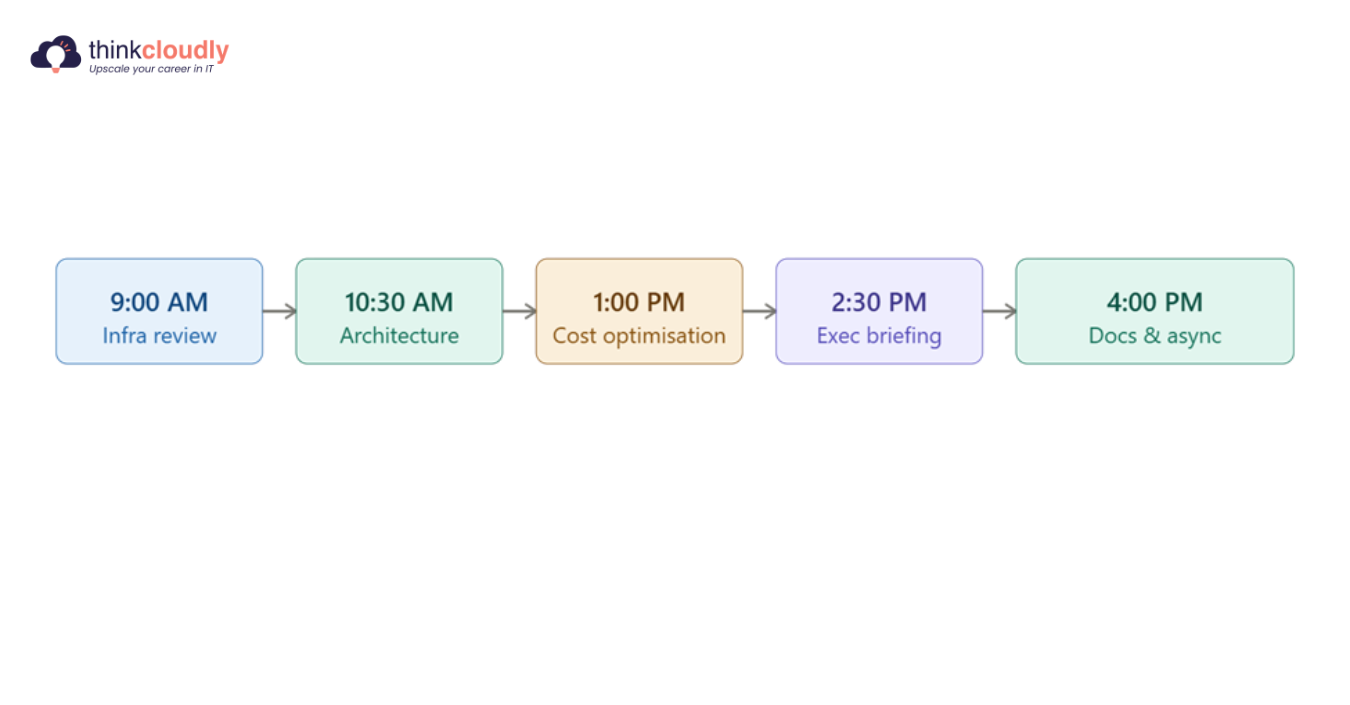
9:00 AM- Infrastructure review
Checks dashboards for overnight alerts — any cost spikes, latency issues, or failed deployments. Reviews a Terraform pull request from an engineer that would change how the company’s staging environment is set up. Leaves comments on two decisions that need to change before merging.
10:30 AM- Architecture design session
Joins a two-hour session with the product and engineering team to design the data pipeline for a new AI feature. Draws out the architecture in Miro — which AWS services will handle storage, processing, and model serving. Flags three security concerns that need to be addressed before development starts.
1:00 PM- Cost optimization work
The company’s AWS bill came in 18% over budget last month. Spends an hour in AWS Cost Explorer identifying idle EC2 instances and over-provisioned RDS databases. Writes a short report with three specific changes that could save roughly $14,000 per month.
2:30 PM- Executive briefing
Presents a migration proposal to the CTO and VP of Engineering. The company currently runs two legacy systems on physical servers — the plan is to move them to Azure over the next two quarters. Walks through the timeline, costs, risks, and what could go wrong. No code- just clarity and judgment.
4:00 PM- Documentation & async reviews
Updates the team’s architecture decision records (ADRs) — internal documents that explain why certain infrastructure choices were made. Responds to two Slack threads from engineers with questions about IAM permission scopes and VPC configuration. Wraps up by reviewing a draft runbook written by a junior engineer.
The pattern you’ll notice
Cloud architects spend more time in meetings, documents, and design tools than in terminals writing commands. The technical knowledge is essential — but the job is largely about making decisions and communicating them clearly to people with very different backgrounds.
Core responsibilities broken down
Across hundreds of real job postings in 2026, these are the responsibilities that appear most consistently for cloud architect roles.
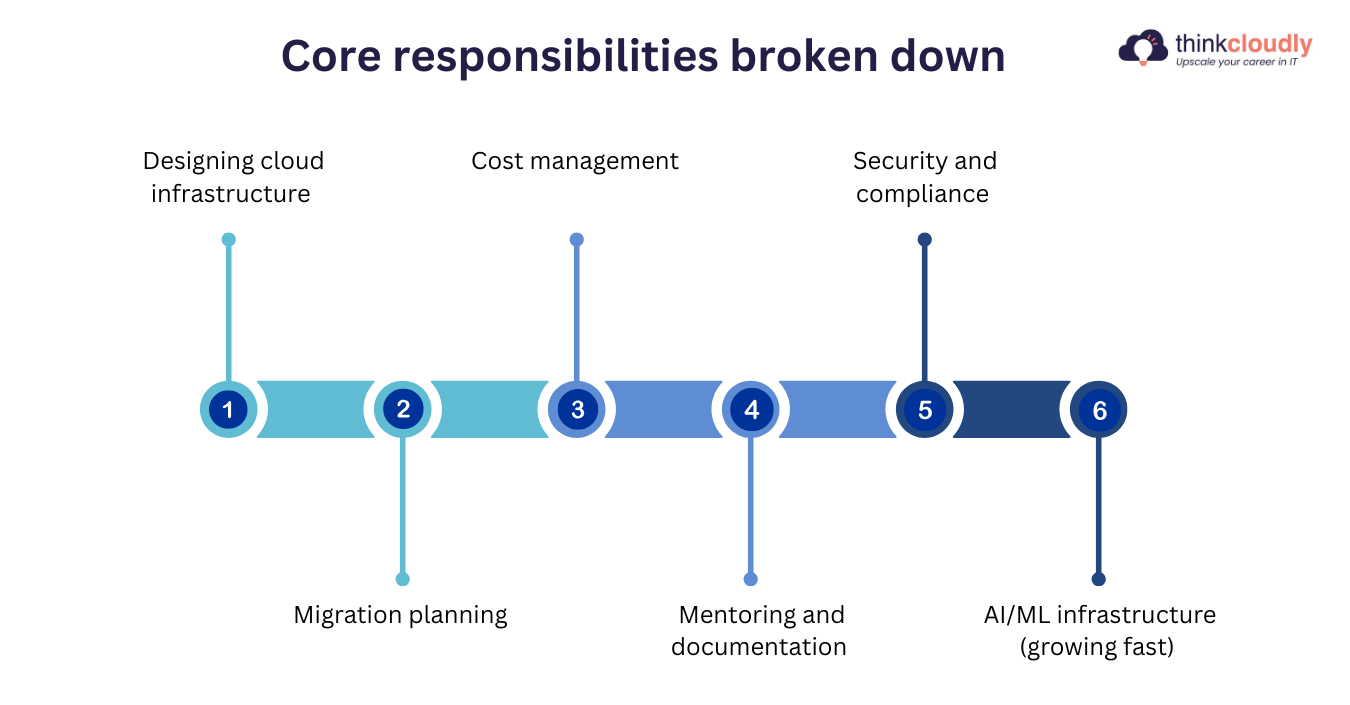
- Designing cloud infrastructure — Building the architecture that applications run on, including how data moves, where it’s stored, and how services communicate. This includes choices between microservices vs monoliths, multi-region vs single-region, and which managed services to use vs build.
- Cost management — Monitoring cloud spend and finding ways to reduce waste. A study by Flexera found that companies waste an average of 28% of their cloud budget. Cloud architects are often the ones responsible for getting that number down.
- Security and compliance — Ensuring that infrastructure meets security standards like SOC 2, ISO 27001, HIPAA, or GDPR. This involves setting up identity and access management (IAM), encryption policies, and network segmentation.
- Migration planning — Many companies are still moving legacy systems to the cloud in 2026. Cloud architects design the migration strategy — what moves first, how to avoid downtime, and what to test before going live.
- Mentoring and documentation — Teaching engineering teams how to use cloud services properly. Writing architecture decision records, runbooks, and standards so the organization isn’t dependent on one person’s knowledge.
- AI/ML infrastructure (growing fast) — In 2026, many cloud architect roles now include setting up the infrastructure to support machine learning workloads — model training pipelines, GPU instance management, and MLOps tooling.
Tools cloud architects actually use
Based on 2026 job postings and practitioner surveys, these are the tools that appear most frequently in the role.
- Cloud platforms: AWS, Microsoft Azure, Google Cloud Platform
- Infrastructure as code: Terraform, AWS CloudFormation, Pulumi
- Containers & orchestration: Docker, Kubernetes, Amazon EKS, Azure AKS
- Monitoring & observability: Datadog, CloudWatch, Grafana, Prometheus
- Security & identity: AWS IAM, Azure AD, HashiCorp Vault, Prisma Cloud
- Design & documentation: Miro, Lucidchart, Confluence, draw.io
- CI/CD pipelines: GitHub Actions, Jenkins, ArgoCD, CircleCI
- Cost management: AWS Cost Explorer, Azure Cost Management, Infracost
What cloud architects earn in 2026
Cloud architect salaries are among the highest in the technology sector. Here is what the market looks like across experience levels, based on data from Glassdoor, LinkedIn Salary, and Levels.fyi (2025–2026, US market).
|
Level |
Base Salary |
Total comp (with bonus) |
|
Associate/ junior (2-4yrs) |
$115K–$145K |
$130K–$165K |
|
Mid-level (5–8 yrs) |
$145K–$175K |
$170K–$210K |
|
Senior (8+ yrs) |
$175K–$220K |
$210K–$270K+ |
|
Principal / Staff |
$220K–$280K |
$280K–$400K+ (FAANG) |
Case study: From Systems Administrator to Cloud Architect in 5 years
This represents a path that appears frequently in cloud architect career histories: someone with a background in on-premises IT infrastructure who transitions over several years into a full cloud architecture role.
The typical progression: systems admin → cloud engineer (after AWS Solutions Architect cert) → senior cloud engineer (after 2–3 years of hands-on AWS work) → cloud architect (after leading a major migration project and earning the AWS Solutions Architect Professional cert).
The critical turning point for most people in this path is not a certification — it’s being trusted to design and own a significant infrastructure decision end-to-end.
| Statistic | Insight |
|---|---|
| 5 yrs | Typical transition timeline |
| $65K → $180K | Common salary trajectory |
| 2–3 | Certifications typically earned along the way |
Note: This career path is illustrative — based on patterns observed across publicly shared career stories and LinkedIn profiles, not a single individual’s experience.
Cloud architect vs cloud engineer — what’s the difference?
This distinction confuses many people because the titles are sometimes used interchangeably. Here’s a practical way to think about it:
The simplest way to think about it
Cloud engineers build the systems. Cloud architects design them. An engineer implements a Kubernetes cluster. An architect decides whether to use Kubernetes at all, why, how it fits with everything else, and what the trade-offs are. In smaller companies, one person often does both. In large enterprises, these are separate roles.
In practice, most cloud architects spent several years as cloud engineers first. The transition to architect usually happens when someone develops both the technical depth to make confident infrastructure decisions and the communication skills to explain and defend those decisions to non-technical stakeholders.
How do you become one?
There’s no single path, but the most common one in 2026 looks like this:
Start with a foundation in cloud engineering or IT infrastructure — Most architects spent 3–5 years as engineers first. Networking, Linux, and scripting knowledge are genuinely useful starting points.
Get certified — but strategically — The AWS Solutions Architect Associate is the most widely recognised entry point. Follow it with the Professional version after a year or two of hands-on work. Azure and GCP equivalents are valuable if that’s your company’s platform.
Own a real project end-to-end — The jump from engineer to architect usually requires demonstrating that you can lead infrastructure decisions, not just implement them. Look for opportunities to own a migration, redesign, or cost reduction project.
Develop your communication skills — Architects present to executives, write technical proposals, and mentor junior engineers. If writing clearly and explaining trade-offs confidently is not a strength, it needs to become one.
Pick a specialization — Security, AI/ML infrastructure, FinOps (cloud cost management), and healthcare/regulated industries all have strong demand and pay premiums. Going deep in one area accelerates the path to senior roles.
Sources and references
All data used in this article is drawn from the following sources, accessed in 2025–2026.
-
US Bureau of Labor Statistics — Computer and IT Occupations Outlook — Job growth projections through 2034
-
Glassdoor — Cloud Architect Salary Data (2025–2026) — US salary ranges by experience level
-
Levels.fyi — Cloud Engineer and Architect Compensation Data — Total compensation including bonuses and equity
-
Flexera — State of the Cloud Report 2025 — Cloud waste statistics and budget data
-
Dice Tech Salary Report 2025 — Specialization salary premiums in cloud roles
-
Course Report — Cloud Certifications Demand Analysis (12M+ postings) — Certification frequency across job postings
-
LinkedIn Jobs — Cloud Architect Global Listings (2026) — Job volume and employer demand data
-
AWS — Solutions Architect Professional Certification — Official certification details and requirements