
Five years of solid IT experience. Strong certifications. A clean track record. And somehow—you didn’t make the shortlist. In 2026, this is not bad luck. It’s the new normal. Here’s why — and what to do about it.
Picture this: you have five or six years of IT under your belt. You know networking, you’ve managed servers, and you can talk cloud all day. You apply for a role you’re clearly qualified for—and you don’t even get a callback. Meanwhile, someone with three years of experience gets the job. What happened?
This is not a one-off story. It’s happening across the globe, in every sector that runs on technology, which is basically all of them now. The tech job market in 2026 has shifted in a way that’s uncomfortable to admit: putting in more years of the same kind of experience no longer moves the needle the way it used to.
The good news? Once you understand why this is happening, you can do something about it.
The ground has shifted under your feet
For a long time, IT worked on a simple model: put in time, gain experience, move up. Certifications helped, but mostly time did the work. Employers trusted experience as a proxy for competence.
AI changed this calculation fast. When AI tools can handle routine coding, basic data processing, and standard troubleshooting, the value of “I’ve been doing this for years” shrinks. What grows in value is the ability to work alongside AI — to judge its output, spot its mistakes, and make decisions it simply can’t.
| According to Robert Half’s 2026 Talent Report, nearly two-thirds of tech hiring managers report that sourcing qualified professionals has become more difficult compared to the previous year. | |
| 2.5 years | Half-life of a technical skill, according to Harvard Business Review |
| 93% | Of tech leaders say their teams lack the skills needed to deliver on 2026 priorities |
The technical skills you learned 2.5 years ago are already approaching their expiration date. If you’ve spent the last few years deepening the same set of skills without branching out, the market may have quietly moved on without you.
A real-life example: The IT manager who got passed over
Marcus, an IT professional based in the UK, has been in IT for eight years, most recently at a mid-size logistics firm. He knows his tools inside out. In early 2026, his company hired a new Head of IT infrastructure—a role Marcus felt he was born for.
They gave it to someone from outside with six years of experience, not eight. The difference? That person had spent the last two years getting hands-on with AI-driven monitoring tools, had led a cross-functional cloud migration project, and could present technical decisions to non-technical executives without breaking a sweat.
Marcus had more hours in the chair. But the new hire had more of what the job actually needed in 2026: AI fluency, business communication, and demonstrated leadership across teams. Marcus’s manager later told him privately, “We weren’t looking for the most experienced person. We were looking for the most ready person.”
Marcus is now upskilling in AI operations and has started speaking up more in leadership meetings. He’s not starting over—he’s evolving.
What employers are actually looking for now
Marcus’s story isn’t unique—and the data backs it up. When you look at what’s driving hiring decisions in 2026, a clear picture emerges. Employers are not just checking boxes on years of experience. They are asking very specific questions: Can this person work with AI tools, not just around them? Can they make judgment calls when something goes wrong at 2 a.m.? Can they explain a complex decision to a CEO in plain language?
According to data from multiple 2026 hiring reports, the skills creating the most demand right now fall into two camps: technical depth in AI-adjacent areas and human skills that AI simply cannot replicate.
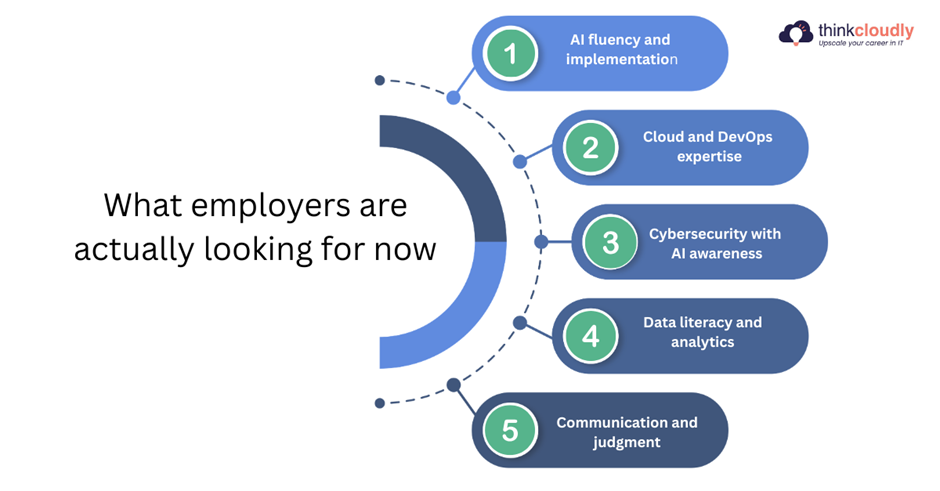
AI fluency and implementation
Not building AI from scratch, but integrating it, evaluating its output, and knowing when to trust it. Featured in 89% of new tech job postings in 2026.
Cloud and DevOps expertise
Multi-cloud environments, CI/CD pipelines, and infrastructure-as-code remain core. Cloud engineers now earn $30,000–$50,000 above average.
Cybersecurity with AI awareness
AI is expanding the attack surface. Employers want people who understand AI-enabled threats, not just traditional vulnerabilities. Projected 367% job growth by 2035.
Data literacy and analytics
Advanced data roles pay 57% more than basic analyst positions. Understanding pipelines matters as much as reading dashboards.
Communication and judgment
Communication skills have appeared in millions of job postings across consecutive years — a trend that has only grown stronger heading into 2026. 89% of hiring failures trace back to soft skill gaps, not technical ones.
The experience paradox
Here is something that catches many people off guard: entry-level roles labelled “junior” now often require 2 to 5 years of experience, while mid-level roles are demanding skills that barely existed three years ago. Deloitte found that nearly 66% of hiring managers believe new hires aren’t fully job-ready — even experienced ones.
This isn’t because people are getting worse. It’s because the bar keeps moving. Companies are choosing fewer, highly effective hires over large, generalist teams. They want someone who can walk in and create impact quickly, not someone who needs six months to catch up with the tools the team is already using.
Skills-based hiring is now the default. That means your resume’s years-of-experience column matters less than your ability to show what you can actually do. Portfolios, project outcomes, and certifications that prove hands-on capability are taking over from job titles and tenure.
The soft skills twist
One of the most surprising shifts in 2026 is how much soft skills now drive outcomes. Research shows that 90% of top performers have high emotional intelligence, and 70% of career advancement for senior professionals hinges on their ability to connect and collaborate. As AI handles more of the execution, the human parts of IT work—managing conflict, explaining trade-offs, and leading a team through uncertainty—have become the real differentiators.
This doesn’t mean technical skills don’t matter. They absolutely do. But technical skills get you in the room. Soft skills decide how far you go once you’re there.
What this means for your next move
If you’re sitting on solid IT experience and wondering why you’re not progressing the way you expected, the answer is probably not that you need more of the same. You need a different kind of growth.
Look at the job descriptions for roles one level above where you are right now. Notice what keeps appearing that you don’t have yet. That gap is your roadmap. Focus on AI tool literacy, communication in business contexts, and one area of deep technical specialization that’s growing—cybersecurity, data engineering, or cloud architecture are all strong bets in 2026.
The professionals who are thriving right now are not the ones who have been in IT the longest. They are the ones who stayed curious, kept learning, and were willing to evolve when the work changed around them.
A quick look at the numbers
|
Skill Area |
Salary Premium / Growth |
2026 Priority |
|
AI & ML integration |
$30,000–$50,000 above average (US) |
Very High |
|
Cloud / DevOps |
$168,000+ annually (US) |
Very High |
|
Cybersecurity |
367% projected job growth |
Critical |
|
Data analytics |
57% above basic analyst pay |
High |
|
Communication skills |
Linked to 89% of hiring decisions |
Essential |
Conclusion
The tech world didn’t pull the rug out from under you. It just moved faster than most people expected. The IT experience you have is valuable — but it’s the starting point for your next chapter, not the whole story.
In 2026, the professionals who are advancing are the ones who treat learning as part of the job description, not something they do when they “have time.” They’re adding AI fluency, sharpening their communication, and picking a technical lane where they can go deep — not just broad.
You already have the foundation. What you build on it from here is up to you. The experience you’ve built matters—but in 2026, it opens the door. What gets you through it is how you’ve grown since.
The next step isn’t another year of the same work. It’s one new skill, intentionally chosen. Start there.
Sources and References
- Robert Half — 2026 Demand for Skilled Talent Report — “87% of technology leaders feel confident about their business outlook for 2026; 65% say finding skilled professionals is harder than a year ago.”
- Robert Half — Tech Skills Gap: 2026 Strategies — “93% of tech leaders report teams lack the staff and skill sets required to deliver on their priority initiatives.”
- CompTIA — State of the Tech Workforce 2025 — “Tech jobs in the US are projected to grow from 6.09M in 2025 to 7.03M in 2035, with 414% growth for data scientists, 367% for cybersecurity, and 297% for software developers.”
- PwC — AI Jobs Barometer 2025 — “Skills sought by employers are changing 66% faster in jobs most exposed to AI than in jobs least exposed.”
- Harvard Business Review — “The half-life of a technical skill is as short as 2.5 years.”
- Kelly Workforce / Scale.jobs — 2026 Skills Roundup — “85% of employers now use skills-based hiring; 89% of hiring failures linked to soft skill gaps; communication appeared in nearly 2 million job postings. “
- Deloitte — 2025 Human Capital Trends — “Nearly 66% of hiring managers believe new hires aren’t fully job-ready.” —
- IDC — AI Workforce Readiness Analysis — “Global skills gap estimated at $5.5 trillion; only 35% of workers considered AI-ready.” —
- AnitaB.org / Legacy — Tech Job Market 2026 — “Candidates with clear, proven expertise are far more competitive than those with broad but shallow skill sets.” —
- CIO.com—Future-proof tech skills for the evolving AI job market—”85% of business leaders and 87% of workers agree organizations are putting more emphasis on human skills alongside technical expertise.”