
Software teams in 2026 ship faster than ever. Daily releases, continuous deployment, and shrinking sprint cycles mean that manual testing can no longer keep up. When a developer merges code every few hours, a QA team manually testing each change becomes the bottleneck that slows every release down.
AI tools for software testing solve this directly. They generate test cases from plain English descriptions, self-heal broken tests when the UI changes, detect bugs before they reach production, and run thousands of checks simultaneously. Teams spending up to 60% of QA time fixing broken selectors can eliminate most of that maintenance overhead with the right AI testing platform.
This guide covers the 10 best AI tools for software testing in 2026 — production-ready platforms that real engineering teams use to improve software quality and accelerate release cycles.
How AI Is Changing Software Testing in 2026
Traditional automated software testing tools required engineers to write every test script manually, maintain selectors when the UI changed, and debug failing tests to separate real bugs from flaky infrastructure.
Modern test automation with AI changes the equation in three ways. First, self-healing: when the application changes, AI adapts test locators automatically. Second, natural language authoring: write tests in plain English, opening QA automation to team members who don’t write Selenium scripts. Third, intelligent execution in CI/CD pipelines—running only the tests most likely affected by recent code changes.
Teams using AI tools for software testing report up to 80% reduction in manual test maintenance and significantly faster test creation. Software quality improves because teams spend more time designing new tests and less time fixing old ones.
Quick Comparison Table
|
Tool |
Best For | Free Plan | Starts At |
|
Katalon |
All-in-one testing platform | Yes |
$208/month |
| Mabl | AI-native autonomous testing | No |
$450/month |
|
Applitools |
Visual AI testing | Yes | Custom pricing |
|
Testim (Tricentis) |
AI self-healing UI tests | Trial | Custom pricing |
| Playwright | Open-source developer testing | Free |
Free |
| BrowserStack | Cross-browser cloud execution | Trial |
$129/month |
|
Keploy |
AI-powered API testing | Yes (open-source) | Free |
|
Selenium |
Foundation open-source framework | Free | Free |
| Testsigma | Natural language test automation | Yes |
$199/month |
| LambdaTest | AI test execution cloud | Yes |
$15/month |
Top 10 AI Tools for Software Testing Reviewed
Choosing the right AI testing platform is no longer just a technical decision — it directly affects how fast your team can ship reliable software. Some tools focus on self-healing automation; others specialize in visual testing, API coverage, or AI-generated test creation. The platforms below represent the best AI tools for software testing in 2026 based on real-world adoption, automation capabilities, CI/CD integration, scalability, and ease of maintenance.
Whether you’re a startup building your first QA automation workflow or an enterprise managing thousands of daily test runs, these tools can help reduce manual effort, improve software quality, and accelerate release cycles.
1. Katalon — The Best All-in-One Testing Platform
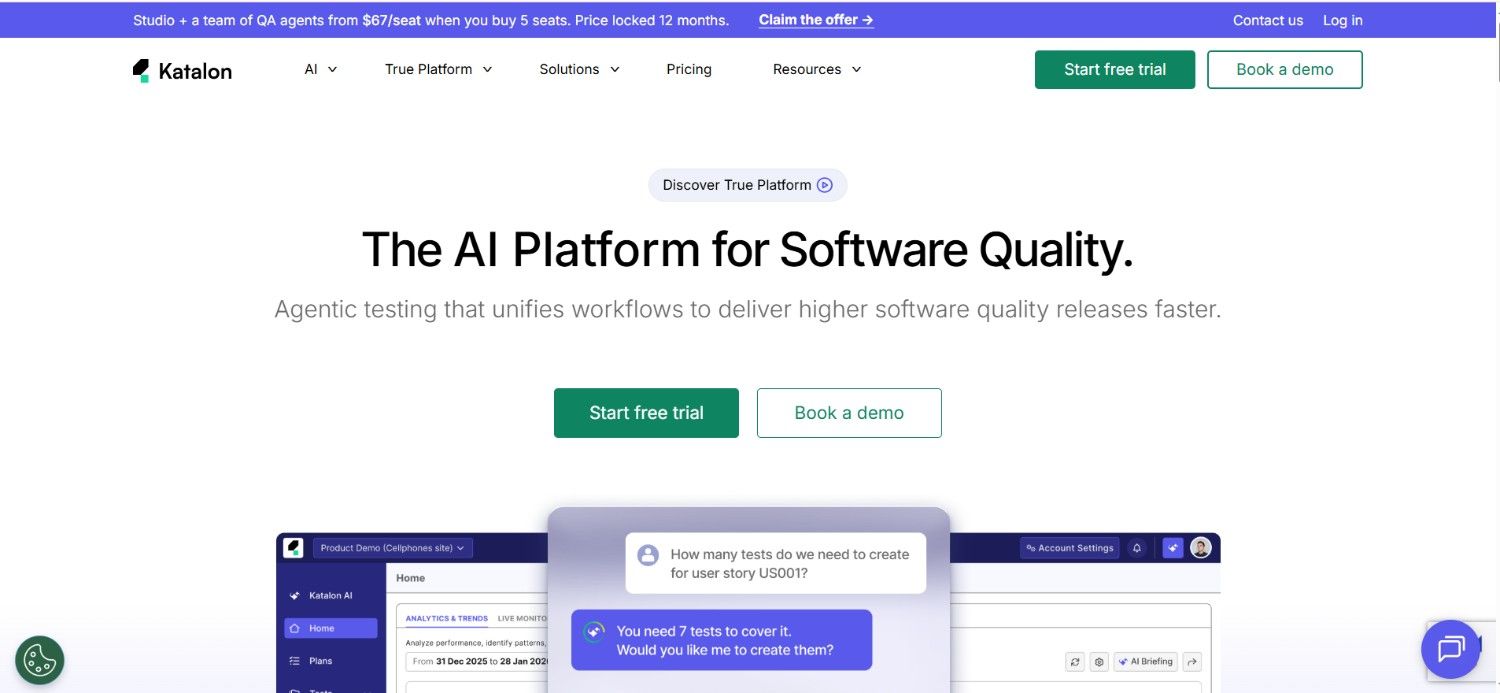
Katalon is the most comprehensive quality assurance automation tool for teams that need everything in one place. It covers web, mobile, API, and desktop testing from a single platform and was recognized as a Visionary in the 2025 Gartner Magic Quadrant—one of the few AI tools for software testing to earn that recognition.
StudioAssist generates executable test code from natural language descriptions. TrueTest autonomously explores your web application to identify untested scenarios. Self-healing detects when UI elements change and adjusts selectors automatically. For teams running tests in CI/CD pipelines, Katalon integrates natively with GitHub Actions, Jenkins, GitLab CI, and Azure DevOps.
Pricing: Free tier available (genuinely usable). Premium starts at approximately $208/month.
Good fit for: Teams with mixed technical skill levels wanting an all-in-one solution, organizations needing web, mobile, and API testing consolidated, and QA managers needing governance alongside automation.
Where it falls short: The platform is heavy with a steep learning curve. AI features feel like enhancements rather than the foundation. Large test suites can experience performance issues.
2. Mabl — The Most AI-Native Testing Platform
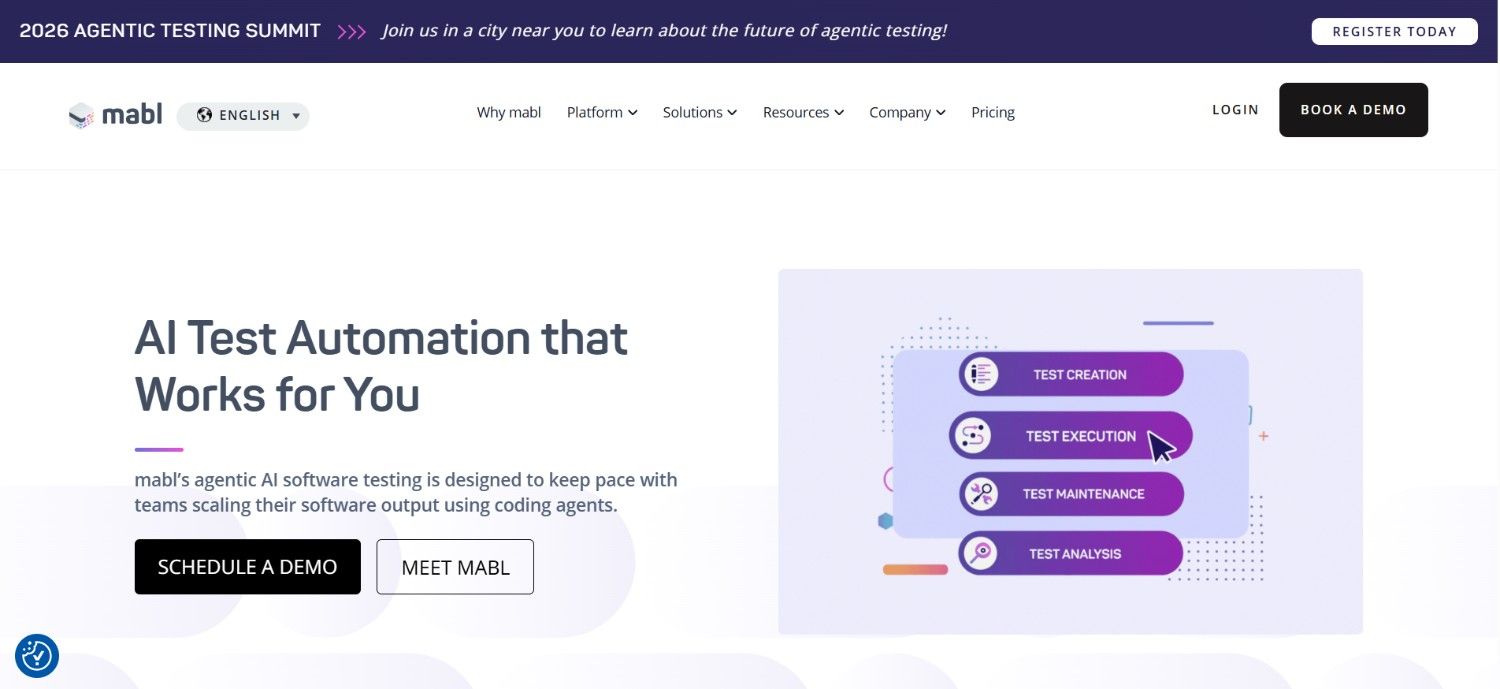
Mabl is built AI-first from the ground up—not a legacy tool with AI bolted on afterward. It delivers 85% less maintenance overhead than traditional automation frameworks, which is the single most important metric for teams whose QA engineers spend more time fixing tests than running them.
The agentic test creation engine generates tests 10x faster than manual scripting. Built-in performance and visual testing eliminate separate specialist tools. Intelligent test selection runs only the tests relevant to recent code changes — dramatically speeding up CI/CD pipelines. One team reported saving $240,000 over two years compared to maintaining a Selenium infrastructure.
Pricing: Starts at $450/month. No free tier.
Good fit for: Enterprise teams that can’t afford test maintenance overhead, organizations wanting truly AI-native test automation with AI, and teams where flaky tests are bleeding into production.
Where it falls short: High price point is inaccessible for small teams. No free tier. Less suited to teams that want full ownership of raw test code.
3. Applitools—The Visual AI Testing Standard
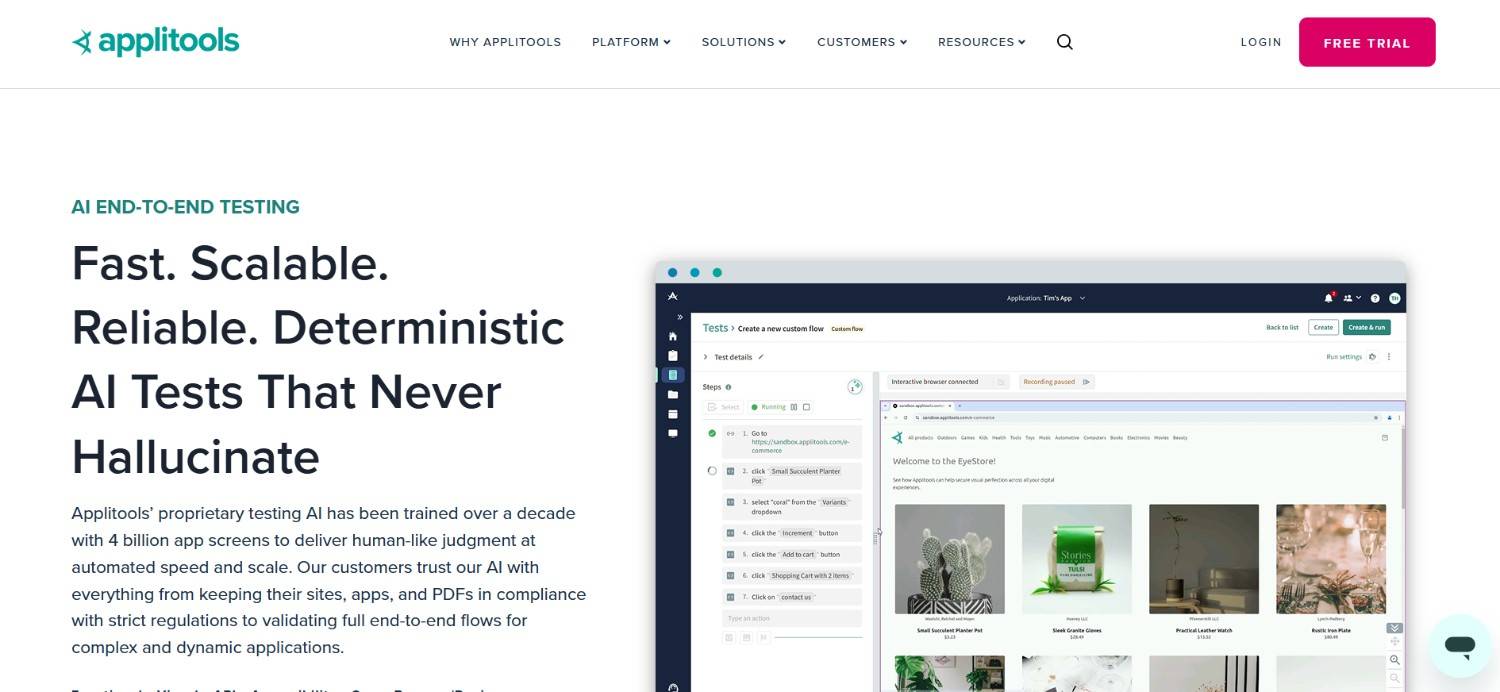
Applitools solves a problem that functional test automation entirely misses: visual bugs. A button can function correctly while appearing in the wrong position. Applitools’ Visual AI, trained on millions of screenshots, catches these issues automatically.
The platform compares screenshots using intelligent baselines, ignoring irrelevant differences while catching genuine visual regressions. Cross-browser validation runs once and checks rendering across every target browser simultaneously. Applitools integrates with Selenium, Cypress, and Playwright, making it a utility layer for teams wanting to detect bugs that code-level tests miss.
Pricing: Free tier available. Paid plans with custom pricing based on usage.
Good fit for: QA teams wanting to catch visual regressions that functional tests miss, organizations running cross-browser suites where rendering consistency matters.
Where it falls short: Focused on visual testing only — not a replacement for functional test automation. Pricing for high-volume usage can be significant.
4. Testim (Tricentis) — AI Self-Healing for UI Tests
Testim accelerates UI testing for web and cloud-native applications with AI-powered stability features. Instead of relying on brittle CSS selectors that break every time a developer changes the DOM, Testim understands the semantic meaning of elements and auto-adjusts test cases in real time when the UI changes.
For CI/CD pipelines that run frequently, this stability directly translates to fewer false failures and more trustworthy test results. Testim integrates with GitHub, GitLab, and other developer tools, making it straightforward to incorporate into existing QA automation workflows.
Pricing: Free trial available. Paid pricing on request.
Good fit for: Teams where UI changes frequently cause test maintenance issues, organizations already using Tricentis tools, and teams wanting CI/CD-integrated automated software testing tools.
Where it falls short: Limited reviews for newer AI features. Some users report debugging challenges when tests fail in unexpected ways.
5. Playwright — The Modern Open-Source Testing Framework
Playwright has overtaken Selenium as the most popular choice for new testing projects in 2026. It is an open-source framework from Microsoft that provides faster execution, a modern API, built-in parallel testing, and better support for modern web applications.
For developers building automated software testing tools without a budget for commercial platforms, Playwright is the foundation. It supports JavaScript, TypeScript, Python, Java, and C#. AI tools like Mabl, Octomind, and Testim generate standard Playwright code as output — meaning teams can adopt AI-assisted authoring without vendor lock-in.
Pricing: Completely free and open-source.
Good fit for: Developer-driven teams wanting a modern open-source foundation, projects starting fresh without legacy Selenium infrastructure, and teams that want AI-generated tests in portable code.
Where it falls short: Requires coding skills — not accessible for manual QA testers. Self-healing and advanced QA automation features require commercial tools on top.
6. BrowserStack — Cross-Browser Cloud Execution
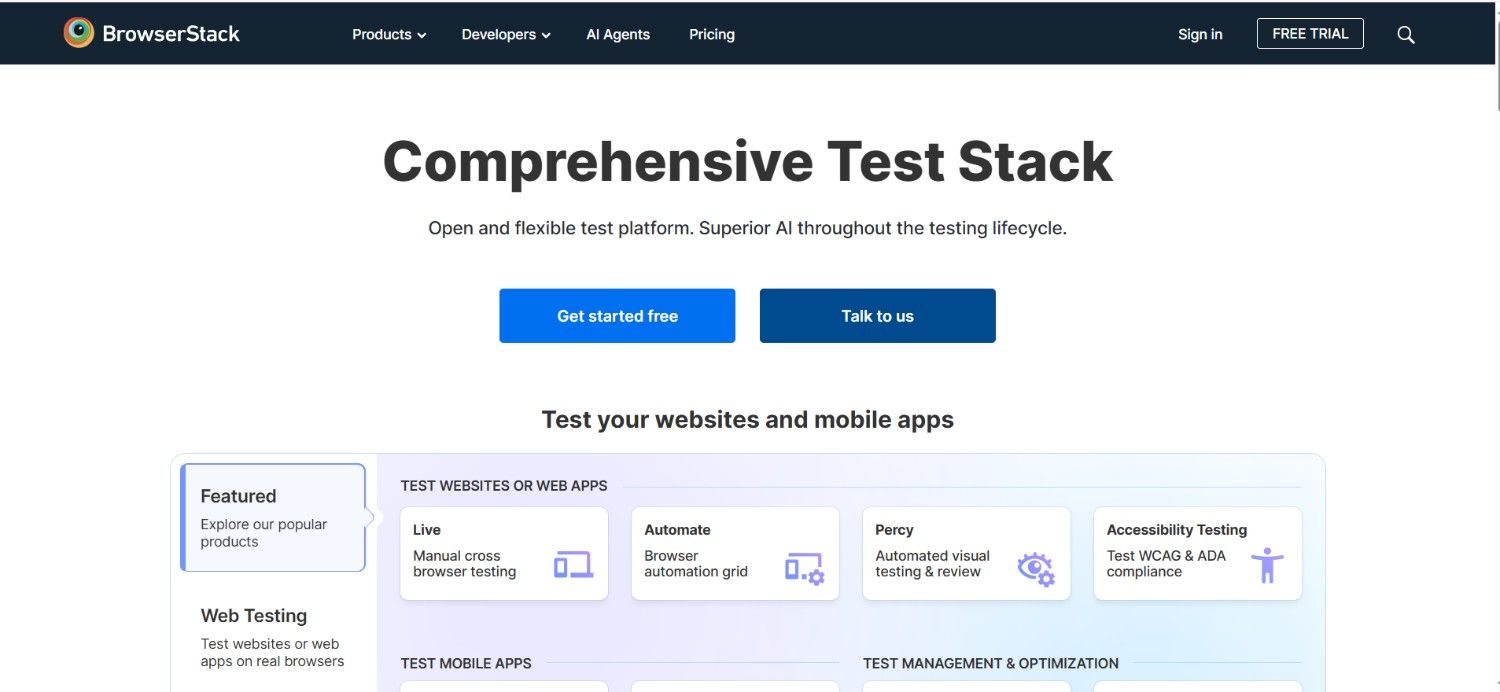
BrowserStack provides access to over 3,000 real browser and device combinations through the cloud, eliminating the need to maintain your own device farm. It integrates with Selenium, Playwright, Cypress, and Appium without requiring changes to your existing test code.
The AI features focus on execution intelligence: prioritizing tests most likely to catch failures first, failure analysis that distinguishes genuine software quality issues from infrastructure noise, and smart notifications that surface actionable results. For teams that need to detect bugs across a realistic matrix of browsers and devices, BrowserStack is the most established cloud execution option.
Pricing: Automation plans from $129/month.
Good fit for: Teams needing real cross-browser and mobile device coverage at scale.
Where it falls short: Cost increases significantly with parallel testing and add-ons. The AI features supplement cloud execution—not a full test automation with an AI platform.
7. Keploy — Open-Source API Testing From Real Traffic
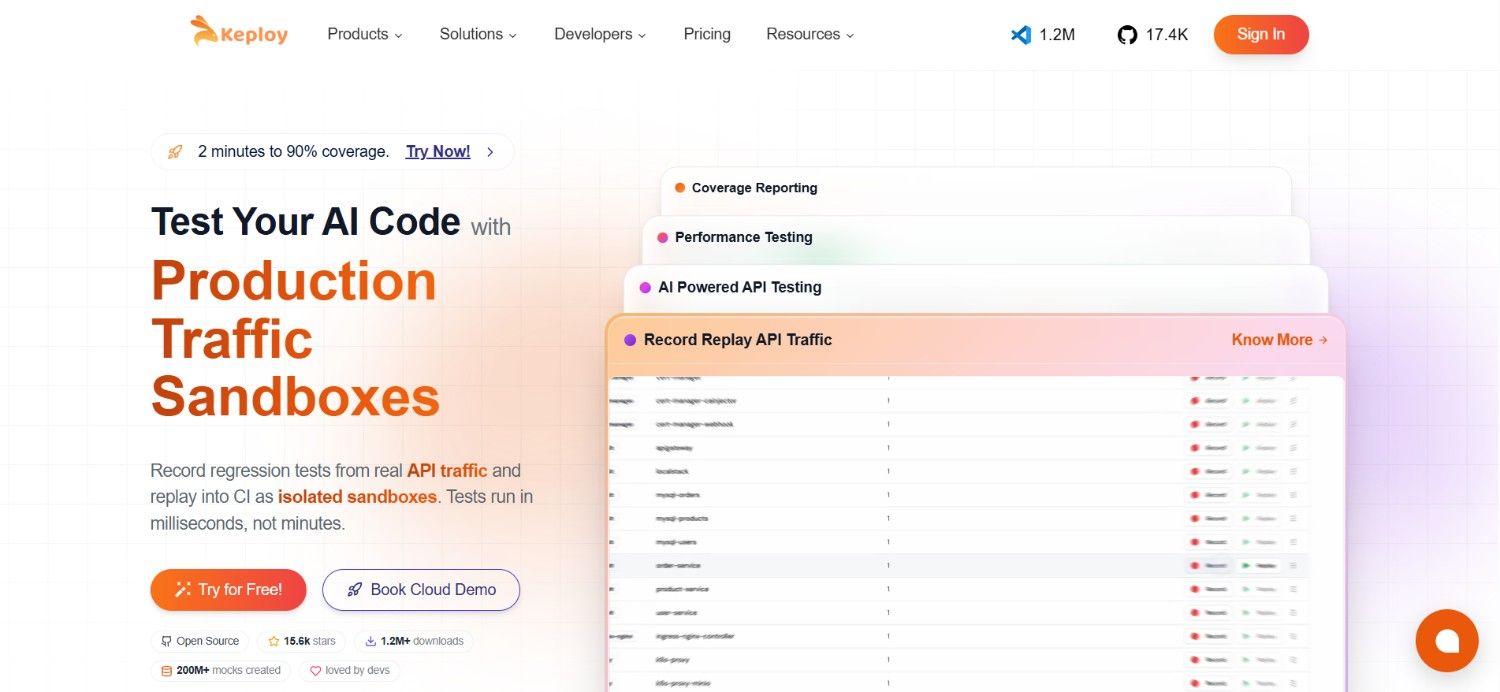
Keploy takes a fundamentally different approach to backend test coverage. Instead of writing API test cases manually, Keploy captures real API traffic from your running application and automatically converts it into test cases with mock and stub generation.
When developers add a new endpoint, Keploy captures real traffic and generates tests automatically — without anyone writing code. For teams with fast-moving APIs where manual API testing creates a constant backlog, this approach removes the bottleneck entirely. Keploy is open-source and free, making it the most accessible dedicated tool for API test coverage.
Pricing: Open-source and free. Enterprise support available.
Good fit for: Backend teams wanting automated API testing based on real traffic, development teams with limited QA resources, and anyone looking for free, open-source API test coverage.
Where it falls short: API testing only — no UI, visual, or mobile testing. Works best when your application generates real traffic to capture.
8. Selenium — The Foundation That’s Still Relevant
Selenium is the most established open-source testing framework in existence—released in 2004 and still the foundation for many enterprise testing infrastructures. While Playwright has overtaken it for new projects, Selenium’s value comes from its breadth of language support and the millions of existing test suites built on it.
Teams with years of existing Selenium investment can add AI capabilities—self-healing plugins, AI-powered locators—without rewriting everything. For organizations with large existing infrastructure, modernizing gradually is more practical than starting from scratch.
Pricing: Free and open-source.
Good fit for: Enterprise teams with existing Selenium infrastructure that isn’t feasible to rewrite and organizations needing multi-language support across Java, Python, JavaScript, Ruby, and C#.
Where it falls short: More complex and dated than Playwright for new projects. Doesn’t detect bugs or provide AI features on its own—those require additional tools.
9. Testsigma — Natural Language Test Automation
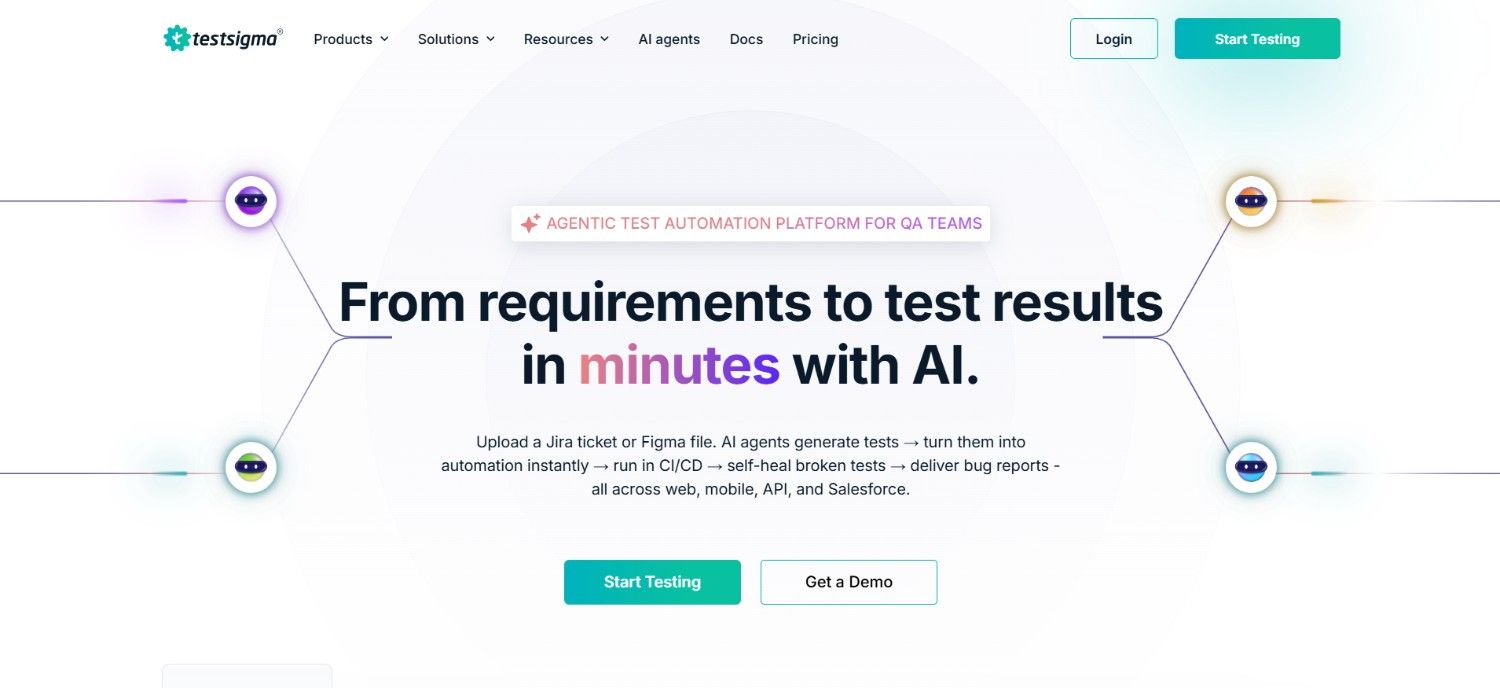
Testsigma is a cloud-based test automation with AI platform that uses natural language processing as its primary authoring method. Instead of writing code in Selenium or Playwright, testers describe what they want to test in plain English, and Testsigma converts those descriptions into executable automation.
This approach makes QA automation accessible to manual testers, product managers, and business analysts who understand what the application should do but don’t write code. Testsigma supports web, mobile, and API coverage from a single platform, with built-in CI/CD pipeline integration.
Pricing: Free tier available. Paid plans starting at $199/month.
Good fit for: QA teams without strong coding skills wanting to adopt automated software testing tools and organizations with manual testers needing to transition toward automation.
Where it falls short: Natural language abstraction can limit control over specific test logic. More advanced scenarios may require scripting support.
10. LambdaTest — AI-Native Test Execution Cloud
LambdaTest is an AI tool for software testing execution platforms, providing cloud infrastructure for running tests across 3,000+ browser and OS combinations. KaneAI, LambdaTest’s AI testing agent, generates and maintains tests from natural language instructions and integrates directly into CI/CD pipelines.
The platform’s test intelligence layer analyzes historical failure patterns, surfaces flaky tests, and provides actionable insights for improving software quality metrics. For teams wanting AI-native infrastructure for running tests at scale, LambdaTest combines cloud execution with AI-assisted test management at a lower entry price than most enterprise alternatives.
Pricing: Free tier available. Paid plans starting at $15/month per user.
Good fit for: Teams needing cost-effective cross-browser test execution and developers running CI/CD pipelines who need reliable parallel testing infrastructure.
Where it falls short: Less mature AI features compared to specialized tools like Mabl or Applitools. Works best as execution infrastructure with separate tools handling test creation.
How to Choose the Right AI Testing Tool
The right quality assurance automation tools depend entirely on where your biggest problem is right now.
- Test maintenance is your bottleneck: Start with Mabl or Testim. Self-healing AI directly attacks the problem of selectors breaking when the UI changes.
- You need to cover more scenarios faster: Katalon or Testsigma lets teams write tests in natural language, dramatically increasing QA automation coverage without proportional engineering effort.
- Growing an API with no test coverage: Keploy generates API tests from real traffic automatically — the fastest path from zero to production-grade API coverage.
- Visual bugs are slipping through: Applitools catches rendering issues across browsers that functional tests miss completely.
- Starting fresh with a limited budget: Playwright and Selenium are free. Keploy is free. These three together give you solid quality assurance automation tools coverage across web and API layers at zero licensing cost.
- Need everything in one place: Katalon is the most complete all-in-one platform for mixed-skill teams.
Final Thoughts
Software quality in 2026 is not about testing more — it’s about testing smarter. The teams shipping most reliably are using AI tools for software testing to automate the repetitive work, detect bugs earlier, and keep CI/CD pipelines moving without sacrificing coverage.
Every tool on this list offers a free tier or trial. The best way to evaluate any quality assurance automation tools is to run it against one real feature in your actual application for two weeks. That is the only way to know whether the self-healing works for your specific UI, and whether the team will actually use it in daily workflow.
Start with one tool. Fix one problem. Measure the improvement. Then add more.