
Imagine spending years building up a skillset — learning the tools, the frameworks, the workflows — and then one day realizing the industry has quietly moved on without you. And it’s not a distant scenario. It’s happening to tech professionals right now, all over the world.
Not long ago, being good at manual software testing or managing physical servers was a solid career move. Today, those same skills are among the first being pushed out by AI tools and cloud automation. It’s not personal—it’s just how fast things are changing in tech.
And the numbers back this up in a pretty striking way.
| Statistic | Insight |
|---|---|
| 39% | of core professional skills will be outdated by 2030 (WEF, 2025) |
| 86% | of business leaders say AI will significantly change their companies by 2030 |
| 2B+ | workers globally will need retraining or upskilling by 2030 |
| 170M vs 92M | 170M new roles created and 92M roles displaced, resulting in ~78M net new jobs by 2030 (WEF, 2025) |
So, What Does “39%” Actually Mean?
Every January, the World Economic Forum publishes something called the Future of Jobs Report. In its January 2025 edition, it surveyed over 1,000 companies across 55 countries — representing more than 14 million workers — and reached a conclusion that’s hard to ignore: nearly 4 out of every 10 skills that professionals rely on today will be significantly transformed or rendered obsolete within the next five years.
In IT specifically, the shift is even sharper. Think about it this way: skills that were considered cutting-edge in 2020 are already partially outdated in 2026. Manual infrastructure management is being replaced by Infrastructure-as-Code. Traditional software testing scripts are being replaced by AI-generated test suites. Even routine day-to-day coding is being supplemented — sometimes replaced — by AI copilot tools.
This doesn’t mean your entire career is at risk. It means roughly four in ten of the specific skills you use at work may need to be updated, replaced, or significantly evolved. The people who stay ahead are the ones who treat learning as part of their job — not as something extra they do on the side.
Which IT Skills Are Losing Ground?
Let’s be direct about what’s fading—knowing early is what gives you the advantage.
|
Skill Area |
Status by 2030 |
Why it matters |
Urgency |
|
Manual software testing (Selenium, JMeter scripts) |
Declining |
AI-generated test suites, intelligent QA automation |
High |
|
Physical server management & on-prem infrastructure |
Declining |
Cloud engineering, Infrastructure-as-Code (Terraform, etc.) |
High |
|
Basic data entry & routine IT support |
Declining |
AI-driven automation tools, RPA (Robotic Process Automation) |
Very high
|
|
Single-language programming with no AI fluency |
Declining |
Multi-stack developers who can guide and audit AI-generated code |
Medium |
|
Monolithic system architecture design |
Declining |
Microservices, serverless architectures, cloud-native design |
Medium |
|
AI & big data proficiency |
Growing fast |
AI/ML roles surging—demand outpaces talent supply globally |
Invest now |
|
Cybersecurity & network security |
Growing fast |
The threat landscape is expanding faster than the available talent pool |
Invest now |
|
Cloud-native development |
Growing fast |
Foundation of modern infrastructure — expected in every engineering role by 2030 |
Invest now |
A Real Story: When the Skills Gap Catches Up
Marcus had been a QA engineer for nine years at a mid-sized software firm in the UK. He was good — genuinely good — at writing manual test scripts and running regression testing cycles. His team respected him. His manager trusted him.
Then, in early 2025, his company adopted an AI-powered QA platform that automated roughly 80% of the regression work his team used to handle. Within six months, three of the five QA roles on his team were restructured. Marcus kept his job—but only because he’d quietly spent the previous year learning Python automation and understanding how to interpret AI-generated test reports.
“I saw the writing on the wall about two years before it happened,” Marcus said. “The colleagues who got displaced weren’t bad at their jobs. They just hadn’t updated what they knew.”
Marcus’s story isn’t unique—it’s playing out across IT departments everywhere. The question isn’t whether this kind of disruption will happen. It’s whether you’ll be the person who saw it coming.
Why Is This Happening So Fast?
A few forces are colliding at the same time, and together they’re accelerating the pace of change in ways we haven’t seen before.
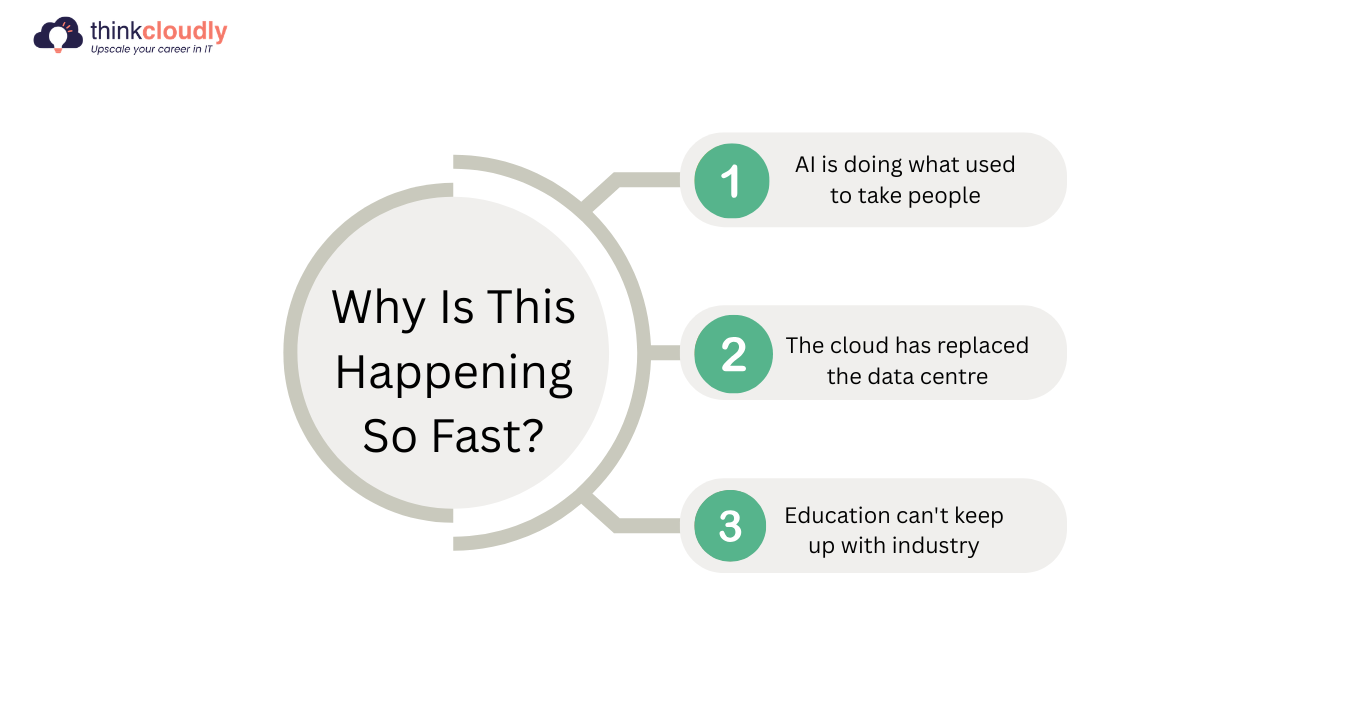
AI is doing what used to take people
AI copilot tools can now boost developer productivity by 20–40% according to multiple industry studies. That’s not a small number. When a tool can do in minutes what a junior developer used to spend hours on, companies start to ask a fair question: what do we actually need people for? The answer is higher-order thinking, problem-solving, creativity, and oversight. Not routine execution.
The cloud has replaced the data centre
Skills that were valuable when IT meant managing racks of physical servers are fading as everything moves to AWS, Azure, and Google Cloud. Knowing how to configure a server manually matters less when the infrastructure is code—written, versioned, and deployed like software.
Education can’t keep up with industry
Universities and colleges are structurally slow to adapt—curriculum updates often lag industry shifts by three to five years. By the time a new curriculum gets approved, the technology it covers may already be evolving past what’s being taught. This is why self-directed learning, online courses, and bootcamps have become so important—they respond to what the market actually needs, right now.
Note on reskilling costs: Research from McKinsey estimates that reskilling an existing employee costs roughly 30–50% of what it would take to hire someone new when you account for onboarding, turnover, and the time it takes a new hire to reach full productivity. In other words, learning now isn’t just good for your career. It’s cheaper for your employer too.
What Skills Will Actually Matter by 2030?
Here’s the encouraging part. The WEF report doesn’t just tell us what’s going away — it tells us what’s coming. And the picture, while demanding, is genuinely full of opportunity.
The fastest-growing skills by 2030 are AI and big data, cybersecurity, cloud-native development, and analytical thinking. But employers aren’t just looking for technical depth. They’re looking for people who combine technical skills with what the report calls “human-centric” abilities: creative thinking, resilience, flexibility, and the capacity to keep learning.
In practical terms, that means the IT professionals who will thrive are those who understand how to work with AI tools, not just how to code around them. People who can look at a problem, think critically, and bring a perspective that a language model can’t fully replicate.
The skills most in demand by 2030:
AI and machine learning literacy, cloud engineering, cybersecurity (especially with the growing threat landscape), data analytics and interpretation, prompt engineering and AI tool management, and systems thinking. On the human side: adaptability, communication across technical and non-technical teams, and the discipline of continuous learning.
How to Start Future-Proofing Your Career Today
You don’t need to overhaul everything overnight. A realistic, steady approach tends to work far better than panic-cramming. Here’s what actually helps:
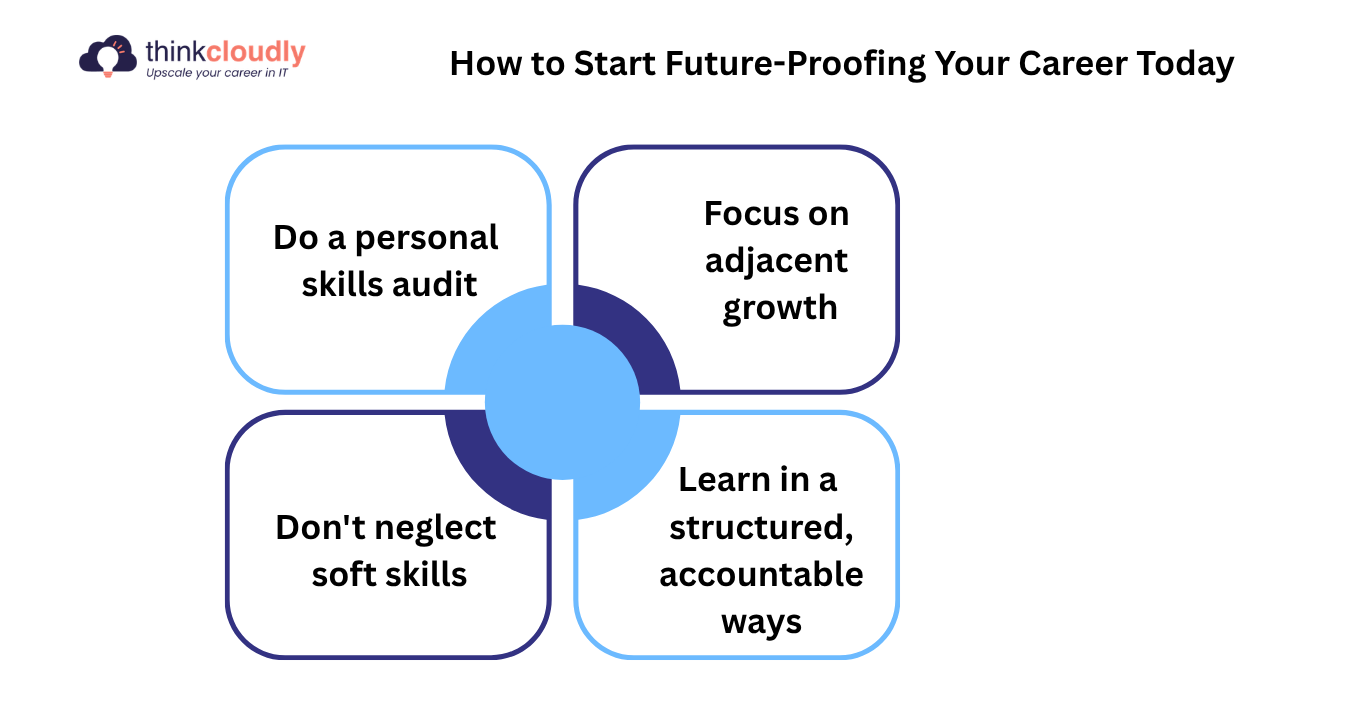
Do a personal skills audit
Look honestly at what you spend most of your working hours doing. Which of those activities could be automated or replaced in the next three to five years? That becomes your reskilling priority.
Focus on adjacent growth
If you’re a sysadmin, cloud engineering is a natural next step. If you’re a manual tester, AI-assisted QA tools are your bridge. You don’t have to start over—you build from where you are.
Don’t neglect soft skills
The WEF report is clear: the human skills—critical thinking, communication, and adaptability—are becoming more valuable, not less, as automation handles more routine work.
Learn in structured, accountable ways
Reading blogs and guides helps, but real skill-building needs hands-on practice, feedback, and structure. That’s where good online learning platforms — the kind built specifically for working professionals — make a real difference.
The Bottom Line
The 39% figure isn’t a threat — it’s a heads-up. The technology landscape is genuinely shifting beneath our feet, and the professionals who will come out ahead aren’t necessarily the most experienced ones. They’re the most adaptable ones.
The good news is that 2030 is still a few years away. You have time to assess what you know, identify what’s worth learning next, and take real steps toward the kind of career that holds up in a world where AI is a colleague, not a threat.
The biggest risk is complacency. The biggest opportunity is adaptability. Those two things have always been true in technology. They’ve just never been more urgent.
Sources & References
- World Economic Forum — Future of Jobs Report 2025 Used for: “39% of core professional skills will be outdated by 2030”; “170 million new roles created, 92 million displaced”; “86% of business leaders expect AI to significantly change their business.”
- WEF Press Release, January 8, 2025 — “78 Million New Job Opportunities by 2030” Used for: Net job growth figure of 78 million; skill gap as the biggest barrier to business transformation.
- Digital Chiefs — “IT Skills 2026: 39% of Competencies Will Become Obsolete” (March 2026) Used for: Manual infrastructure replaced by Infrastructure-as-Code; traditional testing replaced by AI-generated test suites; AI copilots boosting developer productivity by 20–40%; reskilling costs 30–50% of hiring cost (McKinsey).
- Skillsoft — “WEF: Skill Gaps Are the Biggest Barrier to Transformation” (March 2025) Used for: “Almost two-thirds of all workers globally will require training by 2030”; 39% skill obsolescence confirmation; 85% of employers plan to upskill workers.
- Search Engine Journal — “39% of Skills May Be Obsolete by 2030, WEF Jobs Report Warns” (January 2025) Used for: AI and big data as fastest-growing skills; manual dexterity skills declining; employer upskilling and redeployment statistics.
- Human Resources Online — “Most In-Demand Core Skills Globally in 2025–2030” (February 2025) Used for: Cybersecurity and environmental stewardship as emerging skills; leadership and social influence growing in importance; demand for AI and big data roles surging.
- Okoone — “How AI Is Making Some IT Skills Obsolete and Others More Valuable” (February 2025) Used for: Legacy skills fading; demand for AI, cybersecurity, and data science expertise rising; need for continuous learning frameworks in organizations.
- DistantJob — “Is There an IT Skill Gap?” (November 2025) Used for: IBM pledging 30 million digital skills globally by 2030; Cisco is training 25 million in cybersecurity; slow academic curriculum adaptation is affecting skills pipelines.