
I’ve spent the last few months obsessing over one question: If you’re a cloud engineer, does where you live matter more than how good you are?
The honest answer surprised even me—and I’ve been in this industry for nearly a decade.
I pulled salary data from multiple platforms—Glassdoor, ZipRecruiter, Robert Half, ERI Salary Expert, and industry-specific salary guides published in late 2025 and early 2026. I looked at 10 countries across North America, Europe, Asia-Pacific, the Middle East, and South America.
Here’s what I found—and more importantly, what it actually means for your career.
Quick Summary: The 10 Countries at a Glance
| Country | Avg. Annual Salary (USD) | Level |
|---|---|---|
| United States | $130,000 – $152,000 | Highest |
| United Kingdom | $70,000 – $98,000 | High |
| Germany | $74,000 – $102,000 | High |
| Canada | $72,000 – $90,000 (CAD: $97K) | High |
| Australia | $90,000 – $105,000 (AUD: $145K) | High |
| Netherlands | $68,000 – $82,000 | Mid-High |
| Singapore | $60,000 – $80,000 (SGD: $90K) | Mid-High |
| UAE (Dubai) | $55,000 – $75,000 (Tax-Free) | Mid |
| Philippines | $18,000 – $35,000 | Lower |
| Brazil | $12,000 – $22,000 | Lowest |
Country-by-Country Breakdown
1. United States — The Undisputed Leader
The U.S. isn’t just ahead — it’s in a completely different league. Glassdoor’s 2026 data puts the average cloud engineer salary at $151,107/year, with total compensation regularly crossing $175,000. ZipRecruiter sits slightly lower at $130,802, reflecting a broader mix of roles.
Top-paying cities: San Jose, San Francisco, Seattle, New York, and Boston. Entry-level roles start around $85,000–$110,000 — location within the U.S. still matters a lot.
2. United Kingdom — Strong Pay, Strong Benefits
Robert Half’s 2026 UK guide puts cloud engineer salaries at £55,000–£77,250 ($70,000–$98,000 USD). London roles in fintech and insurance push higher. The U.S. gap is real, but employer-covered healthcare, pension contributions, and 30-day leave make UK packages more competitive than the base number suggests.
3. Germany — Europe’s Tech Powerhouse
Glassdoor shows a German average of €68,875 ($76,000 USD), while ERI Salary Expert puts it closer to €93,535 for more senior roles. Industrial cloud adoption in manufacturing and automotive is driving genuine demand. Munich pays the most, followed by Berlin, Frankfurt, and Hamburg.
4. Canada — Growing Fast, Still Behind the U.S.
Glassdoor reports CA$97,577 ($72,000 USD) on average, with top earners reaching CA$148,694. The U.S.–Canada gap is roughly 25–35% in USD terms. Universal healthcare, lower debt burdens, and strong immigration pathways keep Canada among the top relocation destinations globally.
5. Australia — The Quiet High Earner
Often overlooked, Australia pays AUD$145,000 ($96,000 USD) on average — beating most of Europe in USD terms. Sydney, Melbourne, Brisbane, and Canberra all show strong demand, and a real talent shortage is keeping salaries elevated.
6. Netherlands — Europe’s Cloud Hub
Amsterdam is home to major data centres and firms like ASML and Booking.com. Glassdoor shows an average of $74,250 USD (€68,000–€74,000). Add the mandatory 8% holiday pay, pension contributions, and parental leave, and the real package value climbs noticeably.
7. Singapore — Asia’s Top Payer
Singapore averages SGD$90,000 ($66,000 USD), with senior roles at global banks going significantly higher. Low personal tax rates and its position as Southeast Asia’s financial hub make it punch well above the raw salary number.
8. UAE (Dubai) — The Tax-Free Wild Card
Dubai averages $55,000–$75,000 USD — which looks modest until you remember there’s zero income tax. A $70,000 salary in Dubai is effectively equivalent to $85,000–$90,000 gross in the UK after tax. Massive digital transformation projects (UAE smart cities, Saudi Vision 2030) are creating real, sustained cloud demand.
9. Philippines — The Remote Work Opportunity
Local salaries range from $18,000 to $35,000 USD annually. But Filipino cloud engineers working remotely for U.S. or European firms earn 40–60% above local rates—often $50,000–$70,000 USD. Certifications are especially high-value here, with AWS credentials adding meaningful monthly premiums.
10. Brazil — The Emerging Market Gap
São Paulo averages around R$11,971/month ($12,000–$22,000 USD/year). Low by global standards — but Brazil’s cost of living is dramatically lower, and a senior engineer earning R$18,000/month lives comfortably by local benchmarks.
Real Story: From $15K in Brazil to $110K in Canada
Daniel started his cloud engineering career in São Paulo, earning a salary that—converted to USD — barely crossed $15,000 a year. He spent 18 months grinding through AWS certifications while working nights. In 2024, he landed a role in Toronto at CA$95,000. That’s nearly 4x his São Paulo salary for the same job title.
Today he’s exploring remote opportunities with U.S. firms, which could push him closer to $110,000 — without leaving Canada. His story isn’t unique. It’s becoming a roadmap.
Why Do Certifications Matter More Than Ever for Cloud Salaries?
Cloud salaries no longer rely on experience. Hiring managers increasingly turn to certifications to prove that candidates can work with modern cloud services, security practices, and automation tools on day one.
Looking at recent hiring trends, if you are a certified AWS Solutions Architect, Microsoft Azure Administrator, or Google Professional Cloud Architect, you are likely to be invited for higher-paying interviews since employers perceive you as a lower-risk hire. Certifications also demonstrate a commitment to continuous learning, which has become a necessity as cloud platforms roll out new services every month, beyond the technical validation.
Certifications can help bridge the experience gap for professionals early in their careers, while experienced engineers often use advanced credentials to move into architecture, DevOps, security, or leadership roles where compensation grows much faster than in general cloud administration.
The 3 Biggest Surprises From This Data

Surprise 1: Purchasing Power Changes Everything
The U.S. leads in raw salary, but purchasing power tells a different story. A cloud engineer earning €68,875 in Munich, Germany, is—when adjusted for local costs—living comparably to a $110,000 earner in a mid-tier U.S. city. The UAE’s tax-free salaries flip the script further.
Raw numbers can be misleading. Always look at what you can actually do with the money.
Surprise 2: Australia Beats Most of Europe
Most people assume European salaries are competitive with those in Australia. They’re not. Australia’s AUD$145,000 average ($96,000 USD) beats UK, German, Dutch, and Canadian salaries in USD terms. Yet Australia rarely comes up in conversations about where cloud engineers should move.
Surprise 3: Remote Work Is Quietly Flattening the Gap
A Poland-based cloud engineer working directly with Silicon Valley clients can now earn 80% of a U.S. equivalent salary — up from roughly 45% in 2020, according to an ACSMI cybersecurity and cloud salary report. The same dynamic is playing out in Brazil, the Philippines, and Eastern Europe. Location still matters, but it matters less than it did five years ago.
What Actually Drives Your Salary — Regardless of Country
Across all 10 countries, the data consistently point to the same salary multipliers:
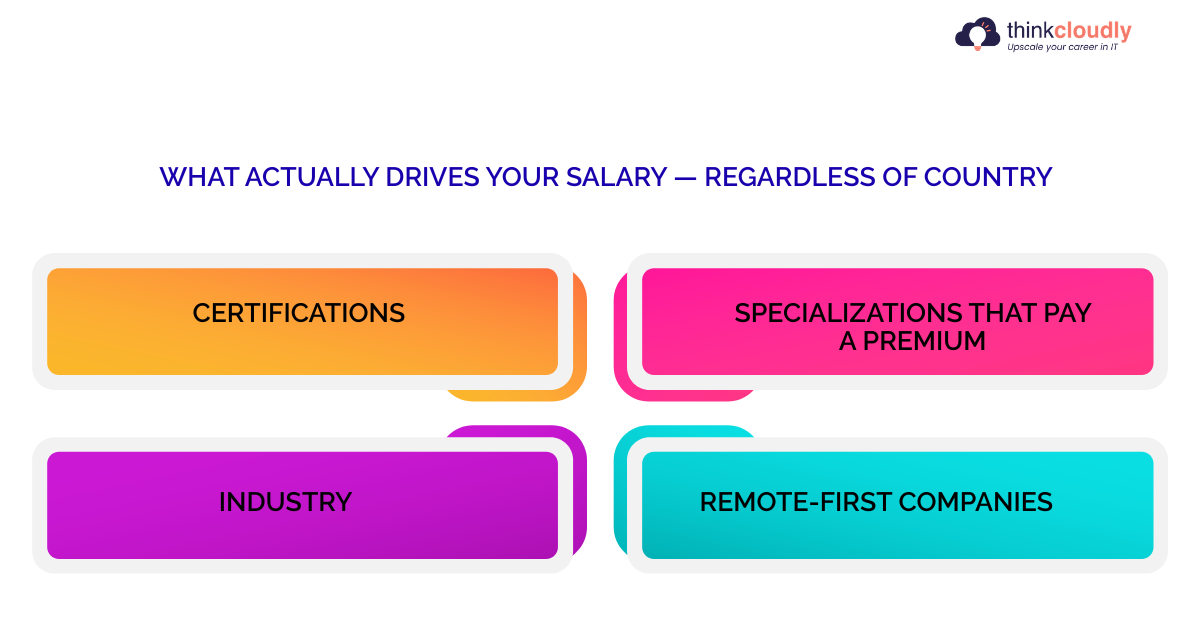
Certifications: AWS Certified Solutions Architect Professional, Microsoft Azure Solutions Architect Expert and Google Professional Cloud Architect credentials can add $15,000+ to your base salary in U.S. terms—and proportionally significant premiums in other markets.
Specializations that pay a premium: Cloud security engineering, Kubernetes and container orchestration, Infrastructure as Code (Terraform, Pulumi), and multi-cloud architecture consistently command 20–40% salary premiums over generalist cloud roles across all markets studied.
Industry: Financial services and healthcare cloud roles pay more than other sectors in virtually every country on this list.
Remote-first companies: A growing segment of global employers now offer location-agnostic salaries benchmarked to major tech hubs. These roles are often the fastest path to U.S.-level pay without relocating to the U.S.
Should You Move? A Practical Framework
If you’re a cloud engineer weighing your options, here’s a simple framework:
- Maximum raw earning power: United States (especially San Francisco, Seattle, New York)
- Best balance of salary + lifestyle + benefits: Germany or Australia
- Best tax efficiency: UAE (Dubai) for mid-to-senior professionals
- Best for remote income without relocating: Focus on certifications and target U.S./EU remote employers from wherever you are
- Fastest career acceleration: Singapore — small market, but enormous career density in cloud and fintech
The Skills That Make High-Paid Cloud Engineers
Learning AWS, Azure, or Google Cloud alone is no longer enough to reach the top salary brackets. More employers are rewarding professionals who have cloud knowledge coupled with skills like Infrastructure as Code (Terraform), Kubernetes, Docker, Python scripting, CI/CD pipelines, cloud security, and cost optimization.
Another big differentiator is the multi-cloud experience, as organizations move beyond a single provider to improve resiliency and flexibility. Those who know cloud architecture, automation, and security together always make more money than those who only know the basics of cloud administration.
Instead of collecting a dozen certifications with no practical skills, candidates should build hands-on projects that demonstrate deployment, monitoring, troubleshooting, and automation. That combination of certification and hands-on experience is what consistently commands premium compensation in today’s cloud market.
Conclusion
The cloud engineering market in 2026 is genuinely global, but it is not equal.
The U.S. still pays the most. Australia quietly outperforms most of Europe. The UAE’s tax-free structure makes a “lower” salary surprisingly powerful. And remote work is slowly but steadily closing the gap between São Paulo and San Francisco.
The most important takeaway? Your passport matters, but your skill set matters more.
A cloud engineer with strong AWS or Azure certifications, hands-on Kubernetes experience, and cloud security knowledge will command a premium in every single country on this list. Geography sets your ceiling — skills determine how close you get to it.
Whether you’re planning a move, negotiating a raise, or just benchmarking where you stand—now you have the numbers. Use them.
Sources & References
- Glassdoor — Cloud Engineer Salary, United States (2026)
- ZipRecruiter — Cloud Engineer Salary (April 2026)
- Robert Half — Cloud Engineer Salary Guide UK (2026)
- Robert Half — Network/Cloud Engineer Salary, US (2026)
- Glassdoor — Cloud Engineer Salary, Germany (March 2026)
- ERI SalaryExpert — Cloud Engineer Salary, Germany (2026)
- Glassdoor — Cloud Engineer Salary, Canada (2025)
- PassITExams — Cloud Engineer Salary Guide 2025–2026 (Australia, Singapore, EU)
- Glassdoor — Cloud Engineer Salary, Amsterdam, Netherlands (2026)
- Second Talent — Cloud Engineer Salary, Philippines (April 2026)
- Glassdoor — Cloud Engineer Salary, São Paulo, Brazil (2025)
- KORE1 — Cloud Engineer Salary Guide 2026 (US Benchmarks)
- Refonte Learning — Cloud Engineering Career Outlook 2026
- Fortray Global Services—Cloud Engineer Salaries 2025
- ACSMI — Global Cybersecurity & Cloud Salary Report 2025