
Mark, a mid-career IT support worker in Ohio, leaves a $72K job, spends eight months studying in the evenings, passes two AWS certifications, and lands a fully remote cloud engineer role paying $148,000. His commute is now twelve steps to his home office.
Illustrative story — based on real career transition patterns documented in the 2025–2026 cloud hiring market. Not a specific real person.
That kind of story isn’t rare anymore. It’s happening across the globe, and most people working traditional tech jobs have no idea it’s possible.
Cloud engineering has become one of the clearest paths to a six-figure remote salary in 2026. No office. No commute. No geography limits your pay. Here’s exactly how it works, what it pays, and what you need to get there.
The Numbers First — Because They’re Hard To Ignore
| Statistic | Insight |
|---|---|
| $151K | Average cloud engineer salary in the US |
| $183K | Senior cloud engineer salary ceiling nationally |
| $135K | Average remote cloud engineer salary, US |
| 15% | Projected job growth for cloud roles 2024–2034 |
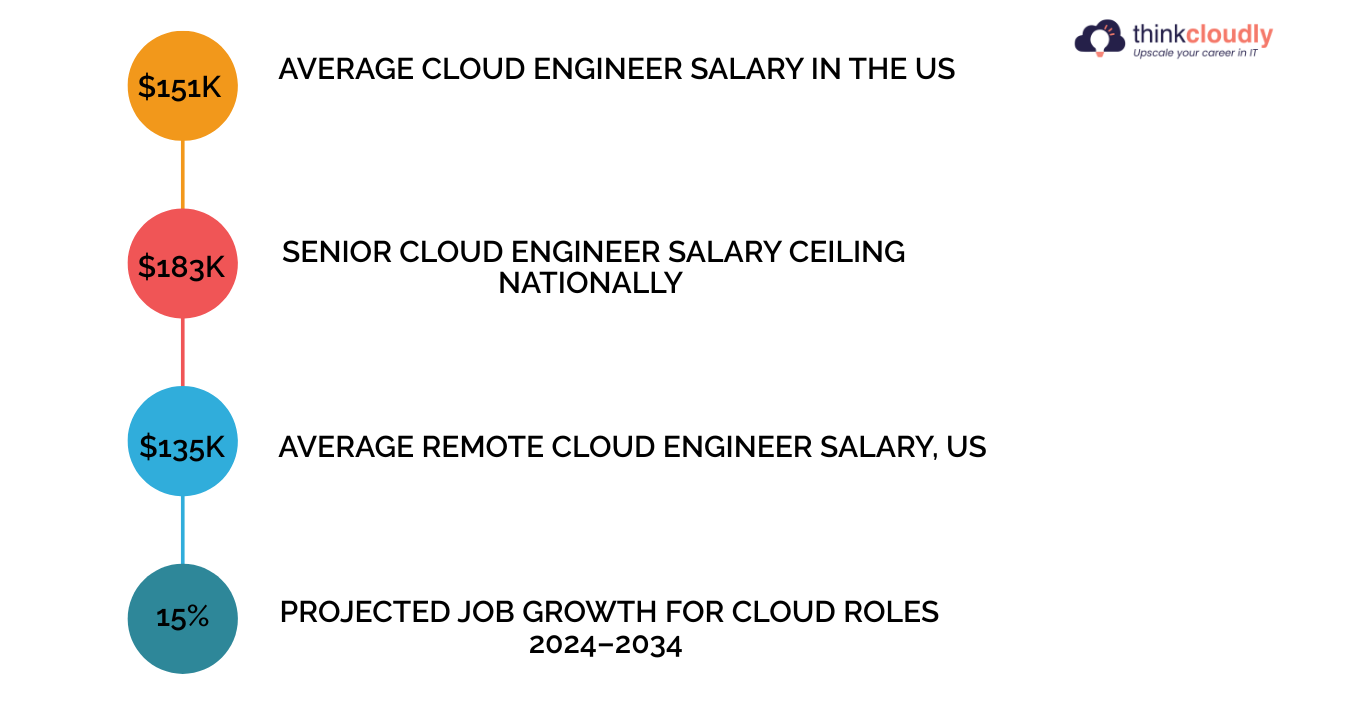
The $150K figure in the headline reflects approximately the 75th percentile of remote cloud engineers in the US, based on ZipRecruiter salary distribution data (Feb 2026)—meaning roughly one in four remote cloud engineers is already earning that or more. And with the right specialization, it’s very reachable within two to four years.
Why cloud engineering is one of the best remote careers in 2026
Here’s what makes cloud engineering uniquely suited to remote work: almost everything you do lives on the internet already. You’re managing servers, writing code, and configuring infrastructure, none of which requires a physical office, a specific city, or even a specific time zone.
Picture this: a cloud engineer in Austin wakes up, reviews overnight alerts on a client’s AWS environment, fixes a misconfigured security group before 9 am, and spends the afternoon designing a new data pipeline, all from a spare bedroom. Meanwhile, a colleague in London does the same work for the same company, on the same platform.
Illustrative scenario — based on real remote cloud engineering workflows.
This is why over 94% of enterprises were using cloud services by 2025 — and why those companies need engineers who can manage that infrastructure from wherever they are. The work is inherently location-independent, which gives cloud engineers leverage that most professions simply don’t have.
What Cloud Engineers Actually Do Day-to-Day
Before we talk about getting there, it helps to know what the job actually involves. Cloud engineers are not just “IT support in the cloud.”
Here’s what the work looks like:
- Design and build cloud infrastructure on AWS, Azure, or Google Cloud — the systems that run apps, store data, and keep businesses online
- Write infrastructure as code using tools like Terraform—so servers and systems can be built and rebuilt automatically
- Set up security, monitoring, and auto-scaling so systems handle real-world traffic without breaking
- Manage costs—companies spend millions on cloud and need engineers who can optimise that spend
- Work closely with software developers, security teams, and product managers to deploy new features safely
The job is problem-solving and system design. You don’t need to code like a software developer. You need to understand how cloud platforms work and how to build reliable, scalable things on top of them.
What these roles actually pay in 2026
|
Role |
Salary range |
Remote-friendly |
|
Cloud engineer (mid-level) |
$118,000-$148,000 |
Widely available |
|
Cloud engineer (senior) |
$139,000-$183,000 |
Standard |
|
Cloud architect |
$150,000-$237,000 |
Highly available |
|
Cloud Security Engineer |
$120,000-$160,000 |
Widely available |
|
MLOps / AI cloud engineer |
$145,000-$190,000 |
Growing fast |
|
Site reliability engineer (SRE) |
$140,000-$185,000 |
Standard |
The certifications that actually move the needle on salary
Cloud engineering is one of the few careers where a certification can genuinely, measurably increase your salary.
Here’s what the data shows:
-
AWS Solutions Architect Associate: Appears in 80% of cloud job postings. The single most recognized cloud cert globally. Entry-level engineers land roles at this level.
- Salary boost: +25.9% on average · Cost: $150
-
AWS Security Specialty: Security is the fastest-growing cloud niche. This cert signals you can protect enterprise cloud environments—a premium skill.
- Typical salary: $150,000+ · High demand in 2026
-
Kubernetes (CKA / CKAD): Container orchestration is now a baseline expectation. Senior Kubernetes engineers were seeing offers above $160K in 2025–26.
- Salary range: $160,000+ for senior roles
-
Azure Administrator (AZ-104): Best for enterprise and government sectors. Azure is Microsoft’s platform and is deeply embedded in large organizations worldwide.
- Salary boost: +18.1% on average · Strong EU/UK demand
A real-world example: major employers hiring remote cloud engineers
Major healthcare systems, banks, insurance companies, logistics firms, and government agencies all run on cloud infrastructure — and they all list fully remote cloud engineer roles requiring hands-on experience with AWS, Azure, and GCP, plus Terraform skills, with starting pay well above $130,000.
Many of these job listings explicitly state that employees’ work locations are entirely based on individual preferences, reflecting how deeply remote-friendly the cloud engineering field has become. The sentiment is now standard across thousands of cloud engineering job descriptions.
The honest path to get there—no fluff
You don’t need a computer science degree. You don’t need to live in San Francisco.
Here’s what the path actually looks like: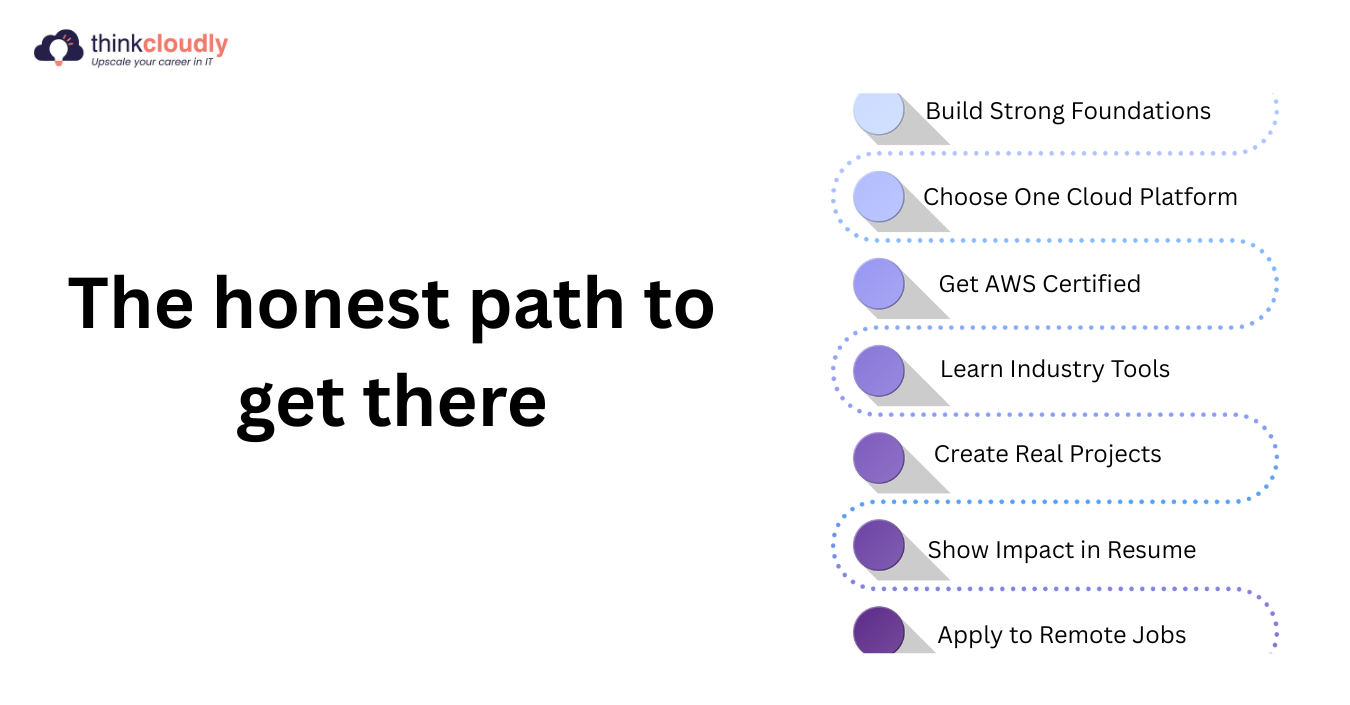
- Start with Linux basics and networking fundamentals—free resources are everywhere; spend 4–6 weeks here
- Pick one cloud platform (AWS is the safest first choice — 30–34% market share) and open a free-tier account. Build things, break things, fix them
- Aim for the AWS Solutions Architect Associate cert ($150 exam fee)—it appears in 80% of cloud job postings and delivers a measurable 25.9% salary boost on average
- Add Terraform and Kubernetes to your toolkit—these appear in almost every mid-to-senior cloud job description
- Build a portfolio project: deploy a real app on AWS, monitor it, document what you built, and put it on GitHub
- Write resume bullets around outcomes—”Reduced infrastructure costs by 30% using Terraform” beats “managed cloud infrastructure” every single time
- Target remote-first job boards: FlexJobs, We Work Remotely, LinkedIn, with remote filters set
Why the Window Is Open Right Now
Gartner projects global public cloud spending will exceed $700 billion, and PwC projects cumulative US data centre infrastructure investment could reach $2.35 trillion by 2030. That’s not a trend. That’s a structural shift in how businesses operate.
Meanwhile, 64% of organizations report cloud skills gaps—meaning demand is outpacing the supply of qualified engineers. That gap is your opportunity. The engineers who move now, build skills now, and get certified now are the ones who will capture the premium salaries and the remote flexibility that comes with being genuinely hard to find.
The window won’t close overnight. But it will narrow as more people realize what’s happening. The question is whether you’re on the inside or the outside when it does.
Conclusion
Cloud engineers in 2026 aren’t just well paid. They’re well paid and working from wherever they want. That combination — high income plus full location freedom — is genuinely rare in any profession, and cloud engineering offers it to people who are willing to put in six to twelve months of focused learning.
For senior engineers and cloud architects, the $150K is closer to the floor than the ceiling.
The path is clear. The demand is real. The only variable is whether you start.
Sources & references
- Glassdoor — Cloud Engineer Salary, US (April 2026): Average $151,107
- ZipRecruiter — Remote Cloud Engineer Salary (Feb 2026): Average $135,741
- Motion Recruit — 2026 Cloud Computing Salary Guide: Senior $139K–$183K
- Robert Half — Network/Cloud Engineer Salary 2026: $110K–$155K
- Refonte Learning — Cloud Engineering Career Outlook 2026: Senior $150K–$190K
- Artech / ASA Staffing — Building a Cloud Career in 2026: Cert + project hiring pattern
- Best Job Search Apps — AWS Certifications 2026: +25.9% salary boost, 80% job postings
- CloudThat—AWS Certifications in 2026: 64% of orgs report cloud skills gaps
- US Bureau of Labor Statistics — 15% projected job growth 2024–2034 for cloud/software roles
- Gartner — Global public cloud spending projected to exceed $700B · Referenced via KORE1 Cloud Engineer Salary Guide 2026
- PwC — Cumulative US cloud + data centre investment to reach $2.35T by 2030 · Referenced via Artech 2026
Author’s Notes
- Opening story (Mark): illustrative composite based on real career transition patterns documented in the 2025-2026 cloud hiring market. Not a specific real person.
- Remote work scenario (Austin/London): Illustrative example based on real remote cloud engineering workflows.