Tom had five years of Python experience. Sarah had three. But Sarah got the job because she could also deploy her models on AWS and monitor them in production. Tom couldn’t.
Illustrative story — based on real hiring patterns observed in the 2026 tech market. Not a real person.
That scenario plays out hundreds of times a week in tech interviews across the globe. And it has a simple explanation: knowing AI isn’t enough anymore. Hiring managers want people who can ship AI and that means cloud.
This guide breaks down exactly why that shift is happening, what the numbers look like, and what you can do about it right now.
The numbers that tell the whole story
| Statistic | Insight |
|---|---|
| 117% | Jump in AI-related job postings between 2024 and 2025 |
| 56% | Higher average salary for workers with AI expertise vs. peers without |
| 80% | Of enterprises deploying GenAI apps by 2026 — almost all on cloud platforms |
| $1.5T | Global investment in AI and cloud projected in 2025 alone |
These aren’t indefinite projections. These figures are based on current hiring data. The gap between those who possess both abilities and those who just possess one is rapidly growing, and both the demand and the money are genuine.
Why AI alone doesn’t cut it anymore
Here’s the honest truth: thousands of people can build an AI model. What few people can do is make that model actually work reliably at scale in a live product, for real users, without breaking.
And that’s where cloud comes in.
Imagine you built a fraud detection model for a bank. It works perfectly on your laptop. But when 50,000 transactions hit it at the same time on a Monday morning, it crashes. The bank loses $2M in fraudulent charges in the 4 hours it takes to fix it.
Illustrative scenario — based on real-world MLOps failure patterns.
That problem is a cloud skills problem, not an AI skills problem. Scaling, deploying, monitoring, and managing AI systems lives entirely in the cloud. Employers know this; that is why they’re now hiring for both.
What “AI + Cloud” actually means in a job description
When a hiring manager writes “AI + cloud experience required,” they don’t mean you need a PhD.
They mean they want someone who can do things like:
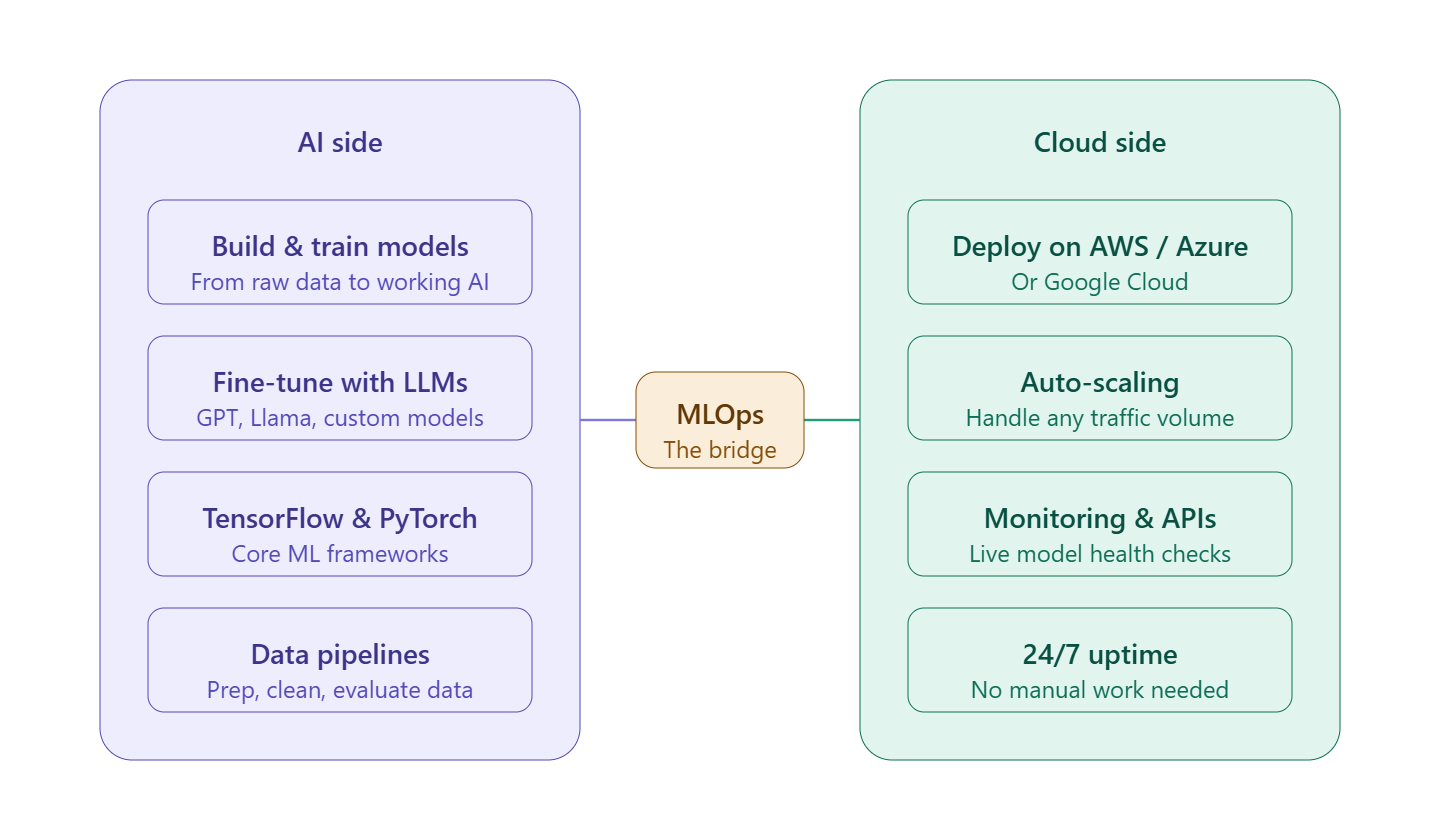
AI side: Build, train, and fine-tune machine learning models. Work with tools like TensorFlow, PyTorch, and LLMs. Understand data pipelines and model evaluation.
Cloud side: Deploy those models on AWS, Azure, or Google Cloud. Set up auto-scaling, monitoring, and APIs so the model runs 24/7 without manual work.
The magic is in the middle — a field called MLOps. It’s the bridge between an AI experiment and a production-ready product. Companies are hiring MLOps engineers, cloud architects, and AI engineers who understand both worlds.
What these roles actually pay in 2026
|
Roles |
Pay |
|
Cloud platform engineer |
$168,000+/yr |
|
AI/ML engineer |
$145,000-$190,000/yr |
|
ML Ops engineer |
$130,000-$170,000/yr |
|
AI product manager |
$120,000-160,000/yr |
|
Data scientist (AI focused) |
$110,000-$150,000/yr |
A real-world example: IKEA’s bet on the combo
IKEA doesn’t just sell furniture. It now runs AI across its entire supply chain—demand forecasting, delivery optimization, and customer service automation. In 2025, it rolled out AI literacy training to over 40,000 employees.
But IKEA’s AI doesn’t run in a vacuum. It runs on cloud infrastructure, with engineers who understand both. That’s why the company specifically looked for talent that could sit at the intersection of machine learning and cloud deployment — not one or the other.
What IKEA figured out, most forward-thinking companies are now figuring out too.
Why the skills gap is getting worse, not better
Here’s something counterintuitive: the more AI grows, the worse the talent gap gets.
Here’s why:
- Only 205 AI PhDs were awarded in the US in 2022 — demand is far outpacing academic supply
- Skills in AI-exposed roles evolve 66% faster than in other roles—last year’s skills get stale fast
- Technical skills now have a half-life of just 2.5 years—continuous learning is the only way to stay relevant
- Just 9% of organizations have reached AI maturity, yet 90% use AI in some form—the execution gap is massive
For you as a job seeker or career builder, this gap is actually good news. It means the window of opportunity is wide open — but only if you move now.
What you should actually do about it
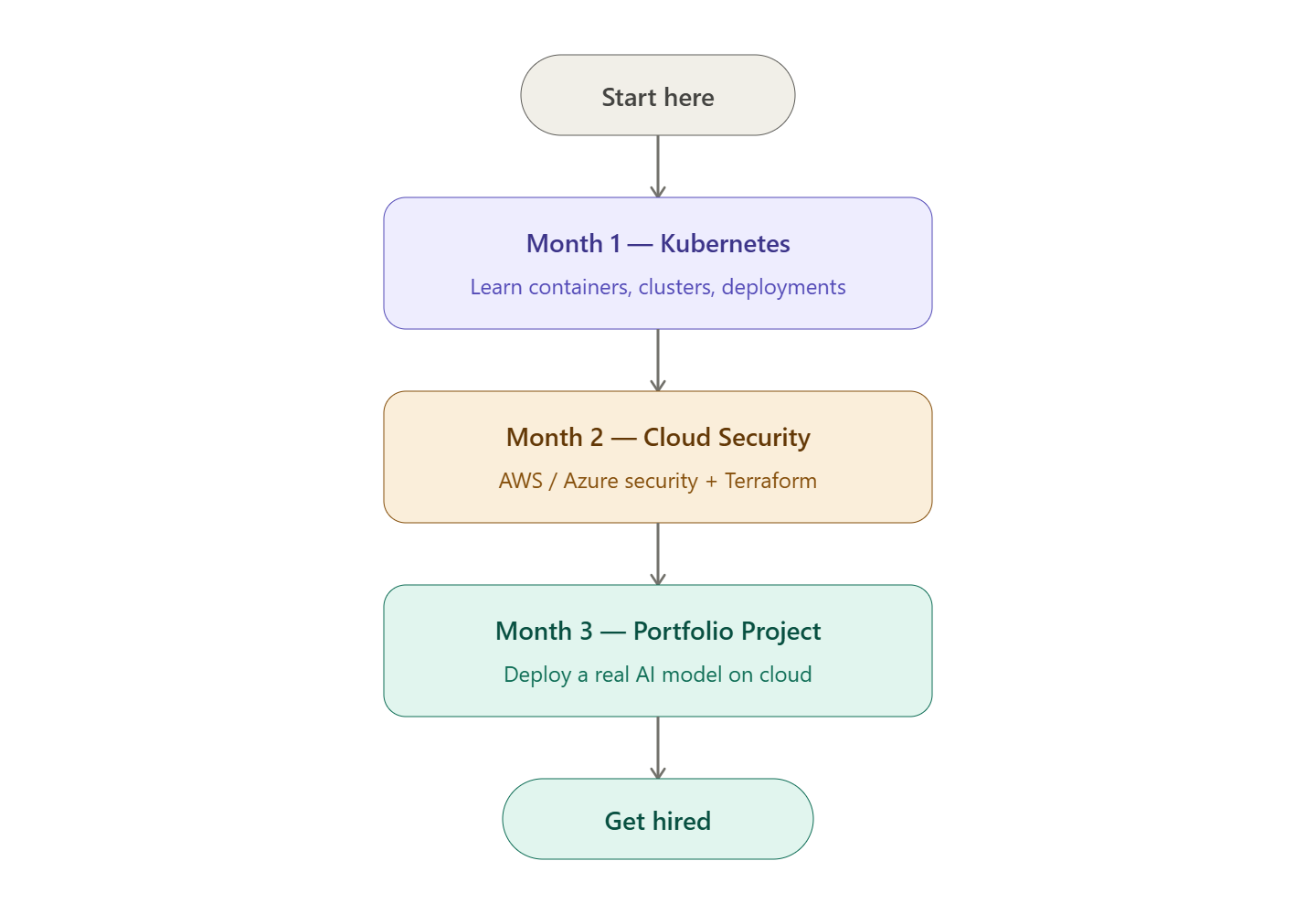
The 90-day plan that works:
Month one: master Kubernetes.
Month two: cloud security or platform engineering.
Month three: build a portfolio project that ties both together.
You don’t need to go back to school.
Here’s a practical path that hiring managers actually respond to:
- Get the AWS Solutions Architect – Associate cert ($150)—holders typically earn 20–25% more
- Add a Kubernetes cert (CKA or CKAD)—adoption surged 68% among employers in 2025–26
- Learn one AI framework (PyTorch or TensorFlow) and deploy a real model on AWS or GCP
- Write your resume bullets around outcomes: “Reduced deployment time by 40% using Terraform” beats “used Terraform.”
- Aim for roles labeled MLOps Engineer, AI Infrastructure Engineer, or Cloud AI Architect—these are where both skill sets command a premium
Conclusion
Hiring managers in 2026 aren’t looking for specialists who know AI or cloud. They’re looking for people who know how to take an AI idea and turn it into something real, live, and scalable—and that path goes through cloud infrastructure every single time.
The person who gets hired isn’t always the smartest data scientist in the room. It’s the one who can also spin up an endpoint on AWS, monitor model drift, and ship without breaking production.
That person is rare. Become that person.
Sources & References
Tech Careers in 2026: AI, Cloud and Emerging Roles Driving the Future: 117% job posting jump · $1.5T global AI+cloud investment · 56% salary premium · skills evolve 66% faster
AI Skills Demand in the U.S. Job Market (2026): 80% enterprises deploying GenAI by 2026 on cloud · 9% AI maturity · 90% orgs use AI · IKEA 40,000 employee upskilling
Enterprise GenAI Deployment Forecast: 80%+ enterprises deploying GenAI apps by 2026, mostly on AWS, Azure, Google Cloud
Top In-Demand Skills of 2026: Salary Comparison and Market Growth Statistics: Cloud engineers earn $168,000+. · AWS cert holders earn 20–25% more. · Kubernetes adoption up 68% · skills half-life: 2.5 years · 90-day learning plan
Tech Hiring Trends in 2026: Top Skills, AI Roles & Market Shifts: Skills-based hiring trend · AI + cloud demand context · LinkedIn Jobs on the Rise: AI Engineer #1 fastest-growing job
2026 Technology Job Market: In-Demand Roles and Hiring Trends: Competing AI + cloud + security priorities · low unemployment in tech roles · employer caution on headcount
AI in Hiring 2026: Five Roles Driving Demand and the Supply Problem Behind Them: Only 205 AI PhDs awarded in the US in 2022 · 70.7% of new AI PhDs went to industry (Stanford HAI). · AI job postings surged 130%
Tech Careers in 2026: AI, Cloud and Emerging Roles Driving the Future: AI job postings jumped 117% between 2024 and 2025. · MLOps and cloud integration cited as essential skills
Which Emerging AI Jobs Will Be in Demand in 2026?: 40% of core tech skills will change by 2030 · AI governance roles salary: £95k–£225k · Agentic AI Specialist salaries: £100k–£180k
Building a Cloud Career in 2026: Tools, Certifications & Projects to Get Hired Fast: PwC $2.35T cumulative US cloud investment by 2030 · cert + project combo hiring pattern · resume bullet strategy
2024 AI Index Report: 70.7% of new AI PhDs went to industry (up 5.3 percentage points in one year)