

Did you know that more than 78% of Scrum teams now use story points or similar techniques to plan their product development, according to a 2026 Agile industry survey?
That is not a small number — it represents the vast majority of software delivery teams across the world. And yet, story points estimation remains one of the most misunderstood concepts in Agile. People argue over whether a task is a three or a five. Meetings drag on. Estimates feel arbitrary. If that sounds familiar, this guide is for you.
Story point estimation sits at the heart of how modern Agile teams decide how much work they can realistically take on in a sprint. Unlike estimating in hours—which is notoriously inaccurate—it measures effort, complexity, and risk together in a single unit. The result? Teams have sharper conversations, plan more honestly, and deliver more predictably. Whether you are brand new to Agile estimation or looking to sharpen how your team works, this blog breaks down everything you need to know, using data from 2025 and 2026 to back it up.
What Exactly Are Story Points and Why Do They Matter?
Think about the last time someone asked how long a piece of work would take. You probably answered in hours or days. And if you have any real experience with software projects, you know that estimate was almost certainly wrong—not because you lack skill, but because humans are genuinely poor at predicting exact durations. What we are much better at is comparison.
Story points work on that basic human strength. Instead of asking “how many hours will this take?”, Agile estimation asks, “Compared to this task we already understand, how much bigger or smaller is this one?” The result is a number that captures relative effort without pinning the team to a time prediction that will likely be wrong.
Asana’s 2026 guide breaks it down simply: story points account for three things — the amount of work, the complexity involved, and the risk or uncertainty attached to the task. Combine those three factors, compare the task to something your team has done before, and assign a number. Teams that consistently estimate relative effort this way build forecasting accuracy that hour-based methods simply cannot match.
Scrum estimation — which uses story points specifically during sprint planning — is when the team decides what work fits into the next two-week cycle. The product owner presents each user story, the team discusses it, and members assign point values. Over several sprints, teams track how many points they complete on average—a metric called “velocity”—which becomes the basis for forecasting future delivery. According to Atlassian, this is what allows product owners to optimize for impact rather than simply tracking logged hours.
Story Point Estimation and the Fibonacci Sequence — Why Your Cards Look Like That
If you have ever sat in a planning session and wondered why the estimation cards jump from 5 to 8 to 13 instead of going 5, 6, 7, 8—the answer is psychology. Fibonacci estimation is not arbitrary; it is surprisingly well-grounded in how humans perceive effort.
Fibonacci estimation uses the sequence 1, 2, 3, 5, 8, 13, and 21 (and sometimes 40 and 100) because the gaps between numbers grow as the values increase. A task worth 8 points does not feel twice as hard as one worth 4. It feels significantly harder, with far more unknowns attached. The sequence reflects that honestly.
Mike Cohn of Mountain Goat Software, widely credited with popularizing story points in the Agile community, recommends a modified sequence of 1, 2, 3, 5, 8, 13, 20, 40, and 100 for practical use. The modification at the higher end makes the numbers more workable while preserving the core principle: larger values carry larger uncertainty, and Fibonacci estimation makes that unavoidable ambiguity visible before a sprint starts rather than mid-sprint.
There is another practical reason for this approach. Linear scales—1, 2, 3, 4, 5, 6—create what experienced practitioners call the “hours trap.” Developers see a 4 and start thinking, “That is four hours of work.” Relative sizing breaks that mental habit. Nobody thinks in hours when they look at a 13. Instead, they think, “That is roughly the size of the authentication feature we built in our last sprint. ” That shift in thinking is exactly what makes Scrum estimation more accurate over time.
Agile Planning Poker: How Teams Estimate Work Together
Agile planning poker is the most widely used technique for collaborative estimation sessions. PlanningPoker.live’s 2025 comprehensive guide says it’s more accurate as it brings together many perspectives, and it leads to real discussion, not just the most senior voice in the room setting the tone for everyone else’s judgement.
A typical session proceeds in the following way:
- The Product Owner or Scrum Master describes a user story and states its business requirements
- Each team member independently picks a card that represents their effort estimation on that story
- Everyone sees all the cards at the same time—this avoids anchoring bias, where the first estimate makes everyone unconsciously gravitate toward the same number
- The team talks about their reasoning when estimates vary wildly (e.g., one person plays a 3 and another plays a 13)
- The dev who picked 13 might know of a database migration the dev who picked 3 didn’t think of
- The team comes to agreement, sometimes through a second round of voting, and records the agreed value
Atlassian’s guide to Fibonacci story points explains why revealing story points simultaneously is important: it encourages honest discussion and surfaces hidden assumptions that would otherwise only come to light partway through the sprint — when it’s expensive to fix them. That’s why Agile planning poker is such a useful team practice, not just a nice estimation nicety.
TeamRetro’s 2026 guide mentions that whether teams are using physical Fibonacci estimation cards in person or using digital tools for remote teams is a significant factor to consider when distributed teams are the norm, not the exception.
Common Mistakes That Undermine Story Point Estimation
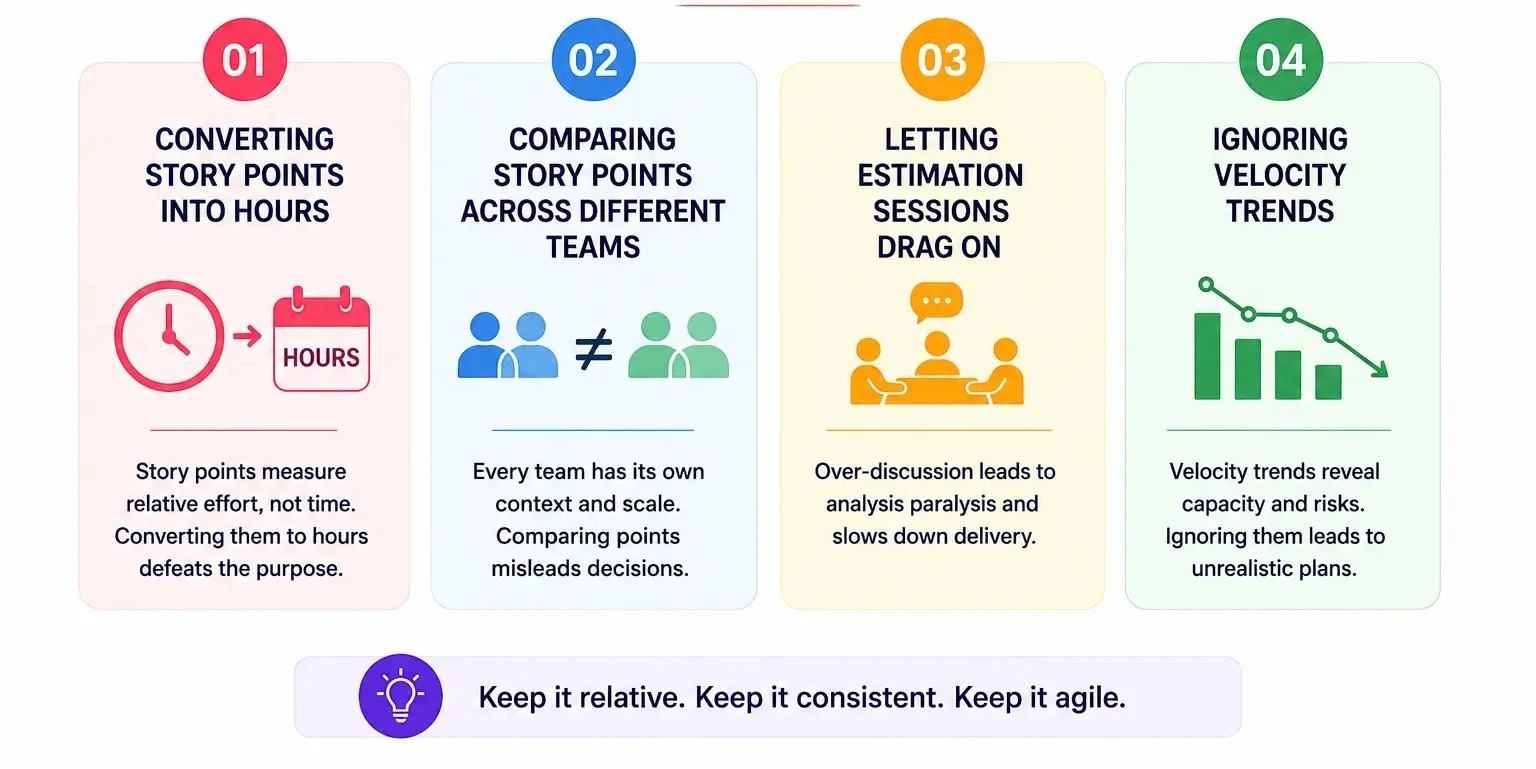
Even experienced Agile teams make the same handful of errors. Knowing what they are saves significant pain.
1. Converting Story Points Into Hours
This is the single most damaging mistake. The moment you say “a story point equals two hours,” you have destroyed the relative nature of the system and reintroduced all the inaccuracy of time-based effort estimation. Points are not hours. They are a unit of relative effort, and they must stay that way.
2. Comparing Story Points Across Teams
If a team finishes 40 points per sprint, they are not more productive than a team that finishes 20; they just have their scale set differently. Larry Putnam’s research (see Agility at Scale’s 2026 analysis) shows huge variation in productivity across teams, confirming that cross-team point comparison is fundamentally misleading and often demotivating.
3. Letting Estimation Sessions Drag On
If a story has been debated for more than ten minutes, that debate is itself useful data. It means the story is not well-understood enough to go into a sprint yet. Break it down first. The Scrum Institute recommends setting strict time limits on story explanations — if the team still cannot understand a story when time runs out, it needs to be rewritten before it comes back to planning.
4. Ignoring Velocity Trends
Scrum estimation does not end when the sprint begins. Tracking velocity—the core feedback loop in Scrum estimation—is the average points completed across multiple sprints, and it transforms story points from a planning technique into a genuine forecasting tool. Teams that track this consistently become measurably more accurate at predicting delivery timelines over a period of three to six months.
How Does Relative Sizing Actually Work Day to Day?
Relative sizing is the conceptual engine beneath all of this. To estimate relative effort, teams do not start from scratch with every new task—they estimate relative effort by building a reference library of tasks they already understand and comparing new work against those anchors.
The most practical starting point for good effort estimation is identifying a “golden story”—a user story that feels like a medium amount of effort to your team. Assign that story a 5. Then, for every new story, is it smaller than the 5? Give it a 3 or 2. Is it significantly bigger? Give it an 8 or 13. Is it so large that nobody can picture how to approach it yet? That is probably a 21 or higher—a clear signal that the story needs to be broken into smaller pieces before it enters a sprint.
Teamhood’s 2025 guide provides a practical calibration table for newly assembled teams who have not yet built that reference library. They recommend a set of example stories with agreed point values that the team can use as benchmarks until sprint history gives them reliable velocity data instead.
This approach works best when the team genuinely treats points as effort rather than time. The moment a manager asks “so how many hours is a story point worth?” the system breaks down. Monday.com‘s 2025 analysis references McKinsey research shows that organizations that correctly adopt effort-based planning—rather than converting points back into hours—achieve significant cost savings by eliminating unnecessary handoffs and keeping the focus on delivered value.
Story Point Estimation vs. Hour-Based Estimation: A Clear Comparison
Here is a side-by-side reference showing how both approaches stack up across the dimensions that matter most to Agile teams in 2025 and 2026:
|
Dimension |
Story Point Estimation |
Hour-Based Estimation |
|
What it measures |
Relative effort, complexity & risk |
Calendar time / duration |
|
Handles uncertainty |
Yes—baked into the scale |
No—assumes predictable conditions |
|
Works across team members |
Yes—relative to team history |
No—varies by individual skill level |
|
Encourages team discussion |
Yes—via Agile planning poker |
No—often assigned by one person |
|
Prevents anchoring bias |
Yes—simultaneous card reveal |
No — prone to early groupthink |
|
Useful for forecasting |
Yes—through velocity tracking |
Unreliable — chronically over or under |
|
Methodology fit |
Agile, Scrum, Kanban |
Waterfall, fixed-scope contracts |
|
Common scale used |
Fibonacci (1, 2, 3, 5, 8, 13, 21…) |
Hours, half-days, days |
|
Best applied to |
Sprint planning, backlog grooming |
Billing, regulatory reporting |
Sources: Asana 2026, Monday.com 2025, Axify 2025 — all comparing effort estimation approaches in modern Agile teams.
What 2025–2026 data actually shows?
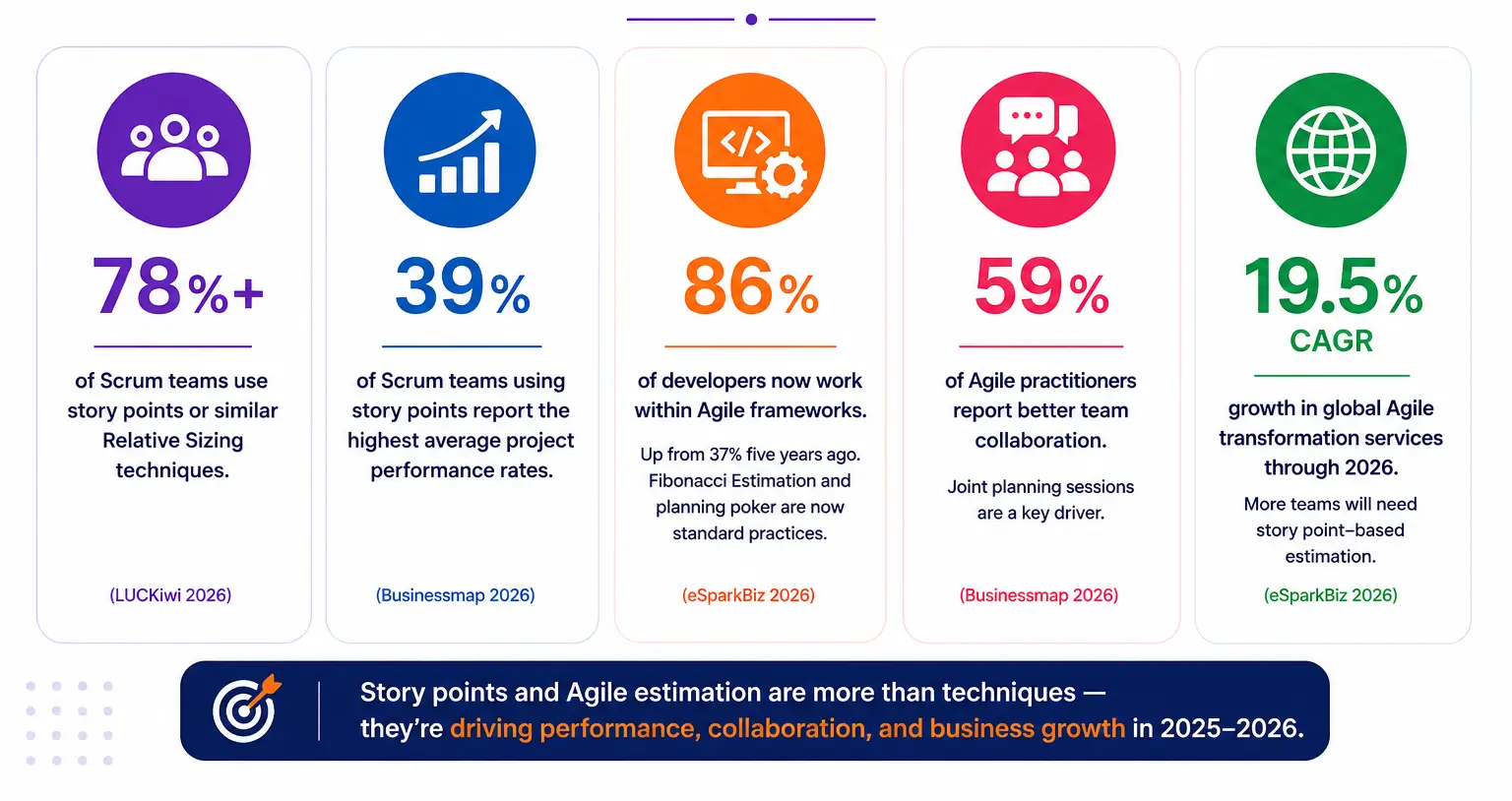
The most recent industry data gives a clear picture of where story points and Agile estimation stand today:
- 78%+ of Scrum teams now use story points or similar relative sizing techniques—confirming that Relative Sizing has become the de facto standard for Agile planning (LUCKiwi 2026)
- 39% of Agile-adopting teams using Scrum estimation and story points report the highest average project performance rates—outperforming predictive methods users (Businessmap 2026)
- 86% of developers now work within Agile frameworks—up from 37% just five years ago—with Fibonacci Estimation and planning poker firmly embedded as standard planning practices (eSparkBiz 2026)
- 59% of Agile practitioners report enhanced team collaboration as a direct result of Agile practices, with joint planning sessions cited as a primary driver (Businessmap 2026)
- Global Agile transformation services are forecast to grow at a CAGR of 19.5% through 2026, meaning significantly more teams will need to master effort estimation approaches built around story points (eSparkBiz 2026)
These numbers confirm what experienced practitioners have long argued: Relative sizing is the planning standard for modern agile delivery—not a passing preference.
Conclusion: It Is a Skill, Not a Formula
Story point estimation takes time to get right — that is the honest truth. The first few sprints will feel uncertain. Velocity will bounce. Some estimates will be wildly off. That is not a problem; that is the process working exactly as intended. Each sprint adds more data, more shared reference points, and better collective intuition about how to estimate relative effort in ways that are genuinely more accurate.
What matters most is that teams resist the urge to convert points into hours, resist comparing their velocity to other teams, and genuinely trust comparison over prediction. The goal, as Mike Cohn has long argued, is not a perfect number — it is a shared understanding of what the work actually involves before it begins.
In 2026, modern delivery teams know that getting the number exactly right on the first try is not the goal. It is about having the right conversation before the sprint starts, learning to estimate relative effort with growing confidence, and building a team that gets measurably more accurate together with every iteration. That is what story points — done well — actually deliver.