
You submitted the application. You checked the box, uploaded the resume, and maybe even wrote a cover letter. Then nothing. No acknowledgment, no rejection, no call. Just silence.
This is not an occasional experience for IT job seekers in 2026. It is the norm. Industry data from hiring platform benchmarks and recruiter surveys consistently points to the same finding: in the IT sector, somewhere around 2% of job applications result in any response at all. That means for every hundred applications sent, roughly 98 go nowhere.
Before you start questioning your qualifications or rewriting your resume for the fifteenth time, it is worth understanding what is actually happening on the other side of that Apply button. Because the problem is largely structural, and once you see it clearly, you can start working around it.
The Invisible Wall Nobody Tells You About
The moment you click Apply, your resume does not land in a human inbox. It goes straight into an Applicant Tracking System, commonly known as an ATS. This is software that companies use to sort, filter, and rank applications automatically before any person ever looks at them.
These systems scan for specific keywords, formatting patterns, and data fields. If your resume does not match what the software is configured to look for, it gets filtered out instantly. No human ever sees it. No feedback is ever given. Your application simply disappears into a queue that nobody reviews.
Research from Harvard Business School, conducted in partnership with Accenture, found that ATS software was actively eliminating qualified candidates from the hiring process, creating what the researchers described as a hidden workers problem. Millions of people were being screened out not because they lacked skills, but because their resumes were not structured the way a machine expected them to be. The employers surveyed knew the system was flawed. More than 90% admitted their ATS was screening out candidates who were genuinely qualified. They kept using it anyway because manually reviewing thousands of applications simply was not practical at scale.
Why IT Jobs Are Especially Brutal
The IT sector is uniquely affected by this problem for a few reasons.
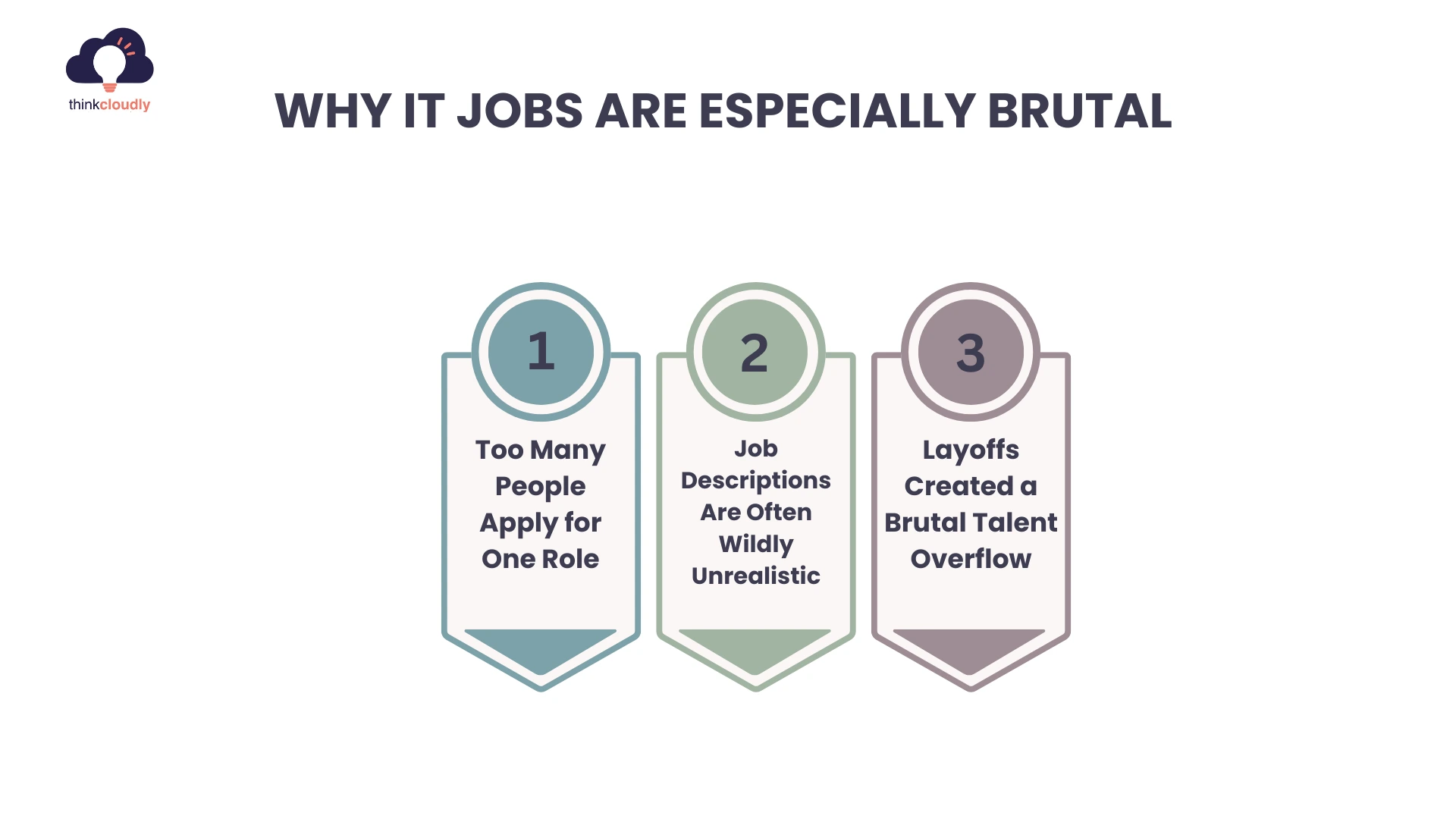
Too Many People Apply for One Role
Technology job postings attract enormous numbers of applicants. A single software engineering role at a mid-sized company can receive anywhere from 200 to over 1,000 applications within the first 48 hours of going live. No hiring team can manually process that volume, so the ATS handles the filtering, and most candidates are cut before the process truly begins.
Job Descriptions Are Often Wildly Unrealistic
IT job descriptions are often written by people who are not fully sure what they need. You have probably seen postings that ask for ten years of experience in a technology that has only existed for five years. Or listings that bundle together five completely different specializations into one role. These bloated, unrealistic job descriptions are written partly to satisfy internal HR requirements and partly because hiring managers copy-paste from old postings without updating them.
Layoffs Created a Brutal Talent Overflow
The wave of tech layoffs that ran from late 2022 through 2024 permanently reshaped the candidate pool. Even as hiring has partially recovered in 2025 and 2026, the market remains saturated with experienced professionals who were displaced during that period and are still competing for roles at all levels.
What Actually Happens to Your Resume
Here is a simplified picture of the journey your application takes:
|
Stage |
What Happens |
Estimated Drop-Off |
|
Application Submitted |
ATS scans for keyword and format matches. | 70 to 75% filtered out here |
| Initial ATS Pass | Resume ranked against other applicants |
Additional 10 to 15% dropped. |
|
Human Recruiter Review |
Recruiters spend 6 to 10 seconds per resume. | Further 5 to 10% cut |
| Hiring Manager Shortlist | Manager selects for phone screen |
Only 2 to 3% reach this stage. |
|
Interview Process |
Multiple rounds, technical tests | Less than 1% receive an offer. |
| Offer Extended | Candidate hired |
Final selection |
The Keyword Problem
ATS systems rely heavily on keyword matching. If a job posting says “Python developer” and your resume says “Python programmer,” some systems will not count that as a match.
This is not because companies want to make life harder for candidates. It is because these systems were built for efficiency, not accuracy. They are blunt instruments being used for a very precise task, and the results are predictably poor.
A study published in 2021 by researchers at Harvard Business School, in partnership with Accenture, found that over 90% of employers admitted their ATS was screening out candidates who were actually qualified for the roles they were applying to. The employers knew the system was flawed. They kept using it anyway because the alternative, reading thousands of applications manually, was simply not practical.
Ghost Jobs Are a Real Thing
Here is something that will make the silence even more frustrating: many of the IT jobs you are applying for may not actually be available.
Companies post job listings for a variety of reasons that have nothing to do with immediately hiring someone. They might be building a talent pipeline for roles they expect to open in the future.
They might be testing the market to see what calibre of candidates is out there. They might have an internal candidate already lined up but are legally required to post the position publicly first. In some cases, budget for the role was frozen after the listing went up, but nobody took the posting down.
A 2024 survey by Resume Builder found that roughly 40% of companies admitted to posting job listings for roles they were not actively trying to fill at that time. These are called ghost jobs, and they represent a significant portion of the listings you see on platforms like LinkedIn and Indeed on any given day.
When you apply to a ghost job, there is no response possible, because nobody is looking at applications. The role is not real in any practical sense.
The Recruiter’s Perspective
It is worth spending a moment understanding the position that recruiters are actually in.
A corporate recruiter at a mid-sized tech company might be managing 20 to 30 open roles at any given time. Each of those roles might have hundreds of applicants. That recruiter is also dealing with internal stakeholders, scheduling interviews, writing job descriptions, managing offer letters, and attending meetings. The time they have available to spend reviewing any individual application is genuinely limited.
Eye-tracking research has shown that the average recruiter spends between six and ten seconds on an initial resume review. In that time, they are looking for a handful of things: job title match, company names, tenure, and overall layout clarity. If any of those elements do not immediately communicate relevance, the resume is moved to the rejection pile.
What Actually Works
Given everything above, here is what the evidence suggests actually improves your chances:
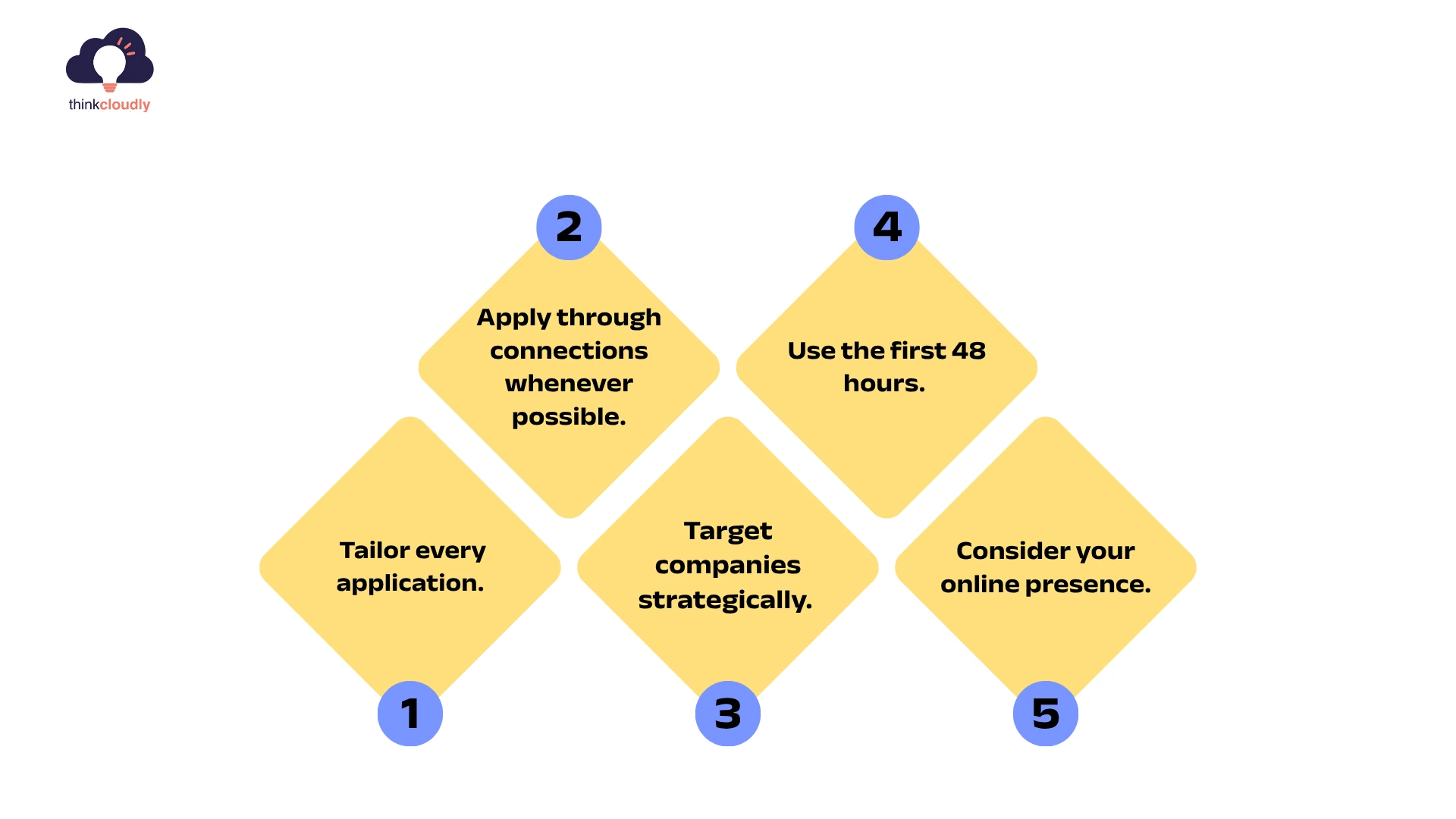
Tailor every application.
Generic resumes perform poorly against ATS systems. Before applying, read the job description carefully and mirror the specific language used. If the posting says “cloud infrastructure,” make sure those exact words appear in your resume.
Apply through connections whenever possible.
Data consistently shows that referred candidates are far more likely to receive responses. A 2022 LinkedIn report found that employees referred by existing staff were four times more likely to be hired than external applicants.
Target companies strategically.
Applying to 100 companies indiscriminately produces worse results than applying carefully to 20 companies where you have done research, tailored your materials, and attempted to make a connection. Volume is not the same as strategy.
Use the first 48 hours.
Research from Talent Works found that applying within the first 96 hours of a job posting going live significantly increases your chances of being seen. Many companies start reviewing applications within hours of a post going live. By the time a listing looks active on a job board, the hiring team may already be deep into interviews, and the role could be filled long before anyone thinks to remove the listing.
Consider your online presence.
Many tech recruiters actively search LinkedIn before or after reviewing a resume. A strong, complete LinkedIn profile that matches your resume and shows engagement with the industry can tip the balance in your favour.
A Final Thought
The silence you hear after submitting a job application is not personal. It is structural. The systems companies use to manage hiring at scale are built for efficiency, not fairness, and the result is that qualified people are being filtered out before anyone even glances at their credentials.
Understanding why this happens is the first step toward working around it. The job market rewards people who understand its mechanics and adapt, not just those who apply the hardest.
Sources & References
The data and statistics in this article are drawn from the following sources:
- Harvard Business School & Accenture — Hidden Workers: Untapped Talent—Research on ATS systems screening out qualified candidates and the hidden workers problem
- LinkedIn Talent Solutions — Global Talent Trends Report — Data on referred candidates being four times more likely to be hired than external applicants
- Resume Builder — Ghost Jobs Survey: 4 in 10 Companies Post Fake Job Listings — Survey findings on the prevalence of ghost job postings across companies
- Talent Works International — The Science of the Job Search: Timing Your Application — Research on how applying within the first 96 hours improves visibility and response rates
- Ladders, Inc. — Eye-Tracking Study: Recruiters Spend an Average of 7.4 Seconds on a Resume — Eye-tracking research on how little time recruiters spend reviewing each resume
- Society for Human Resource Management (SHRM) — Talent Acquisition Benchmarking Report — Industry benchmarks on recruiter workloads and hiring timelines
- Greenhouse Software — Hiring Benchmarks Report — Data on application volumes per role and conversion rates across hiring stages
- Burning Glass Technologies — The Baseline Skills Report: The Common Foundation of the Labor Market — Analysis of how job descriptions are structured and the keyword mismatch problem
- U.S. Bureau of Labor Statistics — Job Openings and Labor Turnover Survey (JOLTS)—Official government data on job openings, hires, and labour market conditions
- Gartner — HR Research: Talent Acquisition Trends—Analyst research on ATS adoption and enterprise hiring practices
- Indeed Hiring Lab — Job Seeker Nation Report—Survey data on job seeker behaviour, application patterns, and response expectations
- McKinsey Global Institute — The Future of Work After COVID-19 — Broader labour market context including the impact of tech sector turbulence on hiring