
Did you know that developers waste an average of 23% of their working time — more than a full day every week — because of poor prioritization and unaddressed technical debt? That figure, drawn from a 2024–2025 Agile Technical Excellence report, is not just a productivity problem. It is a strategy problem. And at the centre of it sits an unorganized product backlog.
Whether you are a product owner, a startup founder, or a project manager trying to make sense of competing demands, getting your product backlog in order is one of the highest-leverage moves you can make. The right prioritization frameworks turn a chaotic list of “maybe-someday” ideas into a clear, ranked queue that your team can actually act on. Solid backlog management is what separates teams that ship predictably from teams that are always putting out fires. In this guide, you will learn exactly how to do it — with the methods, the data, and the practical steps that work in 2026.
Why Getting Product Backlog Prioritization Right Matters More Than Ever
The numbers from 2025 and 2026 paint a clear picture. Agile teams that effectively manage changing priorities report a 64% improvement in their ability to respond to shifting demands, and organizations that adopt structured Agile practices see a 47% improvement in team productivity. Agile projects that maintain a well-ordered backlog achieve a 64% success rate, according to the Standish Group CHAOS report—significantly outperforming traditional project delivery models.
None of that is possible without deliberate requirement prioritization. Without it, teams default to building whatever the loudest stakeholder requested most recently — a pattern that leads to persistent schedule slippages, cost overruns, and context-switching that measurably kills productivity and flow. The good news is that structured prioritization frameworks fix this. And once you understand how each one works, you can pick the right tool for each situation rather than applying one method blindly to every decision.
What Is a Product Backlog and What Should It Actually Contain?
Before diving into methods, it helps to be clear on what a product backlog is—and what it is not.
The product backlog is a prioritized list of work items (user stories, features, bug fixes, technical tasks, research activities, etc.) that are required to improve the product. Clearly describe, estimate, and prioritize each item in terms of business value and urgency. It’s not a dumping ground. A backlog that is ever growing and never pruned becomes unwieldy and discourages the team from trusting the backlog. Good backlog management is about keeping the backlog lean, focused, and up-to-date so that it reflects what you know today, not what you thought six months ago.
Most successful teams spend 15-25% of their development capacity on technical improvements and maintenance to ensure that the system stays healthy and retains velocity. That means technical debt items go into your product backlog with feature work—not buried in a separate spreadsheet to be ignored.
The Most Effective Prioritization Frameworks for 2026
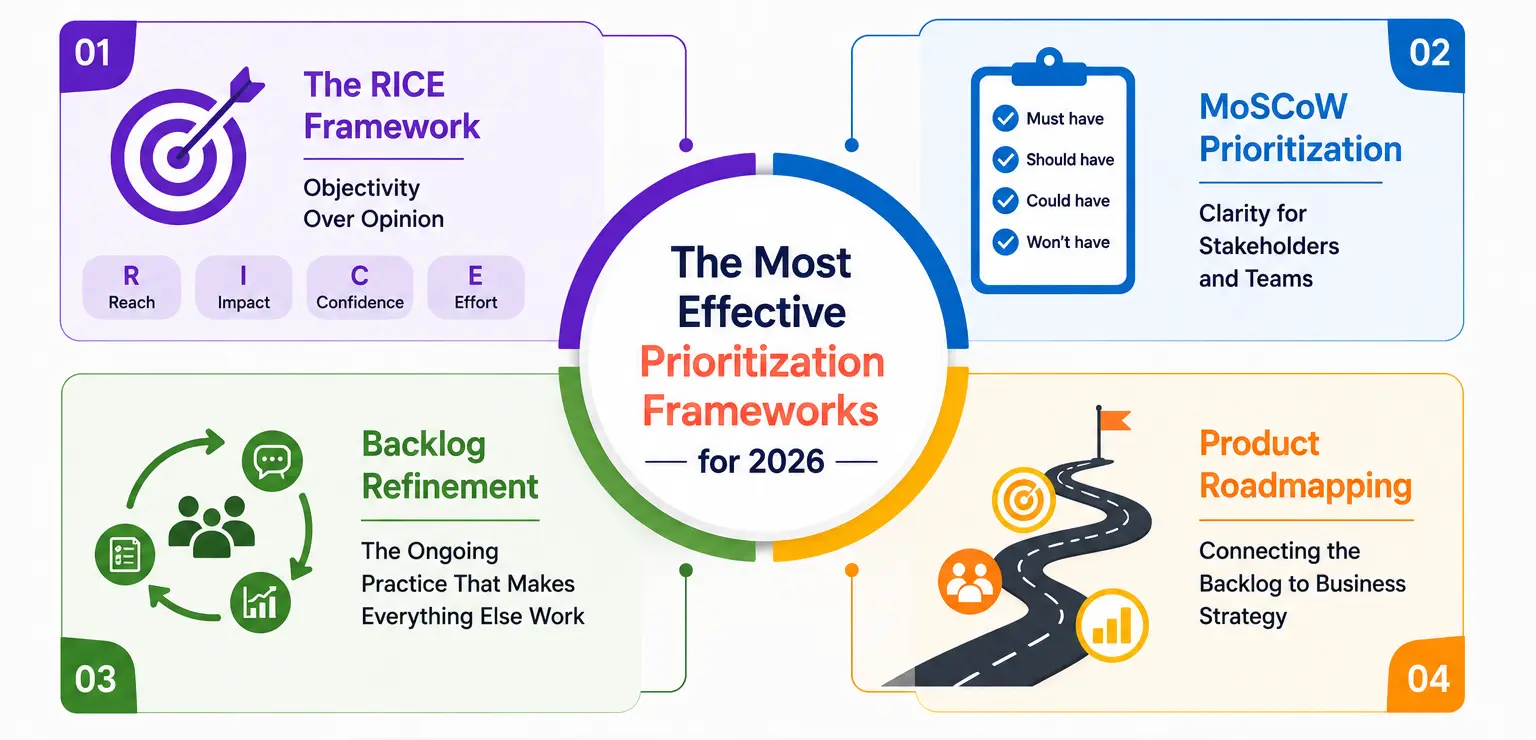
1. The RICE Framework – Objectivity vs. Opinion
The RICE Framework was created in-house at Intercom as a scoring system for prioritizing ideas. This helps product teams focus on the initiatives most likely to move a goal forward. Each idea is scored on four factors: reach, impact, confidence, and effort.
The formula is simple: (Reach x Impact x Confidence) / Effort = RICE Score
The higher the score, the more value the item offers for the effort required. The power of the RICE framework is that it takes the subjective “gut feel” out of requirement prioritization and replaces it with numbers that teams can argue and refine together. The RICE framework reduces bias through a structured, quantitative process. The one limitation to keep in mind is that the RICE Framework requires fairly accurate inputs. Where estimates are speculative, especially in new product areas, the scores may give a false sense of precision. It should be used with qualitative judgment and not as a substitute for it.
2. MoSCoW Prioritization — Clarity for Stakeholders and Teams
MoSCoW Prioritization divides features into must have, should have, could have, and won’t have. It’s simple and works well for communicating with non-technical stakeholders.
MoSCoW prioritization is one of the most popular approaches in Agile and hybrid project environments. It has proven successful in various contexts—it is commonly used in UK government IT projects to define and prioritize project deliverables, and Agile software development teams frequently employ it for feature prioritization, ensuring that sprints deliver the most valuable increments.
The risk with MoSCoW prioritization is one that seasoned product owners know well: Teams tend to over-categorize items as “Must Have,” which dilutes the category and effectively recreates the same prioritization problem you were trying to solve. Define clearly what constitutes Must have before your session starts. Typically, must-haves are things without which the product or business will fail.
3. Backlog Refinement – An Ongoing Practice to Keep Everything Else Running
The best scoring method doesn’t help if your product backlog items are vague, out of date, or poorly described. That’s where backlog refinement comes in. Regular backlog reviews (or backlog refinement in Agile parlance) keep tasks in tune with stakeholder insights. Product Owners should review the backlog before each iteration planning meeting to make sure prioritization is correct and feedback from the last iteration has been incorporated.
Backlog refinement is not a one-off cleanup. It’s a recurring ceremony, usually weekly or bi-weekly, in which the team reviews upcoming items, breaks down big stories into actionable tasks, updates estimates, and removes work that is no longer relevant. You can’t manage a backlog of hundreds of items. Set up a separate parking lot for long-term ideas and run backlog refinement sessions to drill down on the items that are most likely to make it into the next two or three sprints.
If you do backlog refinement well, it’s what keeps your prioritization decisions up to date. Markets are dynamic. Customer feedback is evolving. Technical limitations emerge. A team that refines itself on a regular basis adjusts to these changes before they become issues.
4. Product Roadmapping – Linking the Backlog to Business Strategy
Backlog items only make sense in context. Product roadmapping is how you connect the day-to-day list of what to do to the long-term direction of the product and the business. Productboard is an example of a tool that brings together roadmapping, user insights, and prioritization frameworks to help align backlogs with customer needs and business goals. Product roadmapping isn’t about putting your plan in stone for the next 12 months. This allows teams to adapt to new information while maintaining strategic direction.
Prioritization sessions are much faster if you do product roadmapping before backlog management. Rather than rehashing the debate every sprint, the team can simply ask, “What item best advances the roadmap objectives for this quarter?”
Important Factors in Prioritizing Requirements
Effective requirement prioritization is not only about selecting a scoring method. When making any prioritization decision, four factors should always guide your thinking:
- Business value: How much does this item contribute directly to revenue, customer retention, or strategic goals?
- User Impact: How many users will be impacted and what will be the significance of the impact on their experience?
- Effort and cost: A big development effort for a high-value item might not make it a top priority. Instead, aim for quick wins—things that deliver a lot of value for a reasonable effort.
The best Product Owners mix stakeholder alignment, scoring frameworks, experimentation, and cost awareness. No one method is successful in isolation.
Prioritization Frameworks at a Glance
|
Framework |
Best Used For | Key Advantage |
Watch Out For |
|
RICE Framework |
Feature roadmaps, mid-to-large teams | Removes subjectivity with data-driven scoring |
Requires reliable input estimates |
|
MoSCoW Prioritization |
MVP planning, stakeholder alignment | Simple language non-technical teams understand |
Over-classification of Must-Haves |
|
Value vs. Effort Matrix |
Quick sprint decisions, small teams | Fast, visual, and collaborative |
Ignores strategic alignment |
|
WSJF (Weighted Shortest Job First) |
Large-scale Agile (SAFe), epics | Optimizes for value per unit of development time |
Complex to calculate; overkill for small teams |
|
Kano Model |
Customer satisfaction analysis | Reveals which features genuinely delight users |
Time-intensive to run properly |
|
Cost of Delay |
Business-critical feature sequencing | Puts real monetary stakes on timing decisions |
Estimating delay cost can be speculative |
Sources: monday.com, Tempo, resolution.de
How to Run a Backlog Management Session That Actually Works?
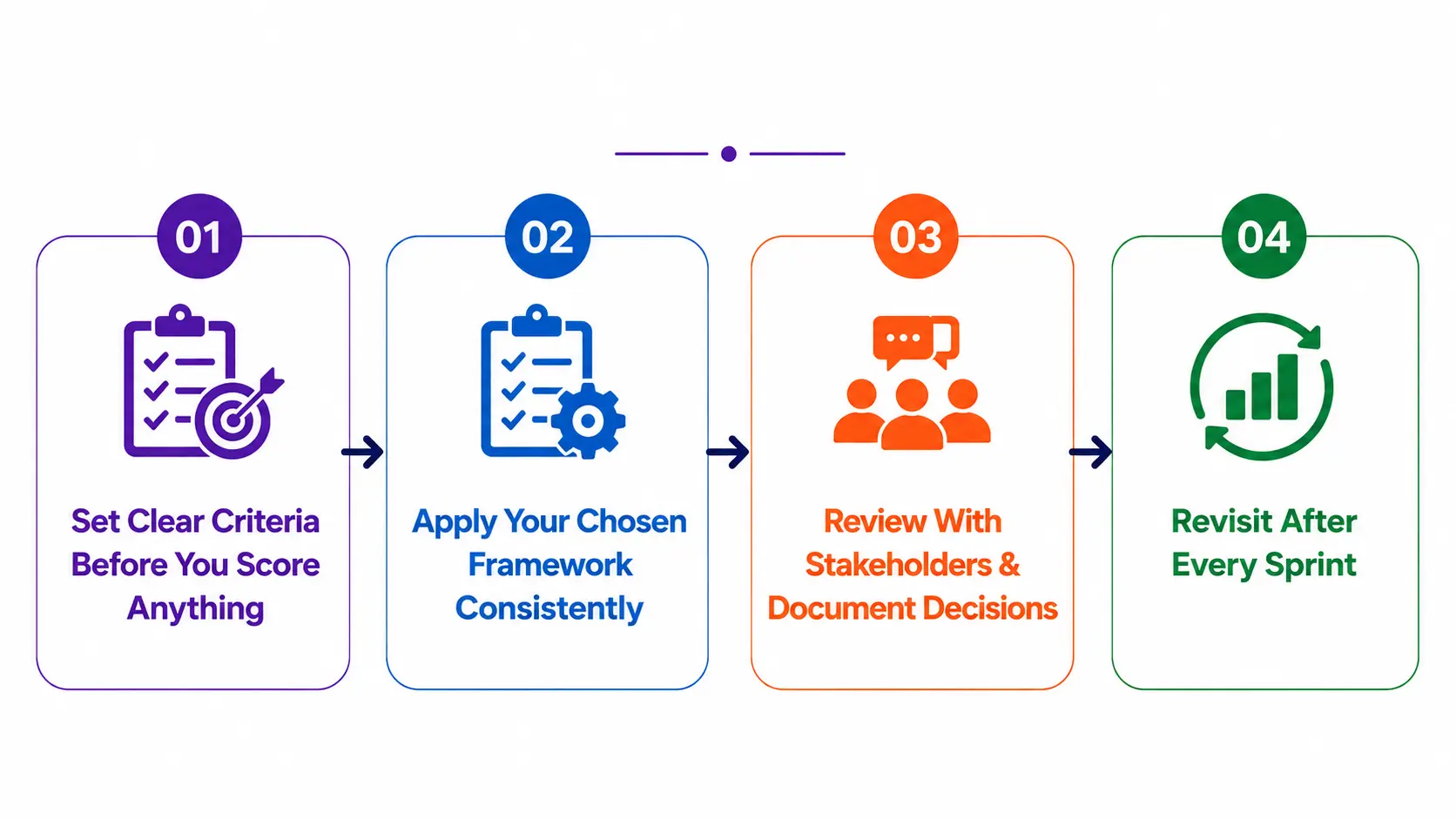
Step 1: Set Clear Criteria Before You Score Anything
Identify what criteria matter – value, urgency, complexity, risk and dependencies Before you start scoring items, assign relative importance to each of them and agree with your team. If you don’t have that agreement up front, every scoring session is a negotiation.
Step 2: Apply Your Chosen Framework Consistently
Whether you go with RICE Framework, MoSCoW Prioritization, or a custom scoring model, the important thing is to be consistent. Use frameworks like RICE or WSJF for rigour, but don’t just follow formulas. Adjust for dependency and capacity constraints.
Step 3: Review With Stakeholders and Document Decisions
Share results after ordering. Record a brief justification for the top items so you can explain decisions to stakeholders later. This builds trust and reduces the need to re-prioritize according to who shouts the loudest. Regularly revisit the backlog and adjust according to new data. Three weeks ago the product backlog was in perfect order; today it may not be valid. Backlog management is a recurring discipline and not a one-time event.
Conclusion
Knowing how to prioritize a product backlog is not a nice-to-have skill in 2026—it is a core competency for anyone responsible for product delivery. Whether you reach for the RICE Framework when you need objective scoring, use MoSCoW Prioritization to align your stakeholders, run weekly backlog refinement sessions to keep your queue clean, or anchor your decisions to a quarterly Product Roadmapping exercise, the method matters less than the discipline of applying it consistently.
Great backlog management is ultimately about one thing: ensuring that every hour your team spends building something is moving the product — and the business — in the right direction. That requires clear requirement prioritization criteria, regular reviews, and the courage to say no to items that are not worth building yet.
Start with one framework. Apply it for one sprint cycle. Measure the difference. Then refine. The teams winning in 2026 are not the ones with the most features in their backlog—they are the ones who are most deliberate about what they choose to build next.