

Did you know that 70% of organizational transformations still fail to deliver their intended outcomes—even in 2026?
That number has barely moved in nearly two decades of research, and it should stop every business leader in their tracks. Because despite billions of dollars invested globally, despite entire consulting industries built around it, and despite widespread adoption across sectors, agile transformation continues to stumble where it matters most: inside the human parts of an organization.
I have spent the last several years observing, writing about, and working alongside teams navigating agile transformation journeys across multiple industries. And what I can tell you from personal experience is this: the frameworks are rarely the problem. The checklists, the Scrum ceremonies, the sprint cadences — teams learn those quickly enough. What breaks down, almost every single time, is everything that sits underneath the process: culture, leadership, communication, and genuine organizational change management. This blog is my honest attempt to pull back the curtain on what the 2026 data actually reveals and why so many Agile transformation efforts continue to hit walls that nobody warned them about.
Why Agile Transformation Is Harder Than It Looks in 2026?
The global appetite for agile transformation has never been stronger. Around 94–95% of organizations now report using Agile practices to some degree, marking a significant shift from experimental adoption to strategic implementation. But here is where that impressive number starts to crack. Despite this near-universal adoption, 84% of organizations acknowledge they are below a high level of agile competency. Adoption and proficiency are two entirely different things—and that gap is where most agile transformation pain lives.
The Agile framework itself is not the villain. Scrum, SAFe, Kanban, and their relatives are well-documented and widely taught. The hidden challenges are organizational, cultural, and deeply human. And in 2026, the data is finally specific enough to name them clearly.
Challenge 1 — Cultural Resistance Remains the Single Biggest Barrier
If I had to point to one factor I have watched derail more agile transformation efforts than anything else, it would be culture—not tools, not methodology, not even budget.
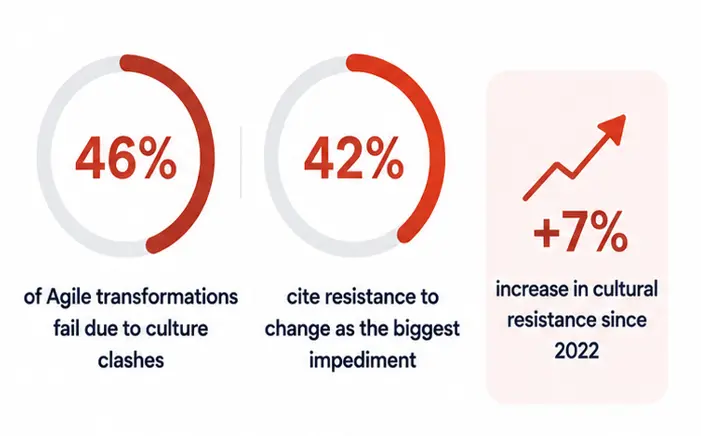
According to February 2026 research, 46% of Agile transformations fail because organizational culture clashes with Agile values, while 42% of survey respondents cite resistance to change as the biggest impediment to Agile adoption. This is not a new finding, but the scale of it in 2026 is significant. Cultural resistance and clashes have increased by 7 percentage points since 2022, making this an accelerating problem rather than a stabilizing one.
What Does Cultural Resistance Actually Look Like?
It rarely looks like outright rebellion. In my experience, cultural resistance is subtle. It shows up as managers who enthusiastically adopt the language of Agile principles while quietly continuing to micromanage every task. It shows up as sprint retrospectives that produce a list of action items that nobody reviews in the following sprint. It is the team that says all the right things in standups and then reverts to waterfall decision-making the moment the Agile coach leaves the room. The deeper issue is that genuine Agile principles—transparency, servant leadership, psychological safety, and continuous improvement—require organizations to change how power is distributed. And that is uncomfortable for nearly everyone who currently holds power.
Transformation management cannot paper over this with a training course. It requires deliberate, sustained behavioral change at every level of the organization, starting at the top.
Challenge 2 — Leadership Engagement Remains Dangerously Low
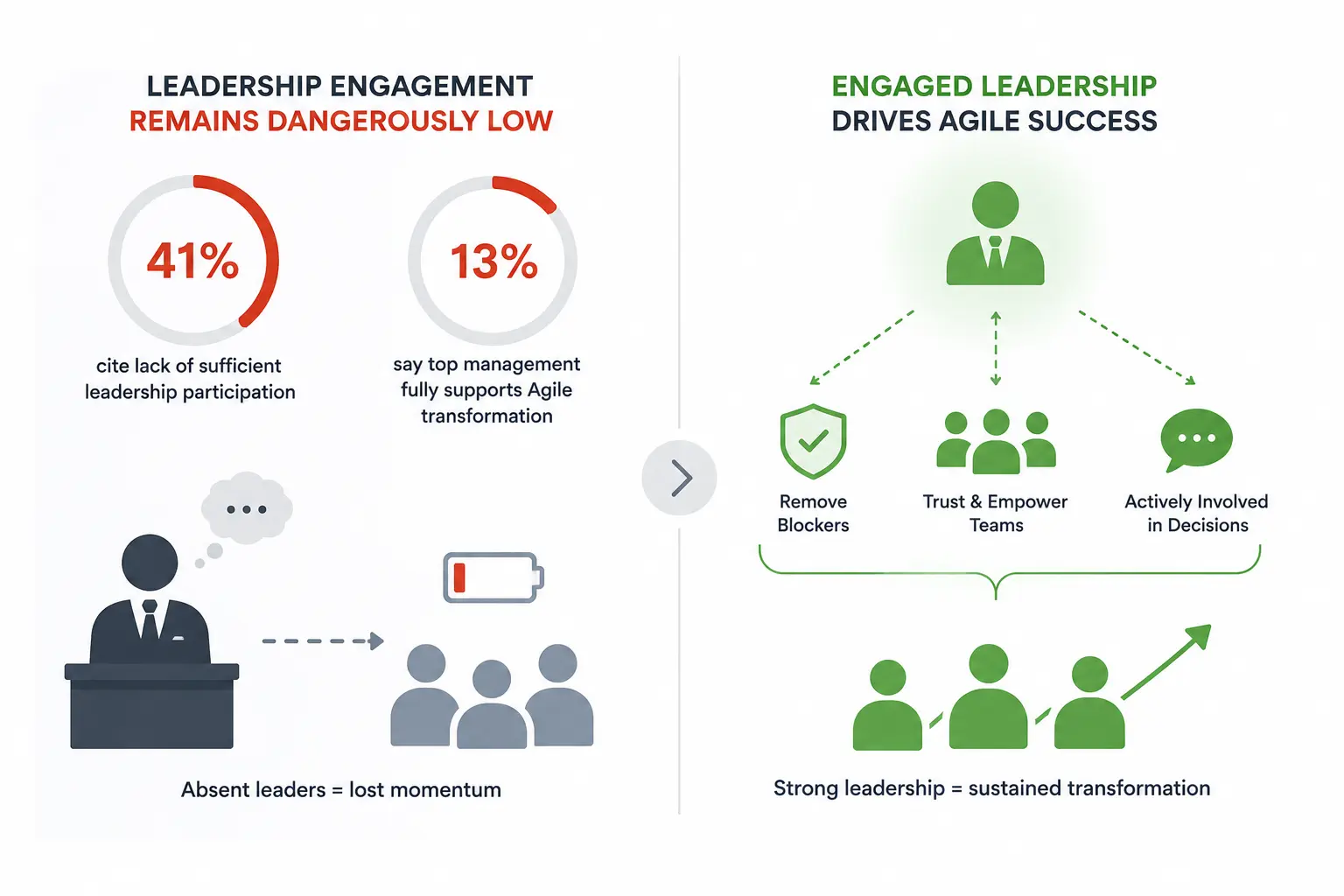
Here is a finding that should make any executive uncomfortable. According to the 2026 data, 41% of respondents cite a persistent lack of sufficient leadership participation as a consistent challenge—appearing for the second consecutive year in the top findings.
A KPMG survey found that only 13% of respondents reported that top management fully supports Agile transformation efforts. Think about what that means in practice. When leadership is absent or passive during a digital transformation, the cultural signal sent to every layer of the organization is this: this initiative is not really important enough for our most senior people to engage with. Teams pick up on that immediately, and momentum quietly collapses. The Agile framework demands servant leadership—leaders who remove blockers, trust teams to self-organize, and actively participate in transformation management decisions. When leaders delegate agile adoption to a consultant or a Scrum Master and then walk away, they are not just missing an opportunity—they are actively creating one of the most common failure conditions.
Cultural resistance and a lack of leadership involvement remain the primary hurdles for Agile Transformation in 2026. Success requires a shift in mindset from top-down control to a supportive, coaching-based leadership style that empowers self-organizing teams.
Challenge 3 — Scaling Agile Beyond Individual Teams
I often joke that organizations are brilliant at Agile in a single team and terrible at it everywhere else. The data in 2026 backs that up more sharply than ever.
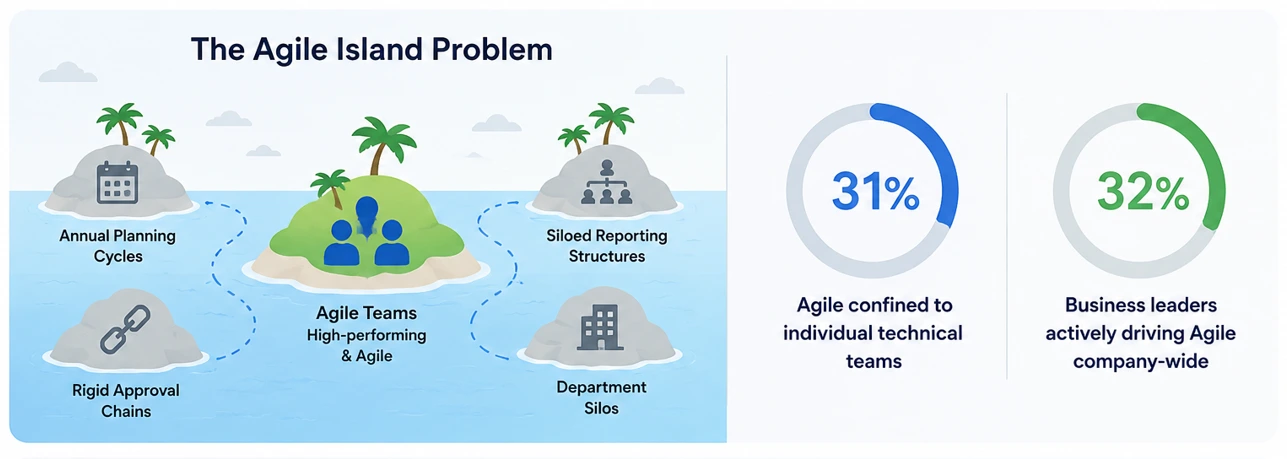
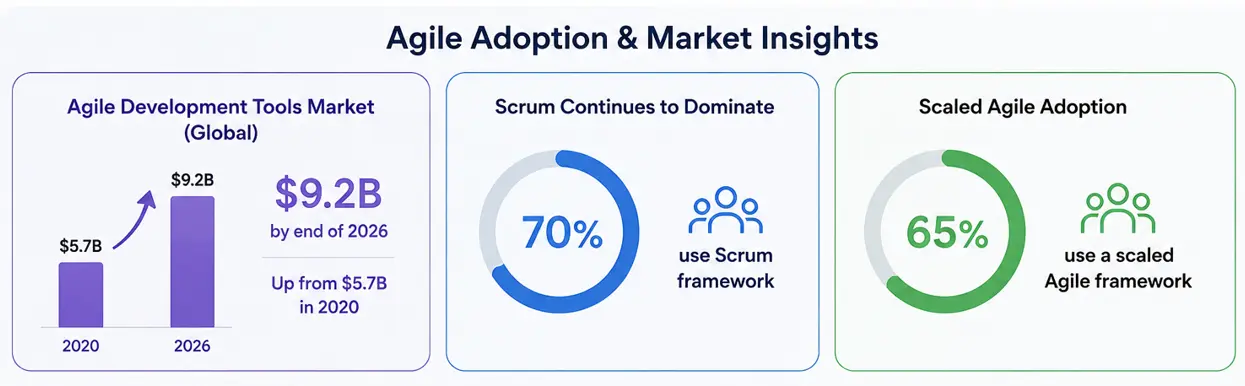
31% of organizations report that Agile practices are confined only to individual technical teams, while just 32% report that business leaders are actively driving Agile transformation across the entire company. This creates what I call the “agile island” problem. A few high-performing cross-functional teams operate with real agility—adaptive, collaborative, and iterative—while surrounding departments continue working in annual planning cycles, rigid approval chains, and siloed reporting structures. The islands are great. The ocean around them defeats everything those teams are trying to do. The global Agile development tools market is estimated to reach $9.2 billion by the end of 2026, up from $5.7 billion in 2020. Scrum continues to dominate as the most implemented Agile framework, used by approximately 70% of practitioners, while 65% of organizations report using a scaled Agile framework.
Yet investment in tools does not automatically translate to investment in the processes, structures, and leadership behaviors that make strategic agility achievable at scale. Agile project delivery across an entire enterprise requires coordinating budgets, governance, hiring, and reward systems around Agile values—not just launching a SAFe program and hoping it spreads.
Challenge 4 — The Skills Gap Is Widening, Not Closing
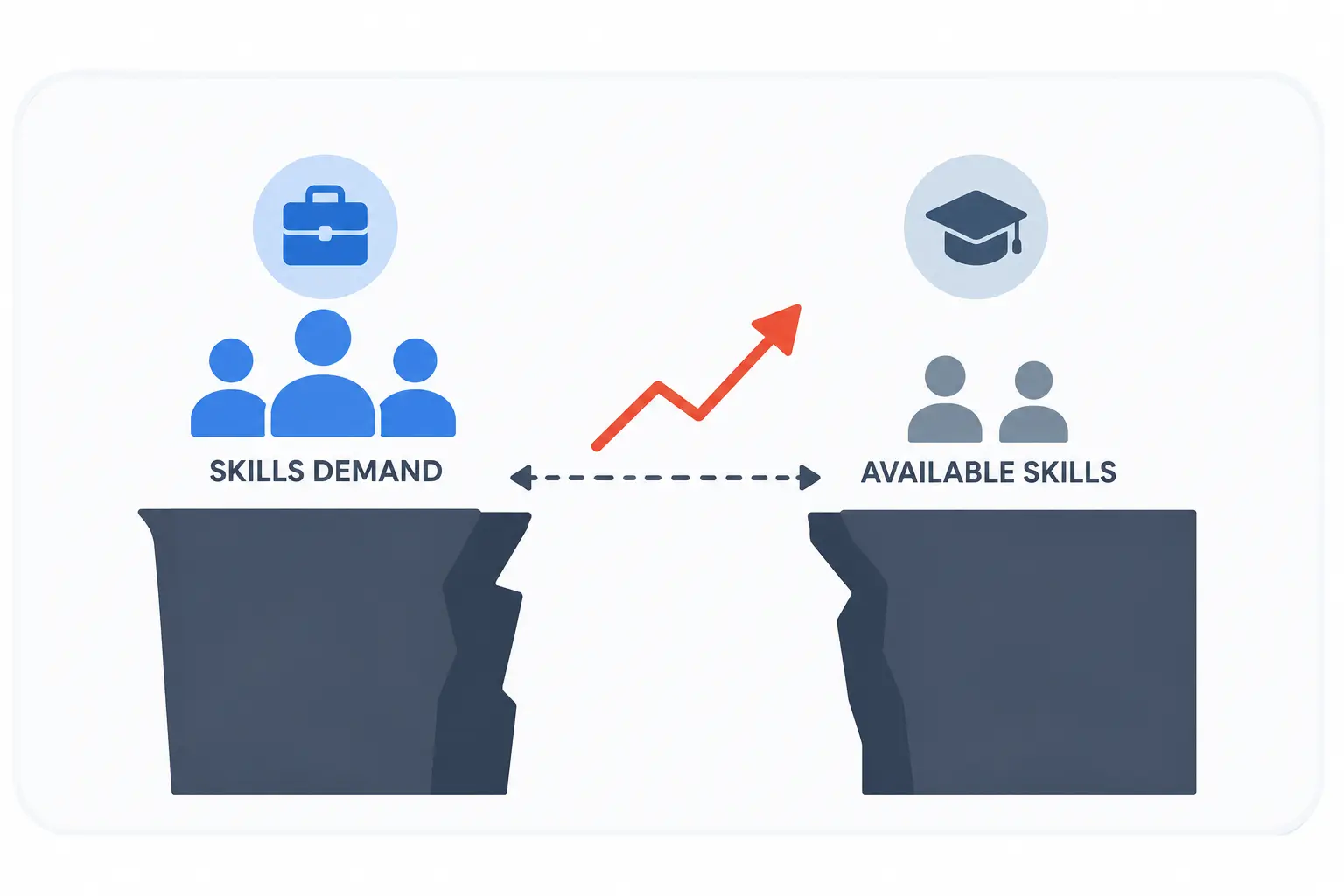
Skills gaps now affect 87% of organizations across industries, with 90% of organizations worldwide expected to face an IT skills crisis by 2026 — potentially costing the global economy $5.5 trillion in losses from delays and missed opportunities.
For agile transformation specifically, this skills gap has a two-sided problem. On one side, technical teams often lack the soft skills—facilitation, active listening, and conflict resolution—that genuine Agile teams facilitation demands. On the other, business and leadership teams frequently lack the literacy to engage meaningfully with Agile processes, backlogs, or iterative development outcomes. 35% of people cite skills gaps as a direct impediment to agile adoption, while 42% find cross-team collaboration—despite being foundational to agile—genuinely challenging.
The solution here is not simply more certifications. Certifications produce knowledge; continuous transformation requires behavioral change. The organizations that are genuinely closing the skills gap in 2026 are investing in embedded coaching, experiential learning programs, and communities of practice—not just sending people on weekend courses.
The Data in Focus
The following table summarizes the key data points from verified 2026 sources that paint the clearest picture of where agile transformation currently stands and where its hidden challenges cluster most intensely.
|
Challenge Area |
2026 Statistic |
Source |
|
Overall transformation failure rate |
70% of organisational transformations fail to meet goals |
McKinsey / Speakwise 2026 |
|
Cultural resistance |
46% of Agile transformations fail due to culture clash |
WifiTalents, Feb 2026 |
|
Resistance to change |
42% cite it as the single biggest Agile impediment |
WifiTalents, Feb 2026 |
|
Leadership participation gap |
41% report insufficient leadership engagement |
State of Agile 2026 |
|
Agile confined to tech teams only |
31% of organizations—Agile hasn’t crossed into the business |
TST Technology 2026 |
|
Organisations below high Agile maturity |
84% acknowledge below-high competency |
State of Agile 2026 |
|
Top management’s full support for Agile |
Only 13% report full C-suite backing |
KPMG via eSpark 2026 |
|
Skills gaps affecting Agile adoption |
35% directly cite skills gaps as a barrier |
eSpark Info 2026 |
|
Agile transformation failures from inconsistency |
67% of failures linked to inconsistent practices |
eSpark Info 2026 |
|
Change fatigue |
66% of employees experience burnout symptoms during change | Speakwise / Mooncamp 2026 |
Challenge 5 — Change Fatigue and the Human Cost of Continuous Transformation
This one rarely appears in boardroom decks, but it is one I have watched quietly destroy the effectiveness of otherwise well-planned agile transformation programs. Two-thirds of employees experience burnout symptoms during change initiatives. The additional cognitive load of learning new processes, adapting to new tools, and managing uncertainty compounds existing workday stress. Continuous transformation is a stated goal for most modern organizations. But continuous transformation without deliberate recovery, celebration of wins, and genuine employee involvement creates what researchers now call “change fatigue”—a state where teams begin to disengage from new initiatives before they even start, simply because they have been through too many of them.
Only 43% of employees now believe their organization manages change effectively—down from 60% in 2019. Strategic agility at the organizational level is not just about moving faster. It is about building the human infrastructure — psychological safety, clear communication, genuine inclusion in decision-making — that lets people absorb and sustain change without burning out. Organizations that ignore this are not doing Agile transformation; they are doing Agile theater.
What Successful Agile Transformation Actually Requires in 2026?
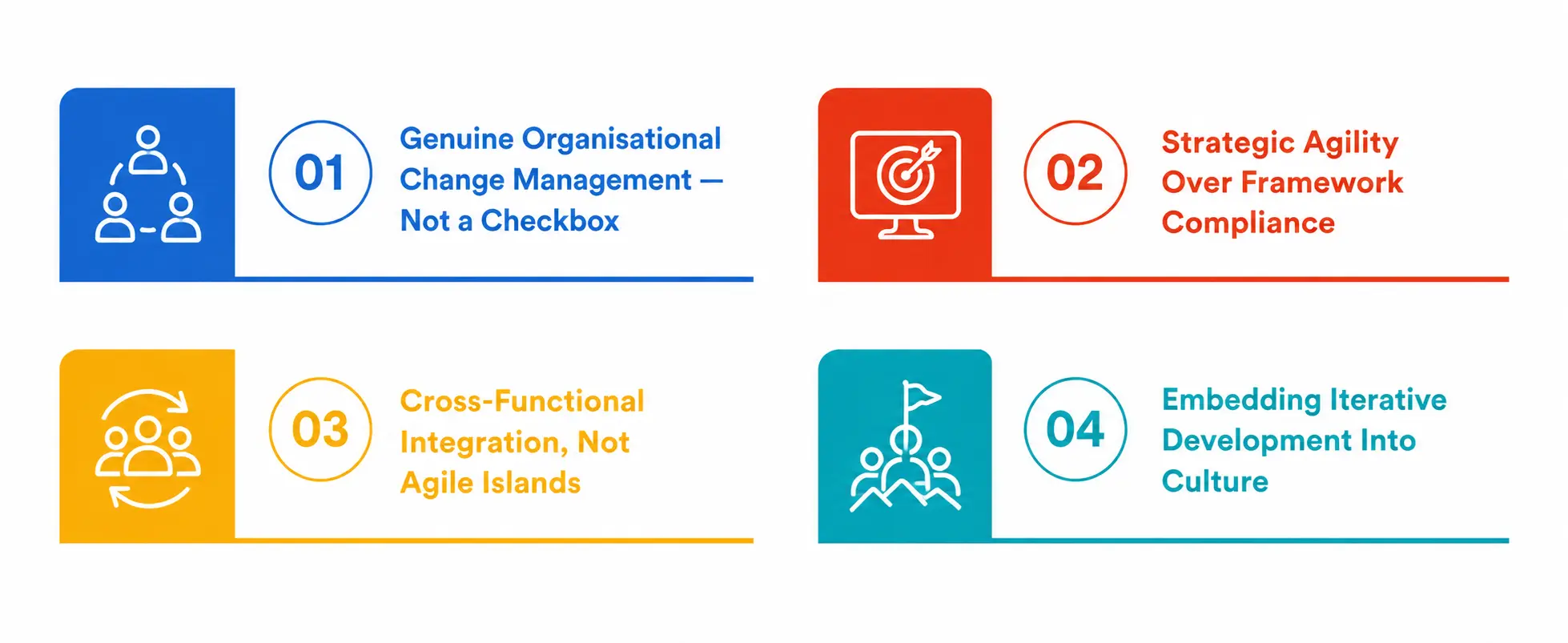
1. Genuine Organisational Change Management — Not a Checkbox
The difference between organizations that succeed and those that do not almost always comes down to how seriously they treat organizational change management as a discipline in its own right. Despite billions spent on transformation, only 17% of business leaders rate their organizations as highly capable of executing change. That self-awareness gap is significant—and closing it starts with treating change management as a strategic investment, not a line item to be cut when budgets tighten.
2. Strategic Agility Over Framework Compliance
The mature landscape of 2026 has exposed the flaws in activity-based measurements. High velocity does not always equate to high value. Leaders are now utilizing Objectives and Key Results (OKRs) that connect directly to team-level daily output, ensuring every sprint increment contributes to a larger strategic goal. Strategic agility means building organizations that can pivot with precision—not organizations that can run a good standup. The focus must shift from doing Agile to being Agile in every decision that matters.
3. Cross-Functional Integration, Not Agile Islands
Cross-functional teams that genuinely include legal, finance, marketing, and operations—not just developers—are the fastest path to enterprise Agile project delivery. When only technical teams are agile, the surrounding organization becomes the bottleneck. Agile principles must apply to how budgets are allocated, how strategy is set, and how success is measured—not just to how software is built.
4. Embedding Iterative Development Into Culture
Agile transformation leads to 30% faster time-to-market for organisations that implement it with genuine depth. But that outcome requires iterative development to be embedded at the cultural level — not just the process level. Teams that can experiment, fail safely, learn fast, and improve continuously are not following a methodology; they are living a set of Agile principles that has become genuinely ingrained.
A Personal Note From the Author
Sitting with all of this data, I keep coming back to the same observation I have had in every conversation about agile transformation over the past few years. The organizations that do it well are not necessarily the ones with the best Agile coaches, the most sophisticated tooling, or the biggest training budget. They are the ones where a senior leader—usually one who has personally felt the pain of slow, rigid decision-making—decides that genuine digital transformation is worth the discomfort it requires. They are the ones where psychological safety is not a slide in a deck but a behavior that leadership models every single day.
Agile transformation is not a project. It is not something you do and then move on from. It is an ongoing commitment to building organizations that are more human, more adaptive, and more capable of delivering value in an uncertain world. The data in 2026 tell us clearly that most organizations have not yet crossed that threshold. But the ones that have are outperforming their peers across almost every measurable dimension—and that gap is only growing.
Conclusion
The hidden challenges of agile transformation in 2026 are not technical. They are human. Cultural resistance, leadership absence, skills gaps, scaling failures, and change fatigue are the real obstacles standing between organizations and the strategic agility they are chasing.
The good news is that none of these challenges are unsolvable. But they require honest diagnosis, sustained commitment, and a willingness to treat agile transformation as a long-term cultural shift rather than a short-term process upgrade. Organizations that invest in genuine organizational change management, connect iterative development to measurable business outcomes, and build true cross-functional teams across the enterprise are the ones that will separate themselves from the 70% failure statistic.
The question is not whether your organization needs Agile transformation. In 2026, that answer is almost certainly yes. The question is whether you are prepared to do it in a way that actually works.