

Here’s something most guides won’t tell you: The AWS Cloud Practitioner certification is the only entry-level credential in tech where you can go from “I don’t know what a server is” to “I hold a recognized AWS credential” in under four weeks—and employers genuinely treat it as a signal, not a participation trophy. That’s not hype. It’s a visible pattern across thousands of LinkedIn profiles, hiring manager comments, and AWS’s own certification holder data. If you’re weighing whether the AWS Cloud Practitioner certification is your right starting point, this guide tells you exactly what the exam tests, what it costs in 2026, how to study without wasting money, and where it actually leads.
We built this AWS Cloud Practitioner Certification guide differently. Instead of repeating what AWS’s own exam guide already says, we pulled the official CLF-C02 domain weightings apart, cross-referenced them against what actually shows up in test-taker reports, and added something you won’t find in a typical study article: a readiness model based on how much prior exposure you already have to cloud concepts. More on that below.
What the AWS Cloud Practitioner Certification Actually Tests
The AWS Cloud Practitioner certification (exam code CLF-C02) is Amazon Web Services’ foundational, role-agnostic credential. “Role-agnostic” is the key phrase—unlike the Solutions Architect or Developer tracks, the AWS Cloud Practitioner certification isn’t designed for a specific job function. It’s designed to prove that you understand how the AWS Cloud works, what it costs, how it’s secured, and which services solve which problems, regardless of whether you’re a sales rep, a project manager, a finance analyst, or a future engineer.
AWS positions the AWS Cloud Practitioner certification as ideal for candidates with up to six months of exposure to AWS, and it explicitly welcomes people from non-technical backgrounds. You won’t be asked to write code, troubleshoot a broken deployment, or design network architecture. The exam exists to test breadth of understanding, not depth of hands-on skill—which is precisely what makes it accessible to career changers and intimidating in the wrong way to engineers who assume every AWS exam requires deep technical fluency.
If you’re mapping where this sits on the broader AWS Certification Path, think of it as the foundation layer beneath everything else. AWS structures its credentials in four tiers—Foundational, Associate, Professional, and Specialty—and the AWS Cloud Practitioner certification is the only Foundational-tier credential most professionals pursue before starting the rest of the AWS Certification Path toward Solutions Architect, Developer, or SysOps Associate.
Why This Certification Still Matters in 2026
Cloud hiring has shifted. As AI workloads move into production at scale, organizations need more people—not fewer—who can speak intelligently about cloud economics, AWS cloud security posture, and service selection without necessarily writing the infrastructure code themselves. Product managers, compliance analysts, sales engineers, and recent graduates are increasingly expected to hold some baseline cloud literacy, and the AWS Cloud Practitioner certification has become the default way to prove it quickly.
There’s also a structural reason this credential persists: AWS gives every certification holder a 50% discount voucher toward their next exam. That single incentive turns the AWS Cloud Practitioner certification into a low-cost on-ramp rather than a dead end — pass it once, and your next attempt at an Associate-level exam costs half as much.
None of this means the credential alone gets you hired. It won’t replace hands-on project work, and engineers already running production AWS workloads typically skip it in favor of Solutions Architect Associate. But for students, IT professionals broadening their skill sets, and career changers, it remains one of the highest-leverage 90-minute investments available.
Exam Format: What You’re Actually Walking Into
Let’s get the mechanics out of the way clearly, since vague descriptions cause unnecessary anxiety. The Cloud Practitioner Exam consists of 65 questions — multiple-choice (one correct answer, three distractors) or multiple-response (two or more correct answers among five-plus options). You have 90 minutes to complete the Cloud Practitioner exam, sitting it either at a Pearson VUE testing center or via online proctoring from home.
Here’s a detail almost nobody explains well: only 50 of those 65 questions count toward your score. The other 15 are unscored — AWS uses them to evaluate future exam questions, and you won’t know which ones they are. This matters psychologically more than technically: if you hit unfamiliar questions mid-exam, several are likely unscored pretest items, not signs you’re failing.
Scoring runs on a scaled range of 100 to 1,000, and you need 700 to pass. AWS uses a compensatory model — you don’t need a minimum threshold in every domain, only the overall bar. That rewards broad, even preparation over narrow over-optimization in any one area.
The Four Domains, Weighted Accurately
Most competing guides either paraphrase the domain names or get the weighting slightly wrong. Here’s the official breakdown, straight from the current CLF-C02 exam guide:
|
Domain |
Weight |
What It Actually Tests |
|
Cloud Concepts |
24% |
Value of the cloud, AWS Well-Architected Framework pillars, migration strategies, cloud economics |
|
Security and Compliance |
30% |
AWS Shared Responsibility Model, AWS IAM, AWS Cloud Security tooling, compliance resources |
|
Cloud Technology and Services |
34% |
Compute, storage, database, networking, AI/ML, and analytics services |
|
Billing, Pricing, and Support |
12% |
Pricing models, AWS Organizations, support tiers, cost management tools |
Notice that Security and Compliance carries nearly a third of the exam’s weight—more than Cloud Concepts. This is the domain most self-taught candidates underestimate, since it rewards understanding two things deeply rather than memorizing service names: the AWS Shared Responsibility Model and AWS IAM. Get comfortable with both and AWS Cloud Security as a whole, and you’ve effectively secured close to a third of your score before touching a single compute or storage service.
AWS IAM and the AWS Shared Responsibility Model: The Two Concepts That Decide Your Score
If there’s one section of this guide worth re-reading before your Cloud Practitioner Exam, it’s this one. AWS IAM (Identity and Access Management) and the AWS Shared Responsibility Model are not just exam topics — they’re the conceptual backbone of how AWS Cloud Security actually works, and the exam treats them accordingly. Anyone serious about the AWS Certification Path should treat these two concepts as non-negotiable, since they resurface at every tier above Cloud Practitioner as well.
AWS IAM governs who can do what inside an AWS account. The exam wants you to understand the principle of least privilege, the difference between users, groups, and roles, how AWS IAM policies attach to identities, why protecting the root user account matters more than almost anything else in a new AWS environment, and how multi-factor authentication and IAM Identity Center fit into a secure access strategy. Candidates often memorize that AWS IAM “manages permissions” without internalizing why a root account compromise is catastrophic in a way that a regular IAM user compromise isn’t. Understand that distinction and a meaningful chunk of the AWS IAM-related questions become straightforward.
The AWS Shared Responsibility Model is the framework that defines where AWS’s security obligations end and your responsibility begins. AWS secures “the “cloud”—physical data centers, hardware, networking infrastructure, and the virtualization layer. You secure what you put “in the “cloud”—your data, your access controls, your operating system patches (on services like EC2, where you manage the OS), and your application-level configurations. The Cloud Practitioner Exam frequently tests how this split shifts depending on the service: with EC2, you carry more responsibility because you manage the OS; with a fully managed service like AWS Lambda or DynamoDB, AWS absorbs more of that load. The AWS Shared Responsibility Model isn’t just a topic on the Cloud Practitioner exam—it’s the single most-cited concept by people who’ve already passed it when asked what mattered most.
Together, AWS IAM and the AWS Shared Responsibility Model form the spine of AWS Cloud Security as a discipline, and understanding both deeply will carry you well past the exam and into how real organizations actually think about protecting their cloud environments.
A Study Framework Most Guides Don’t Give You: The Exposure-Based Timeline
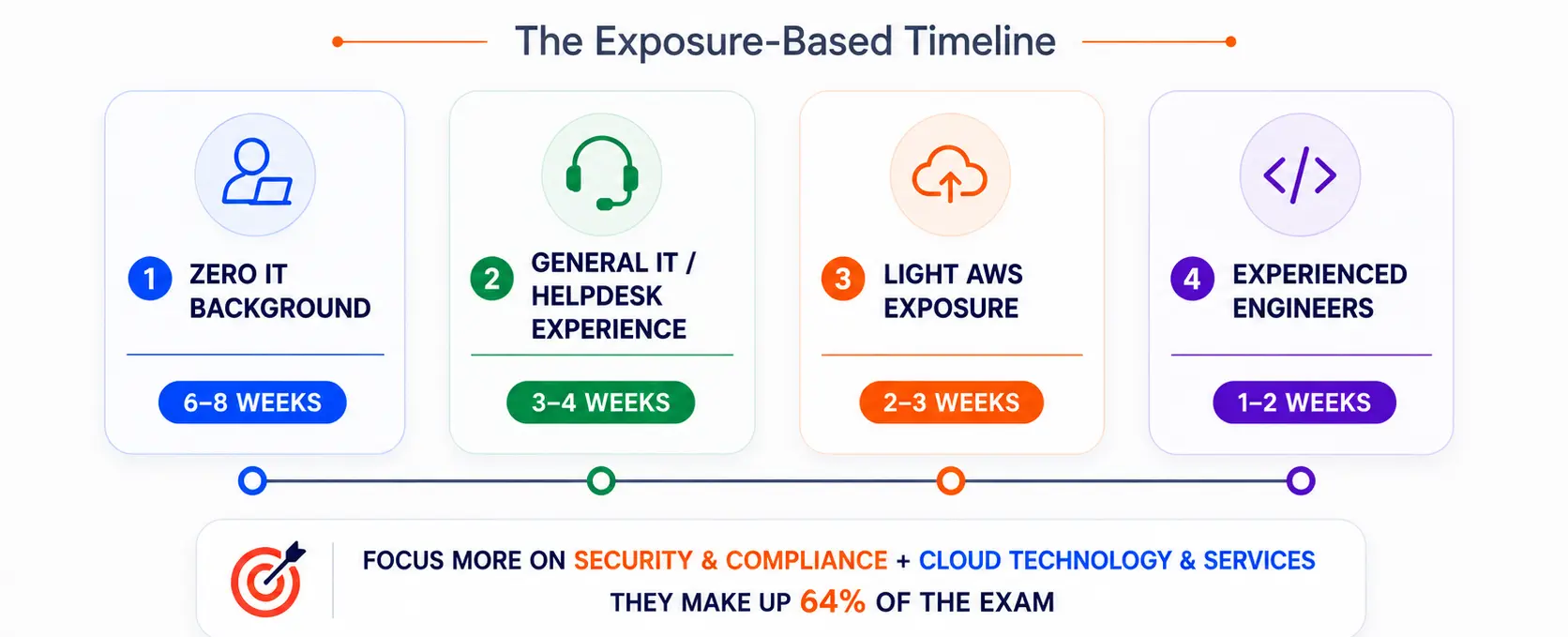
Generic study plans tell everyone to study for “4-6 weeks,” regardless of background—like telling every runner to train for a marathon the same way, whether they’ve run for years or never run at all. Here’s a more honest framework, based on your actual starting point.
Zero IT background: Budget 6–8 weeks. Spend the first two weeks on foundational concepts—what a server, IP address, and network actually are—before touching AWS-specific material. Skipping this step is the most common reason non-technical candidates feel overwhelmed by Domain 3.
General IT or helpdesk experience: Budget 3–4 weeks. You already understand networking vocabulary; your gap is AWS-specific service knowledge and the AWS Shared Responsibility Model’s nuances.
Light AWS exposure (personal projects, a bootcamp, casual work use): Budget 2–3 weeks, with heavy emphasis on Billing, Pricing, and Support, since it’s the domain self-taught candidates skip most.
Experienced engineers pursuing resume completeness: Budget 1–2 weeks, focused almost entirely on AWS-specific terminology and support/billing tooling you may never have needed to touch directly.
Whichever bracket you fall into, the structure of your study time matters more than the total hours. A scattered 40 hours produces weaker retention than a focused 25 hours organized around the official domain weightings—concentrate proportionally more time on Security and Compliance and Cloud Technology and Services, since together they make up 64% of the exam.
If you’d rather follow a structured, instructor-built version of this approach instead of assembling your own study plan from scratch, Thinkcloudly’s AWS Cloud Practitioner certification training is organized around these exact domain weightings, with hands-on labs covering AWS IAM and the AWS Shared Responsibility Model in detail rather than treating them as flashcard topics.
What the AWS Cloud Practitioner Certification Costs in 2026
The official Cloud Practitioner Exam fee is $100 USD, set directly by AWS and unchanged for several years. You pay it once, at the time you schedule through Pearson VUE, whether you sit the exam online or at a physical test center. Fail, and you can retake it after a mandatory 14-day wait—a full $100 each time, with no cap on total attempts.
Here’s a realistic full-cost breakdown, since the exam fee alone rarely reflects what candidates spend:
|
Cost Component |
Typical Range |
Notes |
|
Exam fee (CLF-C02) |
$100 |
Fixed by AWS; identical online or in-person |
|
Self-paced course |
$0–$200 |
Free official AWS Skill Builder content exists; paid courses add structure |
|
Practice exams |
$0–$50 |
Often bundled with paid courses |
|
Optional Skill Builder subscription |
$29/month |
Unlocks gamified labs; not required to pass |
|
Retake (if needed) |
$100 per attempt |
After a mandatory 14-day wait |
For most candidates who prepare seriously and pass on the first attempt, total spend lands between $100 and $250—making the AWS Cloud Practitioner certification one of the most affordable credentials in tech relative to its career impact. Compare that to associate-level exams at $150 and professional-level exams at $300, and Cloud Practitioner remains, by a wide margin, the cheapest entry point on the entire AWS Certification Path.
Beyond Cloud Practitioner: Mapping Your Next Move on the AWS Certification Path
Passing this exam is rarely the end goal — it’s a checkpoint. Once you’ve earned the AWS Cloud Practitioner certification, your next move on the AWS Certification Path typically depends on your career direction:
- Aspiring architects and infrastructure generalists usually move toward Solutions Architect Associate, building directly on the Well-Architected Framework concepts introduced at the foundational level.
- Developers and engineers often head toward Developer Associate, going deeper into services like Lambda, DynamoDB, and deployment tooling that Cloud Practitioner only introduces at a surface level.
- Operations and security-minded professionals frequently choose SysOps Administrator Associate, which extends the AWS Cloud security and governance concepts touched on in Domain 3.
Whichever direction you choose, the 50% discount voucher you earn from passing the Cloud Practitioner Exam applies directly to your next attempt on the AWS Certification Path—a genuinely useful incentive to keep moving rather than letting one certification sit as a standalone achievement.
Common Mistakes That Sink Otherwise-Prepared AWS Cloud Practitioner Certification Candidates
A few patterns show up repeatedly among candidates who fail despite real preparation on their AWS Certification Path:
- Treating it like a memorization exercise. The exam rewards conceptual understanding—particularly around the AWS Shared Responsibility Model—over rote recall of service names.
- Ignoring the Billing, Pricing, and Support domain. It’s only 12% of the exam, but it’s also the domain candidates study least, making it a disproportionately easy place to lose points.
- Skipping identity fundamentals because they seem “too basic.” Access management questions appear throughout Domain 2 and resurface indirectly elsewhere on the exam.
- Studying services in isolation instead of by use case. The exam asks “which service solves this problem,” not “what does this service do.”
- Under-preparing for Domain 3’s breadth. It’s the largest domain by weight, covering compute, storage, database, networking, and AI/ML collectively. Breadth matters more than depth here.
If you want a guided way to avoid these specific traps rather than discovering them the hard way mid-exam, Thinkcloudly’s Cloud Practitioner CLF-C02 course is structured around exactly this failure pattern—weighting instructional time the same way AWS weights the exam, rather than spending equal time on every domain regardless of its actual scoring impact.
Building Real Skills Alongside the Certification
A certification on its own is a credential. A certification paired with a small portfolio of hands-on work is a hiring conversation. Before your exam — or shortly after — consider building a handful of small, demonstrable projects using AWS’s free tier: provision an EC2 instance, configure an S3 bucket with a lifecycle policy, set up an IAM user with a custom least-privilege policy, and document what you built. None of this is required for the Cloud Practitioner Exam itself, but it transforms “I passed a foundational exam” into “I passed a foundational exam and can show you three things I built,” which is a categorically stronger position when you’re applying for roles.
This is also where AWS Cloud Security stops being an abstract exam topic and becomes a skill you’ve actually practiced—configuring an IAM policy yourself teaches the principle of least privilege and the broader discipline of AWS Cloud Security far more durably than reading about it ever will.
Final Thoughts: Is the AWS Cloud Practitioner Certification Still Worth It in 2026?
For the right audience, yes — clearly. The AWS Cloud Practitioner certification remains the most accessible, lowest-cost, highest-leverage entry point into a cloud career, particularly for students, career changers, and IT professionals who need to demonstrate cloud literacy quickly and credibly. It won’t substitute for hands-on experience, and engineers already deep in AWS production environments may reasonably skip straight to Associate-level exams. But if you’re early in this journey, treat the Cloud Practitioner Exam as your starting checkpoint—not an obstacle to rush past—and everything that follows on the AWS Certification Path gets noticeably easier.
If you’d like a structured path rather than piecing together free resources on your own, Thinkcloudly’s AWS Cloud Practitioner certification course walks through every domain at the weighting AWS actually tests, with dedicated modules on AWS IAM, the AWS Shared Responsibility Model, and AWS Cloud Security so you’re not guessing which topics deserve your limited study time.