

Here’s a number that stopped me in my tracks when I first saw it: the global cloud computing market is on pace to cross the $1 trillion mark sometime in 2026, according to Synergy Research Group’s Q1 tracking data. AWS alone still controls roughly 30% of that spend. So when people ask me whether it’s still worth signing up for AWS training online in 2027, my honest answer is that the timing has never been better. I’ve spent the last four years testing AWS courses, sitting exams, and watching colleagues switch careers through AWS. This guide to the best AWS training online is everything I wish someone had told me before I spent my first paycheck on a bootcamp that wasn’t worth it.
Why Is AWS Training Online Still the Smartest Skill Bet of 2027?
Cloud budgets aren’t slowing down. Gartner’s Q1 2027 forecast puts public cloud end-user spending at roughly $850 billion for the year, a jump of more than 21% from 2025. A large share of that money is chasing people who can actually run a cloud environment, not just talk about one. At the same time, over 90% of companies are expected to hit an IT skills shortage this year, based on industry workforce tracking cited by multiple staffing research firms. That gap is exactly why AWS training online has become such a practical starting point rather than a “nice to have.” You don’t need a computer science degree, and you don’t need to relocate. You need a laptop, a study plan, and a realistic view of what AWS certifications actually test.
I want to be upfront about something most blogs won’t tell you: a course alone won’t get you hired. What moves the needle is pairing structured AWS online training with hands-on practice in a real AWS console, plus a certification that proves you can back up what’s on your resume.
AWS isn’t the only cloud platform worth learning, but it remains the default choice for most hiring managers, and the ecosystem goes deeper than most beginners expect. Whichever AWS certification course you eventually choose, make sure it treats the platform as a full career track, not a weekend hobby.
Best AWS Training Online in 2027: Top Options Compared
Before choosing, decide what you need most: a free start, exam-focused prep, or a structured program with labs and career support. Here’s how the main options compare.
AWS Training Option Best For: Hands-On Labs Certificate Path ThinkCloudly AWS Job Seeker‘s Package: Career changers who want structure, labs, and job prep paid Yes, guided CLF-C02 → SAA-C03 AWS Skill Builder (Cloud Practitioner Essentials) Complete beginners testing the waters: free limited CLF-C02AWS Skill Builder subscription Self-learners who want official labs Paid monthly. Yes, all levels. Udemy exam-prep courses Budget learners targeting one exam Low one-time MinimalSingle exam practice-test bundles (e.g., Tutorials Dojo) Final-stage exam readiness Low one-time No single exam
If you’re starting from zero, begin with free AWS Skill Builder content to confirm the cloud is right for you. Then move to a structured AWS course with a certificate and real labs once you’re committed.
AWS Certification Levels in 2027: Costs, Duration, and Who They’re For
AWS organizes its credentials into four tiers. The official AWS Certification pricing page confirms these are the standard 2027 rates. I’ve built this AWS certification cost table using the exam fees exactly as AWS lists them, because third-party estimates vary wildly, and I’d rather you budget with real numbers.
Certification Level Example Exam Fee (USD) Duration Best For Foundational Cloud Practitioner (CLF-C02) $10090 minutes Complete beginners, non-technical roles Foundational AI Practitioner (AIF-C01) $10090 minutes Beginners moving into AI and generative AI roles Associate Solutions Architect – Associate (SAA-C03) $150 130 minutes for IT professionals with 1+ year of hands-on exposure to professional solutions Architect – Professional (SAP-C02) $300180 minutes Senior architects, 2+ years of AWS experience Specialty Security and Networking Specialty exams: $300170–180 minutes Experts narrowing into one technical domain
Source: AWS Certification official FAQ page, 2026 pricing schedule.
A detail people overlook: once you pass any AWS exam, AWS gives you a 50% discount voucher for your next exam. That makes the true cost of stacking two or three certifications lower than it first appears.
Professional and specialty exams lean heavily on cloud operations scenarios like incident response, cost optimization, and multi-account governance. AWS wants certified professionals who can run AWS at scale, not just describe it in an interview.
Choosing the Right AWS Certification Path: 4 Things I Check Before Recommending a Course
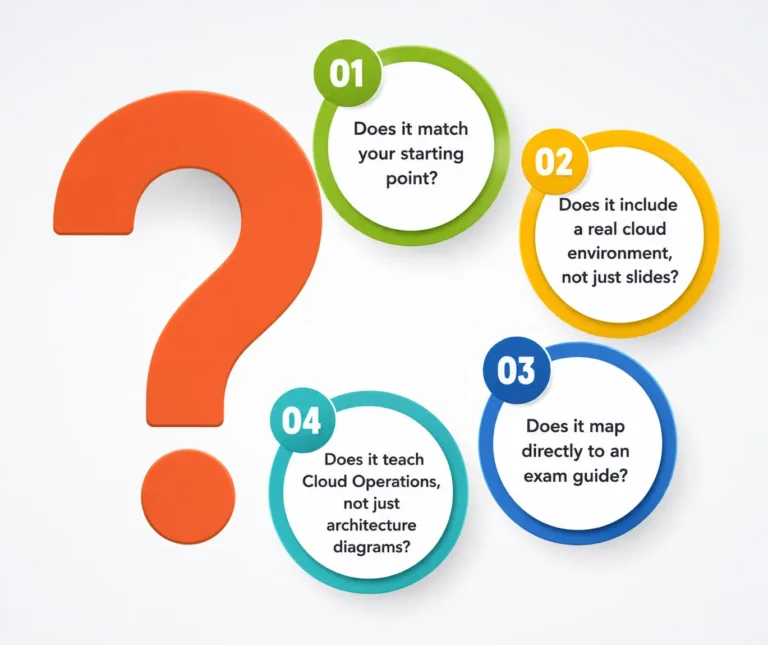
Every week someone messages me asking which AWS learning path to follow. I always run through the same four checkpoints before answering. This isn’t guesswork. It’s the filter I built after wasting money on a course that looked polished but taught nothing practical.
1. Does it match your starting point?
AWS training for beginners looks nothing like a path built for an experienced sysadmin. If you’ve never touched a cloud platform before, start at the foundational level. Jumping straight into an associate-level AWS certification course without that base is the single biggest reason I see people fail on their first attempt.
2. Does it include a real cloud environment, not just slides?
Watching videos teaches vocabulary. Building a virtual private cloud, launching an EC2 instance, and breaking (then fixing) an S3 bucket policy teaches the job. Any AWS training online worth paying for gives you sandboxed labs where mistakes don’t rack up a surprise bill.
3. Does it map directly to an exam guide?
Good cloud certification training follows AWS’s official exam guide domain by domain. If a course can’t tell you which of the four SAA-C03 domains a lesson maps to, it was probably built before the last exam refresh and may be teaching outdated services.
4. Does it teach cloud operations, not just architecture diagrams?
Passing an exam is one thing. Being useful in a live cloud environment on day one of a new job is another. Look for an AWS learning path that covers monitoring, cost control, and incident response. That unglamorous cloud operations work fills most entry-level job descriptions, and employers ask about it specifically in interviews, so don’t skip it while you’re studying.
My Own Path From On-Prem IT to Cloud Specialist
I didn’t start out anywhere near the cloud. My first job was resetting passwords and swapping hard drives for a mid-sized logistics firm, and AWS wasn’t even part of our vocabulary. What changed things was a slow, quiet realization: every vendor we worked with was migrating something to AWS, and I couldn’t keep up in meetings. So I enrolled in AWS training online on evenings and weekends. I started with the free AWS Cloud Practitioner material on Skill Builder, then moved into a paid Associate-level course once I understood the basics.
The exam itself humbled me. I failed my first Solutions Architect – Associate attempt because I’d memorized services instead of understanding the trade-offs between cost, availability, and performance. I retook it seven weeks later, after building three small projects in a real cloud environment, and passed comfortably. Eighteen months after that first failed attempt, I was working full-time as a cloud specialist. The certification badge on my profile was the single detail recruiters mentioned most in first calls. I’m not sharing this to sound inspirational. I’m sharing it because the gap between “watching tutorials” and “getting hired” is almost always hands-on practice, not talent.
Free vs Paid AWS Training: What’s Actually Worth Paying For
You do not need to spend thousands of dollars to pass your first AWS exam. You can learn AWS online for free using AWS Skill Builder’s digital courses, the official practice question sets, and the AWS Free Tier. New accounts now get up to $200 in credits on a free plan that lasts up to 6 months or until the credits run out. Those resources can carry a self-motivated learner through Cloud Practitioner and even the Associate level.
Where paid cloud certification training earns its price is time and structure. A well-built AWS certification course bundles video lessons, guided labs, and realistic practice exams, so you’re not piecing together a study plan from forum threads at midnight. It’s also where you’ll first practice real cloud operations tasks like setting billing alarms and reading CloudWatch dashboards, skills that rarely show up in free tutorials.
If you’re self-disciplined and already have IT fundamentals, free resources plus a $20–$40 practice-test bundle is genuinely enough. If you’re new to tech entirely, paying for structured training will likely save you a failed attempt, and a failed attempt costs you the full exam fee again.
Salary and Career Return After Completing an AWS Certification Course

The financial case is hard to ignore. Cloud engineer salaries averaged around $130,800 in the United States as of early 2027, according to workforce data aggregated by industry salary trackers. The U.S. Bureau of Labor Statistics projects double-digit growth in cloud-related occupations through the early 2030s. In the United Kingdom, professionals holding an AWS Solutions Architect credential report salaries in the £72,000–£85,000 range. Australian professionals in similar roles report AU$145,000–AU$165,000, based on 2027 job market compilations.
None of these numbers are guaranteed. Location, experience, and negotiation all matter. But they explain why so many career changers treat one AWS certification course as the highest-leverage investment they’ll make this year. Recruiters I talk to say the same thing every quarter: a certified cloud specialist who can point to real project work on AWS gets shortlisted faster than a generalist with a long resume and no proof to back it up.
Final Thoughts: Choosing the Best AWS Training Online
If you take one thing from this guide, let it be this: the best AWS training online is the one you pair with real practice, not a video you finish and forget. Pick an AWS certification path that matches where you’re starting from, use official AWS pricing so you budget accurately, and don’t skip the hands-on labs, no matter how tempting the shortcut looks. The certifications are demanding on purpose, and that’s exactly why employers still trust them in 2027. Whether you end up as a cloud specialist, a cloud operations engineer, or an architect running cloud computing for your company, the same rule applies: practice inside a real cloud environment before exam day, not after.
Ready to start? Explore ThinkCloudly’s AWS Solutions Architect Associate (SAA-C03) course or book a free career counselling session to map your AWS learning path.