
Ask any compliance officer, auditor, or GRC student what eats up most of their week, and the answer is rarely the actual rule-following. It’s the paperwork around the rule-following.
Compliance documentation is the unglamorous backbone of every audit, every certification, and every regulatory filing — yet most organizations still treat it as an afterthought, something to scramble together the week before an audit rather than a system built to run quietly in the background.
This guide breaks down what compliance documentation actually is, why it becomes such a headache, and — more usefully — how you can simplify it without cutting corners. Whether you’re a student studying governance, risk, and compliance (GRC) or someone who’s just been handed the task of organizing a company’s audit trail, this is written to be practical rather than theoretical.
What Is Compliance Documentation?
At its core, this is the recorded proof that an organization is doing what it says it’s doing. It includes policies, procedures, training records, risk assessments, audit logs, and the countless smaller artifacts that show a rule wasn’t just written down but actually followed.
Regulators, auditors, and even customers rely on this paper trail, because without it, compliance is just a claim rather than a fact.
Think of it this way: a policy says what should happen. Compliance documentation proves it did happen. That distinction matters enormously during audits, when reviewers aren’t interested in intentions—they’re interested in evidence.
Frameworks such as ISO/IEC 27001 and the NIST Cybersecurity Framework both treat these records as a first-class requirement, not a courtesy. Under regulations like the EU’s GDPR, the absence of proper records can turn a minor gap into a very expensive fine.
Why Does Compliance Documentation Get Complicated?
This rarely gets complicated because of one single big problem—it’s death by a thousand small ones. Most teams are juggling several regulatory frameworks at once: an industry-specific regulation, a client’s security questionnaire, an internal audit checklist, and maybe an ISO certification on top of all that.
Each one wants proof in a slightly different format, which means the same underlying evidence collection effort gets duplicated three or four times over for no real reason. Add to that the reality of policy management inside most companies: policies live in shared drives, get edited by whoever remembers to do it, and rarely get version-controlled properly.
When an auditor asks for the current access control policy, someone has to dig through old email threads just to confirm which version is actually in force. Then there’s the missing habit of checking older files on any real schedule. Records get created once and forgotten until an audit forces a scramble.
By the time anyone actually looks, half the files reference systems that no longer exist or people who left the company two years ago. None of this happens because teams are careless. It happens because the whole exercise gets treated as a once-a-year event instead of an ongoing operational habit.
The Core Elements of a Compliance Program
Before simplifying anything, it helps to know what this paperwork is actually made of. Here’s a quick breakdown of the core categories most compliance programs need to maintain:
|
Element |
What It Covers |
Why It Matters |
|
Policies & Procedures |
Written rules governing behaviour, access, and data handling |
Sets the standard everything else is measured against |
|
Risk Assessments |
Identified risks, likelihood, impact, and mitigation plans |
Shows regulators and leadership where the gaps are |
|
Evidence & Records |
Logs, approvals, screenshots, training completions |
Proves policies are followed, not just written |
|
Audit Trails |
Change history for systems, access, and documents |
Demonstrates accountability over time |
|
Compliance Reports |
Status summaries submitted to regulators or leadership |
Communicates where things stand, clearly and quickly |
Each row above feeds into the next one. Thin evidence collection produces weak audit trails, and weak audit trails make compliance reporting feel like guesswork instead of fact.
Who Usually Owns This Work?
For students weighing a career in governance, risk, and compliance, it helps to know who actually touches this paper trail day to day, because the work rarely sits with one person alone.
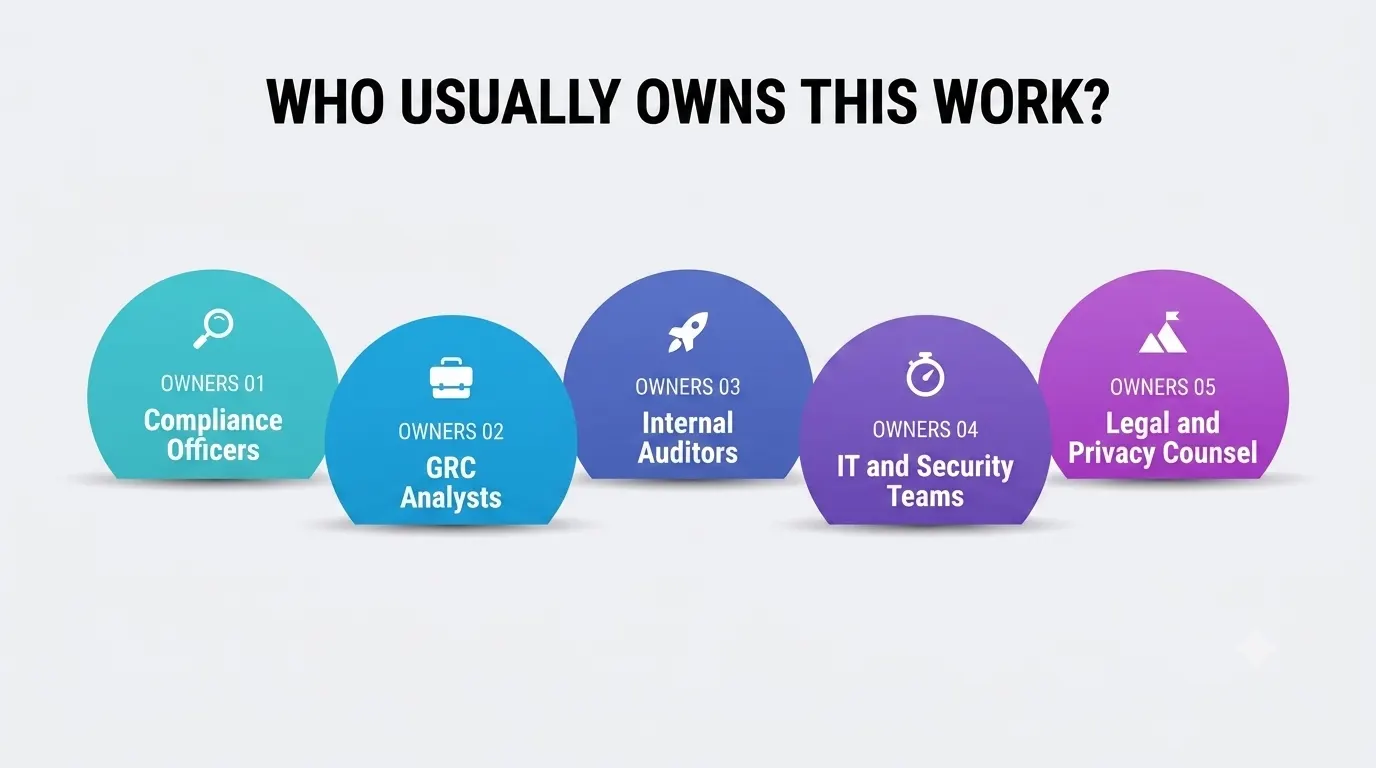
- Compliance officers set the overall program, decide which frameworks apply, and answer to leadership and regulators when questions come up.
- GRC analysts handle the day-to-day grind—tracking policy versions, chasing sign-offs, and keeping the control matrix current.
- Internal auditors test whether the paper trail actually matches reality, flagging gaps before an external reviewer ever sees them.
- IT and security teams generate a huge share of the underlying proof, since so many controls live inside systems and logs rather than written policies.
- Legal and privacy counsel interpret ambiguous regulatory language and confirm that internal records genuinely satisfy what the law requires.
None of these roles work well in isolation. The organizations that stay audit-ready year-round are usually the ones where these groups share a single, well-maintained system instead of each keeping their own private version of the truth.
Step-by-Step: How to Simplify the Process
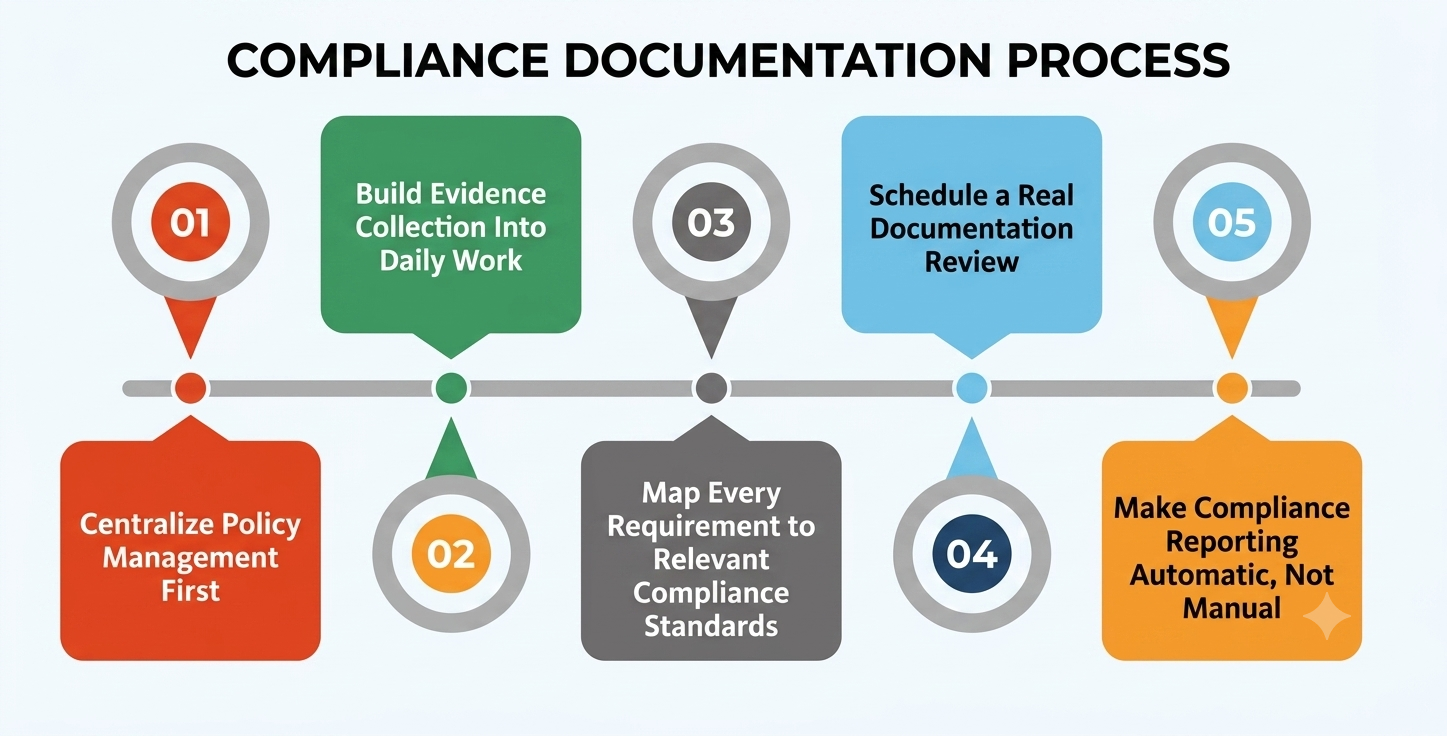
1. Centralize Policy Management First
The single biggest lever for simplifying things is fixing policy management before anything else. If policies live in a dozen different folders with no owner and no review date, everything downstream—the proof you gather, the reports you file, and the audits you face—inherits that same chaos.
Start by creating one source of truth: a single repository where every policy has a named owner, a version number, and a scheduled review date. Retire duplicate or outdated versions immediately instead of letting them linger next to the current one.
Good policy management isn’t about writing more policies; it’s about making the ones you already have easy to find, easy to trust, and easy to update. Students entering GRC roles often assume the hard part is drafting policy language. In practice, the hard part is governance — deciding who owns a policy and when it gets revisited.
2. Build Evidence Collection Into Daily Work
Many teams only think about gathering proof once audit season arrives, and that’s exactly where things fall apart. Waiting until the last minute to gather screenshots, approval emails, and system logs guarantees a stressful scramble and gaps that are hard to explain later on.
Instead, bake evidence collection into workflows people already use. If a manager approves access inside a ticketing system, that approval is already evidence—capture it automatically rather than asking someone to re-document it by hand afterward.
Continuous, largely automated collection turns audits from a fire drill into a formality, because the proof has been quietly accumulating in the background the entire time.
3. Map Every Requirement to Relevant Compliance Standards
Not every regulation demands identical paperwork, but most compliance standards overlap far more than people expect. GDPR, HIPAA, SOC 2, and ISO 27001 all ask, in different words, for the same underlying proof: that you know your risks, that you’ve controlled access appropriately, and that you can show your work when asked.
Build a single control matrix that maps existing documents to each relevant compliance standard, instead of maintaining separate document sets for every regulation you fall under. One well-organized policy can often satisfy three or four compliance standards at once, which cuts duplicate work dramatically.
This is the step students preparing for GRC careers benefit most from understanding early: regulatory mapping, not blind rule-following, is what actually makes compliance scalable.
4. Schedule a Real Documentation Review
Compliance documentation decays quietly. A policy that was accurate eighteen months ago may now describe a tool nobody uses anymore or a process that changed after a reorganization. That’s why a scheduled documentation review — quarterly for high-risk policies, annually for everything else — matters more than trying to write a perfect document the first time around.
A documentation review doesn’t need to be exhaustive every single time. A quick pass to confirm the policy owner, the last update date, and whether the described process still matches reality catches most problems long before an auditor does. Treat this review as routine maintenance, not a once-a-year crisis response.
5. Make Compliance Reporting Automatic, Not Manual
The final piece is compliance reporting — turning all that organized evidence into something leadership and regulators can actually read at a glance. Manually compiling reports out of scattered spreadsheets is slow, error-prone, and usually where these efforts lose momentum entirely.
Where possible, connect the evidence repository to a reporting template or dashboard that can generate status summaries with minimal manual effort. Even a well-structured shared spreadsheet with clear formulas beats a fresh manual write-up every quarter.
Good compliance reporting should tell a story at a glance: what’s covered, what’s outstanding, and what needs attention next, without anyone having to reconstruct it from memory under deadline pressure.
Common Mistakes That Make Compliance Documentation Harder Than It Needs to Be
Even well-intentioned teams fall into a few predictable traps with this process:
- Treating it as a one-time project. This work isn’t a folder you fill once and forget—it needs upkeep, or it slowly turns into a liability instead of a safeguard.
- Delaying evidence gathering until crunch time. Reconstructing proof after the fact rarely holds up as well as real-time records, and reviewers can usually tell the difference.
- Assuming today’s rules will always be the only ones that apply. Businesses that expand into new markets or handle new types of data often discover new regulatory requirements now apply, and their records are already behind.
- Leaving policy management with no clear owner. If nobody is responsible for a policy, nobody notices when it quietly goes stale.
- Rebuilding reports from scratch every cycle, instead of maintaining a living template that only needs updating, not reinventing.
Tools and Habits That Actually Help
You don’t need expensive enterprise software to simplify this process, though it certainly helps at scale. A few habits and tools consistently make the biggest difference:
- A shared, permission-controlled repository — SharePoint, a structured Google Drive, or a dedicated GRC platform — so nobody is ever hunting for the “real” version of a policy.
- Automated evidence capture wherever existing systems allow it. Ticketing tools, identity platforms, and cloud consoles can often export logs directly instead of requiring manual screenshots for every request.
- A recurring calendar reminder tied to specific owners for documentation review, rather than a vague “someone should probably check this eventually.”
- A control matrix mapping documents to every compliance standard the organization is actually subject to, so updates happen once instead of five separate times.
- A reusable reporting template that turns raw records into readable output without starting from a blank page each quarter.
For students building toward this career, it’s worth noting that most of the heavy lifting here is process discipline, not exotic software. Learning to structure a control matrix, write a clear policy, and run a tidy audit trail in a spreadsheet will carry you further in an entry-level GRC role than familiarity with any single expensive platform.
Groups like ISACA regularly publish practical, field-tested guidance on structuring evidence requests during audits, which is genuinely worth reading if you’re building this process from scratch and want to see how experienced auditors think about it.
Bringing It All Together
This work will never be anyone’s favorite part of the job, but it doesn’t have to be the chaotic scramble most teams experience every audit cycle.
Keep policies organized under one clear owner, gather proof continuously instead of saving it for later, map what you have against every relevant compliance standard instead of duplicating it, schedule a genuine documentation review instead of an emergency one, and turn the reporting process into something largely automatic rather than manual.
Do those five things consistently, and it stops being a once-a-year crisis and starts being what it was always meant to be: quiet, reliable proof that an organization does what it says it does.
A Personal Note
I’ve sat through more audit-prep scrambles than I’d like to admit, and the pattern is always the same: teams that treat this process as a living system get through review calmly, while teams that treat it as an annual chore lose entire weeks to it, every single year, without fail. The fix was never fancier software—it was smaller, more consistent habits.
Reviewing one policy a week instead of two hundred in a panic. Capturing evidence as it happens instead of reconstructing it from memory a year later. Giving someone real ownership over how policies get managed instead of leaving it to whoever has time that week.
If there’s one thing worth taking from this piece, it’s that consistency pays off far more than a single frantic burst of effort right before a deadline.