
Every small business owner is already a risk manager, whether they’ve filed any paperwork to say so or not. The moment you extend credit to a customer, hire your first employee, or store a client’s email address on a laptop, you’ve taken on risk. The real question is whether you’re managing that risk on purpose or just hoping nothing bad happens before you get around to thinking about it.
That’s the entire idea behind small business risk management: instead of reacting to problems after they’ve already hit your bank account or your reputation, you build a repeatable process for spotting threats early, sizing them up honestly, and deciding in advance what you’ll do about each one. It sounds like something only large corporations need. It isn’t.
According to the U.S. Small Business Administration, a large share of the small businesses that fail do so because a risk they could have planned for—a lawsuit, a fire, a cash-flow gap, a data breach—caught them completely off guard.
This guide walks through what small business risk management actually looks like in practice: how to track and prioritize threats, why internal controls and basic security habits matter more than most owners realize, how to vet the vendors and tools you rely on, and how all of it adds up to a business that can take a hit and keep going.
It’s written for working owners, but it’s just as useful if you’re a student trying to understand how risk actually gets managed outside a textbook definition.
What Is Small Business Risk Management?
At its core, small business risk management is a four-step cycle: identify, assess, control, and monitor. You identify the things that could disrupt your business—a key supplier going under, a ransomware attack, an employee lawsuit, or a sudden spike in raw material costs.
You assess each one by asking two simple questions: how likely is this, and how badly would it hurt if it actually happened? You put controls in place to reduce the odds or soften the impact. And then you monitor, because risks change as your business grows, your industry shifts, and new threats emerge that didn’t exist last year.
Small business risk management isn’t about eliminating every risk—that’s impossible, and honestly, undesirable. Growth requires taking on some risk. The goal is making sure the risks you carry are the ones you chose on purpose, not the ones that quietly snuck up on you while you were busy running the business.
Why Small Business Risk Management Matters More Than You Think
Small businesses operate with thinner margins and fewer safety nets than large corporations. A single lawsuit, a single week of unplanned downtime, or one stolen customer database can be existential for a five-person company in a way it would never be for a company with a legal department and a dedicated security team on payroll.
That gap is exactly why small business risk management deserves real attention, not just a line item you’ll get to eventually. FDIC and SBA training materials built specifically for small business owners make this point directly: risk is the potential to experience loss or harm, and understanding it is treated as a core business skill, not an optional extra reserved for big companies with big budgets.
The payoff isn’t only about avoiding disaster, either. Businesses that manage risk well also tend to make sharper day-to-day decisions, because they’ve already thought through the downside of expansion, new hires, new markets, and new technology before committing real money to them.
The Main Types of Risk Small Businesses Face
Before you can manage anything, you need an honest map of what you’re actually managing. Most risks facing a small business fall into a handful of categories:
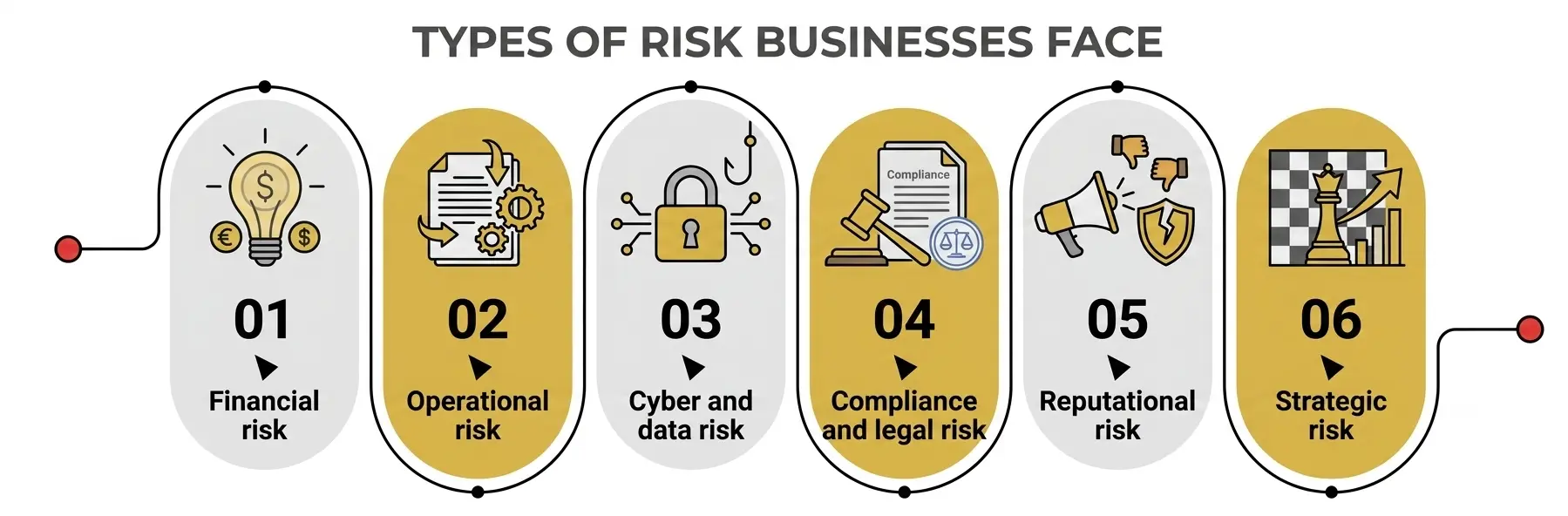
- Financial risk—cash-flow gaps, bad debt, currency swings, rising interest rates
- Operational risk—equipment failure, supply chain disruption, loss of a key employee
- Cyber and data risk—ransomware, phishing, stolen customer data, system outages
- Compliance and legal risk—missed regulations, contract disputes, employment claims
- Reputational risk—bad reviews, public complaints, a mistake that goes viral
- Strategic risk—a competitor undercutting you, a shift in customer demand, a bad expansion call
Not every category applies equally to every business. A solo consultant worries less about equipment failure and more about losing one big client; a restaurant worries about food safety and a fragile supply chain. Part of doing this well is being honest about which categories genuinely threaten your business, instead of copying a generic checklist written for a different kind of company.
Building a Risk Register
Once you’ve identified your risks, write them down. A risk register is simply a running list—usually a spreadsheet—of every risk you’ve identified, how likely it is, how bad the impact would be, and what you’re actually doing about it.
A basic risk register includes:
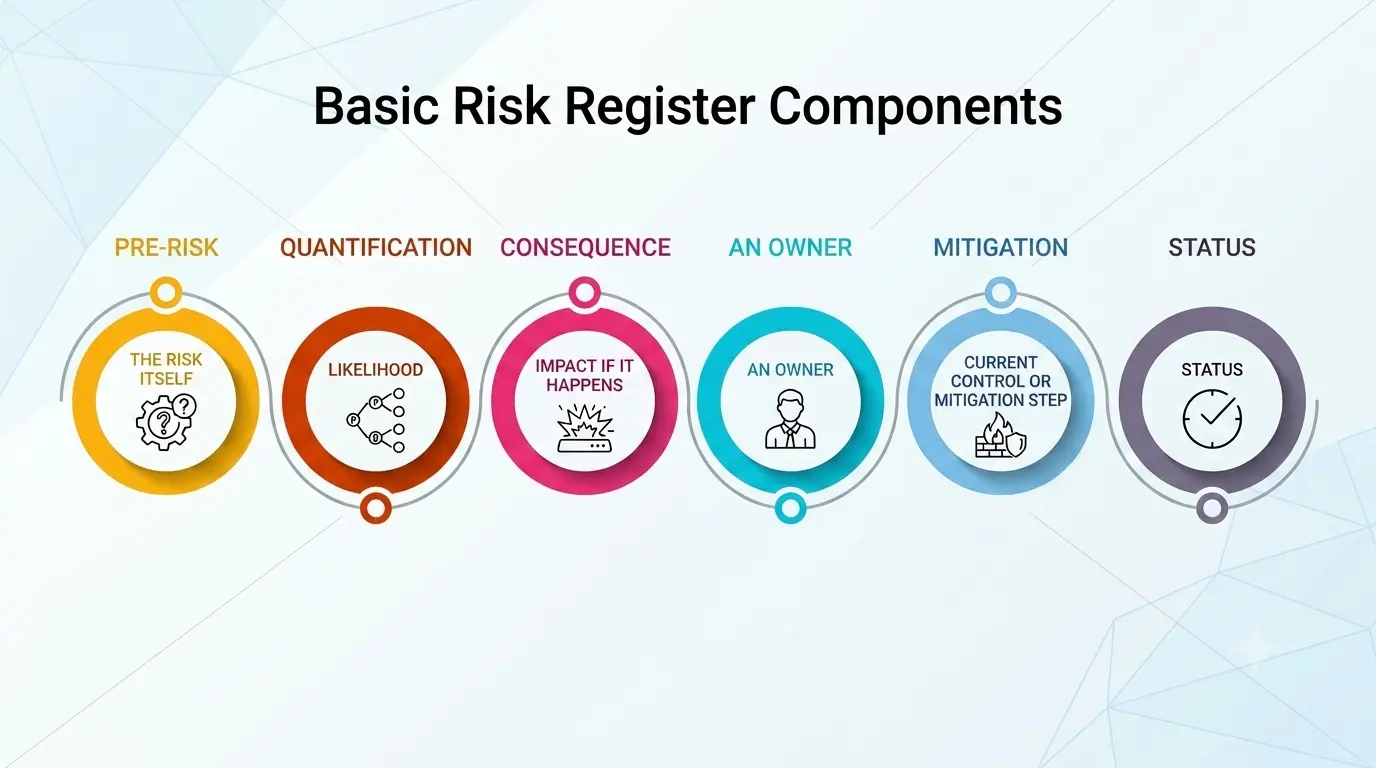
- The risk itself, described in plain language
- Likelihood (low, medium, high)
- Impact if it happens (low, medium, high)
- An owner—the specific person responsible for watching this risk
- The current control or mitigation step
- Status (open, monitored, closed)
You don’t need special software to start—a shared spreadsheet works fine for most small teams. What matters is that it actually gets reviewed, quarterly at minimum, rather than built once and forgotten in a folder nobody opens again. Treat it as a living document, and revisit it any time something changes: a new product line, a new vendor, or a new employee with access to sensitive systems.
Cybersecurity Compliance and Security Controls
For most small businesses today, cyber risk sits near the top of the list—and it’s the one most owners quietly underestimate. You don’t need to be a bank or a hospital to be a target; attackers often prefer small businesses precisely because they assume the security controls in place will be weaker than at a larger company.
Cybersecurity compliance means meeting the specific rules that apply to your business—data protection laws in your state, payment card industry standards if you take credit cards, or HIPAA if you handle health information. It isn’t optional once those rules apply to you, and ignoring cybersecurity compliance can mean fines stacked directly on top of the cost of the breach itself.
Practical security controls a small business can put in place without an enterprise budget:
- Multi-factor authentication on email and financial accounts
- Regular, tested backups stored separately from your main systems
- A written policy on who can access sensitive data
- Basic employee training on phishing and password hygiene
- Keeping software and systems patched and updated
The NIST Cybersecurity Framework 2.0 Small Business Quick-Start Guide was built specifically to help owners with no dedicated IT staff put real safeguards in place without needing a large security budget or specialist knowledge. Pairing that structure with your own tracking sheet turns this from a vague background worry into a specific set of tasks with an owner and a deadline. Getting it right early is far cheaper than fixing it after an incident.
Internal Controls That Actually Protect Your Business
Internal controls are the everyday checks and balances that keep honest people honest and catch mistakes before they turn into something expensive. They’re not about distrust—they’re about not putting any single person in a position where one bad day, or one bad decision, can seriously damage the business.
A short list of internal controls a small business can put in place:
- Separating who approves purchases from who pays the bills
- Requiring two signatures above a certain dollar threshold
- Reconciling bank statements monthly, by someone who doesn’t also make deposits
- Restricting who can edit financial records after they’re entered
- Physically securing cash, inventory, and sensitive documents
The COSO Internal Control framework, the standard reference most auditors and accountants use, breaks strong internal control down into five components: control environment, risk assessment, control activities, information and communication, and monitoring.
You don’t need to adopt the entire framework to benefit from it—picking even two or three controls from that list and applying them consistently puts most small businesses well ahead of where they started.
Weak controls are also how most small businesses discover fraud—after it has already cost them tens of thousands of dollars.
Vendor Risk Assessment: Don’t Forget Third Parties
Your risk doesn’t stop at your own front door. Every vendor, contractor, or software tool you rely on brings its own risk into your business too—which is exactly why checking them matters, even for a five-person company with a short vendor list.
A vendor risk assessment is the process of checking a supplier or service provider before and after you start working with them. Do they handle data securely? Are they financially stable enough to still be around next year? Do they have their own backup and continuity plans?
A payroll processor with weak security, a cloud storage vendor with no backup plan, or a sole supplier for a critical part can all become your problem overnight if something goes wrong on their end.
You don’t need a formal audit team to run a basic assessment. A short questionnaire covering data handling, insurance coverage, financial stability, and what happens if they can’t deliver covers most of what a small business actually needs to vet a supplier.
According to UpGuard’s practical guide, well-managed assessments do more than help you avoid disaster—they also strengthen the vendor relationship itself and demonstrate real due diligence if a regulator or a major client ever asks.
Prioritize: run a full vendor risk assessment on the handful of vendors that touch your money, your data, or your ability to operate day to day. A lighter check is perfectly fine for the office coffee supplier.
Building Business Resilience
All of this work—tracking threats, staying compliant, tightening internal processes, and vetting the people you rely on—feeds into one larger goal: business resilience. That’s the ability to keep operating, or recover quickly, when something disruptive actually happens to your business.
Business resilience isn’t only disaster planning for hurricanes and fires, though that’s part of it. It also covers questions like, “What happens if your main supplier disappears overnight?” What’s the plan if your systems go down for three days? Who makes decisions if the owner is unreachable?
Ready.gov’s business continuity planning guidance, built by FEMA and the Department of Homeland Security, recommends organizing a small continuity team and writing down, in advance, how the business will keep critical functions running through a disruption.
The SBA’s Business Resilience Guide exists for exactly this reason: helping small business owners plan before, during, and after a disruption, rather than improvising in the moment it actually happens.
None of this requires a large budget to get there. It requires writing your plan down before you need it, testing it once a year, and making sure more than one person in the business knows where that plan actually lives.
How the Pieces Fit Together?
|
Step |
What It Involves |
Example Tool or Practice |
|
Identify |
List possible threats to the business. |
Team brainstorm, tracking sheet |
|
Assess |
Rate likelihood and impact of each risk |
Likelihood × impact scoring |
|
Control |
Reduce likelihood or soften impact. |
Security controls, internal controls |
|
Transfer |
Shift part of the risk to a third party. |
Insurance, contracts |
|
Monitor |
Review regularly and update the plan. |
Quarterly tracking review |
|
Recover |
Restore operations after an incident |
Business continuity plan |
Common Mistakes Small Businesses Make
A few patterns show up again and again when risk management is done badly at a small business:
- Treating it as a one-time project instead of an ongoing habit
- Buying insurance and assuming it covers everything—it usually doesn’t
- Skipping a vendor risk assessment for a “trusted” vendor who’s actually never been checked
- Letting the tracking sheet go stale after the first quarter
- Assuming cybersecurity compliance is only the IT department’s job, even when there isn’t one
Every one of these is fixable, and none of them require hiring a full risk department to fix.
How to Get Started This Week?
You don’t need a consultant to begin. A workable first pass at small business risk management can happen in a single afternoon:
- List your top ten risks in one sitting—don’t overthink it
- Turn that list into a basic risk register with likelihood and impact
- Pick the three risks that would hurt most and write one control for each
- Check whether your most critical vendors need a proper assessment
- Write down, in one page, what you’d do in the first twenty-four hours of a major disruption
None of it needs to be perfect. It needs to exist, and it needs to actually get reviewed.
A Personal Note
I’ve watched more small businesses get hurt by risks they’d already thought about—and then filed away and forgot—than by risks nobody ever saw coming. The businesses that hold up under real pressure usually aren’t the ones with the fanciest plan sitting in a binder.
They’re the ones that actually open the plan, update it, and treat small business risk management as a habit rather than a document collecting dust on a shelf. Start small, start a little messy, and revisit it often. That’s genuinely most of the secret.