
Nobody is making announcements. There are no dramatic press conferences, no industry-wide warnings, no headlines telling you that something fundamental has changed. And yet, if you look closely at what is happening inside tech companies right now, the signs are everywhere. Positions that used to open up every quarter are staying closed. Teams that used to grow are being quietly reorganized. Job postings go up, then disappear, and never come back.
The numbers are hard to ignore. The tech sector lost close to 80,000 roles in the first three months of 2026 alone. Roughly half of those losses trace back, directly or indirectly, to AI taking over work that humans used to do. This is not a prediction about what might happen. It is a description of what already has.
This piece lays out what is actually happening, without the hype in either direction. Which roles are losing ground and why? What is growing to take their place and what that work actually involves. And what someone sitting in an IT role today, or thinking about entering one, can realistically do to make sure they are on the right side of where things are heading.
Why This Is Happening Now?
There was a time, not long ago, when AI felt like something on the horizon. Companies talked about it in strategy meetings and five-year plans. It was always coming. Always almost here. In 2026, that waiting period is over. AI is not approaching anymore. It is already inside the building, already running, already doing work that people used to get paid to do.
Look at how software gets written today. Look at how a support ticket moves through a system or how a data report gets pulled together on a Monday morning. In most large organizations, AI is somewhere in that process. Not as an experiment. Not as a pilot program. As standard operating procedure.
The scale of what is shifting is genuinely difficult to get your head around. Researchers looking at labour markets across developed economies now broadly agree that more than half of all jobs will require meaningfully different skills within the next two to three years. Not eventually. Soon. And the gap between how fast that change is moving and how fast most training programs are responding to it is wide enough to fall through.
Here is the part that tends to get lost in the noise. AI has not marched in and cleared out entire workforces. That is not what is happening. What is happening is quieter and, in some ways, harder to see. Specific tasks are being hollowed out. Entry-level positions are drying up. The doors that used to be propped open for people just starting out in tech are closing, one by one, without much ceremony.
The IT Jobs That Are Shrinking
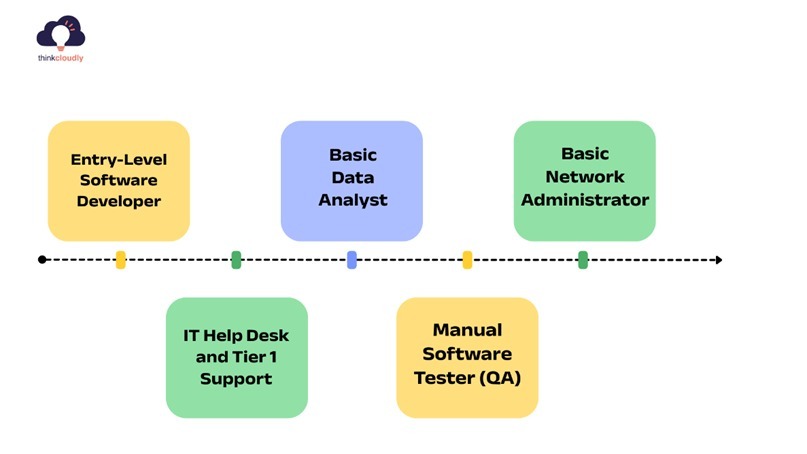
1. Entry-Level Software Developer
Let us start with the one nobody really wants to talk about. If you are a junior developer, or you were planning to become one, the entry point you were counting on is shrinking. Not disappearing in a headline-grabbing way. Shrinking, quietly, in the background, while everyone debates whether AI is overhyped.
The work that used to fill a junior developer’s first year—the renaming of components, the wiring up of basic connections between systems, the fixing of small and repeatable bugs, and the writing of code that follows a pattern someone else already established—that work is now something an AI tool handles in the time it takes to type a sentence. GitHub Copilot, Cursor, and tools like them are not experimental anymore.
What the hiring data from early 2026 shows is not subtle. Teams that used to bring in two or three junior developers at a time are restructuring around a single experienced engineer who directs AI output rather than writing everything from scratch. The ratio has flipped. Experience and judgment are in. Volume hiring of beginners is out. Some of the people closest to these tools, the ones who build them for a living, have said publicly that AI will likely handle most routine coding work within a handful of years.
The demand for senior engineers has not dropped. It has held. Because the work that actually requires a senior engineer is the work AI still cannot do. Reasoning about how an entire system should be structured. Anticipating where it will break under pressure. Knowing not just how to build something, but whether it should be built that way at all. An AI can produce a working function. What it cannot do is sit with the ambiguity of a hard architectural decision at three in the morning when something has gone wrong and the answer is not obvious.
2. IT Help Desk and Tier 1 Support
Think about what an IT support agent actually spends most of their day doing. Someone cannot log in. Someone’s printer is offline. Someone forgot their password again. Someone needs the same walkthrough they needed three months ago. These are not complex problems. They are repetitive ones. And repetition, it turns out, is exactly what AI is built for.
Chatbots and virtual agents are now handling a substantial portion of the queries that used to sit in a human agent’s queue. Not as a backup. Not as a first filter that eventually hands off to a person. In many organizations, the bot resolves the ticket entirely, logs it, and closes it without a human ever getting involved. If your average workday involves following the same decision tree you followed yesterday, and the day before that, the technology to replace that workflow already exists. In most places, it is already running.
That is why help desk roles keep appearing near the top of every serious analysis of jobs being wound down by automation. The volume of human-staffed positions at the entry level of IT support is contracting, and it is not contracting slowly.
What is left, though, is genuinely interesting work. The calls that do not fit any template. The user who has already tried everything and is losing patience. The situation that requires someone to actually think rather than follow a flowchart. The moment when the script runs out and a real human judgment call is the only thing that will move things forward is crucial. That is what remains. And the people who are good at that part, the part that was always harder to automate, are not going anywhere.
3. Basic Data Analyst
Most data analyst roles have always had two jobs hidden inside them. One is clerical. The other is intellectual. For a long time, both came bundled together in the same job description, and nobody thought too hard about where one ended and the other began.
The clerical half looks like this. Last week’s numbers get pulled from the same place they always get pulled from. They go into the same template they always go into. A short write-up follows, explaining the spike on Tuesday, the dip on Thursday, and the metric that leadership will probably ask about in the next all-hands. The whole thing gets sent before anyone arrives on Monday morning. Then the following week, it starts again.
That half of the job is being handled by software now. The tools built into most data platforms do not sit waiting for instructions. They surfaced the anomaly before you noticed it existed. They wrote the summary before you opened the document. They connect the numbers to the commentary without being asked. A task that used to justify a full-time role now runs quietly in the background of a platform subscription.
Labour market researchers have been consistent on this point for long enough that it no longer reads as a prediction. It reads as an observation. Analytical roles rank among the highest for overlap between daily human tasks and current AI capability. If the core of your working week is producing the same output from the same inputs on the same schedule, that core is under real pressure right now.
The other half of the job, the intellectual half, is a different story entirely. It is the part that begins before any data gets pulled. It is a judgment call about which question is actually worth answering. It is the ability to look at a number on a screen and understand which business decision it is connected to and why that matters today specifically.
It is the skill of walking into a room where nobody ran the analysis themselves, nobody wants to sit through a methodology explanation, and everyone needs to leave with enough understanding to make a real call. That is not something a tool does. That is something a person does. And right now, the analysts building that version of their skillset are the ones the market is moving toward.
4. Manual Software Tester (QA)
Picture a QA tester whose primary responsibility is checking whether the same features still work after each release. The login button. The checkout flow. The form that submits data to the database. Every two weeks, like clockwork, the same battery of tests runs through the same sequence of steps. If something breaks, it gets flagged.
That rhythm is exactly what automated testing tools were built to absorb. And over the past few years, they have gotten very good at it. The checks that once required a dedicated team to sit down and run manually can now execute continuously, around the clock, without anyone scheduling them or reading the output unless something actually fails. The tools do not get tired. They do not skip steps on a Friday afternoon. They do not need a handover document when someone leaves the team.
What this means practically is that the large manual testing departments that used to be a standard part of any serious software company are getting leaner. Not because quality matters less, but because the portion of quality work that was always repetitive and rule-based no longer needs a human to perform it. The people who remain are the ones working on the problems the automated tools surface but cannot solve and the edge cases no script thought to cover in the first place.
5. Basic Network Administrator
Picture the person whose job is to make sure the network is up, the traffic is flowing, and nothing unusual is happening on the dashboard. Check in the morning. Check after lunch. Flag anything that looks wrong. Run the standard configuration when a new device gets added. Repeat.
That pattern of work is exactly what AI-powered network management tools were built for. They do not check in twice a day. They watch continuously, around the clock, flagging anomalies the moment they appear, rerouting traffic before a human would have noticed the problem, and logging everything without being asked. The monitoring layer of network administration, the part that used to justify a full-time role at many organizations, is now largely handled by software running in the background.
What is contracting as a result is the volume of entry-level positions built around routine observation and standard maintenance. What is not contracting is the need for people who understand what to do when the automated system surfaces something it cannot resolve on its own. Complex infrastructure decisions, security architecture, and the judgment calls that come with designing a network that has to stay reliable under real pressure still require a person. The tools can watch. They cannot think.
What Is Growing to Replace These Roles
Here is the part that gets less airtime: AI is genuinely creating new jobs, and demand for people with the right skills is surging.
Job postings tied to AI skills more than doubled in the US in a single year. Four of the five fastest-growing job titles on LinkedIn right now are AI-related. And people with hands-on AI expertise are earning, on average, more than half again what their peers without it take home.
That is not a footnote. That is a fundamental shift in what the market is willing to pay for.
|
Role |
Growth signal |
Why demand is rising |
What AI cannot do here |
Where to start |
|
AI and ML engineer (Building and deploying AI systems) |
Growing fast |
Deploy it. Monitor it. Use it responsibly. |
Knowing when AI is wrong. Knowing when to stop. |
Python, cloud ML platforms, model deployment fundamentals |
|
Prompt engineer (Human and AI interaction design) |
Emerging fast |
Without the right direction, AI just confidently gets it wrong. |
Reading what people mean, not just what they type. |
Hands-on practice with AI tools, technical writing |
|
Cybersecurity analyst (Threat detection and response) |
Growing fast |
Threats evolve daily. Humans are still the last line. |
Pressure decisions no algorithm can make alone. |
CompTIA Security+, ethical hacking courses, network fundamentals |
|
AI product manager (Strategy for AI-powered products) |
Emerging fast |
Tech that works for people, not just on paper. |
AI can build it. Humans decide if it should. |
Product management basics, AI literacy, user research skills |
|
Cloud architect (Infrastructure design and security) |
Consistent Demand |
Bigger AI means bigger infrastructure. Someone has to build it. |
Designing systems that hold when everything else breaks. |
AWS, Azure, or Google Cloud certifications, infrastructure as code |
|
Data engineer (Pipelines and data infrastructure) |
Consistent Demand |
No clean data, no working AI. |
Dirty data breaks AI. Someone has to fix the pipes. |
SQL, Python, Apache Spark, cloud data platforms |
The Bigger Picture
Before this starts to feel overwhelming, it is worth slowing down for a moment and looking at what history actually tells us about moments like this one.
Every major wave of technology has arrived with predictions of mass displacement. When ATMs rolled out across the banking sector, the near-universal assumption was that bank tellers were finished. They were not. The role changed, the headcount shifted, and tellers moved toward the parts of the job a machine could not handle. When early diagnostic AI tools started outperforming doctors on specific imaging tasks, radiologists were written off in certain corners of the medical world. They are still here, still essential, still doing work that the technology could not fully absorb.
This is not a coincidence. People who study how labour markets respond to technological change have noted, consistently, that our predictions tend to be more dramatic than the outcomes. The reality of how work changes is usually slower, messier, and more uneven than the forecasts suggest. Recent patterns in AI adoption reinforce that. A meaningful number of companies that moved aggressively to automate certain tasks have since pulled some of that work back to human employees. Not because the technology stopped working, but because the gap between what AI can do in a controlled setting and what it can do reliably inside a real organization turned out to be wider than expected.
None of this softens the disruption into something harmless. It is real, it is happening, and sitting still is not a reasonable response to it. But the shape of what is happening is transformation, not elimination. Most of the roles that exist today will still exist in some form. They will just require different things from the people doing them.
The shift that is already underway is less about jobs disappearing and more about the gap widening between people who know how to work alongside AI and people who do not. That gap is showing up in hiring decisions, in salary data, and in which teams inside organizations are getting more resources and which are getting less. Demand for people who understand how to use these tools, direct them, and build on top of them has moved faster than almost any other skill category in recent memory. That is not a reason for alarm. It is a reason to move. And the window for moving is still open, though it will not stay that way indefinitely.
What You Can Do Right Now
There’s no need to become an AI researcher to stay relevant in tech. Here are practical, grounded starting points:
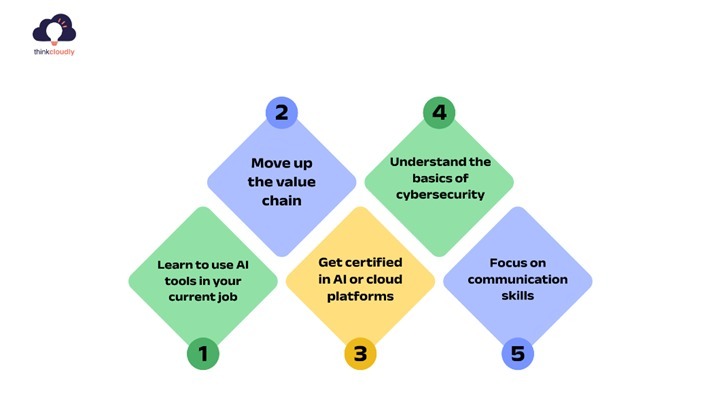
- Learn to use AI tools in your current job: The people who get cut first are the ones who resist AI. The ones who stay are the ones who become productive with it.
- Move up the value chain: If your current role involves mostly repetitive tasks, invest in skills that require judgment, creativity, or complex problem-solving.
- Get certified in AI or cloud platforms: AWS, Google Cloud, and Microsoft Azure all offer accessible certifications. Roles with cloud-specific AI certifications earn 20 to 25% more on average.
- Understand the basics of cybersecurity: It is one of the most stable and growing areas in tech, and foundational knowledge adds value to almost any IT role.
- Focus on communication skills: The most in-demand tech professionals in 2026 are not just technical. They can explain complex ideas to non-technical people and connect technology decisions to business outcomes.
Sources and References
- BCG: AI Will Reshape More Jobs Than It Replaces (2026)
- Medium / MyDataSchool: 5 IT Jobs AI Will Replace, and 5 It Will Not (2026)
- SNHU: What Jobs Will AI Replace?
- Washington Post: Jobs Most Affected by AI Automation (2026)
- Charter Global: Tech Careers in 2026
- Lorien Global: Emerging AI Jobs in Demand (2026)
- HeroHunt.ai: Fastest Growing AI Roles in 2026
- Built In: What Jobs Will AI Replace?
- Masai School: Which Tech Jobs Won’t Be Replaced by AI in 2026?
- Rest of World: Tech Jobs in 2026