
Right now, companies hiring for AI developer and AI engineer roles are not short of applicants. Knowing that a tool like ChatGPT exists is not enough. Being able to explain the architecture behind it, the problems it solves, the ways it fails, and the techniques used to make it more reliable: that is what separates the freshers who get offers from the ones who get polite rejection emails.
This blog is built around the AI interview questions that come up most consistently in real hiring conversations for fresher-level roles. Every answer is written in plain, human language, the kind you can actually reproduce under pressure rather than the kind that sounds right when you read it but disappears the moment someone asks a follow-up.
Whether you are working through AI ML courses, following an AI learning roadmap, or preparing to interview for your first position in AI development, understanding the generative AI concepts and AI core concepts in this guide gives you a genuine edge in the conversations that matter.
Why Generative AI Interview Questions Matter for Freshers
The bar for AI engineering roles has shifted considerably. Knowing how to use AI tools is no longer enough. Interviewers want to know if you understand how they actually work, what goes wrong, and how you would fix it.
Most freshers handle the first question fine. The follow-up is where genuine understanding separates itself from borrowed vocabulary.
The questions in this guide cover what actually comes up in real interviews. Go through each one with the intention of truly understanding it, not memorising it. If an interviewer takes the conversation somewhere unexpected, you want to follow them there comfortably.
Question 1: What is Generative AI and how is it different from traditional AI?
Answer: Traditional AI systems were built to choose from existing possibilities, classifying data, predicting outcomes, or selecting from predefined options. A spam filter, a recommendation engine, and a diagnostic tool. All of them pick from a range established at the time they were built.
Generative AI creates something entirely new. It learns the deep patterns of its training data well enough to produce original text, images, audio, and code that never existed before. One system recognizes. The other creates. That distinction is the right place to start when understanding how modern AI actually works.
Question 2: What is a Large Language Model? How does it work ?
Answer: A Large Language Model is a neural network trained on a staggering amount of text, books, articles, code, forums, and more, developing a statistical understanding of how language works across all of it.
When you send a prompt, the model does not retrieve a pre-written answer. It generates a response one token at a time, each prediction shaped by everything said before it.
The word “large” describes something real. Billions of parameters, fine-tuned through enormous training data, give the model its ability to handle complex tasks, maintain coherent context, and produce responses that feel genuinely useful rather than hollow.
Question 3: What is a Transformer architecture, and why is it important?
Answer: Nearly every major language model today traces back to a single 2017 paper by Google researchers titled Attention Is All You Need. The breakthrough it introduced was the attention mechanism. Rather than processing text word by word, the model looks at an entire sequence at once, weighing how every word relates to every other word.
Earlier architectures lost context over long passages because they read sequentially. Attention solved that directly. Without the Transformer, modern LLMs would not exist. For anyone building in the AI space, this architecture is not optional background knowledge. Everything else in generative AI builds on top of it.
Question 4: What is the difference between a foundation model and a fine-tuned model?
Answer: A foundation model is trained on vast, diverse data to build general capability across many tasks. Summarizing, translating, answering questions, and writing code. GPT-4, Claude, and Gemini all fall here, built for breadth rather than depth in any single area.
A fine-tuned model takes that generalist and gives it a specialty. A customer service team might fine-tune their own conversation history. A hospital on clinical notes. A law firm’s legal documents.
The efficiency is what makes fine-tuning genuinely valuable. You are adjusting a model that already understands language, requiring far less data and computing power than starting from scratch.
Question 5: What do you understand by “prompt engineering,” and why does it matter?
Answer: Prompt engineering is the practice of crafting inputs to a generative AI model in a way that consistently produces something useful back, accurate answers, the right tone, and the right format.
The same model can produce wildly different responses depending on how a request is phrased. A vague question gets a vague answer. Clear, well-structured prompts produce noticeably better results. The model has not changed. The framing has.
For anyone building with AI seriously, this is a practical skill with real consequences. Getting prompts right is one of the most direct levers you have for making generative AI reliably useful.
Question 6: What is hallucination in generative AI and why does it happen?
Answer: Hallucination is when a generative AI model produces something confidently, fluently, and completely wrong. It might cite a paper that does not exist or describe an event that never happened.
This happens because these models are not fact checkers. They predict what text should logically come next based on training patterns. When solid information is unavailable, the model fills the gap with whatever sounds statistically reasonable.
For anyone building AI systems, this cannot be treated as a minor quirk. Undetected hallucinations in live products cause real harm, and designing systems that account for them is simply part of the job.
Question 7: What is Retrieval Augmented Generation (RAG)?
Answer: RAG, which stands for Retrieval-Augmented Generation, is an approach that stops a generative AI model from working purely off memory. Instead of relying entirely on what it absorbed during training, the system pulls in relevant documents or data from an external source at the moment a query comes in and hands that information to the model as part of the context it uses to build its response.
The practical difference this makes is significant. Rather than giving you an answer shaped only by whatever the model happened to learn before its training cut off, RAG grounds the response in information that is current, specific, or in some cases entirely proprietary to your organization. It is the difference between a model guessing from old knowledge and a model actually working with the right material in front of it.
Answer 8: Differentiate between supervised, unsupervised, and reinforcement learning?
Answer: Machine learning systems learn in fundamentally different ways depending on the task at hand.
Supervised learning trains on labelled data. The model makes predictions, compares them against correct answers, and keeps adjusting until performance improves consistently.
Unsupervised learning removes the labels entirely. The model receives raw data and figures out patterns and structure without any guidance on what to look for.
Reinforcement learning teaches through experience and feedback. The model tries, receives rewards or penalties, and gradually steers toward better outcomes. Applied to language models through RLHF, human evaluators shape the model toward responses people actually find helpful and trustworthy.
Each approach serves a different purpose, and modern AI systems often combine all three.
Question 9: What is tokenization, and why does it matter in LLMs?
Answer: Before a language model does anything with text, that text gets broken down into smaller units called tokens. These are not simply words. A token can be a word fragment, punctuation mark, or special character, and the same sentence can produce different token counts across different models.
Three things make this worth understanding properly. The model works entirely with tokens, never raw text. The context window, which sets the limit on how much the model considers at once, is measured in tokens. And API providers charge by the token, making tokenization directly relevant to both how you build and what you spend.
Question 10: What is RLHF and how does it improve language models?
Answer: RLHF stands for Reinforcement Learning from Human Feedback, and it is what transforms a technically capable language model into one that actually feels good to use.
The process works in stages. Human raters rank different model responses by quality. Those rankings train a separate reward model that learns to predict what humans prefer. That reward model then guides the main model through reinforcement learning, continuously pushing it toward better outputs.
The result is significant. A model can be statistically impressive and still feel frustrating to interact with. RLHF closes that gap, and understanding it clearly is genuinely valuable for any AI engineering role.
Question 11: What is a diffusion model, and how does it generate images?
Answer: Diffusion models power most modern image generation tools, including Stable Diffusion and DALL-E 3.
The process works in two phases.
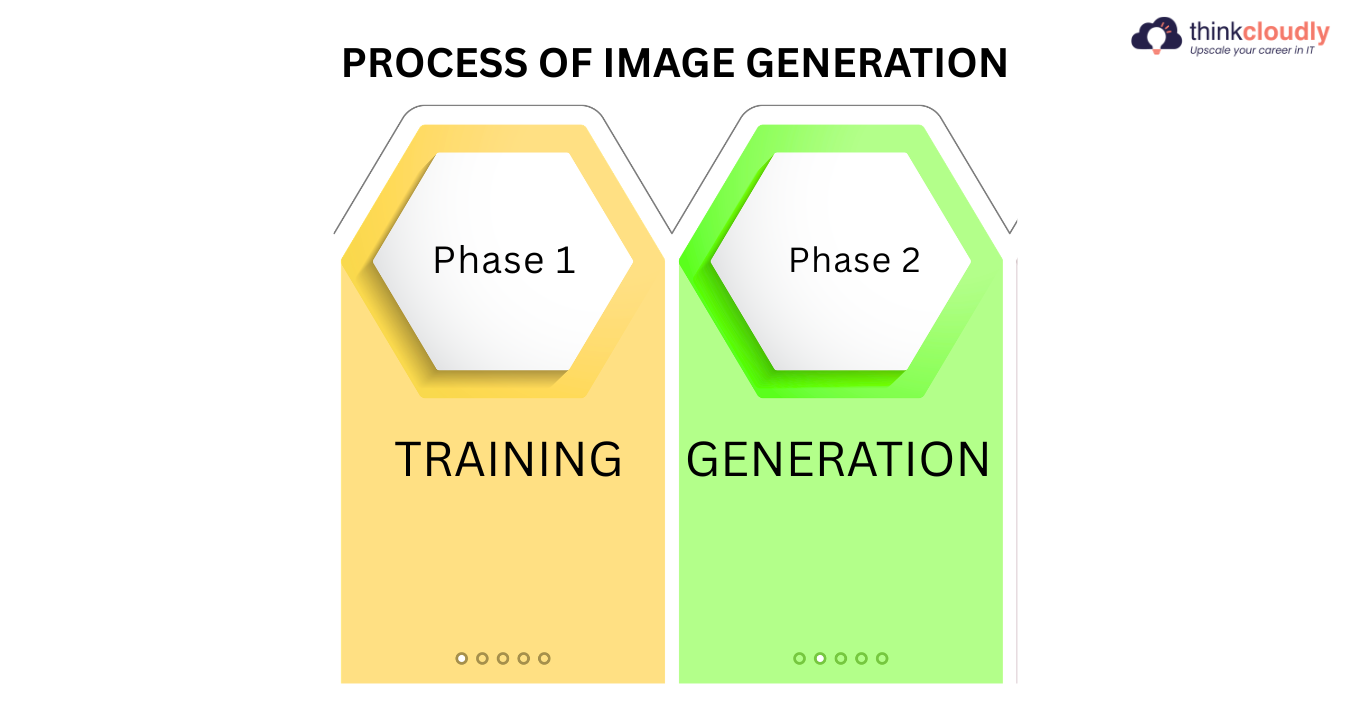
During training, the model watches noise get added to a real image step by step until nothing recognizable remains. It then learns to reverse that process, starting from pure noise and reconstructing something visually coherent.
When you provide a text prompt, the model starts with random noise and iteratively removes it, guided by your description, until a matching image emerges.
What makes this genuinely interesting is that learning to denoise effectively requires building a deep understanding of how visual reality actually looks.
Ques 12: Differentiate between GPT and BERT.
Answer: GPT and BERT are both Transformer-based models, but they were built for different purposes.
GPT is a decoder-only model trained to predict the next token in a sequence. That single objective makes it naturally powerful for generating text, answering questions, and writing code.
BERT takes a different approach, predicting masked words within a sequence by reading in both directions simultaneously. That bidirectional understanding gives it richer contextual awareness.
In practice, GPT excels at generating new content while BERT excels at understanding existing content, making it particularly strong for sentiment analysis, classification, and extracting answers from passages.
Question 13: What is vector embedding, and why is it used in AI systems?
Answer: A vector embedding translates text, images, or other content into lists of numbers that machine learning models can actually work with. Models cannot process raw text directly, so everything has to become numerical first.
What makes embeddings genuinely useful is semantic search. Traditional keyword search finds what you typed, not what you meant. Embeddings find content that is relevant regardless of the specific words used.
In RAG systems, this powers the retrieval step directly. A user query gets converted into an embedding, and the system finds the closest matching documents in the database, giving the model real, relevant context to work from.
Answer 14: What are the main ethical concerns around generative AI?
Answer: Ethical concerns around generative AI cluster around four core areas.
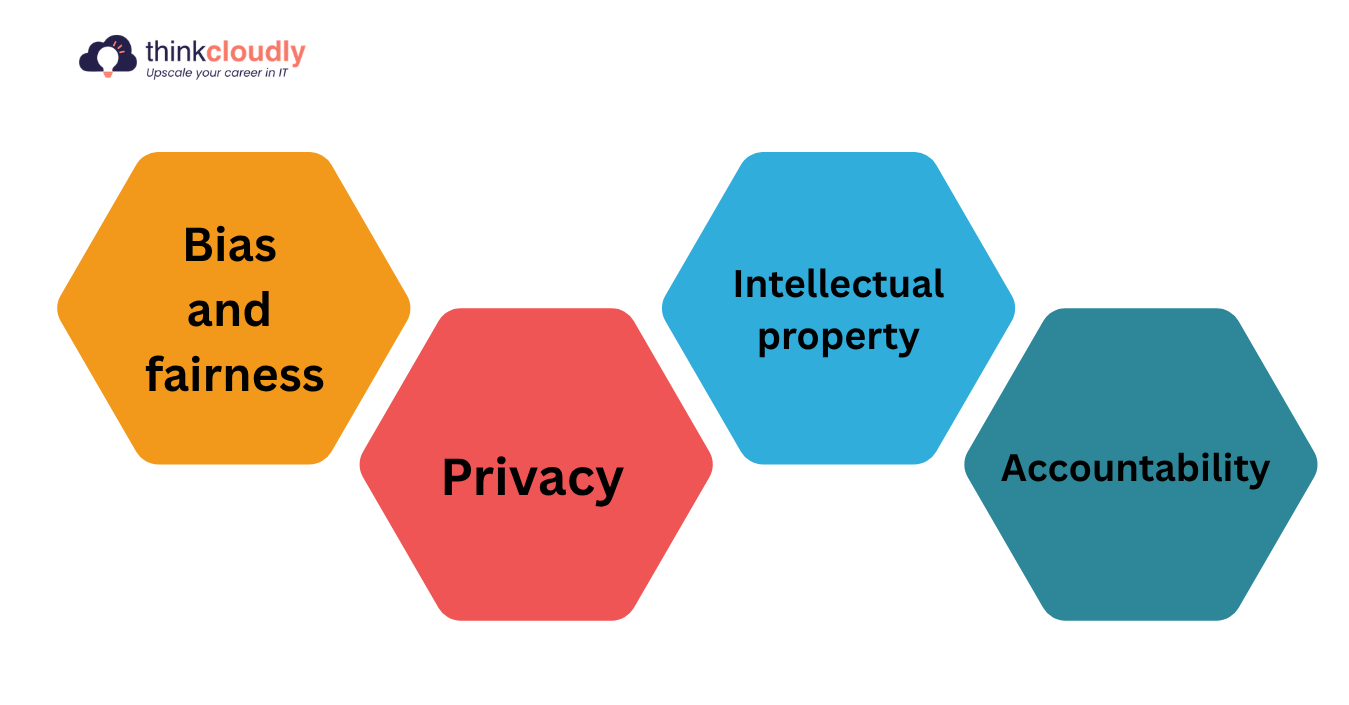
Bias and fairness: models trained on skewed data reproduce and often amplify those biases in real world decisions.
Privacy: models trained on personal data can unintentionally reproduce that information, raising serious consent and data protection questions.
Intellectual property: the legal status of content generated from copyrighted training data remains genuinely unsettled.
Accountability: when an AI system causes harm, responsibility between developers, deployers, and users remains unclear.
Understanding these concerns is not a formality: It is what separates developers who build things carefully from those who simply build things fast.
Question 15: How would you detect and reduce hallucinations in a production AI system?
Answer:: Here is the thing about this question—most candidates either recite theory or say “use RAG” and stop there. Neither answer is what an interviewer is actually looking for. What they want to hear is that you understand hallucinations as a systems problem, not just a model quirk, and that you have thought about both sides: catching them and preventing them.
Detection:
- Ground outputs against retrieved documents and flag anything the model asserts that has no source
- Route outputs through a second, smaller model whose only job is fact-checking the first one’s claims
- Log confidence scores and surface low-certainty responses for human review before they reach users
Reduction approaches:
- Add explicit instructions in the system prompt telling the model to say “I don’t know” rather than guess—this alone cuts a surprising amount of confident nonsense
- Constrain the model to answer only from provided context, not from general memory
- Lower the temperature setting—higher values make the model more creative, which in this context means more wrong
- Fine-tune on corrected examples so the model learns from its own past failures
The honest answer is also the correct one: hallucinations cannot be fully eliminated in current models. The goal in production is not a zero-hallucination system. It is a system where hallucinations get caught before they reach users.
Quick Reference: Generative AI Core Concepts at a Glance
Here is a quick reference covering the core concepts from this guide.
|
Concept |
What It Is | Why It Matters |
| Large Language Model (LLM) | Neural network trained on text at scale |
Foundation of most generative AI applications |
|
Transformer Architecture |
Attention-based neural network design | Enables LLMs to handle complex language tasks |
|
Prompt Engineering |
Designing inputs to get better outputs |
Directly affects production AI quality |
| Hallucination | Confident but factually incorrect output |
Critical risk in production deployments |
|
RAG |
Combining LLMs with external knowledge retrieval | Grounds model responses in current information. |
|
Fine-tuning |
Adapting a foundation model for specific tasks |
More efficient than training from scratch |
| RLHF | Aligning models with human preferences |
Reason modern LLMs feel helpful and safe |
|
Vector Embeddings |
Numerical representations of content | Enables semantic search and retrieval |
|
Diffusion Models |
Image generation through learned denoising |
Powers tools like Stable Diffusion and DALL-E |
| Tokenisation | Breaking text into processable units |
Affects context limits and API costs |
Conclusion
Preparing for AI interview questions as a fresher is less about memorising definitions and more about developing a genuine understanding of how generative AI systems work. The fifteen questions in this guide cover the generative AI concepts and AI core concepts that come up most consistently in real interviews, from the architecture behind LLMs to the ethical considerations every AI engineer is expected to think about.
If you are following an AI learning roadmap and targeting roles in AI development, treat each of these questions as a starting point rather than an endpoint. Understand them well enough to go deeper when an interviewer pushes. Build the projects that let you talk about real experience rather than theoretical knowledge. That combination of understanding and demonstrated capability is what separates the freshers who get offers from the ones who do not.