
The headlines have been alarming. Google cut thousands of positions. Microsoft reduced headcount across multiple divisions. Meta trimmed roles it had filled just two years earlier. If you have been following the technology industry in 2026, the layoff news has been hard to miss.
And yet, right now, there are 275,000 unfilled technology roles sitting open in the United States alone, according to CompTIA’s State of the Tech Workforce 2026 report. Employers are actively searching for people to fill them. Salaries in several of those categories are at all-time highs. Recruiters in specific technical areas are struggling to find qualified candidates.
Both things are true simultaneously, and understanding why is more useful than picking one headline and ignoring the other.
The short version: the jobs that got cut and the jobs that are open are not the same jobs. The technology industry is not contracting. It is restructuring, and restructurings create losers and winners in different parts of the same market at the same time.
What Actually Got Cut?
When a technology company announces layoffs, the coverage tends to treat every eliminated role as equivalent. They are not.
The roles most affected by the 2026 cuts fall into recognizable patterns. Recruiting and HR functions that expanded aggressively during the 2021 and 2022 hiring surge were reduced as companies stabilised their headcount. Middle management layers that grew during rapid scaling were flattened as organizations shifted toward leaner structures. Marketing and communications teams at companies that had over-invested in brand building during the growth years were trimmed back.
Within technical roles specifically, the positions most affected were those built around repetitive, predictable execution. Junior developers whose primary function was writing boilerplate code found that AI coding tools had significantly reduced the volume of that work. Data analysts running standard reports on fixed schedules found that automated systems could produce those reports without requiring human involvement. IT support staff handling common troubleshooting queries found AI-powered help systems resolving more tickets before they reached a person.
According to Challenger, Grey and Christmas’s 2026 Job Cuts Report, technology sector layoffs were concentrated in consumer technology companies, digital advertising businesses, and companies that had expanded headcount at rates their revenue growth could not sustain. Enterprise software, cloud infrastructure, and cybersecurity companies cut far less and, in several cases, continued hiring through the same period.
What Is Actually Open?
The 275,000 open roles tell a completely different story.
These are not the roles that were eliminated. They are positions that organizations are struggling to fill because the skills required are genuinely scarce relative to demand. According to the LinkedIn Economic Graph’s 2026 Jobs on the Rise data, the categories with the largest supply gaps include AI and machine learning engineering, cybersecurity analysis, cloud architecture, data engineering, and roles sitting at the intersection of technology and governance or compliance.
Several of these categories did not exist at a meaningful scale three years ago. The demand for people who can manage AI systems in production, govern their outputs, audit their decisions, and secure the infrastructure they run on arrived faster than the education and training pipeline could respond. The result is a skills gap that is structural rather than cyclical, meaning it will not resolve itself when the broader economy improves. It will only close when more people develop the specific capabilities these roles require.
The World Economic Forum’s Future of Jobs Report 2025 describes what is happening in language that is worth sitting with for a moment. The roles growing fastest in technology right now are the exact same roles where employers are struggling most to find qualified people. That is not a coincidence. It is what a structural supply shortage looks like in practice.
The report goes further, noting that the gap between available jobs and available candidates in these categories has reached levels not seen since the early days of mobile development, when an entirely new platform appeared overnight and the workforce simply had not had time to develop the skills it required. That moment created a significant opportunity for people who moved early. This one is doing the same thing.
The Roles Nobody Can Fill
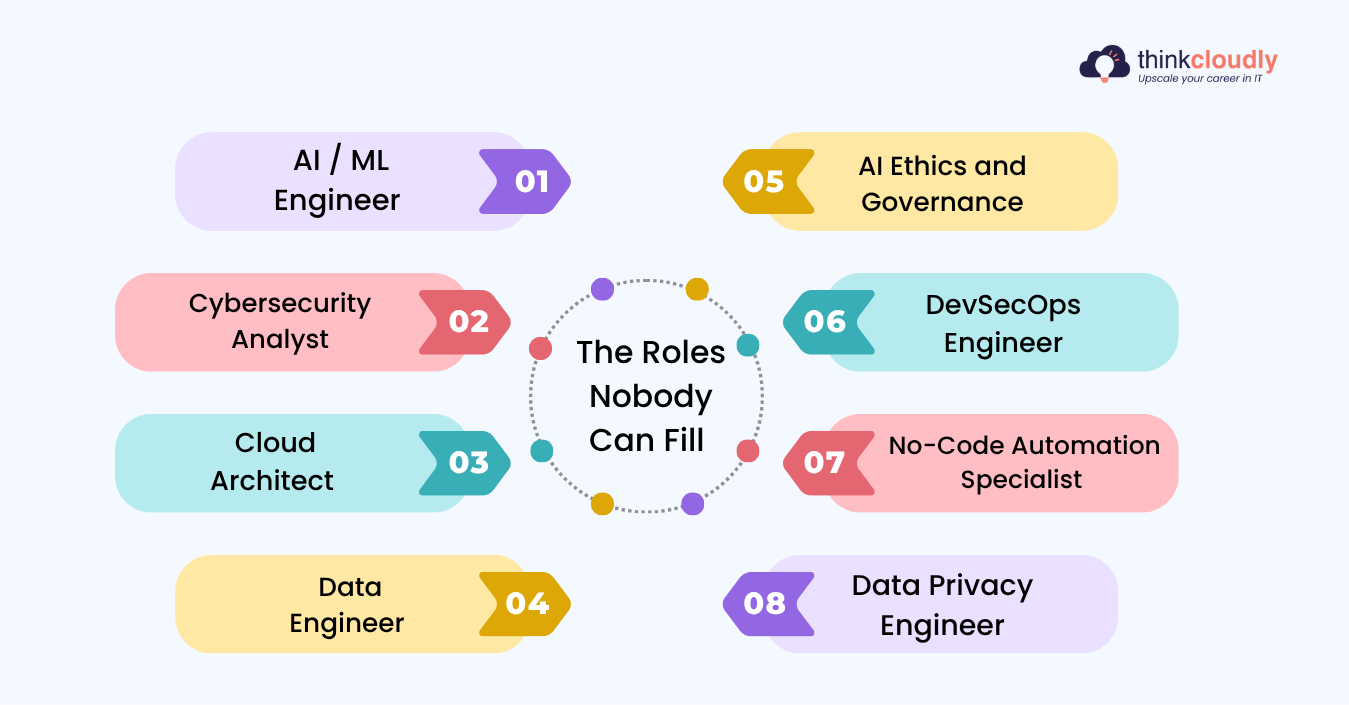
| Role | Open Positions (US, 2026) | Avg. Salary |
Primary Skills Gap |
|
AI / ML Engineer |
47,000+ | $115,000 – $160,000 | Vertex AI, PyTorch, LLMOps |
| Cybersecurity Analyst | 38,000+ | $85,000 – $120,000 |
Threat detection, AI security tools |
|
Cloud Architect |
31,000+ | $120,000 – $165,000 | Multi-cloud design, FinOps |
|
Data Engineer |
29,000+ | $95,000 – $135,000 |
Pipeline design, BigQuery, Spark |
| AI Ethics and Governance | 18,000+ | $95,000 – $145,000 |
EU AI Act, risk frameworks |
|
DevSecOps Engineer |
22,000+ | $110,000 – $150,000 | Security automation, CI/CD |
|
No-Code Automation Specialist |
16,000+ | $70,000 – $100,000 |
Make, Zapier, workflow design |
| Data Privacy Engineer | 14,000+ | $90,000 – $130,000 |
GDPR, privacy engineering |
Why Does the Gap Exist?
The simplest explanation for what happened in the technology job market in 2026 is that the industry changed faster than the people in it could adapt.
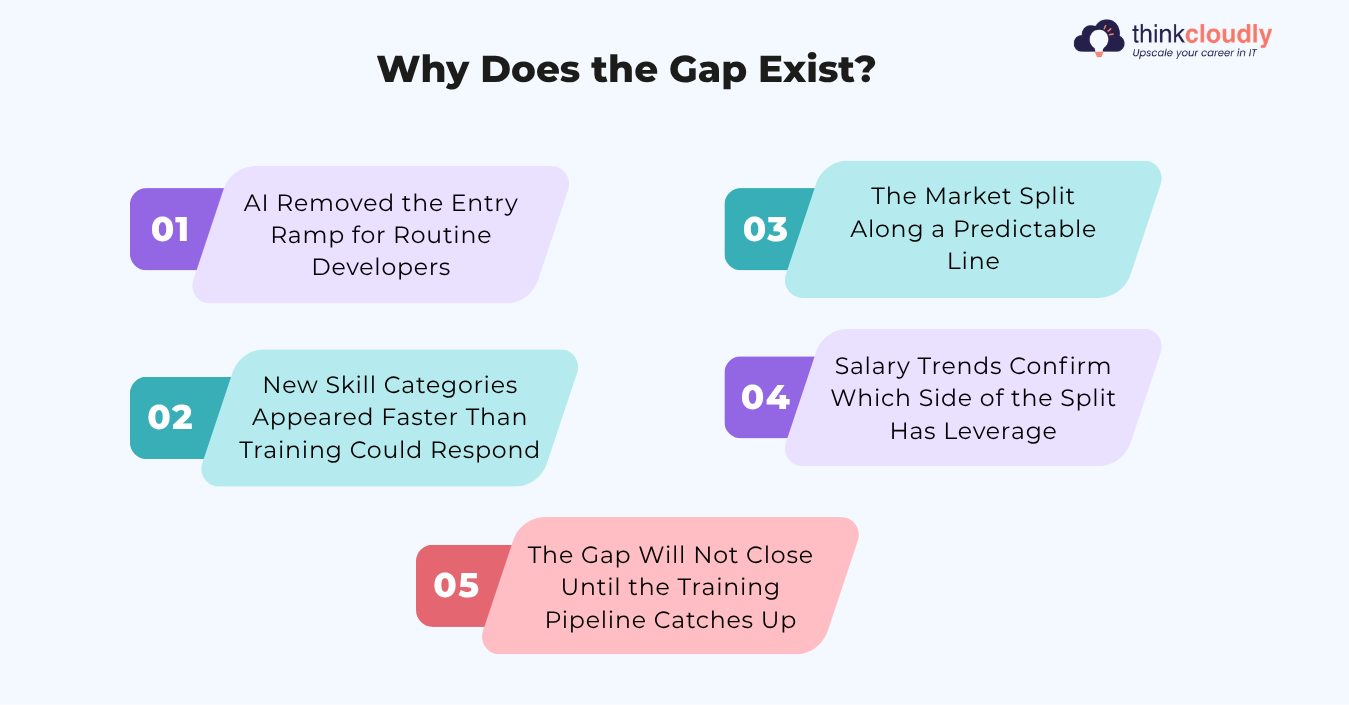
AI Removed the Entry Ramp for Routine Developers
The most direct cause of junior developer pressure is not layoffs. It is a productivity tool. AI coding assistants reduced the volume of routine, predictable development work that junior roles were built around. The entry ramp into development careers that bootcamps were built to provide became narrower as the tools became more capable. Companies that previously hired five junior developers to handle a volume of routine work found they could manage with three using AI tools. That arithmetic played out across thousands of organizations simultaneously.
New Skill Categories Appeared Faster Than Training Could Respond
AI governance, cybersecurity AI analysis, cloud financial operations, and data privacy engineering became urgent hiring priorities. None of these had established training pipelines. The bootcamp ecosystem had not built programs for them. Universities had not yet designed curricula around them. The demand arrived before the supply had any realistic path to developing.
The Market Split Along a Predictable Line
The result is a bifurcated market. Abundant supply of coding skills meeting declining demand on one side. Acute shortage of cross-domain technical skills meeting growing demand on the other side. Both conditions exist simultaneously inside the same industry, which is why the layoff numbers and the open role numbers look contradictory when they are actually describing two completely different populations of workers and roles.
Salary Trends Confirm Which Side of the Split Has Leverage
Robert Half’s 2026 Technology Salary Guide provides the clearest evidence of where the real supply shortage sits. AI engineering, cloud architecture, and cybersecurity roles averaged 12 to 18 percent salary increases in 2025. Those increases happened during a year of broad technology layoffs. The salary data is not an anomaly. It is a direct reflection of where supply is most inadequate relative to demand.
The Gap Will Not Close Until the Training Pipeline Catches Up
The 275,000 open roles will not fill themselves as the economy improves, because the shortage is not cyclical. It is structural. The specific skills those roles require are not being produced at anywhere near the rate they are needed. Stanford HAI’s 2026 AI Index Report found that the supply of graduates with relevant AI governance and security skills is growing at roughly half the rate of demand. The bootcamp ecosystem that produced the surplus of coding talent is now running programs that teach skills the market already has too many of. Until the training infrastructure reorients toward the cross-domain skills the market actually needs, the gap will persist regardless of what happens in the broader economy.
What This Means for Anyone Thinking About Technology Careers
The practical implication of this gap is significant, but only for people who understand which side of it they want to be on.
The technology careers that are contracting are largely those built around doing the same thing repeatedly and predictably. If a role can be reduced to a pattern that AI tools can replicate, it is under pressure regardless of what company it sits inside. This is not a temporary condition. It is the direction the market is moving, and it will continue moving that way.
The technology careers that are growing are largely those built around judgment, governance, security, and the ability to work at the intersection of technology and other domains. An AI ethics specialist needs to understand both how AI systems work and how regulatory frameworks apply to them. A cybersecurity AI analyst needs to understand both the offensive tools attackers are using and the defensive platforms organizations are deploying. A cloud FinOps specialist needs to understand both infrastructure architecture and financial accountability.
These roles are harder to fill because they require people to have developed competence in two areas rather than one and because most traditional education and training programs have been slow to build pathways toward them.
Stanford HAI’s 2026 AI Index Report notes that the supply of graduates with skills relevant to AI governance and AI security is growing at roughly half the rate of demand for those roles. That gap is expected to persist through at least 2028 under the current trajectory.
The Skills That Bridge the Gap
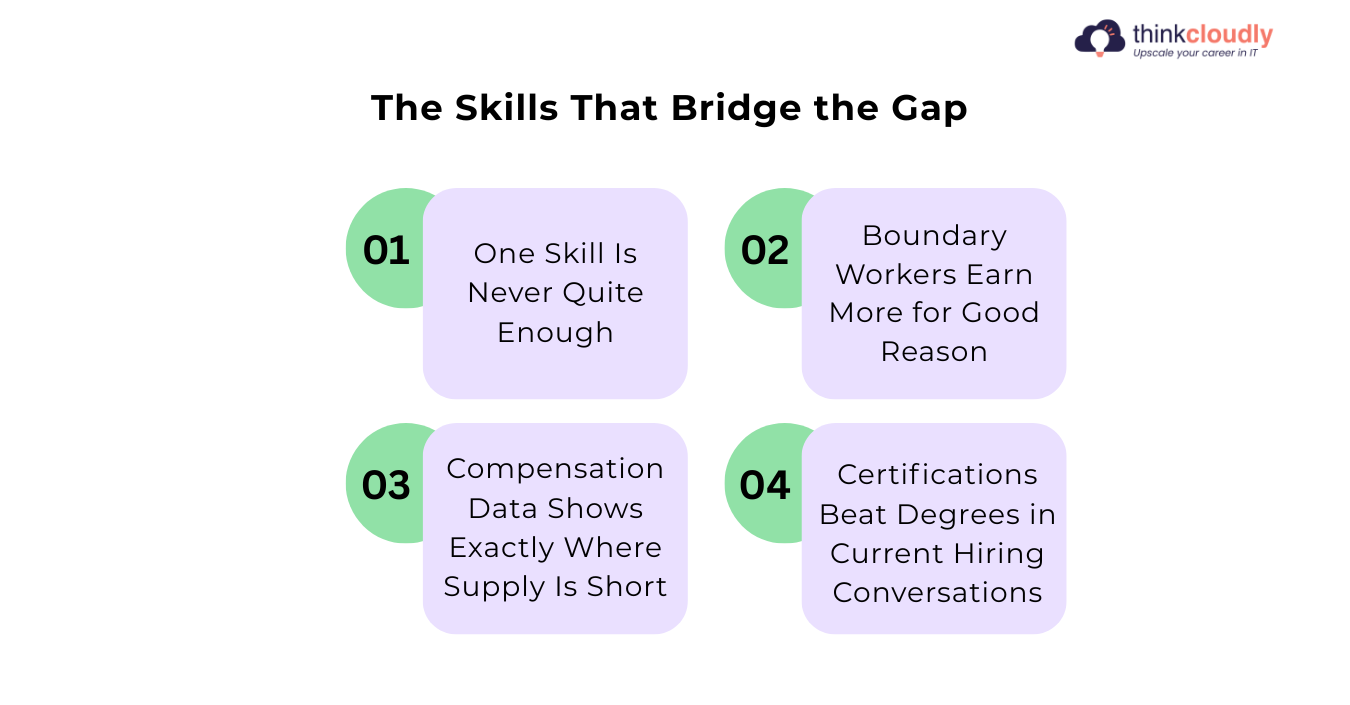
One Skill Is Never Quite Enough
Here is the pattern that shows up across every open role category in the table above. The people being hired are not simply the most technically advanced candidates available. They are the candidates who bring technical competence and something else that the organization needs but cannot find separately. Regulatory understanding. Financial literacy. Security awareness. The ability to explain a complex technical constraint to a senior leader who does not share the same background. Any of these combinations makes a candidate significantly more valuable than technical depth alone, and organizations struggling to fill these roles are learning that the hard way.
Boundary Workers Earn More for Good Reason
The roles that command the highest compensation and sit open the longest share something that is easier to recognize than to teach. They exist at the intersection of technical expertise and a second domain, and the professionals who can work fluently in both directions without losing competence in either are rare enough that employers compete for them rather than selecting from a comfortable pool. This is not a soft observation about soft skills. It is a structural feature of a job market where the problems organisations need to solve require people who understand both the technical system and the broader context it operates in.
Compensation Data Shows Exactly Where Supply Is Short
When you want to know where the real scarcity is in a labour market, look at where salaries are rising fastest. The IAPP Privacy Workforce Study 2025 documented 22 percent compensation increases for data privacy engineering roles between 2024 and 2025. Those are roles that require both data pipeline knowledge and legal compliance understanding. The FinOps Foundation’s State of FinOps 2026 found cloud cost management specialists earning 25 to 30 percent more than single-domain technical peers. Salaries do not rise this fast in categories where supply is adequate. They rise when employers are competing for people they cannot find enough of.
Certifications Beat Degrees in Current Hiring Conversations
The hiring conversations happening right now in cloud, cybersecurity, and AI governance are not leading with academic credentials. They are leading with demonstrated competence, and certifications are the most direct way to demonstrate it. AWS, Google Cloud, and Microsoft Azure certifications consistently carry more weight than degrees in cloud hiring decisions. CompTIA Security+ is the recognized entry point in cybersecurity. The FinOps Foundation’s Certified FinOps Practitioner takes six to eight weeks and opens doors in a category with one of the most acute supply shortfalls in the current market. It is focused, deliberate preparation pointed in the right direction.
The Honest Picture
The technology job market in 2026 is not simply good or simply bad. It is bifurcated in ways that require more nuance than either the layoff headlines or the talent shortage headlines provide on their own.
If your skills are concentrated in areas where AI tools have reduced the volume of human work required, the market is harder than it was three years ago, and the honest assessment is that it will continue to be harder without deliberate skill development toward the growing categories.
If your skills are in the areas where demand is outrunning supply, or if you are willing to develop them, the market is offering conditions that have rarely been better. Open roles at high salaries, certifications that open doors without requiring academic credentials, and a supply gap that is structural rather than temporary.
The 92,000 cuts and the 275,000 open roles exist in the same market at the same time because the market is doing what markets do: rewarding what is scarce and reducing what has become abundant. The question for anyone thinking about their career trajectory is simply which side of that dynamic they want to be on.
Sources and References
- CompTIA: State of the Tech Workforce 2026
- LinkedIn Economic Graph: Jobs on the Rise 2026
- World Economic Forum: Future of Jobs Report
- Challenger, Grey, and Christmas: 2026 Job Cuts Report
- Robert Half: 2026 Technology Salary Guide
- Stanford Institute for Human-Centered AI: AI Index Report 2026
- ISC2: Cybersecurity Workforce Study
- IAPP: Privacy Workforce Study
- FinOps Foundation: State of FinOps 2026
- US Bureau of Labor Statistics: Computer and Information Technology Occupations
- Gartner: Technology Workforce Trends 2026
- GitHub Octoverse Report 2026: The Rise of AI-Native Development