

Something big is happening in the tech world right now — and most people are getting only half the story.
In just the first few months of 2026, more than 113,000 tech workers have lost their jobs. That works out to roughly 825 people every single day. Companies like Amazon, Meta, Oracle, Dell, and Spotify have all made cuts. And almost every one of them has pointed to the same reason: artificial intelligence.
But here’s the thing—that explanation is not entirely true.
This piece breaks down what is really going on, who is actually affected, and what it means for anyone building a career or trying to learn new skills right now.
The Numbers Are Real — But the Reason May Not Be
Between January and April 2026, US tech companies announced 85,411 job cuts — a 33% increase over the same period in 2025. That is the worst start to a year for tech jobs since 2023.
Nearly half of those cuts — about 47.9% — were officially blamed on AI and automation. Companies said they no longer needed as many people because AI tools were doing the work instead.
But experts are pushing back on that story.
OpenAI CEO Sam Altman said it directly: “Almost every company that does layoffs is blaming AI, whether or not it really is about AI.” He called it “AI washing”—using AI as a cover story for decisions that have other reasons behind them.
So what are those other reasons?
Three Real Reasons Behind the Layoffs
The layoffs happening across the tech industry are not only about AI replacing people. In reality, most companies are dealing with three bigger problems: overhiring during the pandemic, slowing revenue growth, and massive spending on AI infrastructure. AI has become an easy explanation for cost-cutting decisions that were already coming.
1. Companies hired too many people during the pandemic
Between 2020 and 2022, tech companies went on a massive hiring spree. Remote work exploded, digital services boomed, and companies thought that growth would last forever. It did not. Now they are correcting that mistake—quietly—and blaming AI along the way.
Venture capitalist Marc Andreessen made this point clearly, saying the layoffs are mostly about fixing pandemic-era overhiring rather than genuine AI replacement.
2. Big AI investments need big money
The four largest tech companies — Amazon, Microsoft, Alphabet, and Meta — are expected to spend $725 billion on AI infrastructure in 2026. That figure is nearly double what they spent the previous year. Data centres, chips, cloud systems, and AI research all cost an enormous amount of money. The easiest way to free up that money? Cut staff.
As one analyst put it bluntly: “Companies are firing people and buying GPUs with the savings.”
3. Revenue growth has slowed down
After years of explosive growth, many tech companies are simply not growing as fast as they used to. Shareholders want profits. CEOs need to cut costs. And “we grew too fast and spent too much” is not a great message for investors. “AI is changing everything” sounds much better.
Who Is Affected Most?
Not all jobs are being cut equally.
Early-career workers are taking the hardest hit. Yale researchers found that recent college graduates are having an increasingly difficult time landing that first job, because AI tools are now doing much of the entry-level work that used to bring new people into the industry.
This matters more than most people realize. If young workers cannot get that first job, they cannot build the experience needed to grow into senior roles. IBM noticed this risk and actually went in the opposite direction—tripling its entry-level hiring in 2026, saying that while AI can handle many tasks, it still needs human judgment to work well.
The jobs being cut most often right now include:
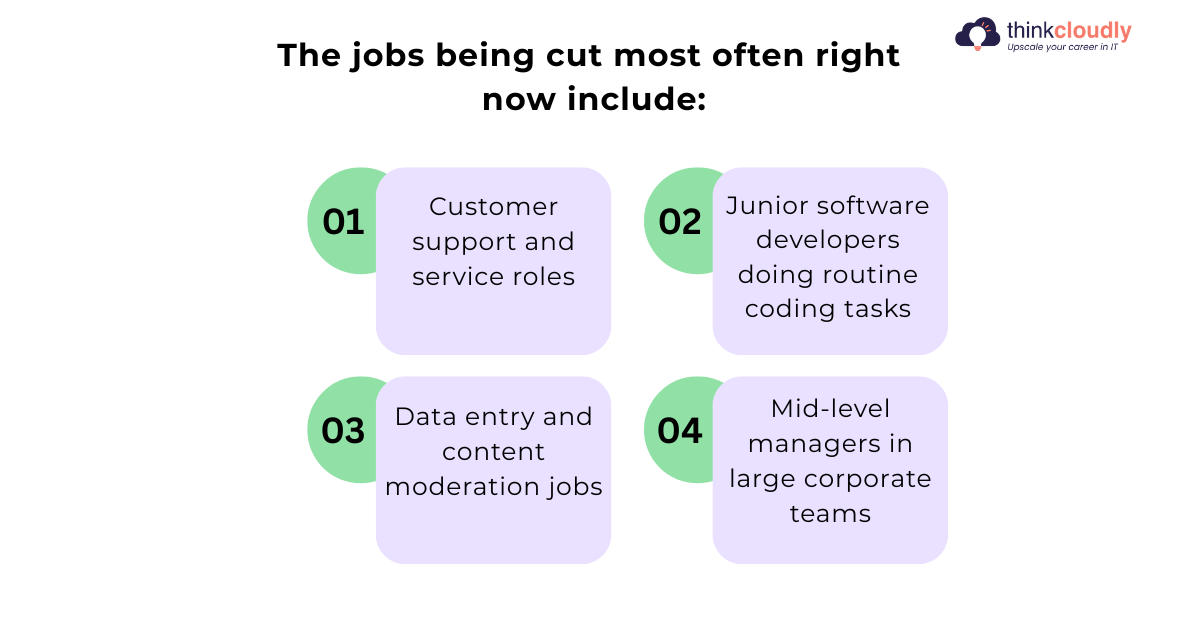
- Customer support and service roles
- Junior software developers doing routine coding tasks
- Data entry and content moderation jobs
- Mid-level managers in large corporate teams
Meanwhile, companies are actively hiring for AI-specific roles. There is a clear split: people who understand AI are in demand; people doing work that AI can now do are being pushed out.
The “AI Washing” Problem
There is a term for what many companies are doing: AI washing.
It means using artificial intelligence as the public reason for a business decision that actually has little to do with AI. It makes companies sound forward-thinking and tech-savvy. It avoids blame. And right now, almost no law stops them from doing it.
There is currently no federal law in the United States requiring companies to prove that AI actually caused a layoff. California has proposed a bill that would require 90 days’ notice before AI-driven layoffs, along with disclosure of which AI systems were involved. Colorado’s AI Act takes effect in June 2026 and requires fair treatment in AI-assisted employment decisions. But for now, companies can say whatever they want in a layoff announcement.
Cognizant’s Chief AI Officer, Babak Hodjat, said it well: “Sometimes AI becomes the scapegoat from a financial perspective—like when a company hires too many or they want to resize, and it gets blamed on AI.”
Is AI Replacing Jobs at All, Then?
Yes — but the scale is nowhere near what the headlines make it sound like.
Some roles are genuinely shrinking. Customer service scripts, basic data entry, routine code fixes — these are the kinds of tasks that software tools can now handle without a person behind them. But work that needs a real human—someone who can read a room, make a judgment call, build trust, or handle emotionally complex situations—is not going away anytime soon.
Here is something the doom-and-gloom coverage tends to skip over: the US Bureau of Labour Statistics projects software developer employment to grow by 15% through 2034. Starting salaries for computer science graduates are expected to climb by close to 7% in 2026 alone. People who have learned to work with newer tools are, on average, earning around 56% more than those in traditional tech roles.
So the actual picture is not “tech careers are over.” It is closer to this: the floor is shifting, and the people who move with it will be just fine. The ones who stand completely still are the ones taking on real risk.
The Human Cost Nobody Is Talking About
The headlines focus on the numbers—113,000 jobs, 825 cuts per day, billions in AI spending. What gets far less attention is what this actually feels like for the people on the other side of those announcements.
The anxiety is real, and it is spreading fast. According to a global survey by Mercer covering 12,000 workers worldwide, employee concerns about losing a job to AI jumped from 28% in 2024 to 40% in 2026. That is not a small shift — that is nearly half the workforce carrying genuine fear about their future. And 62% of those workers say company leaders are underestimating the emotional weight of all of this.
It is not just people who have been laid off. The ones still employed are struggling too. Eighty percent of senior managers say they feel more pressure than ever. One in four say their team’s mental health has noticeably worsened in 2026. People are working harder, worrying more, and feeling less supported — all at the same time.
The IMF’s Managing Director put it plainly at the World Economic Forum: AI is hitting the labour market “like a tsunami,” and most companies and countries are not ready for it.
Here is a simple breakdown of who is feeling the pressure most right now:
|
Group |
Main Concern |
How It Shows Up |
|
Laid-off workers |
Income loss and identity |
Financial stress, loss of purpose |
|
Employed workers |
Fear of being next |
Anxiety, burnout, disengagement |
|
Senior managers |
Rising expectations + team morale |
Pressure, poor mental health |
|
Early-career workers |
Fewer entry-level openings |
Difficulty starting careers |
|
Families |
Financial instability |
Long-term household stress |
What Should You Actually Do Right Now?
If you are worried about layoffs or just trying to figure out where to focus your energy, here is honest advice:
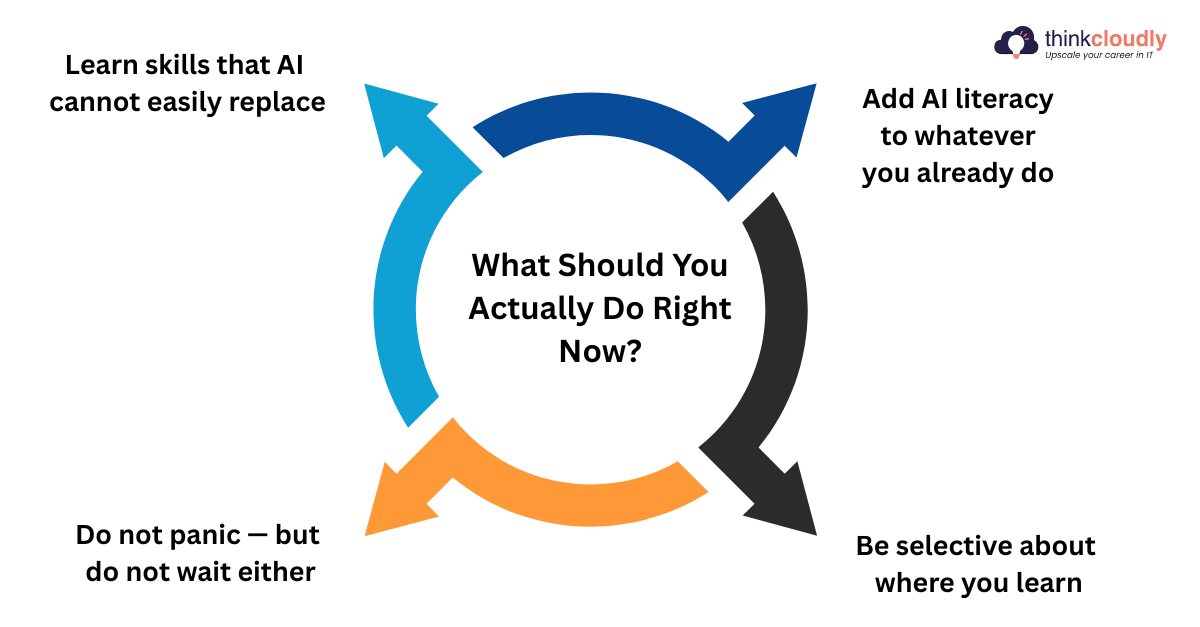
- Learn skills that AI cannot easily replace: Critical thinking, communication, management, creativity, and human judgment are still very hard for machines to replicate well. Double down on those.
- Add AI literacy to whatever you already do: You do not need to become an AI engineer. But knowing how to use AI tools in your field — whether that is marketing, design, healthcare, or finance — makes you far more valuable than someone who ignores them.
- Be selective about where you learn: Not every online course leads somewhere useful. Look for programs that offer real projects, mentorship, community, and some kind of job support. The certificate alone is worth very little in 2026.
- Do not panic, but do not wait either: The workforce is shifting. That shift will create real winners and real losers. Starting now, even with small steps, puts you ahead.
The Bottom Line
Over 113,000 tech jobs have been cut in 2026. Companies keep pointing at AI. And while AI is genuinely changing work, a lot of what is happening right now has more to do with bad financial decisions, an overcorrection after pandemic-era overhiring, and the need to fund massive infrastructure investments.
The bigger danger is not a machine taking your job tomorrow. It is staying in the same place while everything around you shifts.
The people who treat this moment as a reason to learn, adapt, and grow will come out ahead. That has been true in every technological shift in history — from the printing press to the internet — and this one is no different.
Sources and References
- Moneywise—”Experts say companies blame AI for layoffs, whether or not it really is about AI”
- Used for: Q1 2026 layoff statistics (80,000+ workers, 86 companies) and Sam Altman’s “AI washing” quote
- TechTimes — “Tech Layoffs Surpass 113,000 in 2026 With No Federal Law Requiring AI Disclosure”
- Used for: 113,000 job cuts figure, 825/day average, 33% YoY increase, California SB 951 and Colorado AI Act legislation details
- TechJournal—”113K Tech Layoffs in 2026 While AI Spending Hits $725B — What’s Really Going On?”
- Used for: $725B capex projection, 47.9% AI attribution figure, Marc Andreessen’s over-hiring comment, OpenAI vs Anthropic hiring contrast
- Tom’s Hardware — “Tech industry lays off nearly 80,000 employees in the first quarter of 2026”
- Used for: Babak Hodjat’s “AI scapegoat” quote, Sam Altman’s public statement on AI-driven layoffs, IBM tripling entry-level hiring detail
- DEV Community—”AI didn’t cause 2026’s layoffs.” “History predicts more developers.”
- Used for: $700B capex context, Bureau of Labour Statistics. 15% developer growth projection
- Programs.com — “List of Companies Announcing AI-Driven Layoffs”
- Used for: 45+ CEOs citing AI for layoffs; over 70,000 employees impacted by AI-driven cuts in 2026
- TechRadar—”Nearly 80,000 tech workers have already lost their jobs in 2026. ”
- Used for: Layoffs. FYI Q1 2026 data (70,474 jobs), year-over-year comparison with 2025 and 2024 figures
- Analytics Insight — “Why AI Layoffs May Spark a Talent Shortage in the Future”
- Used for: 56% salary premium for AI-skilled workers, growing demand for AI specialists
- Yale Insights—”The Real Job Destruction from AI Is Hitting Before Careers Can Start”
- Used for: Entry-level hiring difficulty for recent graduates, 7% salary increase for CS majors in 2026
- CNBC — “AI impacting labor market ‘like a tsunami’ as layoff fears mount”
- Used for: Mercer Global Talent Trends 2026 data (28% to 40% fear jump), 62% of workers saying leaders underestimate emotional impact, IMF Managing Director’s “tsunami” quote
- BusinessWire — “U.S. Workforce in Mental Health Crisis Driven by AI Anxiety”
- Used for: 80% of senior managers feeling more pressure than ever, 1 in 4 managers reporting team mental health has worsened in 2026, 74% of senior managers expecting AI-driven layoffs at their company